
.png?width=120&height=55&name=Blitzz-Logo-right%20white%20eyes%20-%20not%20transparent%20(3).png)
Hey — we’re a month into 2026. Have you audited your customer ratings so far? How about your average handling time?
If you haven’t taken a hard look yet, now’s the time — because telecom support metrics are telling a story many teams still haven’t fully addressed. In 2026, the average handle time (AHT) for telecom contact centers hovers around 8‑10 minutes, significantly higher than many customers want to wait, even as expectations for speed and convenience rise.
Long handling times aren’t just numbers — they translate into longer queues, frustrated subscribers, and customers who don’t hesitate to switch providers when support takes too long.
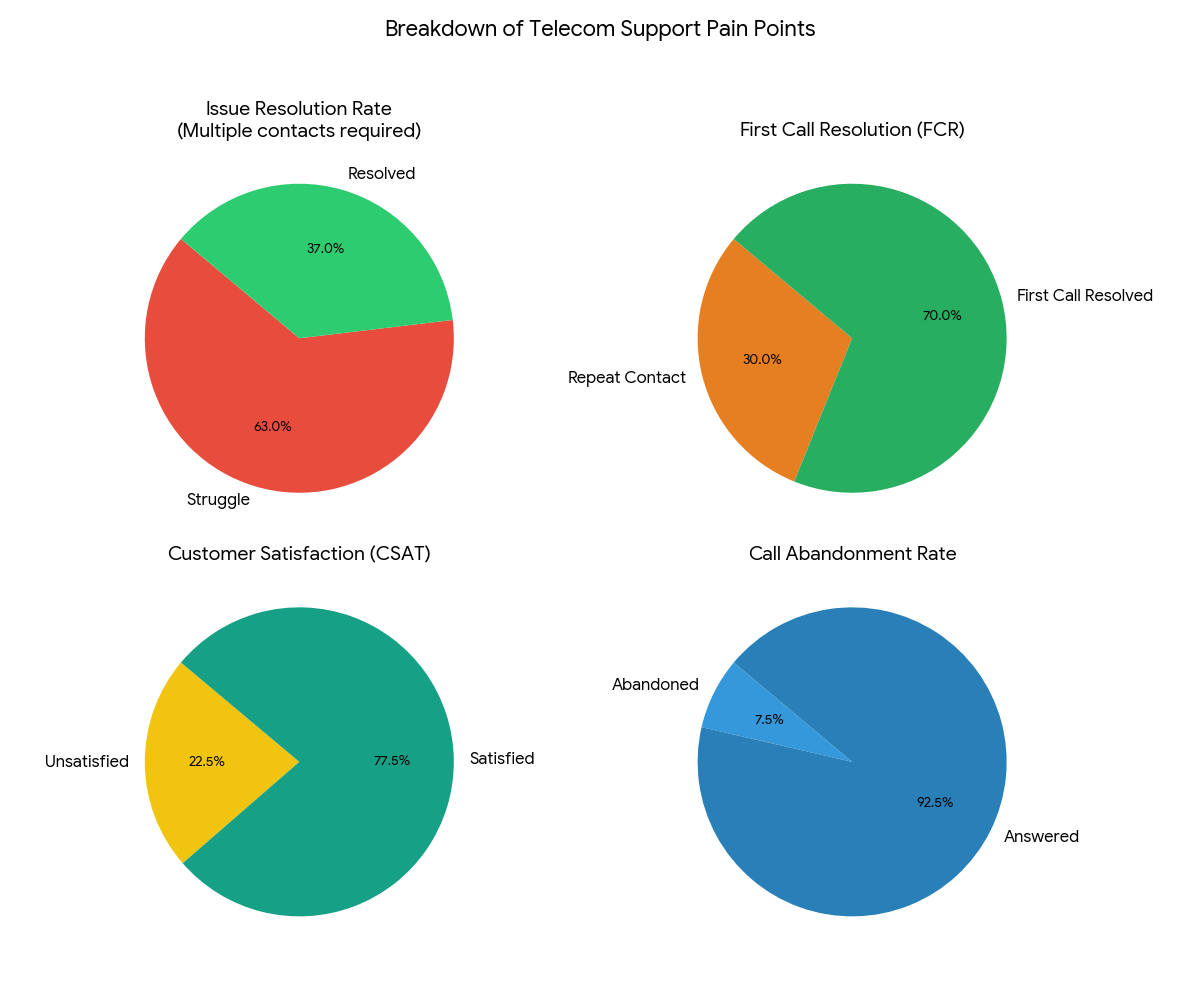
And not just that... Here’s the pie chart showing telecom support struggles in 2026. Each slice represents the percentage of difficulty for each key metric:
- Average Handling Time (AHT)
Industry benchmark ~8–10 minutes, meaning many telecoms struggle to keep AHT low — customers are waiting longer than they want. - First Call Resolution (FCR)
Only ~65–75% of issues are resolved on the first try in telecom — meaning 25–35% of customers need repeat contact. - Customer Satisfaction (CSAT)
Telecom CSAT often lingers in the mid‑70% range, showing 20–25% of customers aren’t fully satisfied with support. - Call Abandonment Rate
Industry averages for abandonment sit around 6–9%, indicating about 1 in 10 customers hang up before support even answers. - Issue Resolution Rate
Around 59–67% of telecom customers report their issue isn’t resolved in a single go — reflecting ongoing friction in support outcome quality.
These stats highlight common pain points still dogging telecom support performance in 2026 and help frame why frictionless tools (like no‑app video calling and visual support) matter more than ever.

10 Things Affecting These Pitfalls
1. App Downloads as a Gatekeeper
Nothing frustrates a customer faster than being told, “Download our app first.” Extra steps, forgotten passwords, and compatibility issues create friction before the support even starts. Solution: Browser-based video calling lets customers connect instantly — no downloads, no waiting.
2. Long Average Handling Times (AHT)
When support calls drag on, customers feel their time isn’t valued. Extended AHT often results from poor visibility into the problem or having to repeat information. Solution: Real-time, visual support reduces back-and-forth and resolves issues faster.
3. Connectivity Woes
Remote areas, spotty Wi-Fi, or mobile networks can make even simple support calls impossible. Without a fallback plan, calls drop and frustration rises. Solution: Tools that adjust video quality dynamically or allow offline data capture keep support running smoothly.
4. Complex Login Requirements
Multi-step authentications, passwords, or system logins slow down support. Customers abandon calls mid-process, leaving tickets unresolved. Solution: One-click, secure links for browser-based sessions eliminate login friction.
5. Limited Visual Context
Explaining problems over text or audio alone often leads to misdiagnosis and longer resolution times. Solution: Live video sharing and annotated images give support agents exactly what they need to solve the problem first time.
6. Fragmented Communication Channels
Email, chat, phone, and apps scattered across different platforms create delays and confusion. Customers often repeat themselves multiple times. Solution: A single, seamless video-first platform consolidates communication and keeps the story consistent.
7. Poor Follow-Up Visibility
Without clear records of past interactions, customers repeat issues and teams lose efficiency. Solution: Platforms with timestamped photos and GPS-tagged documentation ensure accurate records for every session.
8. Limited Access to Experts
Field technicians or specialized teams aren’t always nearby, leaving customers waiting hours or days for help. Solution: Remote visual support allows experts to guide on-site staff instantly, wherever they are.
9. Data Loss or Miscommunication
Dropped calls, unsaved notes, or lost images can derail a support session entirely. Solution: Modern platforms store data securely and auto-sync when the connection returns — nothing is lost.
10. Lack of Customer-Friendly Experience
Complex tools, slow response times, or repeated friction points leave a poor impression, even if the issue is eventually resolved. Solution: Focus on frictionless tools that let customers connect instantly, see solutions visually, and leave satisfied.

How No-App Download Remote Visual Support Solves These Challenges
Remote visual support software allows support agents to see exactly what a customer sees in real time, using live video, photos, and annotations to guide troubleshooting or inspections. It transforms traditional support by reducing miscommunication, speeding up problem-solving, and enabling accurate documentation.
Blitzz takes this a step further with no-app download technology — customers can join a session instantly via a secure browser link, removing technical friction and reducing average handling time. With features like offline photo capture, timestamped documentation, GPS location preservation, and automatic synchronization, every interaction becomes fast, accurate, and hassle-free, even in remote or low-connectivity areas.
Takeaway
In 2026, telecom support teams can no longer rely on slow, friction-filled processes. Tools like Blitzz show that removing barriers — from app downloads to long handling times — isn’t just a convenience, it’s a competitive advantage. By embracing no-app remote visual support, businesses can resolve issues faster, keep data accurate, and deliver seamless experiences that customers actually enjoy. The result? Higher satisfaction, lower churn, and a support operation built for the demands of today — and tomorrow.