
.png?width=120&height=55&name=Blitzz-Logo-right%20white%20eyes%20-%20not%20transparent%20(3).png)

On this page
The future of customer service isn't AI or humans — it's both, working in balance. AI delivers speed, scale, and round-the-clock availability; human agents bring empathy, judgment, and trust. The smartest organizations pair them — and increasingly, they connect both through remote visual support and remote video inspection tools that let AI and people actually see the customer's problem instead of guessing at it from text.
This guide breaks down the real strengths and limits of each side, why a hybrid model wins, and how visual AI — from remote visual inspection to AI-assisted diagnosis — is becoming the layer that ties speed and empathy together.
The rise of AI in customer service
AI has moved from novelty to necessity in customer service. The global AI customer service market reached roughly $15.1 billion in 2026 and is on track to surpass $117 billion by 2034, and around 91% of companies with 50 or more employees now run AI somewhere in the support journey. Businesses are adopting AI-powered support — including remote visual support and remote video inspection software — because it cuts costs, scales instantly, and answers customers in seconds.
That surge has fueled a familiar debate: AI versus human agents. Will bots replace support teams? The honest answer is that framing the question as "either/or" misses the point. The future isn't about choosing one over the other — it's about finding the right balance, and using tools like remote visual inspection and live video to let each side do what it does best.
Understanding AI customer support
What is AI customer support?
AI customer support is the use of artificial intelligence — chatbots, agent-assist copilots, voice assistants, and visual AI — to resolve customer issues faster and at greater scale than human-only teams. The common technologies span natural-language chatbots, sentiment analysis, automated ticket routing, and, more recently, remote visual support platforms and remote video inspection software that analyze images, screenshots, and live camera feeds.
AI has evolved well beyond basic scripted chatbots. Today's systems understand context, complete multi-step tasks, and — through remote visual inspection capabilities — interpret what a customer or field technician is actually looking at. That leap from text-only to visual is what makes modern remote video inspection genuinely useful for support and field operations alike.
Common applications of AI in customer service
AI now powers a wide range of support functions:
- Automated chat support for high-volume, repetitive questions.
- Self-service knowledge bases that surface answers instantly.
- Ticket routing and prioritization that sends each issue to the right place.
- Customer sentiment analysis that flags frustration in real time.
- AI-powered voice assistants for hands-free help.
- Remote video inspection software and site inspection software that let teams assess assets, property, and equipment visually — without a truck roll.
That last category matters here: site inspection software and remote visual inspection tools have pushed AI support out of the chat window and into the physical world, where many of the hardest problems actually live.
The strengths of AI customer support
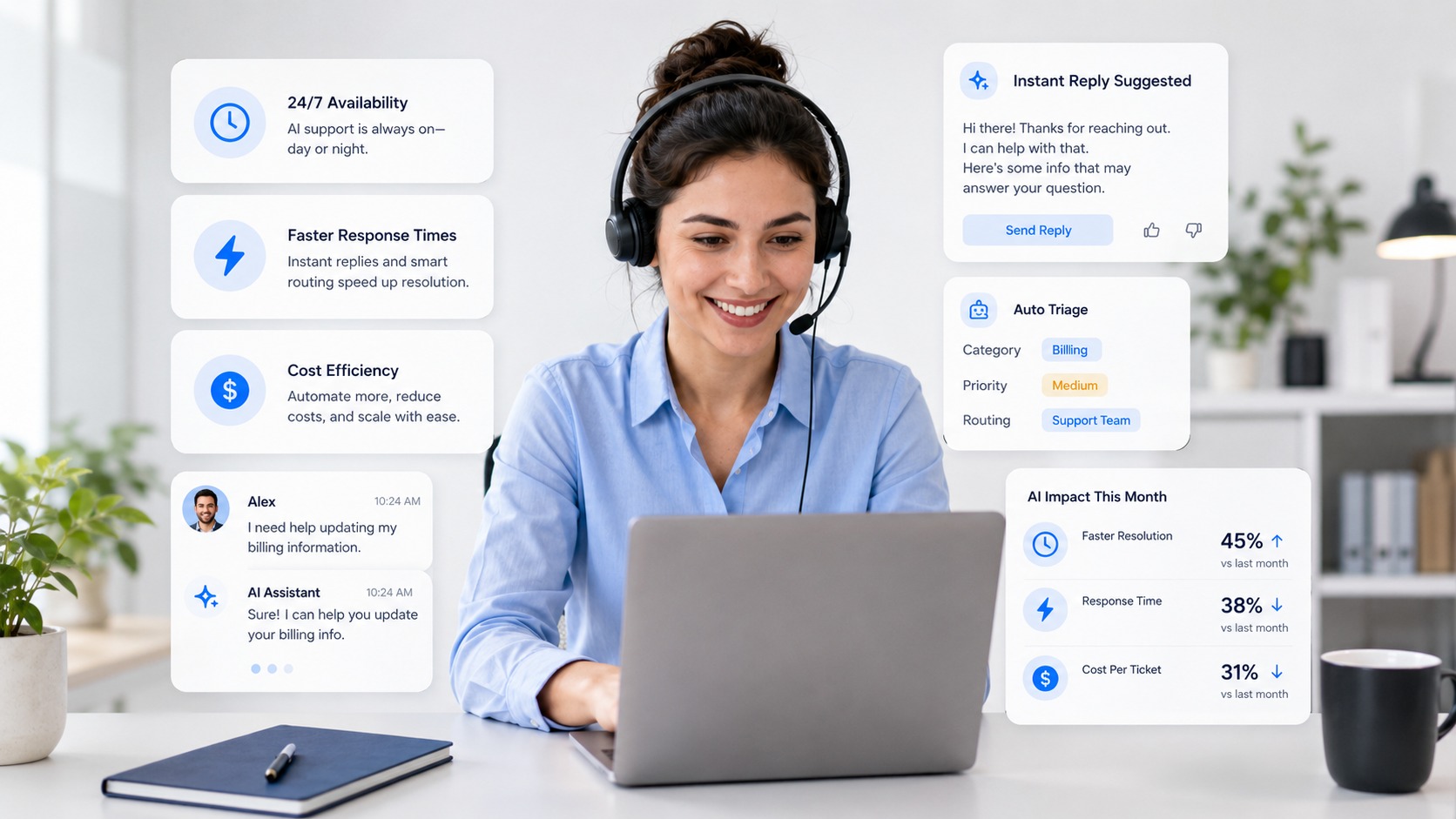
24/7 availability
AI never sleeps. Always-on assistance means customers across every time zone get help at 2 a.m. as easily as 2 p.m. The same is true for remote visual support — a customer can launch a guided session or a remote video inspection the moment a problem appears, not when the office reopens.
Faster response times
AI delivers instant answers to common questions and slashes wait times. With remote video inspection software, that speed extends to physical issues: instead of scheduling a site visit days out, a technician runs a remote visual inspection on the spot and resolves it in minutes.
Scalability
AI handles thousands of interactions simultaneously, letting businesses grow without proportional staffing increases. A single remote visual support deployment can absorb spikes in volume, and cloud-based site inspection software lets one expert cover dozens of sites a day through remote video inspection rather than driving between them.
Cost efficiency
The economics are decisive. Routine AI resolution runs roughly $0.50–$2.00 per interaction versus $6.00–$12.00 for a human-handled one. Remote video inspection compounds those savings by eliminating travel entirely — one tank-inspection business cut travel costs by 75% using remote visual inspection, and site inspection software routinely removes the largest line item in field operations: the drive.
Consistency
AI delivers standardized responses and reduces human error. Every remote video inspection captured through dedicated remote video inspection software is timestamped, documented, and uniform — no two inspectors interpreting the same checklist differently. That consistency is one of the biggest quiet advantages of remote visual inspection over ad-hoc manual processes.
The limitations of AI customer support
Lack of emotional intelligence
AI struggles with empathy. A frustrated or distressed customer needs to feel heard, and even the best model can read sentiment without truly understanding it. No amount of remote visual support automation replaces a calm human voice when someone is upset.
Difficulty with complex cases
Situations that demand judgment, critical thinking, or a non-standard solution still trip up AI. A nuanced warranty dispute or an unusual equipment fault caught on a remote visual inspection may need a human to make the final call.
Limited contextual understanding
AI can misread intent and stumble on ambiguous requests. A customer's vague description — "the thing is making a noise" — is exactly where text-only AI fails, and where remote video inspection software earns its place by letting the system see rather than guess.
Customer trust concerns
Some customers simply prefer a human, and trust in AI is still being built. Transparency helps — and so does giving customers a real person on a remote visual support call when the stakes feel high.
The strengths of human customer support
Empathy and emotional connection
Humans understand emotion and build trust and loyalty in ways AI can't replicate. In a tense remote video inspection of storm damage, for instance, a human adjuster's reassurance matters as much as the assessment itself.
Complex problem solving
People navigate unique situations by applying experience and critical thinking — interpreting what a remote visual inspection reveals and deciding the right course of action when no script fits.
Relationship building
Human agents create memorable experiences and strengthen long-term retention. A field expert who guides a customer through a remote video inspection with patience earns loyalty that automation alone rarely does.
Flexibility and adaptability
Humans handle the unexpected and make judgment calls when policies don't fit. When a remote visual support session surfaces something the playbook never anticipated, a person adapts on the fly.
The challenges of human customer support
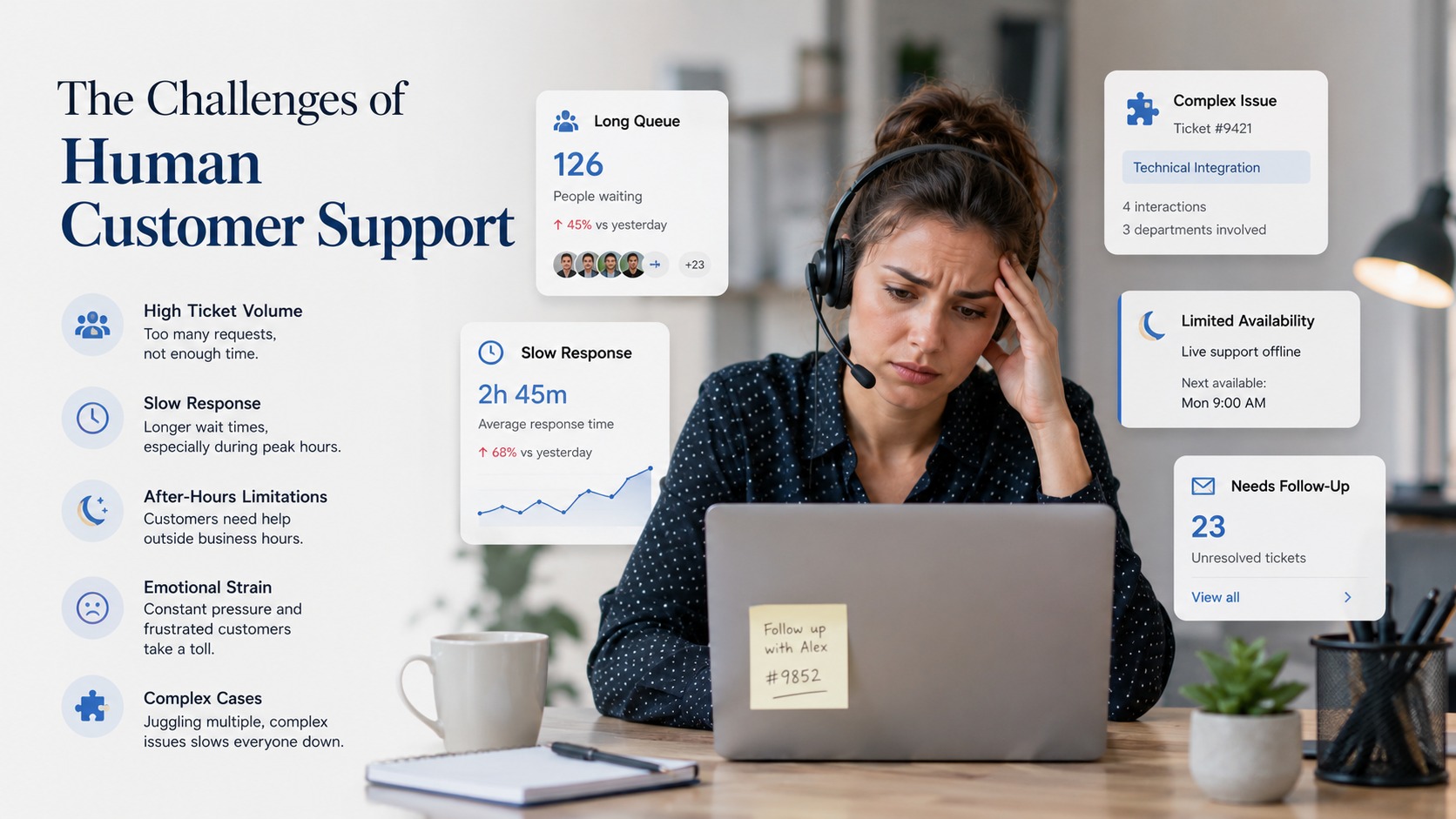
Higher operating costs
Recruitment, training, and staffing are expensive — and dispatching people for on-site work costs even more, which is precisely why remote video inspection software and site inspection software deliver such fast ROI.
Limited availability
Human teams are bound by business hours and headcount. Remote visual support extends their reach, but people alone can't be everywhere at once.
Inconsistent experiences
Quality varies between agents and across days. Two inspectors may document the same asset differently — a gap that standardized remote visual inspection workflows close.
Scalability challenges
Humans can't instantly absorb demand spikes. When claims or service requests surge, remote video inspection lets a small team scale coverage without scrambling to hire.
AI vs. human support: side-by-side comparison
| Factor | AI Support | Human Support |
|---|---|---|
| Response speed | Instant, 24/7 | Limited by availability |
| Cost efficiency | ~$0.50–$2 per interaction | ~$6–$13 per interaction |
| Personalization | Data-driven, scalable | Deep, intuitive, relationship-based |
| Emotional intelligence | Limited | Strong |
| Scalability | Near-infinite | Constrained by headcount |
| Complex issue resolution | Struggles with nuance | Excels |
| Customer satisfaction | High for routine tasks | High for sensitive/complex issues |
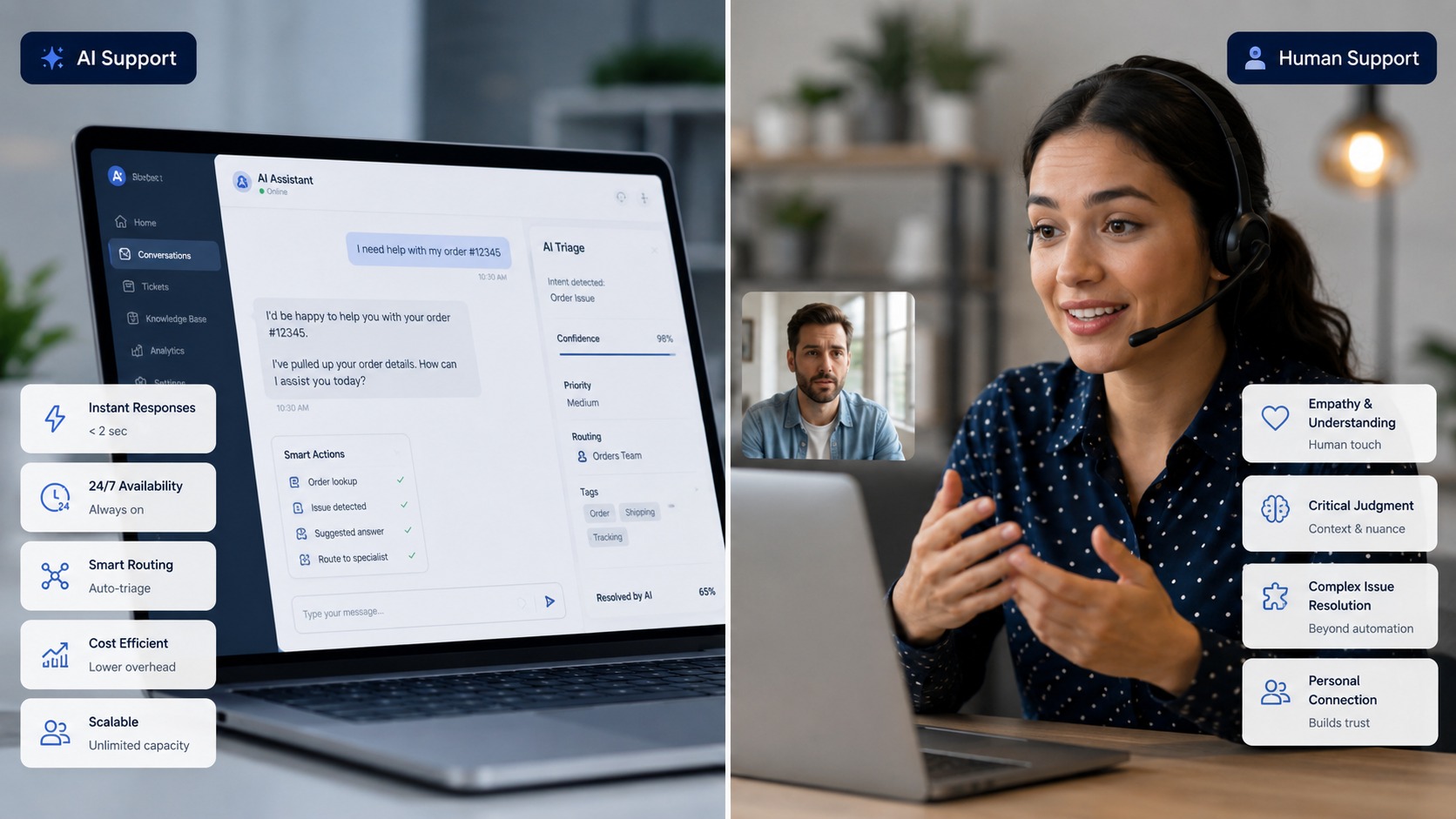
The takeaway is clear: neither column wins outright. AI dominates speed, cost, and scale; humans dominate empathy and complexity. Bridging them — often through remote visual support and remote video inspection — is where the real advantage lies.
Why the best strategy is a hybrid approach
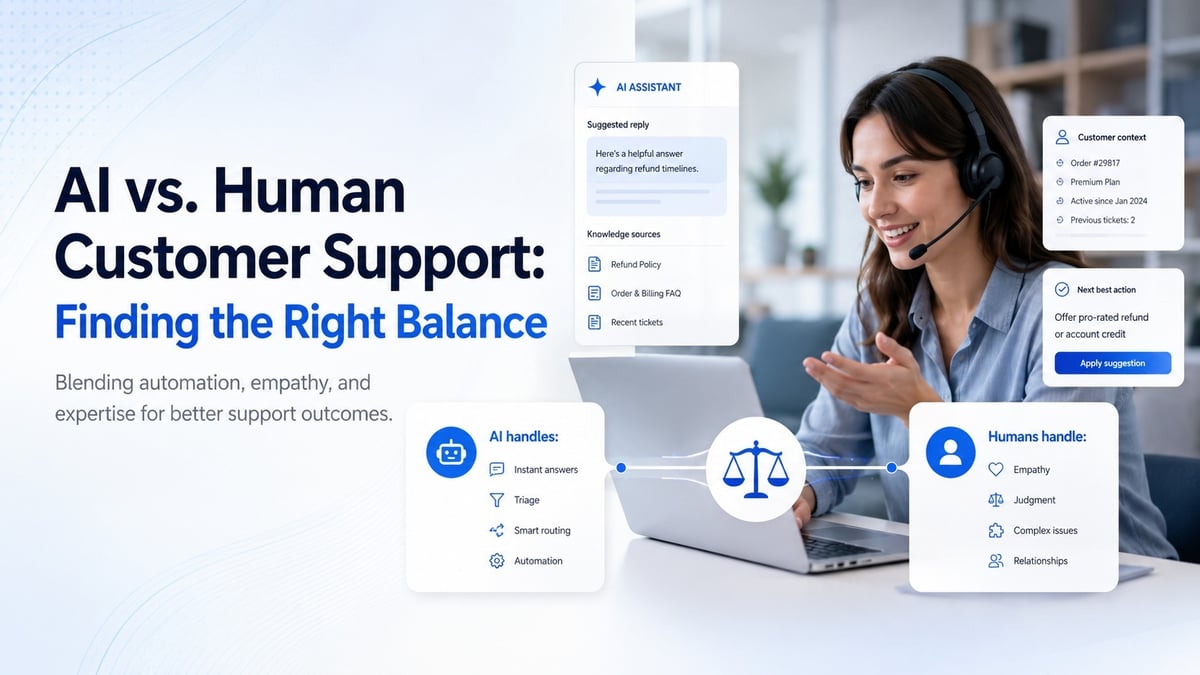
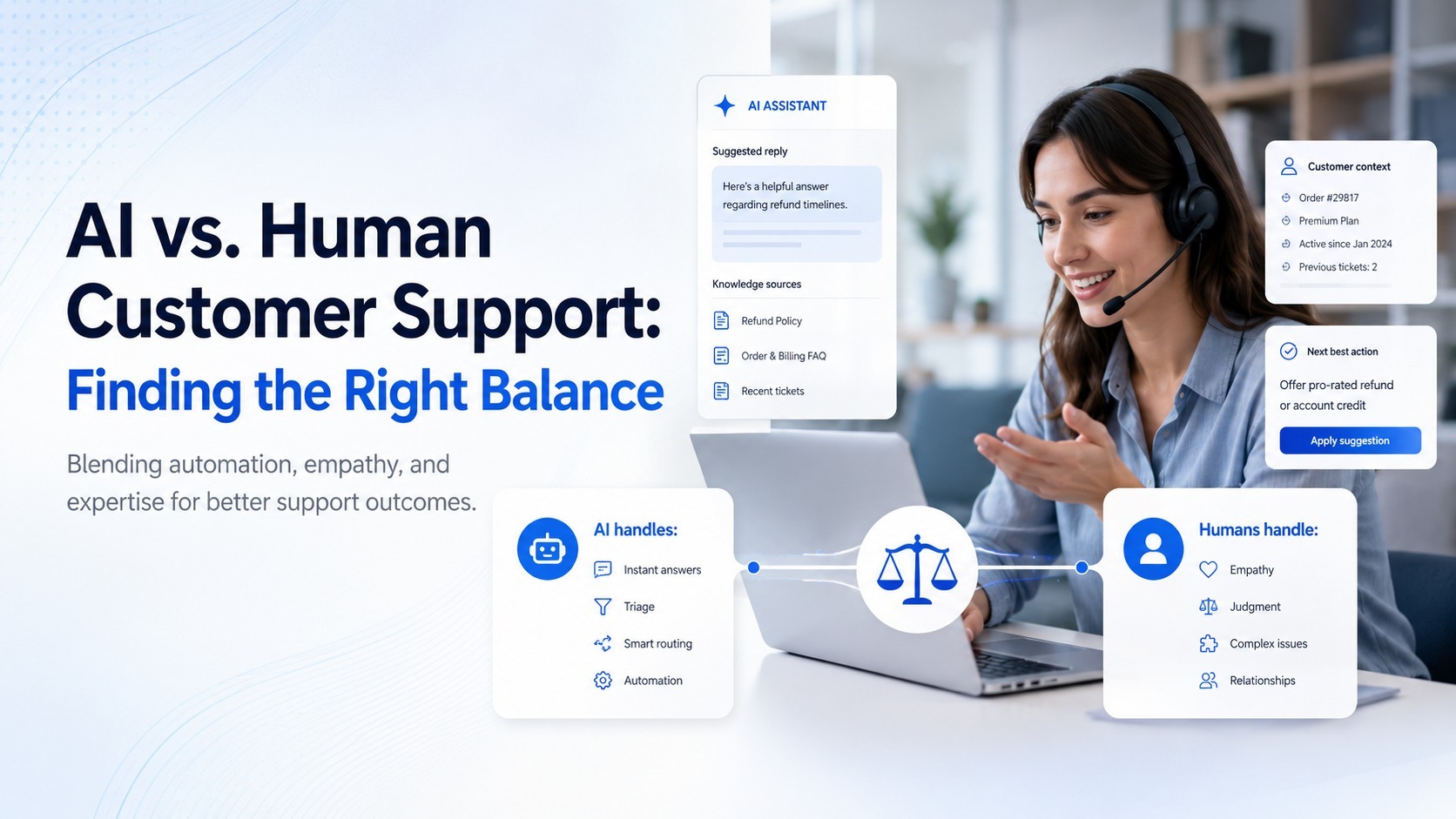
AI handles routine tasks
Let AI absorb the repetitive load: FAQs, order tracking, password resets, and appointment scheduling. The same logic applies in the field, where remote video inspection software automates routine documentation and image capture so people don't have to.
Humans handle high-value interactions
Reserve human attention for escalations, sensitive situations, complex technical issues, and relationship management — including the judgment calls that a remote visual inspection surfaces but can't decide on its own.
Creating a seamless handoff process
The hybrid model lives or dies on the handoff. AI should transfer to a human the moment an issue exceeds its scope — and it must carry full context with it, so the customer never re-explains. A well-built remote visual support platform preserves the live video, annotations, and remote video inspection record through the transition, making the switch invisible to the customer.
Real-world examples of hybrid customer support
E-commerce
AI handles order updates and tracking; humans step in for returns and disputes. A remote video inspection of a damaged product lets AI document the defect instantly, while a human approves the resolution.
SaaS companies
AI answers onboarding questions; humans handle technical troubleshooting — often using remote visual support to see a user's screen and diagnose the issue directly.
Healthcare and financial services
AI manages routine enquiries; humans take compliance-sensitive interactions. In insurance specifically, remote video inspection for claims lets AI capture timestamped evidence while a human adjuster makes the regulated decision — a textbook remote visual inspection hybrid.
Construction and field operations
On job sites, site inspection software lets project managers run remote video inspection for progress and safety checks, with experts joining live only when a finding needs judgment. The same pattern holds in manufacturing and heavy equipment, where remote visual inspection replaces costly supplier-site travel.
The next evolution: AI that supports human agents
Agent assist technology
The newest model puts AI in the passenger seat. Agent-assist tools deliver real-time suggestions, automated note-taking, and instant knowledge retrieval — and teams that combine front- and back-of-call automation report 25–50% reductions in average handle time. In a remote visual support session, that means the AI summarizes and documents while the human focuses on the customer.
Visual AI and agentic AI
This is where remote visual inspection and support converge. Visual AI helps agents interpret screenshots, photos, and live camera feeds, while agentic AI takes action on what it sees — speeding diagnosis and resolution. Platforms like Blitzz Concierge combine live video, AR annotation, and AI-powered session capture for remote visual support, while Blitzz Inspect applies the same engine to remote video inspection — making it a single platform for both remote video inspection software and customer-facing visual help. You can see the contrast with legacy methods in visual customer support vs. traditional call centers.
Augmentation, not replacement
The thread running through all of it: AI empowers support teams rather than replacing them. About 69% of consumers say it's important that AI and human agents work together, and Gartner expects half the firms that cut staff to swap in AI to resume hiring by 2027. Whether it's remote visual support for customers or remote visual inspection in the field, the winning pattern is augmentation.
How businesses can find the right balance
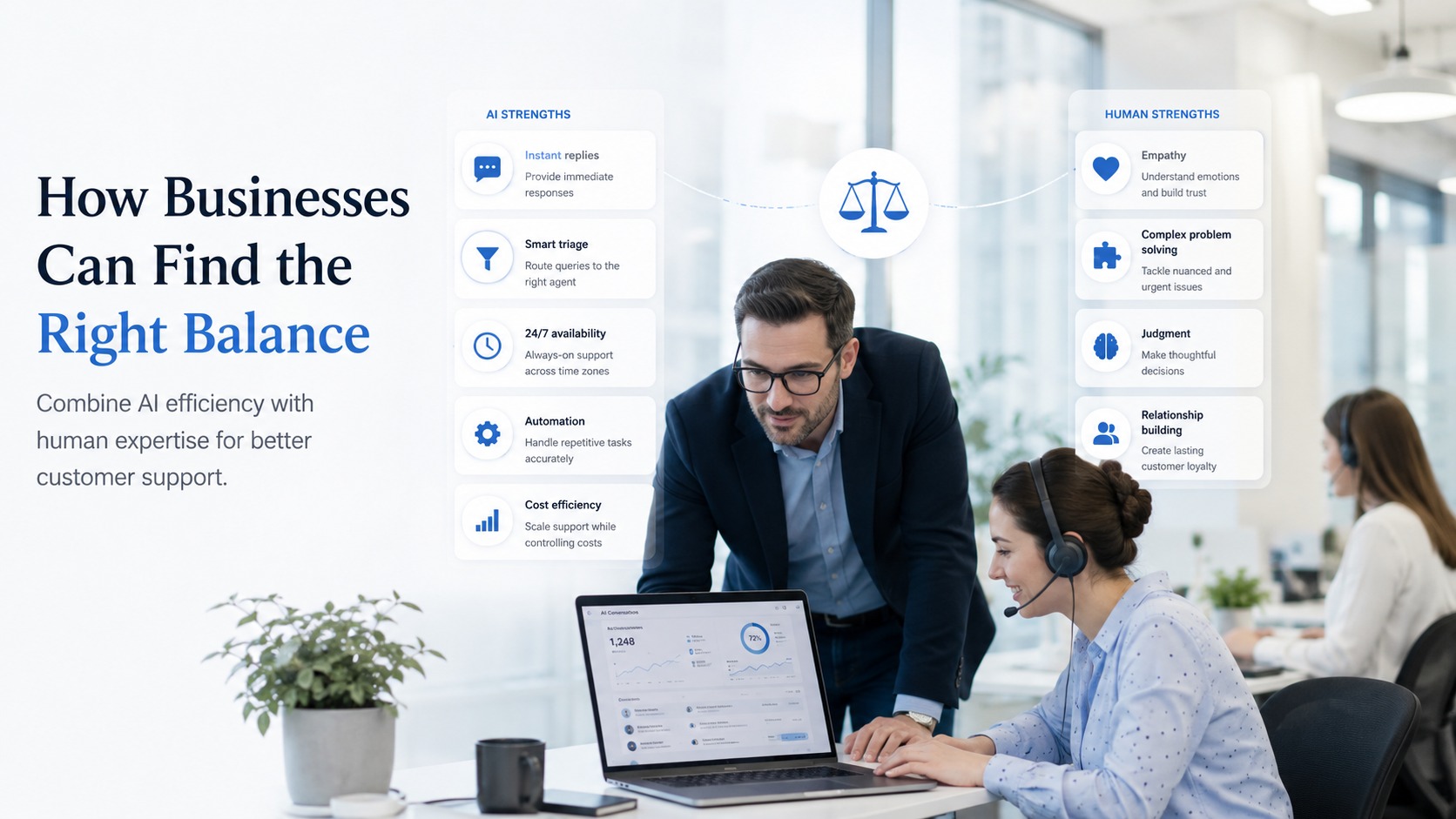
Five steps turn the hybrid model from theory into practice:
- Assess customer needs — understand which issues your customers actually contact you about, and which suit remote visual support versus a human touch.
- Identify repetitive tasks — route high-volume, low-complexity work (including routine remote video inspection documentation) to AI.
- Define escalation rules — set clear thresholds for when AI hands off to a human, with context intact.
- Train human agents alongside AI — teach teams to work with remote video inspection software and site inspection software, not around it.
- Continuously measure performance — track first-contact resolution, handle time, truck-roll rate, and CSAT, and tune the balance over time.
For a deeper look at how this works in practice, see how Blitzz uses AI to transform remote support.
Frequently asked questions
Will AI replace customer support agents?
No. AI changes what agents do rather than eliminating them. It absorbs repetitive tasks — including routine remote video inspection documentation — so humans can focus on complex, empathy-driven work. Most companies are pairing the two, not picking one.
Do customers prefer AI or human support?
It depends on the task. Customers prefer instant AI answers for simple queries but want humans for sensitive or complex issues. Remote visual support bridges the gap by combining AI speed with human judgment on the same call.
What types of support tasks should be automated?
Repetitive, high-volume, rule-based tasks: FAQs, order tracking, password resets, scheduling, and standardized remote visual inspection documentation captured through remote video inspection software.
How can businesses improve AI-human collaboration?
Build seamless handoffs that preserve context, deploy agent-assist tools, and use remote visual support platforms that let AI and humans work the same session. Clear escalation rules and shared site inspection software keep both sides aligned.
What is the ideal balance between AI and human support?
There's no fixed ratio — the right balance routes routine work to AI and reserves human attention for high-value, sensitive, or complex interactions. Many teams find remote visual inspection and remote video inspection the natural meeting point, where AI documents and humans decide.
Conclusion
AI and human agents each bring something the other can't. AI offers speed, scale, and cost efficiency; humans offer empathy, judgment, and trust. Businesses that rely entirely on one approach leave value on the table — over-automating frustrates customers, while staying all-human can't scale.
The most successful customer support strategies combine AI's efficiency with human expertise, and increasingly they connect the two through remote visual support and remote video inspection. With the right remote video inspection software and site inspection software, AI captures and documents while people decide and reassure — turning a binary debate into a genuine partnership.
The future of customer service is collaborative, not competitive. And whether the issue arrives as a support ticket or a remote visual inspection, the businesses that balance AI and human strengths will resolve it faster, cheaper, and better.
See remote visual support and remote video inspection on one platform →

Blitzz Team
The Blitzz Team writes about remote video support, virtual inspections and field service. Our guides come from working with home builders, property managers, warranty teams, contact centers and field service organizations that use Blitzz to see and solve issues without a truck roll.