
.png?width=120&height=55&name=Blitzz-Logo-right%20white%20eyes%20-%20not%20transparent%20(3).png)
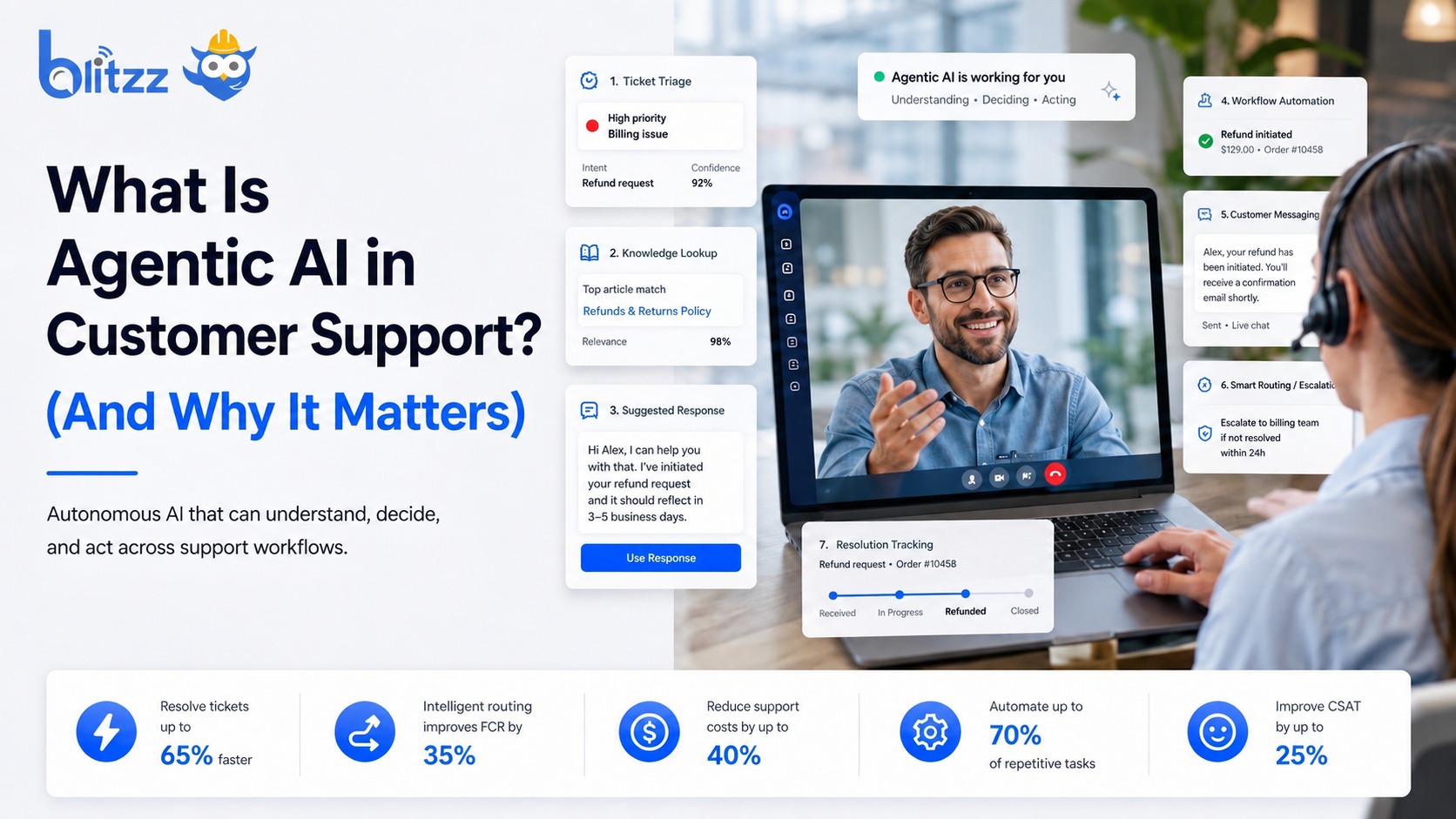
Agentic AI is artificial intelligence that doesn't just answer questions — it takes action, completing multi-step tasks on its own to resolve a customer's issue end to end. Where a chatbot tells a customer how to request a refund, an agentic system looks up the order, checks the return window, processes the refund, and confirms it — all in one conversation, without a handoff. It's the difference between an AI that responds and an AI that resolves.
This guide explains what agentic AI actually is, how it works in customer support, where it delivers, and — just as importantly — where it still falls short. Because for all its reasoning power, today's agentic AI has one critical blind spot: it can't see. And a growing share of customer problems can't be solved with words alone.
From human teams to AI that acts
Customer support has moved through three distinct eras. First came human-only teams — capable but expensive and impossible to scale. Then came chatbots, which deflected routine questions but frustrated customers the moment a query strayed from the script. Now comes agentic AI: systems that reason about a problem, decide what to do, and act on their own.
The shift is happening fast. Cisco's 2025 global survey of nearly 8,000 leaders projects that more than half of customer support interactions will use agentic AI by mid-2026, rising to roughly 68% by 2028. Gartner has gone further, predicting that agentic AI will autonomously resolve 80% of common customer service issues by 2029 while cutting operational costs by around 30%.
But here's the tension this article keeps returning to: intelligent action still depends on intelligent perception. An AI agent can only act on what it understands — and when a customer's problem is visual, text-based reasoning hits a wall.
What is agentic AI?
Agentic AI is a type of artificial intelligence that can independently make decisions, take actions, and work toward specific goals with minimal human intervention. Here is a more detailed explanation of what agentic AI is.
Understanding the concept
Agentic AI refers to AI systems that operate with autonomy toward a goal. Rather than producing a single response and stopping, an agentic system breaks a problem into steps, executes those steps using connected tools and data, adapts as it goes, and keeps working until the objective is met.
The cleanest way to understand it is by contrast with traditional generative AI. Generative AI produces — it writes an answer, drafts an email, summarizes a ticket. Agentic AI does — it executes a workflow, triggers a transaction, updates a system of record. Generative AI is the brain that thinks; agentic AI is the brain wired to hands that act.
That's the fundamental shift: from answering questions to completing tasks. A generative chatbot might explain your billing policy. An agentic system reads the disputed invoice, identifies the error, issues the correction, and updates the account.
Key characteristics of agentic AI
Four traits separate a true AI agent from a dressed-up chatbot:
- Goal-oriented decision-making. It focuses on solving the customer's actual problem, not just generating a plausible reply.
- Autonomous action-taking. It acts without a human approving every step, executing workflows and triggering real outcomes.
- Multi-step problem solving. It chains tasks together — look up, verify, act, confirm — within a single interaction.
- Context awareness and memory. It knows who the customer is, what they've purchased, and what they've contacted about before.
- Continuous learning and adaptation. It improves from every interaction rather than running the same fixed script forever.
The distinction is architecture, not branding: chatbots follow scripts, while AI agents understand context, access backend systems, and complete multi-step workflows.
How agentic AI works in customer support
Moving beyond basic chatbots
Traditional chatbots are built on decision trees — predefined paths that work beautifully until a customer asks something the tree didn't anticipate. That's why the average chatbot resolution rate across industries sits around just 44.8%. Scripted workflows fail because real customer problems are messy, conditional, and rarely fit a clean branch.
The result is the familiar dead end: "I'm sorry, I didn't understand that. Let me connect you to an agent." More intelligent automation was needed — automation that could reason about an unfamiliar request and figure out the steps to resolve it rather than matching it against a fixed menu. That's the gap agentic AI fills.
Examples of agentic AI in action
In a live support setting, an agentic system can:
- Process refunds automatically — verify eligibility, issue the refund, and confirm, with no human in the loop.
- Troubleshoot technical issues — diagnose a problem by querying device or account data and walking the customer through a fix.
- Schedule appointments — check availability, book the slot, and send confirmation.
- Update customer records — change an address, swap a payment method, or adjust a subscription across connected systems.
- Escalate complex cases to human agents — recognize when it's out of its depth and hand off with full context attached.
The performance is real. Salesforce's Agentforce reported an 84% autonomous resolution rate across more than 380,000 conversations, with only about 2% requiring human escalation. Companies using AI agents report roughly 45% fewer escalations than those running rule-based chatbots.

Benefits of agentic AI for customer service teams
Faster resolution times
By acting instead of merely advising, agentic AI collapses the back-and-forth that drags out resolution. Routine requests that once took a multi-message exchange now close in a single interaction — industry data points to resolution times under two minutes for routine requests once repetitive tasks are automated end to end.
Lower support costs
The economics are the headline. Autonomous resolution runs roughly $0.50–$2.00 per case versus $6.00–$12.00 for a human-handled one. That lets teams absorb far more ticket volume without adding headcount, which is why Gartner ties agentic adoption to a projected 30% reduction in operational costs. Efficiency improves not because agents work harder, but because the repetitive load is lifted off them entirely.
Better customer experiences
Customers get faster answers, more personalized service (the agent already knows their history), and consistent quality that doesn't degrade on a Friday afternoon. Generative AI agents now reach around 92% accuracy in understanding customer intent, compared to 65–70% for older keyword-based bots — which means fewer misreads and fewer frustrating loops.
Improved agent productivity
Crucially, agentic AI supports human agents rather than replacing them. By handling the repetitive tier autonomously, it frees teams to focus on high-value, high-empathy conversations. Around 69% of consumers say it's important that AI and human agents work together — and Gartner expects half the companies that cut staff to swap in AI to resume hiring people by 2027. The role changes; it doesn't disappear.
Where agentic AI still falls short
The challenge of text-only understanding
For all its reasoning ability, most agentic AI shares one limitation with the chatbots it replaced: it works in text. It can read an order history and execute a refund, but it cannot look at a problem. And a large share of customer issues are fundamentally visual — the customer is staring at something they can't accurately put into words.
This is exactly where AI support struggles most. Industry analysis shows AI-powered customer service fails at roughly four times the rate of other AI-assisted tasks, and the failures cluster around complex, physical, and visual problems.
Common examples
Text-only agents struggle the moment the issue lives in the physical or visual world:
- Damaged products — "there's a crack, but I can't describe where."
- Software errors — a cryptic on-screen message the customer can't transcribe correctly.
- Equipment malfunctions — a blinking light or misconnected cable.
- Installation issues — "I don't know which part goes where."
- Billing document disputes — a discrepancy buried in a statement the AI never sees.
The missing piece: seeing what the customer sees
When an AI relies solely on written descriptions, it inherits all the noise of human communication — vague language, wrong terminology, stress, and guesswork. The customer says "the thingy is flashing," and even the smartest agent is now reasoning from bad input. The growing need is for visual understanding: the ability to perceive the problem directly instead of interrogating the customer about it.
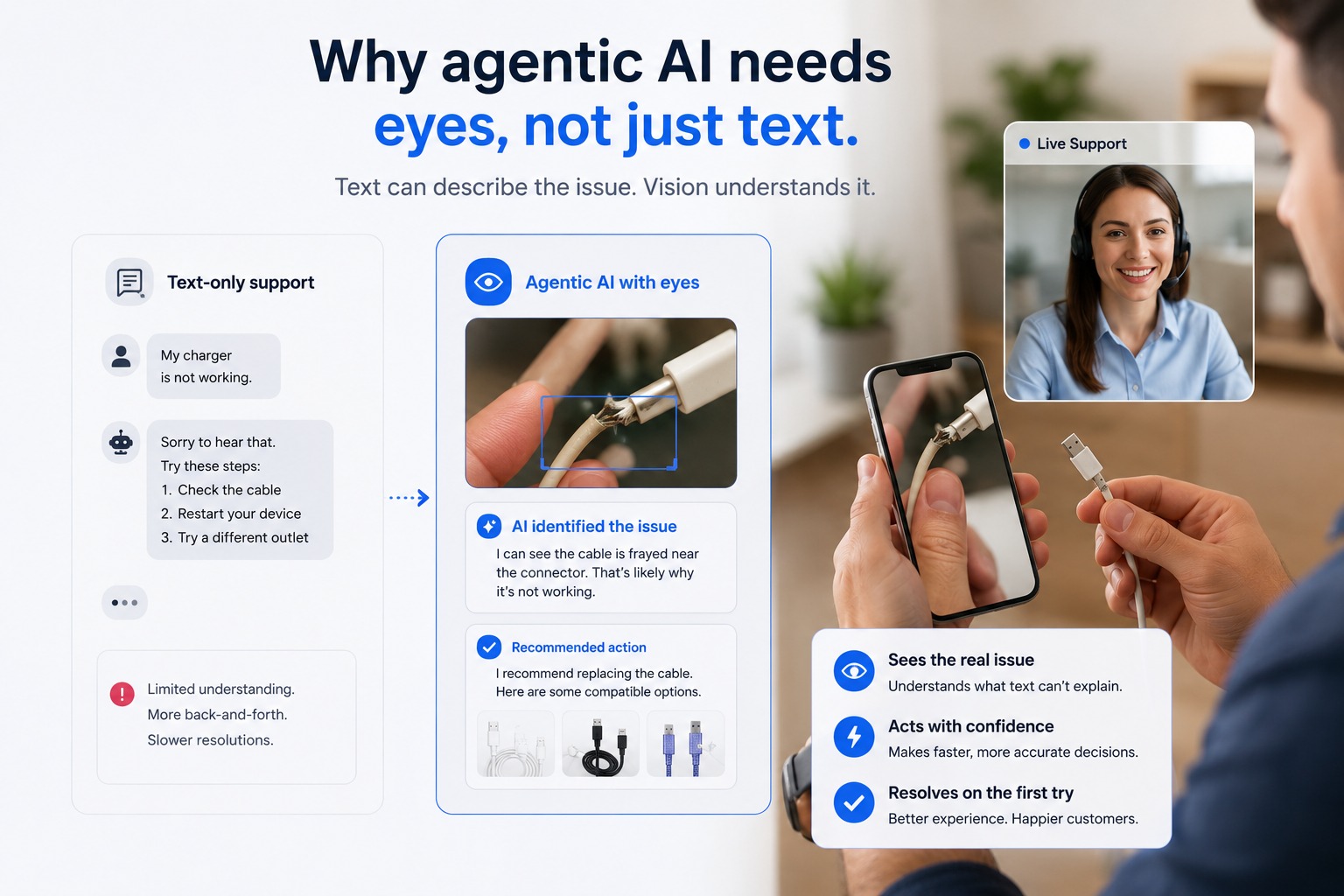
Why agentic AI needs eyes, not just text
Text and voice AI have transformed Tier-1 support. But for complex, visual, or technical issues — the kind where a customer says "I don't know how to describe it" — AI still needs eyes. That's where visual AI agents change the equation.
The rise of visual AI agents
Visual AI brings perception to the agentic stack. Instead of parsing a typed description, a visual agent processes images, screenshots, recorded video, and live camera feeds — turning the customer's actual problem into something the AI can analyze and act on. It's the missing sensory layer that lets an agentic system reason about the physical world.
What visual AI agents can do
- Detect product defects from a single photo.
- Analyze screenshots to identify the exact error a user is seeing.
- Guide troubleshooting in real time over a live video feed, with on-screen annotation.
- Verify warranty claims with timestamped visual evidence.
- Assist with technical support by showing, not just telling, the customer what to do.
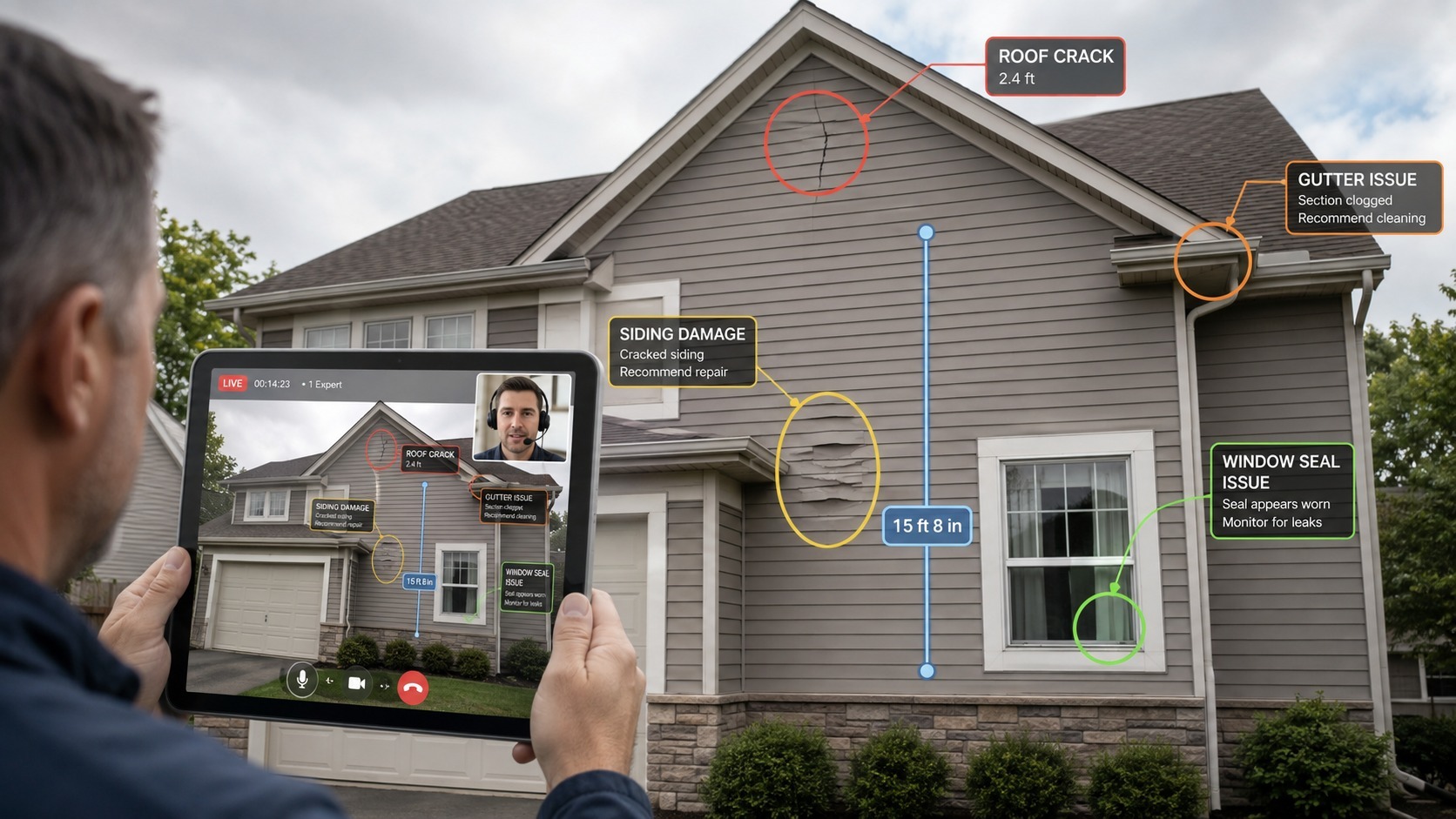
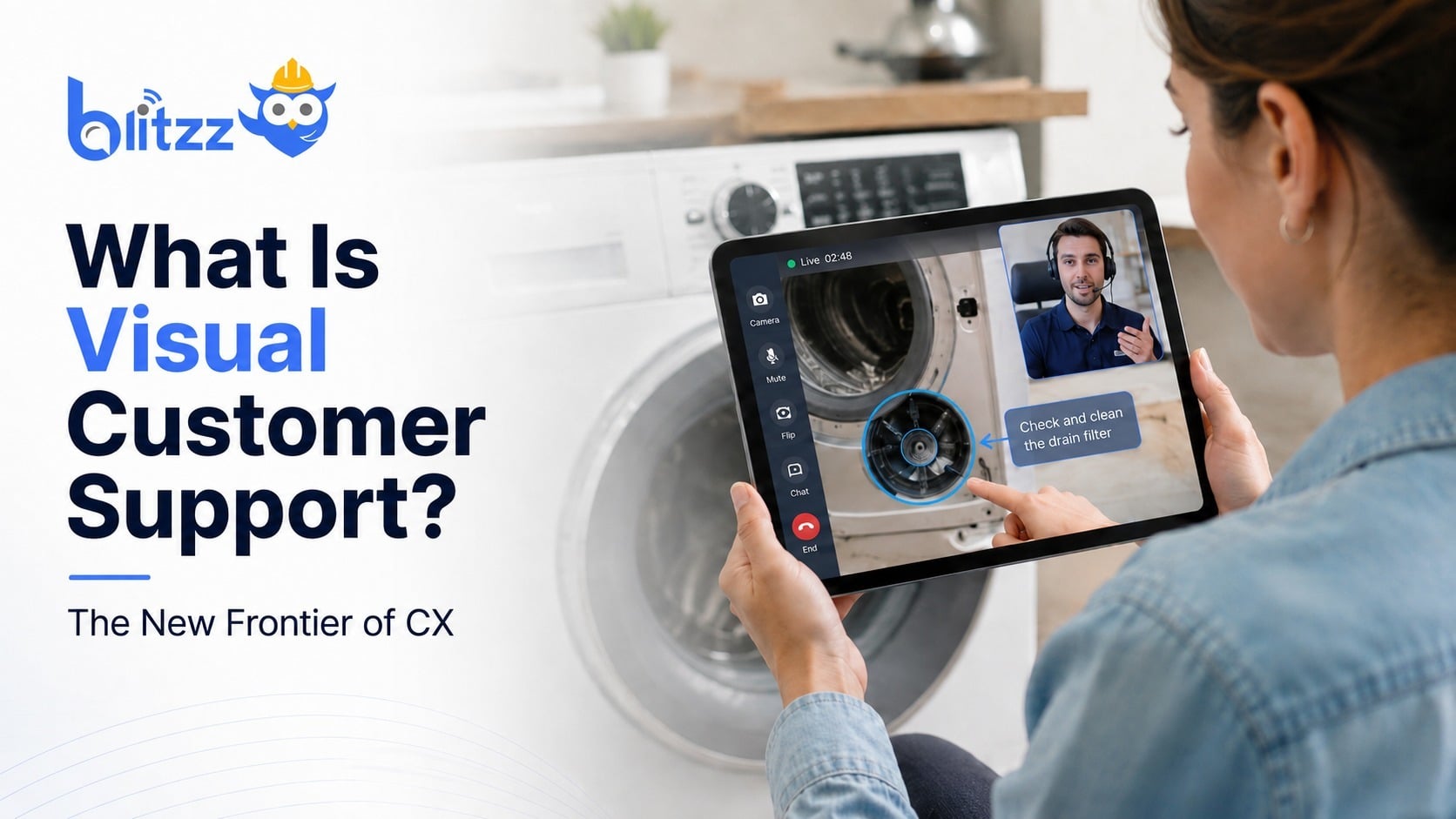
This is the foundation of platforms like Blitzz Concierge, which combines live video, AR annotation, and AI-powered session capture so an agent — human or AI-assisted — can see exactly what the customer sees, mark up the live feed to point to the precise button or component, and resolve the issue in one session. You can see how this plays out against traditional handling in visual customer support vs. traditional call centers.
Real-world example
Consider a customer reporting a damaged product:
- Traditional AI asks a chain of clarifying questions — Where is the damage? How big? What color? Which model? — and still ends up with an imprecise picture.
- Visual AI asks for one photo and instantly identifies the defect, its location, and its severity.
- Agentic AI takes it from there: confirms warranty coverage, approves the replacement, and triggers the shipment — all in a single interaction.
Perception plus action, working together. That combination is what makes the resolution feel effortless to the customer.
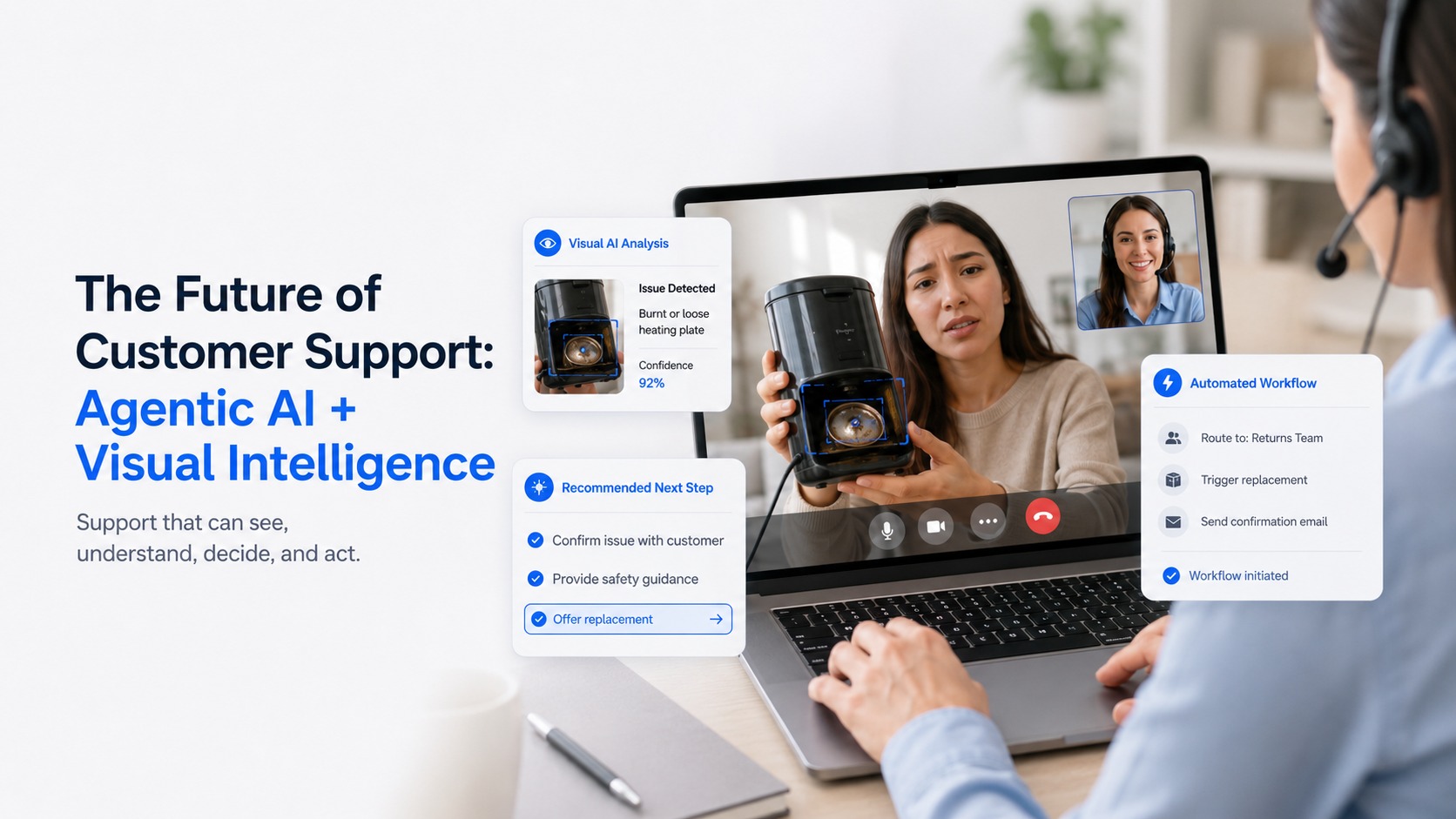
The future of customer support: agentic AI + visual intelligence
Creating truly autonomous support experiences
The next leap isn't reasoning or perception — it's both. When you combine an agent's ability to reason and act with a visual system's ability to see, you get support that can handle problems end to end with almost no customer friction. The customer shows the problem; the AI understands it and resolves it. No describing, no escalating, no waiting for a technician.
Industries leading adoption
The verticals moving fastest are the ones where issues are high-volume and often visual:
- E-commerce — product defects, returns, and damage verification.
- SaaS — screenshot-driven error diagnosis and onboarding.
- Telecommunications — router, cable, and device troubleshooting, the most AI-saturated vertical at ~95% adoption.
- Manufacturing — equipment diagnostics and remote inspection.
- Healthcare equipment support — guiding patients and clinicians through device setup remotely.
What businesses should prepare for
Three forces are converging. Customer expectations keep rising — instant, accurate resolution is now the baseline, not a delight. Demand for multimodal AI (systems that handle text, voice, and vision together) is growing as buyers realize text-only agents leave their most expensive tickets unsolved. And there's a real first-mover advantage: with adoption accelerating, the teams building visual-plus-agentic capability now will be resolving in seconds what competitors still escalate. The flip side is also worth heeding — analysts expect roughly 40% of AI-agent projects to stall by 2027, almost always where deployment outran a clear, well-scoped use case.
Frequently asked questions
Is agentic AI the same as generative AI?
No. Generative AI produces content — it answers, drafts, and summarizes. Agentic AI takes action — it executes multi-step workflows and triggers real outcomes autonomously. Generative AI is the reasoning engine; agentic AI puts that engine to work completing tasks.
Can agentic AI replace customer service agents?
No. The evidence points to agentic AI changing agent roles rather than eliminating them. It absorbs repetitive, high-volume tasks so humans can focus on complex and emotional interactions. Most consumers want AI and humans working together, and Gartner expects half the firms that replaced staff with AI to resume hiring by 2027.
What are visual AI agents?
Visual AI agents are systems that process images, screenshots, video, and live camera feeds to understand a customer's problem visually — then guide or resolve it. They add perception to agentic AI, letting it act on physical problems it could never grasp from text alone.
How does visual AI improve customer support?
It removes the guesswork of verbal description. Instead of asking a customer to describe a defect or error, a visual agent sees it directly — diagnosing the issue faster, improving first-contact resolution, and eliminating the back-and-forth that frustrates customers.
Is agentic AI suitable for small businesses?
Yes. Because autonomous resolution costs a fraction of human handling and modern platforms deploy without heavy engineering, small teams can use agentic AI to handle volume that would otherwise require hiring. The key is starting with a clear, well-defined use case rather than trying to automate everything at once.
Conclusion
Agentic AI represents the next major leap in customer support automation — a move from systems that respond to systems that reason, decide, and act. The autonomous-resolution numbers, the cost savings, and the speed gains all point in the same direction.
But intelligent action requires intelligent perception. An AI that can think and act but cannot see will keep stumbling over the visual, physical problems that drive customers' most frustrating support experiences. The future belongs to AI systems that can not only think and act, but also see.
Businesses that pair agentic AI with visual AI agents will deliver faster, smarter, and more efficient customer experiences than those relying on text alone.
See what visual AI can resolve that a text-only agent can't

.jpg)