
.png?width=120&height=55&name=Blitzz-Logo-right%20white%20eyes%20-%20not%20transparent%20(3).png)
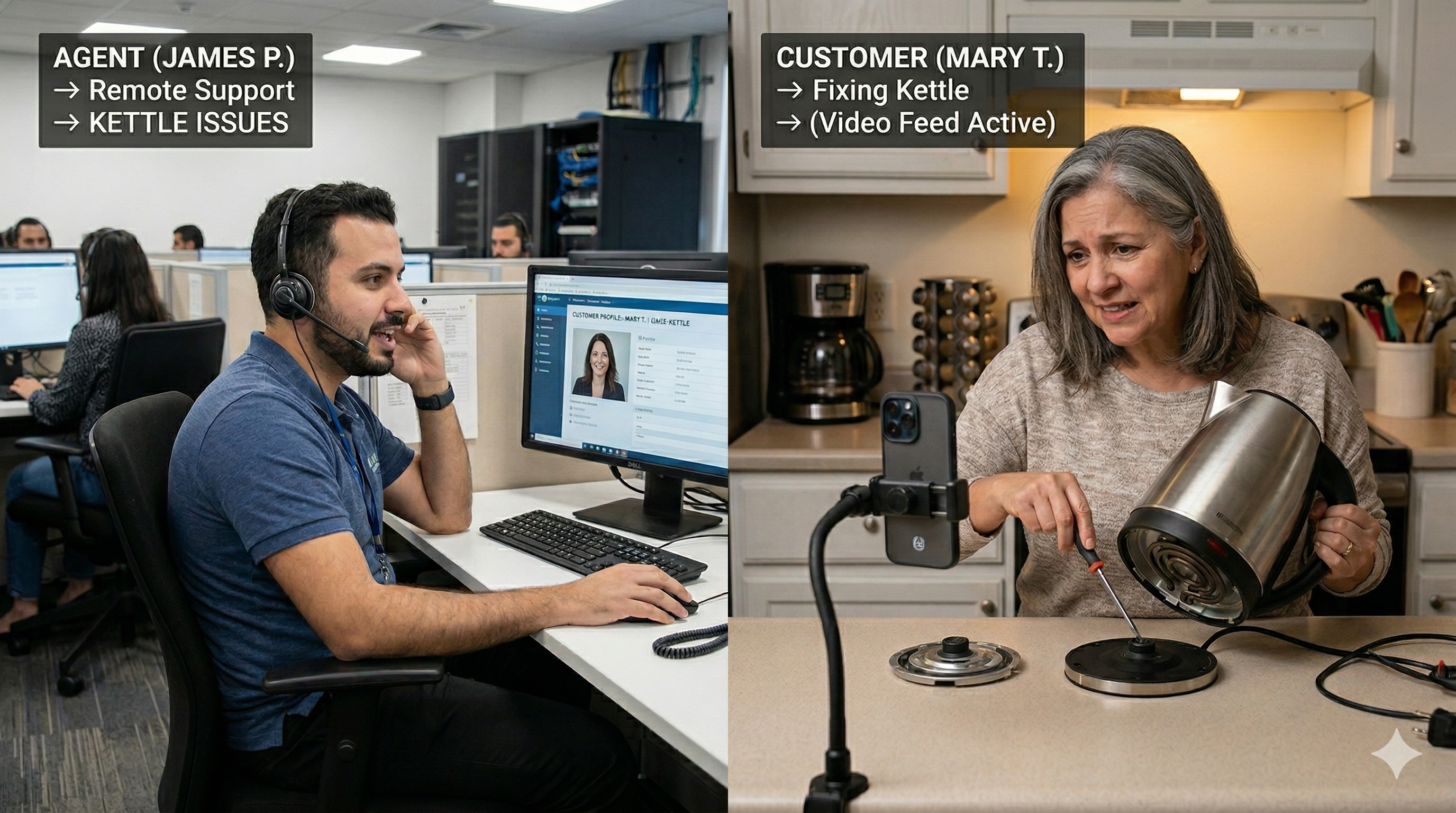
Picture the scene: a customer calls support about a device that won't connect. The agent answers. The customer describes the problem — in their own words, with their own level of technical vocabulary. The agent interprets. They ask follow-up questions. The customer tries again. They describe the same problem differently. The agent guesses. They suggest a fix. It doesn't work. They suggest another. The call drags past eight minutes. Past twelve. Past the point where the customer stops caring about the solution and starts caring about how unhappy they are.
This is the traditional call center model in its most honest form. And for an enormous number of interactions, it's still the default.
It doesn't have to be.
Visual customer support — the practice of connecting remote agents to customers through live video, co-browsing, AR annotation, and real-time visual guidance — doesn't just make support interactions faster. It fundamentally changes what's possible in a support conversation. When agents can see what customers see, everything that depends on verbal description disappears. Problems that took four exchanges to diagnose get resolved in one look.
This article makes the case for visual customer support with real data, shows exactly where it outperforms voice-only service, and explains how platforms like Blitzz are making the switch accessible for teams of every size.
What Is Visual Customer Support?
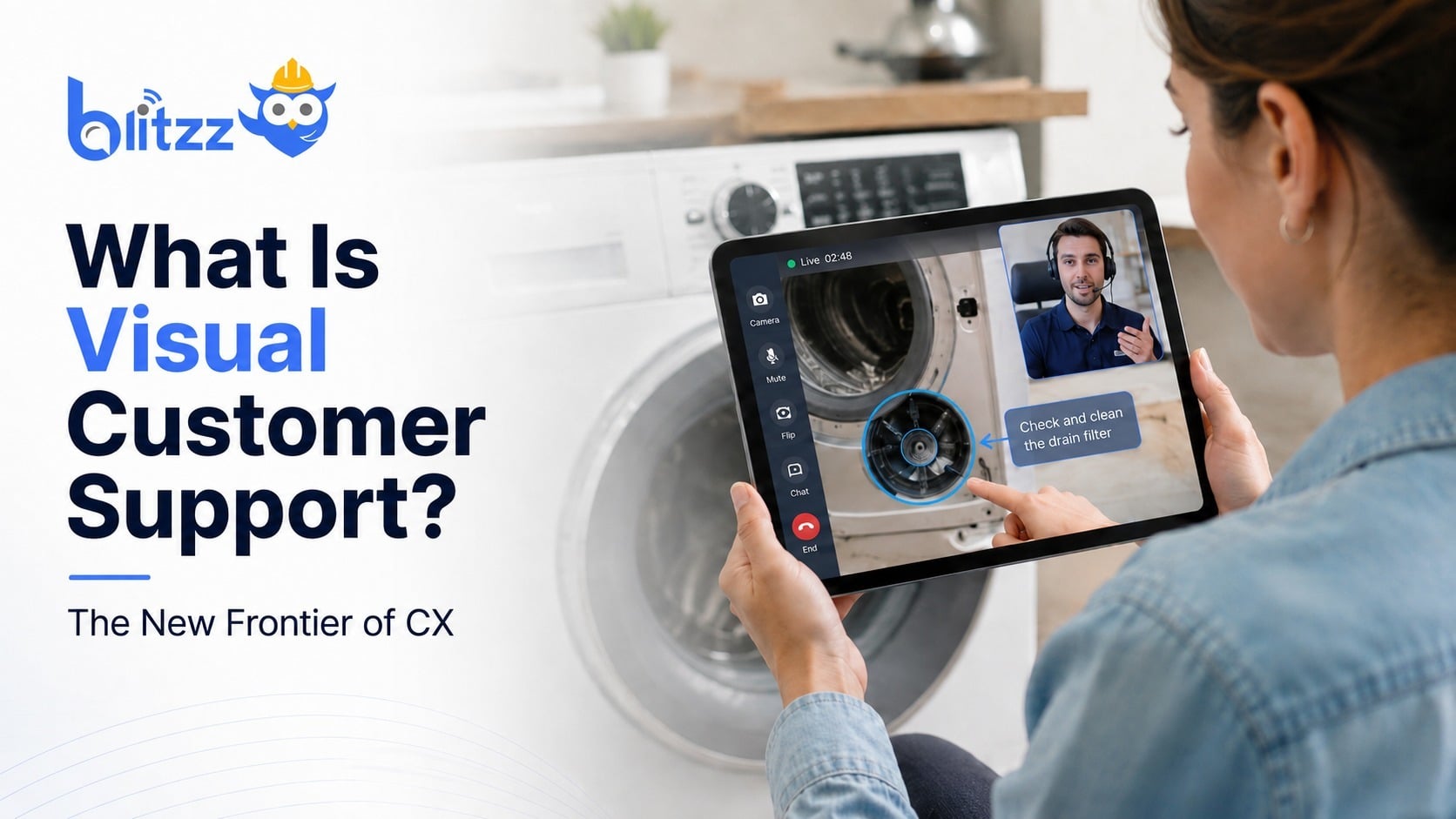
Visual customer support (also called visual customer service, visual remote assistance, or live visual support) is an approach to customer service that goes beyond voice and text by giving agents a real-time, shared visual connection with the customer's environment — whether that's a browser session, a camera feed of physical equipment, or an annotated live screen.
The category includes several complementary tools that often work together:
- Live video support — an agent views a customer's live camera feed via smartphone, seeing the physical environment, equipment, or product in real time
- Co-browsing — agent and customer share a synchronized view of the same browser session, with the agent able to annotate, highlight, and guide navigation
- Screen sharing — customer shares their screen or a specific application window for the agent to view or take over
- AR annotation — the agent draws, labels, and annotates directly on the live video or screen feed using augmented reality tools
- Remote camera controls — agents can zoom in, toggle flashlights, and freeze frames on the customer's device remotely
What unifies all of these is a simple but powerful idea: the agent can see what the customer sees. That single shift — from verbal description to shared visual context — is what makes visual customer support categorically different from traditional voice-based service.
The Traditional Call Center: What the Numbers Say
Before making the case for visual customer support, it's worth being honest about the current state of voice-only service — because the data is more sobering than most contact center leaders want to acknowledge.
Satisfaction Is Stubbornly Low
Phone support reaches only 44% customer satisfaction — compared to 87% for live chat. That's not a marginal gap. It's a near doubling of satisfaction from one channel to another. And yet voice remains the dominant channel in most contact centers by volume.
The average U.S. CSAT score across call centers sits around 73% — and is one of the most widely used KPIs for call center performance. A score of 73 sounds passable until you consider what sits below it: 73% of consumers will switch to a competitor after multiple bad experiences, and 56% of customers won't even complain after a bad experience — they just quietly leave and switch brands.
Customer silence is not customer satisfaction. It's customer departure.
Handle Times Are Climbing
The industry average handle time (AHT) for call centers is just over 6 minutes and 10 seconds. That figure includes talk time, hold time, and post-call documentation. For technical support, product troubleshooting, and anything requiring the customer to describe a visual problem — handle times run significantly longer.
The core driver of extended handle time in voice support is information asymmetry: the agent knows what the solution looks like, but can't see the problem. Every question asked to compensate for that asymmetry adds time, agent cognitive load, and customer frustration.
Agent Burnout Is a Growing Crisis
77% of service agents report rising workload, and 56% experience burnout. In the U.S., call center turnover rates run between 30% and 40% annually — one of the highest attrition rates of any professional category. This isn't a culture problem. It's a structural problem. When agents spend their days navigating ambiguous descriptions, making repeated follow-up calls, and manually documenting interactions, the cognitive cost compounds fast.
Visual customer support reduces the ambiguity load — and with it, the burnout risk.
Customer Expectations Have Moved
77% of customers expect to reach someone right away when they contact a company, and 90% say a quick response is critical, with 60% defining "immediate" as within 10 minutes. These aren't aspirational benchmarks. They're the minimum table stakes for customer retention in 2026.
Voice-only channels that rely on queuing, verbal triage, and multiple escalation steps are structurally unable to meet these expectations consistently. Visual customer support — where the agent sees the problem instantly and begins resolving it in real time — is far better positioned to deliver on what customers actually expect.

Visual Customer Support: What Changes When Agents Can See
The gap between a voice-only support call and a visual customer support session is not incremental. It's qualitative — a different kind of interaction that produces different outcomes at every stage.
Here's what actually changes.
Diagnosis Goes From Guesswork to Certainty
In a traditional call, the agent diagnoses based on what the customer tells them. This introduces error at every step: the customer may not know the right technical vocabulary, may miss a relevant detail, may not notice what the agent would immediately spot if they could see it.
In a visual support session, the agent sees the environment directly. The error code on the device display. The incorrectly wired connection. The form field that's been filled incorrectly. The product damage that wasn't quite matching the description. There's no interpretation layer — what the agent sees is what's actually there.
The result is faster, more accurate diagnosis. And more accurate diagnosis means fewer repeat contacts, fewer escalations, and fewer unnecessary dispatches.
First-Contact Resolution Jumps
First-contact resolution (FCR) is the single metric most directly tied to both CSAT and operational cost in customer support. Every issue that requires a follow-up call or a second technician visit costs money and erodes trust.
Visual customer support dramatically improves FCR by giving agents the information they need to resolve issues completely on the first contact. Blitzz customers consistently report FCR improvements of 20–40% after deploying live visual support — not because their agents got smarter, but because their agents finally had enough context to do the job completely.
The math compounds: fewer repeat contacts means lower total call volume. Lower call volume means better occupancy rates, shorter wait times, and lower cost per resolution. Improving FCR doesn't just improve CSAT — it reduces cost-to-serve.
Average Handle Time Drops — But Quality Goes Up
This is one of the counterintuitive results of visual customer support: handle time typically decreases even though the interaction feels richer. The reason is efficiency of information transfer.
In a voice-only call, the agent spends significant time gathering information verbally — asking for model numbers, error codes, descriptions of what the customer sees, step-by-step confirmation of what was tried. Each of these exchanges takes time and introduces the possibility of miscommunication.
In a visual support session, the agent can read the model number directly from the camera feed using Blitzz's OCR text extraction. They can see the error code without asking. They can confirm the customer is looking at the right settings screen without a step-by-step verbal guide. Information that took five questions to gather takes five seconds to observe.
One major Canadian telecom using Blitzz saw a 40% improvement in first-call resolution while simultaneously reducing the time agents spent on each interaction — not a trade-off, but a compound improvement in both dimensions.
Customer Satisfaction Scores Climb Measurably
The connection between visual customer service and CSAT is well-documented. Customers who can show their problem rather than describe it have a categorically different emotional experience of support. They feel heard immediately. They don't have to repeat themselves. They see their issue acknowledged visually rather than verbally confirmed.
Live chat already achieves an 87% satisfaction rate compared to 44% for phone support. Live visual support — which adds a camera feed, AR annotation, and real-time shared context to the interaction — consistently outperforms text-based live chat in customer satisfaction surveys. Customers who can literally see an agent annotating their problem and guiding them to a solution report the interaction as more personal, more effective, and more trustworthy than any voice-only alternative.
Documentation Is Complete, Automatic, and Accurate
Traditional call center documentation is the dirty secret of the industry. Post-call documentation — the notes agents are supposed to write after each interaction — is frequently incomplete, inconsistently formatted, and delayed. Agents under occupancy pressure don't have time to write thorough notes. What makes it into the CRM is often a rough summary written minutes or hours after the call ended.
Visual customer support platforms like Blitzz generate documentation automatically. Timestamped photos are captured during the session. Session recordings are saved with annotations intact. AI-generated call summaries draft the case notes before the agent even closes the interaction. OCR-extracted data — serial numbers, model codes, VINs — populates the CRM record without manual entry.
When the session ends, the case record is complete. No post-call scramble. No documentation gaps. No "the agent forgot to note that" conversations in the next escalation.
Head-to-Head: Visual Customer Support vs. Traditional Call Center
| Dimension | Traditional Call Center | Visual Customer Support |
|---|---|---|
| Information access | Agent works from verbal description | Agent sees what customer sees, in real time |
| Diagnosis accuracy | Interpretation-dependent | Direct observation |
| Average handle time | 6+ minutes industry average | Typically 30–50% lower for visual interactions |
| First-contact resolution | Industry average ~70–75% | Consistently 20–40% higher with visual tools |
| CSAT score | Phone support: ~44% satisfaction | Visual support: measurably higher per channel |
| Documentation quality | Manual, often incomplete, post-call | Auto-generated: photos, recordings, AI summaries |
| Agent burnout | High — 56% report burnout | Lower — less ambiguity, faster resolution |
| Unnecessary dispatch rate | High no-fault-found rates | Dramatically reduced with remote visual triage |
| Customer effort | High — must describe problem verbally | Low — show, don't tell |
| Repeat contact rate | High when FCR is low | Drops with improved first-contact resolution |
| Compliance documentation | Variable, agent-dependent | Consistent, timestamped, audit-ready |
Where Visual Customer Support Delivers the Biggest Impact by Industry
Visual customer support isn't a one-size-fits-all improvement. Different industries feel the impact in different ways — but across every sector, the common thread is the elimination of the verbal description problem.
Visual Support for Telecoms and Internet Providers
Telecoms deal with one of the highest-volume, most technically complex support environments in any industry. Customers trying to troubleshoot routers, cable connections, set-top boxes, and signal issues struggle to describe the problem accurately over the phone — leading to extended calls, high no-fault-found dispatch rates, and repeat contacts.
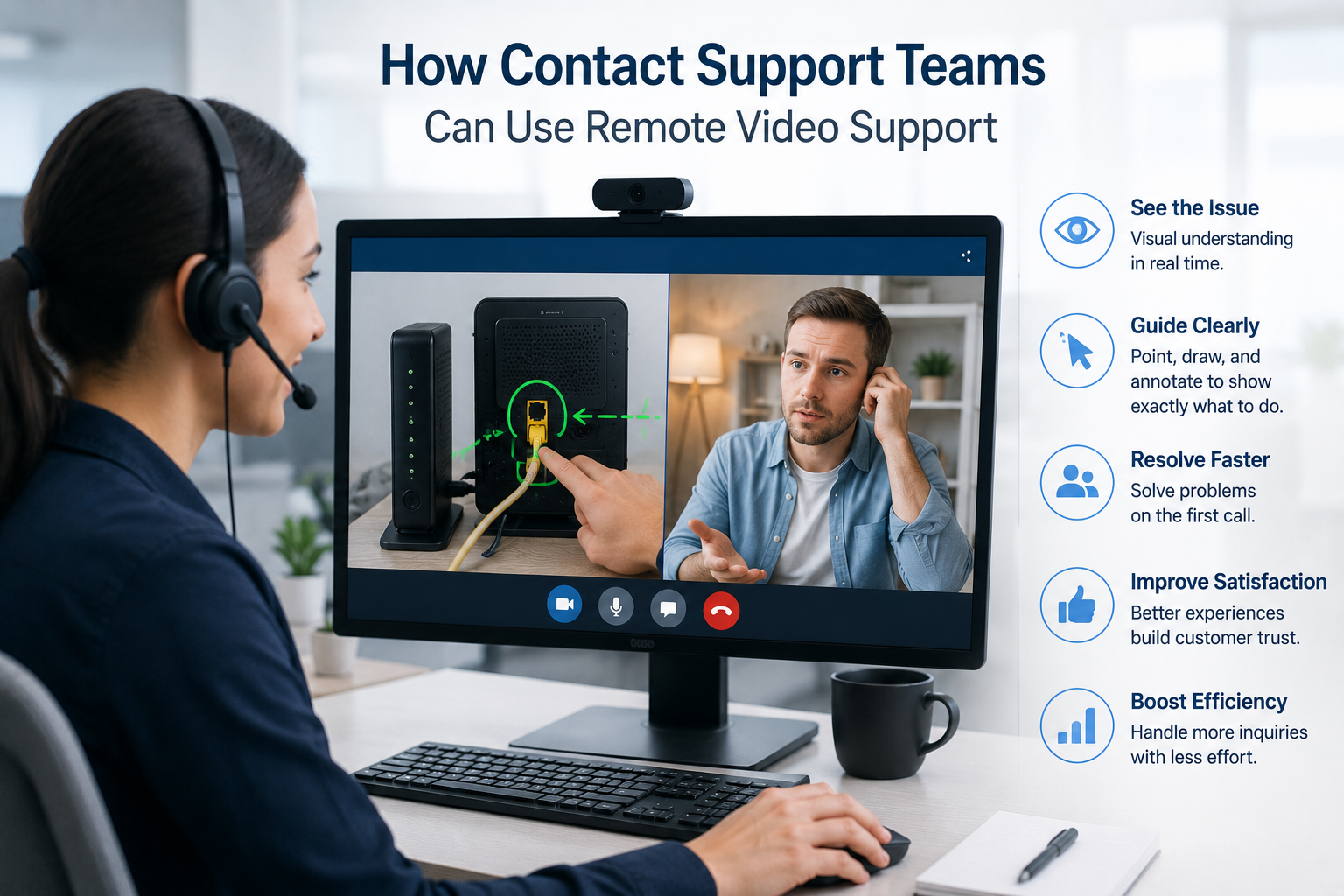
With visual customer support, agents see the device, the cable configuration, and the error indicator directly. They can guide customers through a reset procedure using AR annotation — drawing on the live camera feed to show exactly which button to press or which cable to check. Blitzz Concierge customers in telecom have reduced truck rolls by up to 30% and improved first-call resolution by 40% — not by hiring smarter agents, but by giving existing agents eyes on the problem.
Visual Customer Service for Insurance
Insurance claims are built on evidence. But when a customer calls in to report damage, the evidence is all on their side of the phone. The adjuster is working from a description. The customer is working from emotion and stress. The gap between what actually happened and what gets documented is where disputes, delays, and fraud all live.
Visual customer support in insurance means adjusters can assess damage remotely — seeing the cracked windshield, the water damage, the fire-affected area — while capturing timestamped, annotated photos that go directly into the claim record. Blitzz Inspect was specifically built for this: insurance-grade visual documentation with GPS capture, OCR for VIN and policy numbers, and full session recording that creates a defensible audit trail from the first moment of contact.
Visual Remote Assistance for Field Service and Equipment Support
When equipment fails, the difference between a remote resolution and an on-site dispatch can cost hundreds to thousands of dollars per incident. The key variable is information: does the remote agent know enough about the problem to resolve it without sending someone out?
Live visual customer support gives field service teams the information they need to make that decision correctly. An agent who can see the equipment — the error display, the component configuration, the installation setup — can diagnose remotely and guide the customer through a fix using AR annotation. When a dispatch is genuinely necessary, the prior visual session ensures the right technician with the right parts goes out on the first visit.
Blitzz's truck roll reduction data is compelling: customers reducing unnecessary dispatches by 25–30% report annual savings that dwarf the cost of the platform by an order of magnitude.
Visual Support for Banking, FinTech, and Financial Services
Financial services interactions often involve complex digital workflows: account applications, document submission, loan configuration, benefits enrollment. When customers get stuck in these processes, they call in — and the agent is flying blind, unable to see where in the form the customer stopped, which field they filled incorrectly, or why the system rejected their submission.
Visual customer service in financial services means agents can join a customer's browser session directly using Blitzz Co-Browse — seeing the same screen, the same form, the same error message — and guiding the customer through it step by step. Sensitive financial fields are automatically masked from the agent's view, maintaining compliance without creating friction. The result is faster form completion, fewer abandoned applications, and significantly better customer satisfaction scores.
Visual Customer Support for Consumer Electronics and Retail
Product setup and troubleshooting calls are some of the highest-volume, most frustrating interactions in consumer support. A customer who can't get a smart home device to pair, can't configure a new laptop, or can't understand why their appliance is throwing an error code is trying to describe something technical in non-technical terms — a recipe for extended calls and low resolution rates.
Visual support tools turn these interactions around. The agent sees the device, reads the error code directly, and walks the customer through the fix using a live AR pointer. What averaged twelve minutes on a voice call resolves in three. First-call resolution improves. The customer hangs up feeling capable rather than frustrated.

What Makes Visual Customer Support Work at Enterprise Scale
Deploying live visual support as a point solution — one agent, one team, one use case — is straightforward. Deploying it at enterprise scale — across hundreds of agents, multiple contact center platforms, varied CRM environments — requires a platform built for that complexity.
This is where Blitzz's integration ecosystem becomes the operational backbone of visual support at scale.
Salesforce agents launch visual support sessions directly from case records, with all session data syncing back automatically — recordings, captured images, AI summaries, GPS location, OCR-extracted data.
Zendesk agents start visual sessions from any ticket, with documentation attaching automatically to the ticket record.
HubSpot connects visual support to both sales and customer success workflows — launching sessions from contact records and logging activity back automatically.
Microsoft Dynamics 365 brings visual remote assistance to Field Service, Customer Service, and Sales — with session recordings and AI summaries syncing to customer records.
Genesys Cloud CX agents transition from voice to live visual support during active calls — no tool switching, no context loss, full continuity.
NICE CXone and Procore integrations extend visual customer support into contact center operations and construction project management respectively.
The practical consequence of deep integrations: visual customer support sessions generate documentation, but more importantly, they generate data. Every session that syncs to a CRM record is a deposit in the institutional knowledge base that future AI personalization, agent coaching, and quality assurance programs draw from.
The Business Case — Making Visual Customer Support ROI Concrete
For CX leaders bringing this to leadership, the ROI calculation needs to be specific. Here's a realistic model based on Blitzz customer outcomes:
Baseline assumptions:
- 500 support interactions per month that involve technical troubleshooting or visual complexity
- Average handle time of 8 minutes per voice-only interaction
- Average cost per interaction: $12 (fully loaded, including agent time, overhead, documentation)
- Current first-contact resolution rate: 72%
- Current CSAT score: 74%
- Dispatch rate for unresolved issues: 15% of interactions (75 truck rolls/month)
- Average cost per truck roll: $400
After deploying visual customer support (based on Blitzz customer data):
- Handle time reduction: ~35% → 5.2 minutes average
- FCR improvement: +30 points → 93%+ first-contact resolution
- Dispatch reduction: 30% fewer truck rolls → 52 dispatches/month saved
Monthly financial impact:
- Handle time savings: 500 interactions × 2.8 minutes saved × ($12/8 min) = $2,100/month
- FCR improvement (fewer repeat contacts): 150 fewer repeat contacts × $12 = $1,800/month
- Avoided dispatches: 22.5 fewer truck rolls × $400 = $9,000/month
- Total monthly savings: ~$12,900 | Annual: ~$154,800
This doesn't include the CSAT improvement value — which translates directly to retention. Customer-obsessed organizations achieve 49% faster profit growth and 51% better customer retention than their peers. In most industries, a 5% improvement in retention is worth more than the sum of all operational savings above it.
How to Transition From Voice-Only to Visual Customer Support
The good news: you don't need to replace your entire support infrastructure to start delivering visual customer support. The transition is incremental by design.
Phase 1 — Identify your highest-value visual interactions. Not every support call benefits equally from visual tools. Start by identifying the interaction types where verbal description is the biggest constraint: technical troubleshooting, product setup, form completion guidance, damage assessment, field equipment diagnosis. These are your highest-ROI targets for visual support.
Phase 2 — Deploy on a single channel or team. Launch visual customer support with a pilot team — 10–20 agents — working the interaction types you identified. Use Blitzz's 30-day free trial to measure baseline vs. visual-support FCR, AHT, and CSAT scores before expanding.
Phase 3 — Integrate with your existing CRM or contact center platform. The moment you integrate Blitzz with Salesforce, Zendesk, HubSpot, or Genesys, session documentation becomes automatic and the data starts flowing into the places your team already works. This is when visual support tools stop being a separate workflow and become part of your standard operating procedure.
Phase 4 — Extend to the physical world. Once your team is proficient with co-browse and screen share for digital interactions, introduce camera-based live visual support for physical product and field equipment scenarios. This is where the truck roll reduction numbers start to compound.
Phase 5 — Build the data infrastructure for AI. As your visual support sessions accumulate — recordings, photos, OCR data, AI summaries — you're building the interaction history that future AI copilot and agentic capabilities will draw from. The organizations investing in this data infrastructure today will have a meaningful advantage as AI-assisted support matures.
Frequently Asked Questions About Visual Customer Support
What is visual customer support?
Visual customer support is a customer service approach that gives agents a real-time, shared visual connection with the customer's environment — through live video, co-browsing, AR annotation, or screen sharing. Rather than relying on verbal description, agents can see what customers see, diagnose problems directly, and guide resolution through visual tools. It encompasses live video support, co-browsing, AR remote assistance, and screen sharing.
How does visual customer support improve CSAT scores?
Visual customer support improves CSAT by reducing customer effort and improving resolution quality. When customers can show their problem rather than describe it, they feel heard immediately. When agents have direct visual context, they diagnose accurately on the first attempt. The result is faster resolution, fewer repeat contacts, and an interaction that feels more personal and effective. Live chat already achieves 87% CSAT compared to 44% for phone support — visual support consistently outperforms text-based live chat in satisfaction scores.
Does visual customer support require customers to download an app?
With Blitzz, no. Customers receive a session link via SMS, email, or WhatsApp. They tap it and join the session directly in their mobile browser — no app download, no account creation, no technical setup. This frictionless access is critical for enterprise deployment, where any friction in the customer's join experience reduces session completion rates.
What industries benefit most from visual customer support?
Telecoms (reducing truck rolls and improving equipment troubleshooting), insurance (remote claims assessment with visual documentation), field service (remote diagnosis and AR-guided repair), banking and financial services (form completion guidance and digital workflow support), consumer electronics (product setup and error resolution), manufacturing (quality control and equipment support), and healthcare (patient portal navigation and medical device support).
How does visual customer support connect to existing CRM systems?
Blitzz integrates natively with Salesforce, Zendesk, HubSpot, Microsoft Dynamics 365, Genesys Cloud CX, NICE CXone, and Procore. Visual support sessions launch from within these platforms, and all session data — recordings, images, AI summaries, OCR-extracted data — syncs automatically to customer records. Agents never leave the tools they already use. See the complete Blitzz integrations page.
What is the difference between visual customer support and traditional screen sharing?
Traditional screen sharing transmits a pixel-by-pixel feed of the entire screen — which is bandwidth-heavy, exposes potentially sensitive information, and doesn't support camera-based physical environments. Visual customer support tools like Blitzz are purpose-built for support: they include AR annotation, remote camera controls, automatic data masking for sensitive fields, timestamped photo capture, OCR text extraction, and automatic CRM sync. They work on both browser sessions and live camera feeds — extending support to physical environments that screen sharing cannot reach.
How quickly can a team deploy visual customer support?
Most teams are live within one to two days. Blitzz installs from the Salesforce AppExchange, Zendesk Marketplace, or other integration points with a straightforward API key configuration and field mapping setup. A 30-day free trial is available with no credit card required, allowing teams to pilot visual customer support before making any purchasing commitment.
Does visual customer support work for field service teams, not just contact centers?
Yes — and this is one of its most valuable applications. Blitzz Inspect extends visual support into field inspection scenarios: remote equipment assessments, QA walkthroughs, insurance inspections, construction site reviews, and manufacturing audits. Field service teams use it to triage problems before dispatching technicians, reducing unnecessary truck rolls and improving first-visit resolution rates. See the full truck roll reduction guide.
The Future of Customer Support Is Visual — and It's Already Here
The traditional call center model — customers describe, agents interpret, resolutions lag — was built for the constraints of 1980s telecommunications. Those constraints don't exist anymore. The customer's smartphone has a high-definition camera, an AR-capable browser, and a one-tap link that connects them to a remote expert in seconds.
Visual customer support isn't a future state. It's a present capability that forward-looking organizations are deploying right now — and the performance gap between those organizations and the ones still relying purely on voice is widening every quarter.
The data is unambiguous: customer-focused organizations achieve 49% faster profit growth and 51% higher retention rates than their competitors. The differentiator isn't the price of the product. It's the quality of the support experience — and visual customer service is the most direct lever available to improve it.
Blitzz is built for this transition — across Concierge for customer-facing visual support, Inspect for field inspection and documentation, and Co-Browse for guided browser sessions — all connected to the platforms your team already uses through a deep integration ecosystem.
Ready to see the difference?
Start a free 30-day Blitzz trial — no app download required for your customers, no credit card needed to begin.
Related reading:
- What Is Co-Browsing? The Complete Guide for 2026
- The Future of Co-Browsing: AI, AR and What's Next
- 10 Best Remote Visual Support Software in 2026
- Less Trucks, Cleaner Skies: The Complete Guide to Reducing Truck Rolls
- Blitzz Integrations: Connect to Your Existing Workflow
- Co-Browsing vs Remote Desktop: Which Does Your Team Need?