
.png?width=120&height=55&name=Blitzz-Logo-right%20white%20eyes%20-%20not%20transparent%20(3).png)
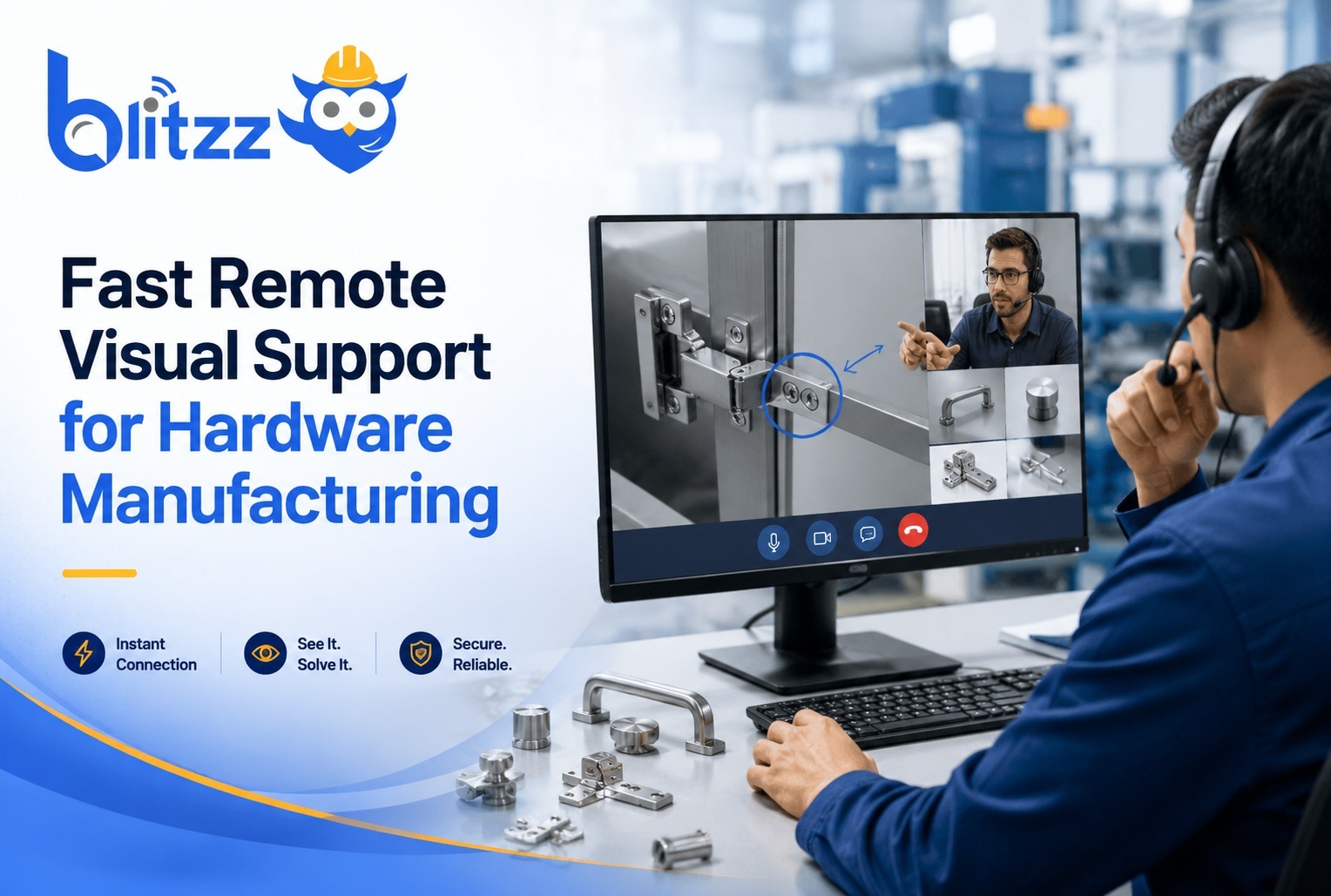
When a Phone Call Can't Show What You're Holding
Hardware manufacturing is one of the most detail-driven industries in the world. From door handles and cabinet pulls to deadbolts and hinges, hardware manufacturers produce thousands of SKUs — often with dozens of customizable variations in finish, size, and function. A single product line can span hundreds of configurations, each with its own installation requirements, compatibility specs, and troubleshooting nuances.
For companies like Emtek, a premium hardware brand known for its extensive catalog of customizable architectural hardware, that complexity doesn't stop at the factory floor. It follows the product all the way to the customer's door — sometimes literally.
Where Support Usually Breaks Down
When a homeowner installs a new door set or a contractor fits hardware mid-job, questions come up fast. Does this backset match the prep? Is this the right rosette for my door thickness? Why won't the latch align? These aren't abstract questions — they're urgent, hands-on problems that need answers in real time.
And yet, for most hardware manufacturers, the support infrastructure hasn't kept pace with catalog complexity. More than half of businesses — 53% — still handle support interactions primarily through email, with 48% relying on voice calls as their main channel. Many manufacturers continue to juggle disconnected tools — email, phone, and legacy CRM systems — that don't talk to each other, leading to agents wasting time switching between platforms and customers experiencing fragmented, inconsistent service.
The result? A support model built for simpler times, stretched thin by the demands of a highly customizable product world.
Manufacturing and heavy equipment teams that have modernised their support operations know the difference. But for many, the gap between what customers need and what traditional channels can deliver continues to widen.
Manufacturing contact center agents are constantly fielding complex technical questions and order-specific inquiries, requiring deep product knowledge just to begin troubleshooting. When a customer calls to describe a piece of hardware they're holding — using words like "the silver thing" or "the part that clicks" — agents are essentially flying blind.
The Stakes Are High for Every Caller
This isn't just an inconvenience. For homeowners midway through a renovation and contractors on a job site with a client waiting, a delayed answer means delayed work. Repeat calls pile up. Handle times stretch. And resolution times in manufacturing can stretch for hours or even days when diagnostics are delayed or cross-team coordination breaks down.
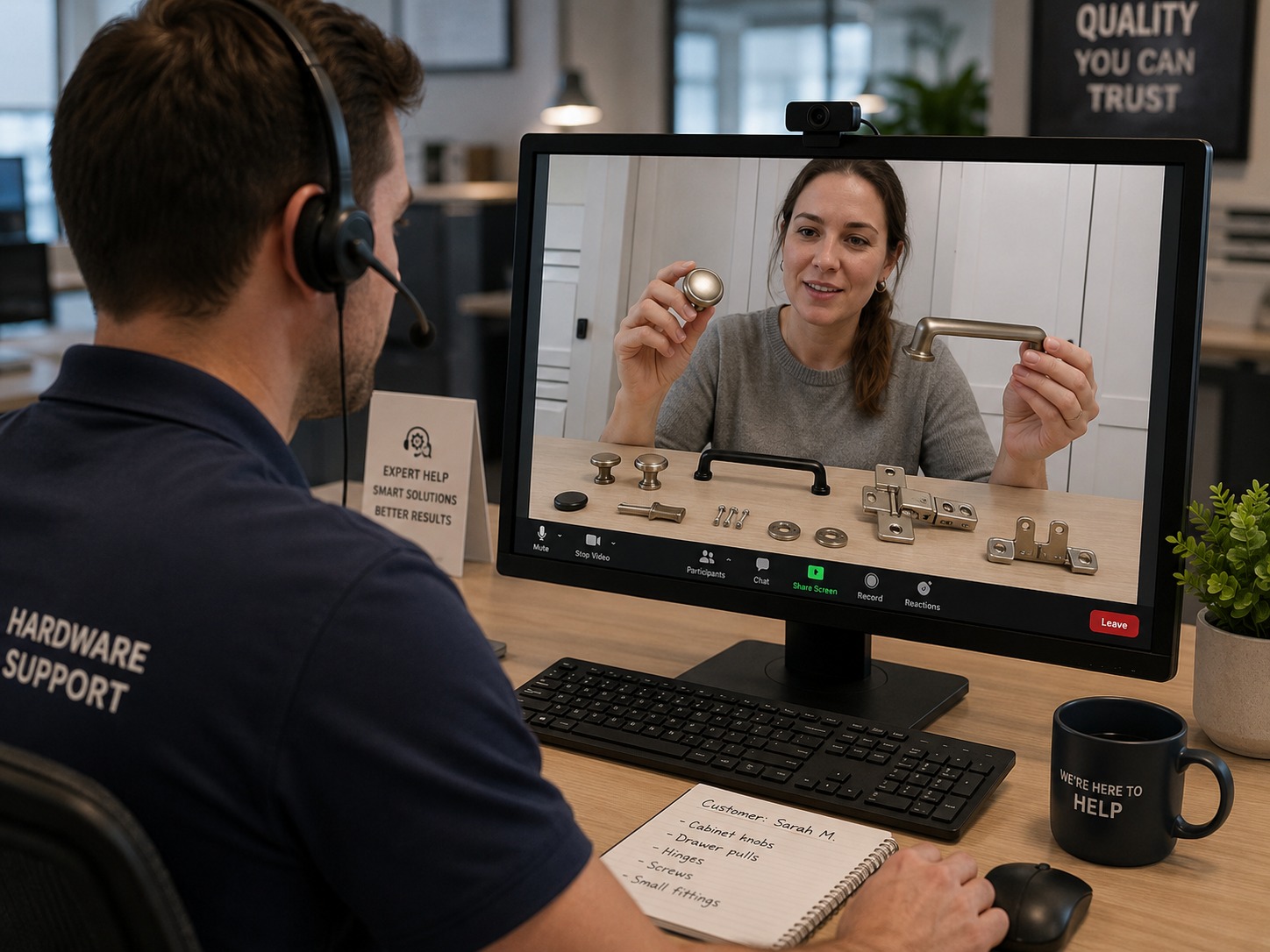
The Challenges of Traditional Customer Support for Hardware Manufacturers
For Emtek, these industry-wide pain points were playing out at scale across a vast catalog of customizable hardware.
Slow Product Identification
Without the ability to see what a customer was holding, agents had to rely entirely on verbal descriptions to identify the correct product, finish, or part. A single misidentification could send a customer down the wrong path entirely — wrong replacement part ordered, wrong installation attempted, wrong outcome delivered. With hundreds of SKUs in play, even experienced agents faced lengthy back-and-forth just to confirm what they were looking at. This is exactly the gap that remote visual assistance for retail and e-commerce and hardware-adjacent sectors has been designed to close.
Repeat Calls and Escalations
When issues couldn't be resolved on the first contact, customers called back. And called back again. Customers would email on one day, call the next, and follow up again later — each time expecting the agent to remember full context, yet most companies fell short. Every repeat contact added cost, consumed agent capacity, and eroded customer trust — particularly frustrating for contractors managing tight project timelines.
A Support Team Overwhelmed by Catalog Complexity
Only 16% of customer service agents in manufacturing feel empowered enough to do their jobs well — and it's easy to see why. Supporting a customizable hardware catalog means agents must hold an enormous amount of product knowledge in memory, navigate complex compatibility questions, and guide customers through physical installations without being able to see the product. The cognitive load is immense, and traditional phone and email support offered no tools to bridge that gap.
Something had to change.
Why Traditional Support Fell Short
The gap between what customers needed and what phone and email could actually deliver wasn't a staffing problem. It was a structural one.
Phone Limitations: You Can't See What You Can't See
Phone support has been the backbone of customer service for decades — and for good reason. It's immediate, personal, and scalable. But when the problem is physical, voice-only support hits a hard ceiling. Call centers that rely solely on verbal communication are locked into a lengthy back-and-forth process, with agents forced to diagnose issues based on a customer's description alone — a fundamentally inefficient approach when the problem is something you need to see to understand.
In hardware support, this plays out constantly. A customer trying to identify a specific rose trim or explain why a latch won't align doesn't have the vocabulary an agent needs. They know what they're holding; they just can't describe it accurately over the phone. Without visual assistance, the customer must take time to verbally describe their situation as accurately as possible, and the agent must then attempt to blindly guide them through a solution — a process that's slow, frustrating, and prone to error.
The result: longer calls, more transfers, and resolutions that don't stick. This is the core problem that Blitzz's visual remote assistance platform was built to solve.
Email Lag During Time-Sensitive Installs
Email compounds the problem further. While it works well for non-urgent inquiries, it's completely unsuited for the pace of an active installation. A contractor mid-job can't wait 24 hours for a response. A homeowner with a door off its hinges needs help now, not tomorrow morning.
Customers with a time-sensitive issue might email one day, follow up with a call the next, and reach out again days later — each time expecting continuity, but rarely getting it. Every back-and-forth exchange on email adds friction, delays resolution, and leaves customers feeling unsupported at exactly the moment their frustration is highest.
The Impact on Customer Satisfaction and Brand Trust
The downstream effects of this support gap are significant. Research shows that 39% of customers admit to leaving a provider over poor customer service, and 86% say they trust a brand more when it provides excellent support experiences. For a premium hardware brand like Emtek — where the product itself signals quality — a poor support experience is a direct contradiction of the brand promise.
Organizations that retool their customer experience with better technology have seen a 15–20% increase in customer satisfaction and a 20–40% reduction in cost to serve — but only when the technology actually addresses the core friction. For Emtek, that meant finding a solution that could put eyes on the problem in real time. See how companies across field service are making that shift today.
The Solution: Blitzz Concierge
What Blitzz Concierge Is and How It Works
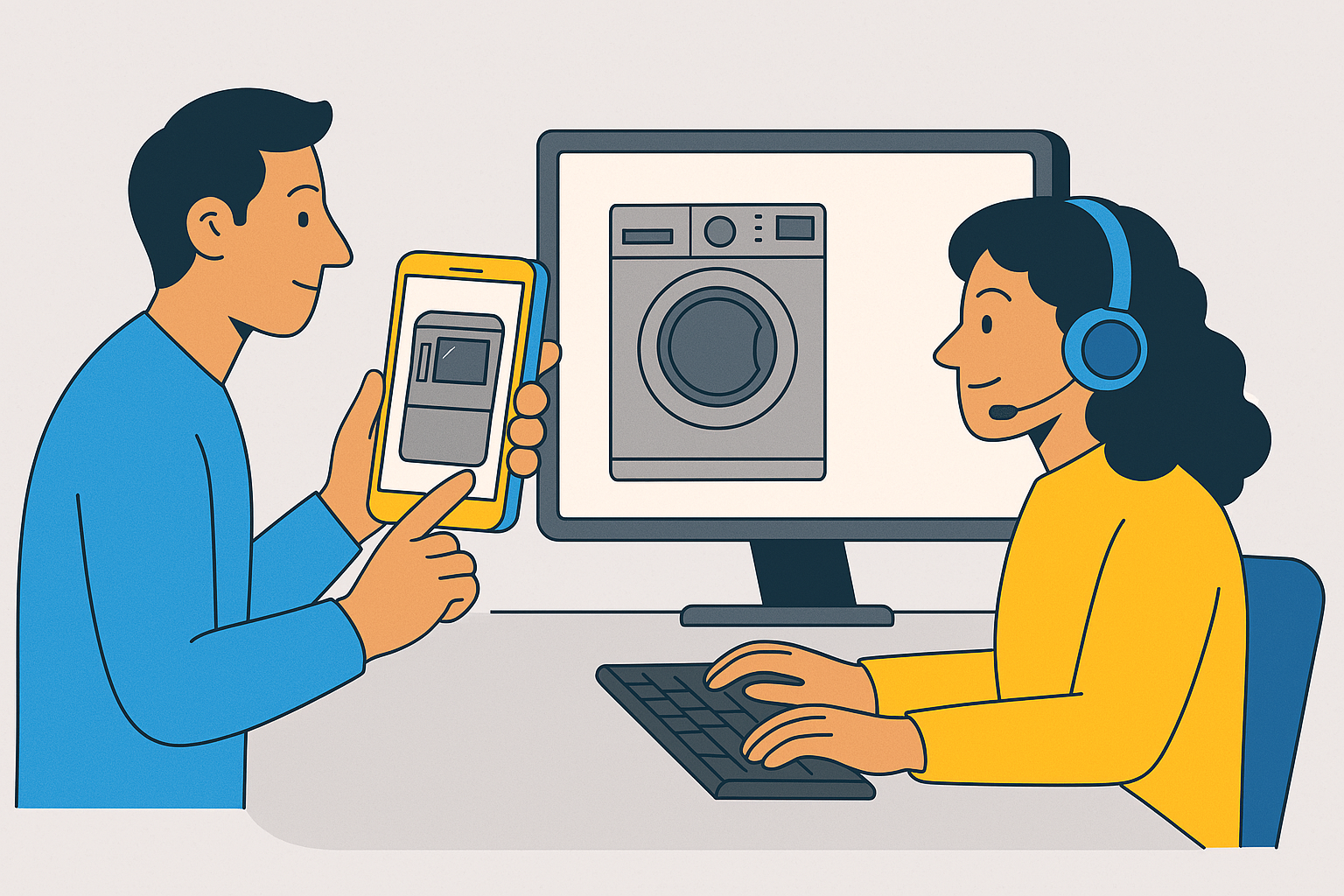
Blitzz Concierge is a visual remote assistance platform built for customer-facing support. Rather than relying on verbal description, Blitzz connects customers and support agents through live video — no app download required. A customer receives a simple SMS or email link, taps it, and their smartphone camera instantly becomes a live visual feed that the agent can see in real time.
From there, agents can annotate on screen, zoom in on product details, capture images for records, and guide customers step by step through identification or installation — all within a single seamless interaction. It's not a video call. It's a structured support session with the tools agents need to actually resolve the issue, not just talk about it. Explore the full Blitzz feature set to see what's available out of the box.
Why Visual Remote Assistance Fits Hardware Support Specifically
Hardware support is one of the highest-fit use cases for visual assistance technology. The products are physical, the problems are tactile, and the customers — homeowners and contractors alike — often lack the technical vocabulary to describe what they're looking at. Visual assistance allows the customer to simply use their smartphone camera to show the product to the agent in real time, along with any connections, error messages, part numbers, or other details the agent needs — instantly replacing the guesswork inherent in voice-only support.
Teams equipped with remote visual assistance software see a 30% reduction in the time required to provide a solution and a 35% increase in first-time fix rates — outcomes that map directly to the challenges Emtek was facing. Similar results have been documented across consumer electronics support, another high-SKU, tactile-product environment where verbal-only support consistently falls short.
How Emtek Implemented It
Emtek deployed Blitzz Concierge as a live, agent-assisted support channel, making visual sessions available to customers who called in for product identification, installation guidance, or troubleshooting. The no-download model was critical — it eliminated the friction of onboarding customers onto a new platform mid-call. Agents could initiate a visual session in seconds, see the product, confirm the finish, walk through the install, and close the ticket in a single interaction.
Blitzz also integrates directly with existing support stacks — including Salesforce, Zendesk, and Genesys — meaning session data synced automatically into Emtek's existing workflows without requiring agents to manage a separate system.
Within 90 days, the results spoke clearly.
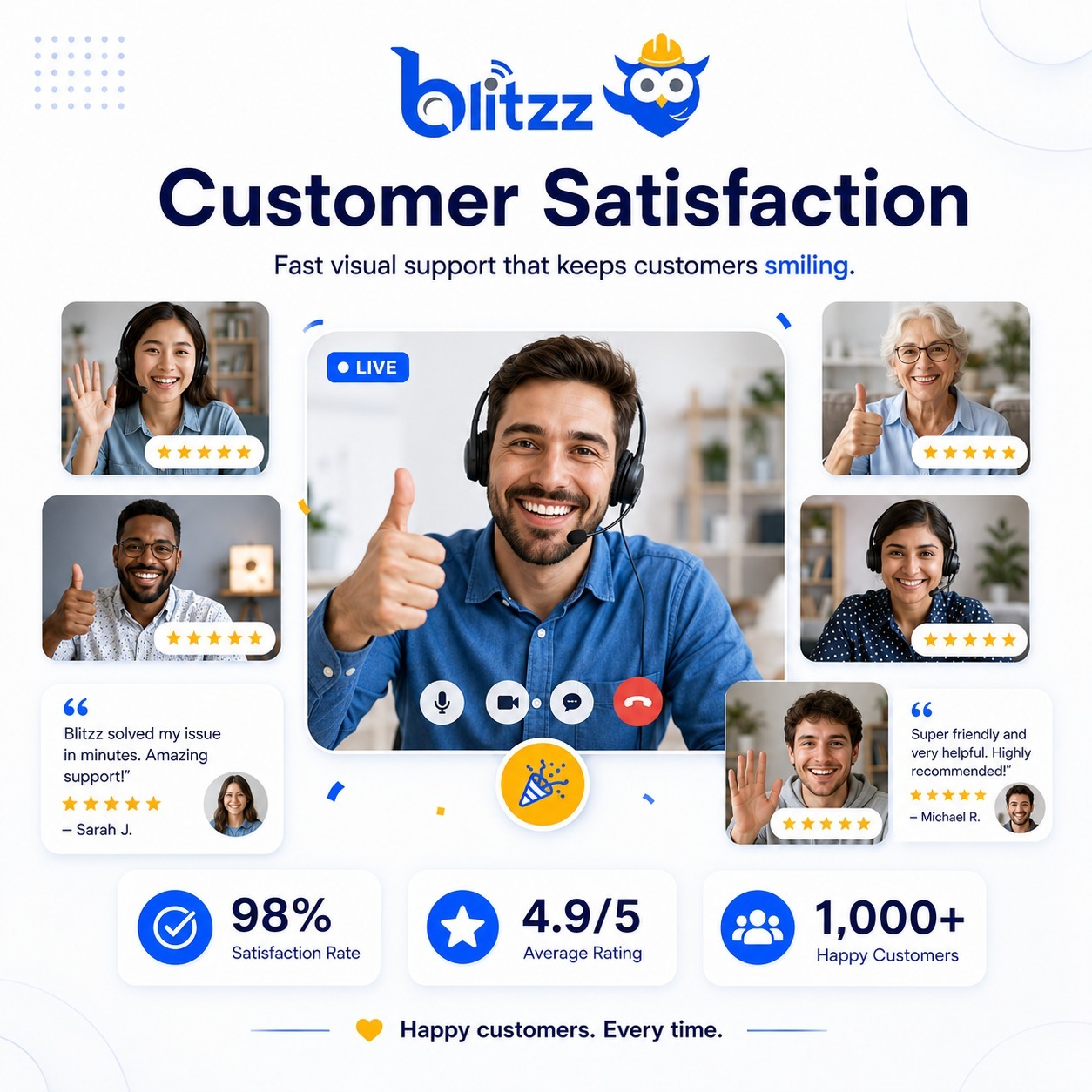
The Results
The numbers Emtek recorded after implementing Blitzz Concierge weren't marginal improvements — they were a step-change in support performance across every key metric.
1,000+ Customers Served via Live Video in 90 Days
In just three months, Emtek's support team had completed over 1,000 live video sessions with customers. That's not a pilot program or a soft rollout — it's evidence of rapid adoption on both sides, with customers embracing the channel and agents leaning into it as their primary tool for complex interactions. Read more outcomes like this in the Blitzz case studies library.
Average Handle Time Down 1 Minute 29 Seconds
Nearly 90 seconds shaved off every single interaction. At scale, this is transformative. For Emtek, this wasn't achieved by rushing customers — it was achieved by eliminating the back-and-forth that used to eat up every call. When an agent can see the product, identification takes seconds instead of minutes.
87% First-Contact Resolution
More than 8 in 10 customers had their issue resolved without needing to call back. Video-assisted support has been shown to increase first-call resolution rates by up to 20% — and Emtek's 87% FCR demonstrates what's possible when agents can actually see the product they're supporting. This mirrors results seen in telecom and internet provider deployments, where visual identification has long been a key driver of FCR improvement.
9.8/10 CSAT and 95.8 NPS
These are exceptional numbers by any standard. Being able to visually guide a customer to a solution doesn't just fix the problem — it empowers the customer, increasing their confidence in the product and the brand, which translates directly into loyalty and positive recommendations. A 95.8 NPS is a strong signal that customers weren't just satisfied — they were actively willing to refer others based on the support experience alone. See what other customers are saying on Blitzz video testimonials.
Key Takeaways: Why It Worked
Speed of Visual Identification vs. Verbal Description
The single biggest efficiency gain was eliminating the identification problem. When an agent can see exactly what a customer is holding — the finish, the configuration, the part in question — the conversation moves from diagnosis to resolution almost immediately. What previously took multiple exchanges to establish (and often got it wrong anyway) now takes seconds. This is the core value of Blitzz Concierge for product-heavy support environments.
Reduced Repeat Contacts
87% first-contact resolution means that 87% of customers didn't need to call back. That's not just better for the customer — it's a direct reduction in inbound volume, freeing the support team to handle new contacts faster and with more capacity. The compounding effect of reducing repeat calls is one of the most significant operational wins visual support delivers across remote inspection and customer support use cases alike.
Customer Confidence During Install
There's a meaningful difference between telling someone what to do and showing them. Visual customer engagement allows agents to see the problem firsthand and guide customers directly, building confidence and reducing frustration in a way that verbal support simply cannot replicate. For homeowners and contractors mid-install, that confidence is the difference between a completed job and a callback.
Conclusion: The Future of Hardware Support Is Visual
Emtek's results with Blitzz Concierge are a clear signal for any hardware manufacturer still relying on phone and email as their primary support channels. The limitations of those channels aren't a people problem — they're a visibility problem. When agents can see what customers see, everything improves: speed, accuracy, resolution rates, and the trust customers place in the brand they bought from.
The use case extends well beyond hardware. Any business supporting physical products — from appliances and tools to healthcare devices and automotive troubleshooting — faces the same fundamental challenge: customers who need help with something they can't adequately describe, and agents who need to see it to solve it.
If your support team is still guiding customers blind, it's worth asking what one visual session could change.
Ready to see what Blitzz can do for your support team? Schedule a demo and explore the full Emtek case study to learn how Blitzz Concierge is helping manufacturers close the gap between complex products and exceptional customer experiences.