
.png?width=120&height=55&name=Blitzz-Logo-right%20white%20eyes%20-%20not%20transparent%20(3).png)
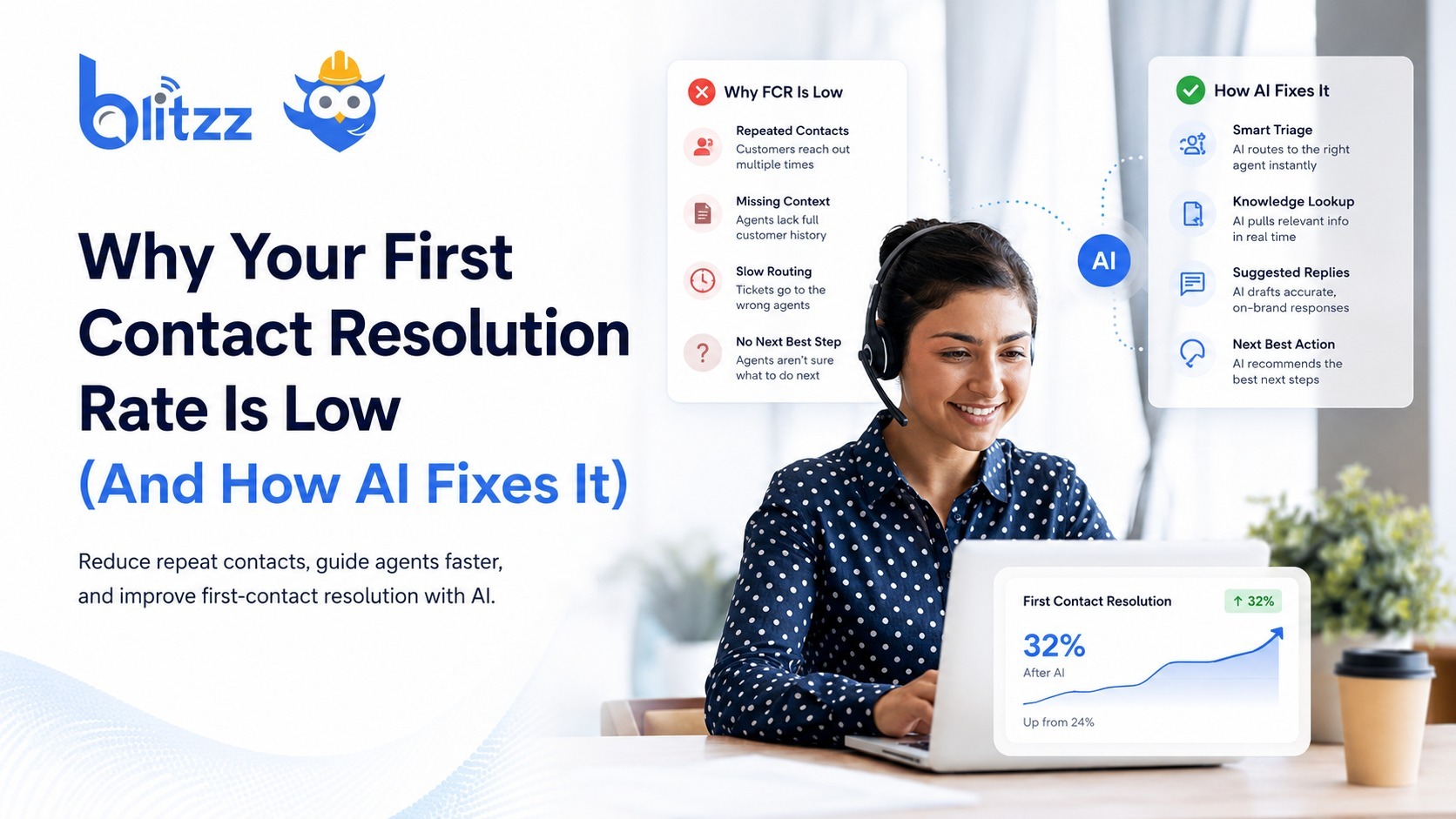
If your first contact resolution rate is stuck below 70%, the problem usually isn't your agents — it's that they can't see what the customer sees. First contact resolution (FCR) measures how often you solve a customer's issue in a single interaction, and it's one of the truest signals of both customer satisfaction and operational efficiency. The reason most teams plateau isn't effort or training. It's missing context. And the fastest way to fix it is to add what text and voice alone can't provide: visual understanding.
This guide explains what's really dragging your FCR down, why traditional fixes fall short, and how AI — paired with AR visual support — closes the gap in one interaction instead of three.
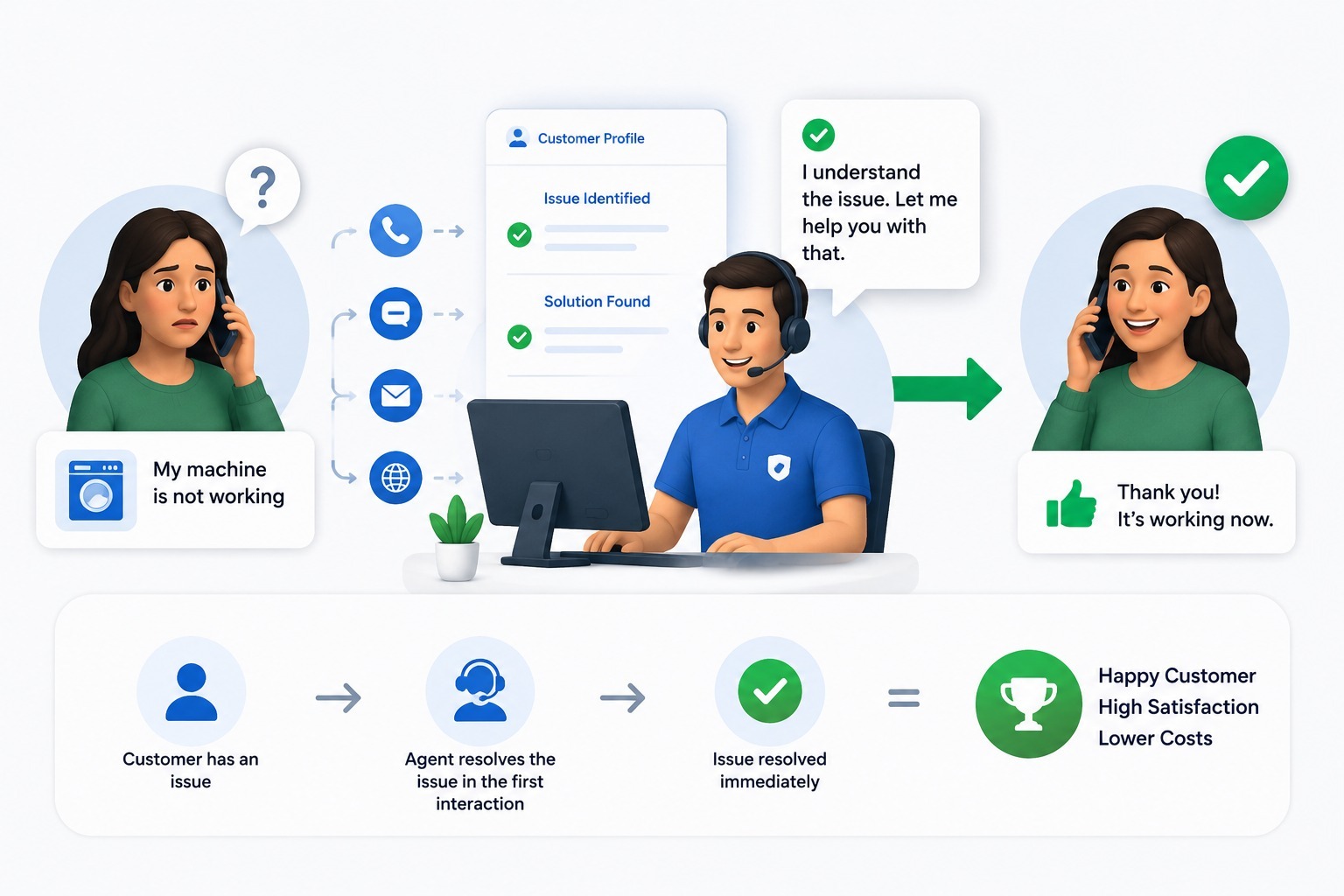
First contact resolution is the percentage of customer issues resolved in a single interaction, with no follow-ups or repeat contacts. It's one of the most important metrics in customer experience because it sits at the intersection of two things every support leader cares about: happy customers and lower costs.
The hidden cost of low FCR is steep. Every unresolved first contact becomes a repeat ticket, a frustrated customer, and added expense — and the math is precise. SQM Group's research shows that for every 1% improvement in FCR, customer satisfaction rises 1% and operating costs fall 1%. Run the reverse and a low FCR quietly compounds: more callbacks, more handle time, more churn. Around 85% of CX leaders say customers will abandon a brand that fails to resolve their issue on first contact.
Yet many businesses struggle to move the number despite the usual fixes — more training, more scripts, more staff. That's because they're treating a visibility problem as a people problem.
What is first contact resolution (FCR)?
Simple definition of FCR
FCR is resolving a customer's issue on the first interaction — one call, one chat, one session — with no need for the customer to come back about the same problem. If a customer contacts you once and walks away with a working solution, that's a first contact resolution. If they have to follow up, it isn't.
Why FCR matters
FCR punches above its weight as a metric because it moves so many others at once:
- Customer satisfaction (CSAT) — the single strongest driver of how customers rate you; every 1% FCR gain lifts CSAT roughly 1%.
- Lower operational costs — fewer repeat contacts means less agent time per issue.
- Reduced ticket volume — solved-once issues don't boomerang back into the queue.
- Higher agent productivity — agents move on instead of reworking old tickets.
- Better brand loyalty — customers stay with brands that resolve quickly.
For context, SQM Group — the recognized benchmark authority — puts a "good" FCR at 70–79%, with 80% and above considered world-class (a level only about 5% of contact centers reach). If you're below 70%, you're in the bottom half of the market.
Why your FCR rate is low
1. Poor issue diagnosis on first contact
You can't solve what you can't see. Agents routinely lack full visibility into the problem, and customers struggle to describe technical issues accurately. The result is a diagnosis built on guesswork — and a guess that's wrong means a second contact.
2. Over-reliance on text-based support
Text and chat strip away the single richest source of information: what the issue actually looks like. Miscommunication thrives when a customer types "it's not working" and an agent has to interpret it. Missing visual context is one of the most common reasons issues survive the first interaction.
3. Knowledge gaps in support teams
Agents don't always have the right troubleshooting steps at hand, and internal documentation is often inconsistent or outdated. When the answer isn't accessible in the moment, resolution slips to a follow-up.
4. Escalation dependency
Too many issues get punted to senior teams or specialists. Each escalation adds a handoff, a delay, and another touchpoint — the opposite of first contact resolution.
5. Fragmented support channels
When email, chat, and phone don't talk to each other, context evaporates between interactions. The customer re-explains everything each time, and the clock on resolution resets.
The real root problem: lack of context
Strip away the symptoms and one cause sits underneath nearly all of them: missing information, not lack of effort. Notably, industry analysis attributes roughly half of FCR failures to inadequate processes and procedures rather than agent mistakes — the agent simply doesn't have what they need to resolve the issue.
Text alone is no longer enough to diagnose many modern customer problems. A blinking light, a misconnected cable, a cryptic error screen, a damaged product — these are visual problems, and describing them in words introduces noise at exactly the moment precision matters most. Visual context is the missing link in resolution speed.
Why traditional solutions aren't enough
More training isn't solving it
Even your best, most experienced agents struggle without visibility. Training sharpens judgment, but it can't show an agent a problem happening 500 miles away. You can't train your way out of a perception gap.
More scripts don't fix complex issues
Static workflows assume the problem fits a predictable branch. Real-world issues rarely do. A script handles the common case and breaks on the exception — and exceptions are precisely what drive repeat contacts.
Longer conversations reduce FCR further
The instinct to ask more clarifying questions often backfires. More back-and-forth means more chances for misunderstanding, more customer frustration, and more handle time — without getting closer to an accurate diagnosis.
How AI improves first contact resolution
AI-powered triage and routing
AI identifies the issue type the moment a customer makes contact and routes the case to the right agent or workflow instantly — no misrouting, no bouncing between departments. Getting the issue to the right place the first time is half the FCR battle.
Smarter knowledge assistance
AI surfaces relevant solutions in real time, reducing agents' dependence on memory or manual searching. Given that roughly 45% of support calls involve an agent stopping mid-conversation to look something up, eliminating that pause directly protects first contact resolution. AI-powered agent-assist tools have been shown to improve resolution accuracy by up to 25%.
Faster diagnosis through context understanding
AI analyzes patterns in customer input — past tickets, product data, behavioral signals — to detect likely causes before an agent even engages. It narrows the field fast. But there's a ceiling to what AI can infer from text, and that ceiling is exactly where visual support takes over.
The game changer: AR visual support
Why visual context changes everything
Seeing the problem removes ambiguity. The instant an agent can view the actual issue, the guesswork disappears and the endless clarifying questions stop. AR visual support replaces "describe what you're seeing" with "show me" — and that single shift is the most powerful lever on FCR there is.
What AR visual support enables
- Live visual troubleshooting — the agent sees the problem in real time through the customer's camera.
- Remote assistance using augmented reality overlays — agents annotate the live feed, pointing to the exact button, port, or component.
- Real-time guidance for customers — step-by-step direction tied to what's actually on screen, not a generic manual.
How it directly improves FCR
AR visual support attacks the root cause head-on. It eliminates guesswork, lets agents "see what the customer sees," and enables instant, accurate diagnosis. When the diagnosis is right the first time, the resolution lands the first time — which is the entire definition of FCR. You can see how this compares to legacy methods in visual customer support vs. traditional call centers.
Blitzz Concierge: turning AI + AR into higher FCR
What Blitzz Concierge does
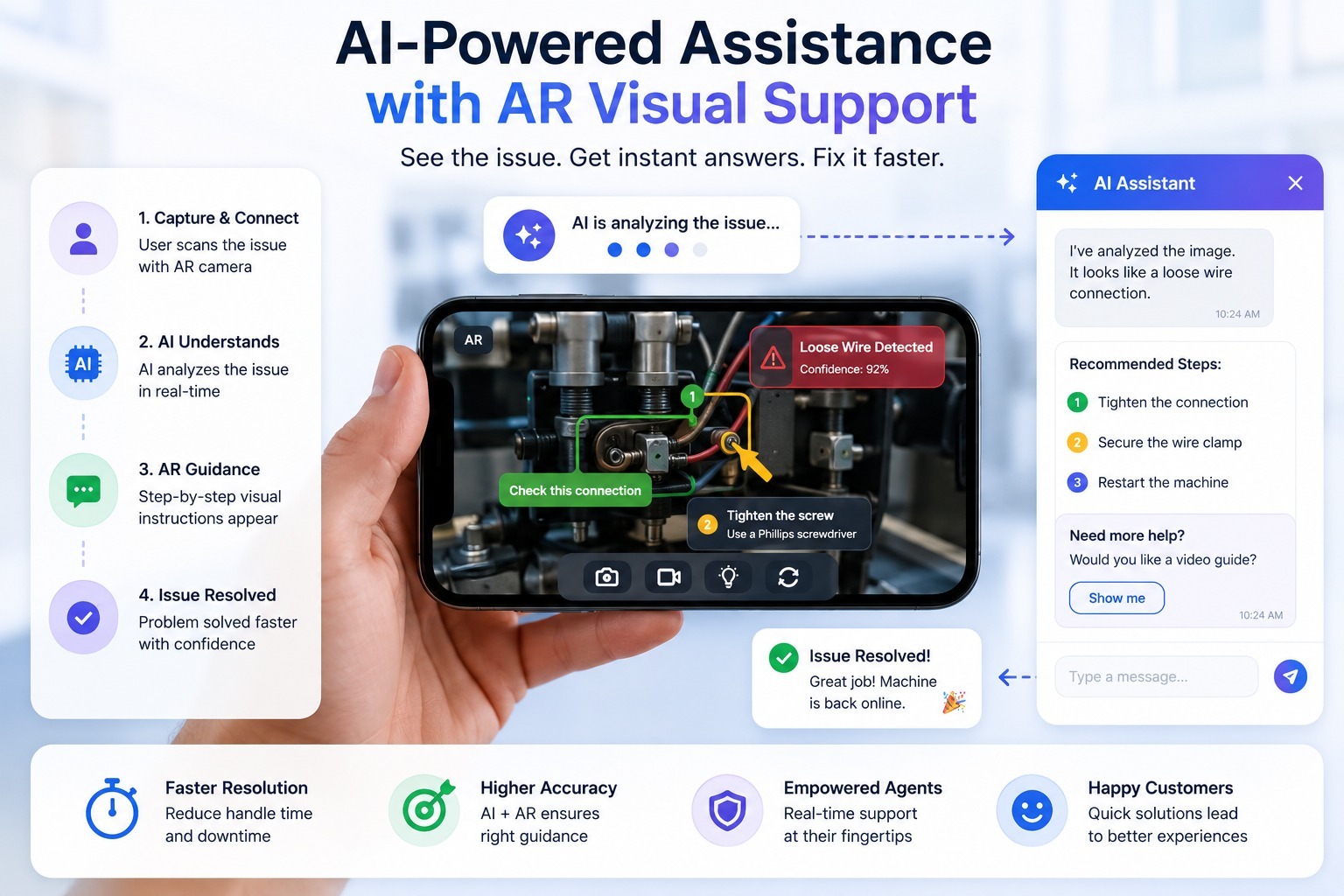
Blitzz Concierge combines AI-powered assistance with AR visual support so agents can guide customers visually, in real time. The agent sends a secure link by SMS, email, or WhatsApp; the customer taps it and connects instantly through their phone browser — no app download. The agent then sees through the customer's camera, annotates the live feed, and the session is automatically captured and summarized by AI.
How it improves first contact resolution
By collapsing diagnosis and resolution into one visual session, Blitzz Concierge drives FCR through:
- Faster problem identification — the issue is seen, not described.
- Fewer escalations — agents resolve on the spot instead of passing cases up.
- Immediate visual confirmation — the agent verifies the fix worked before ending the session.
- Reduced follow-up interactions — fewer callbacks because the issue was truly resolved.
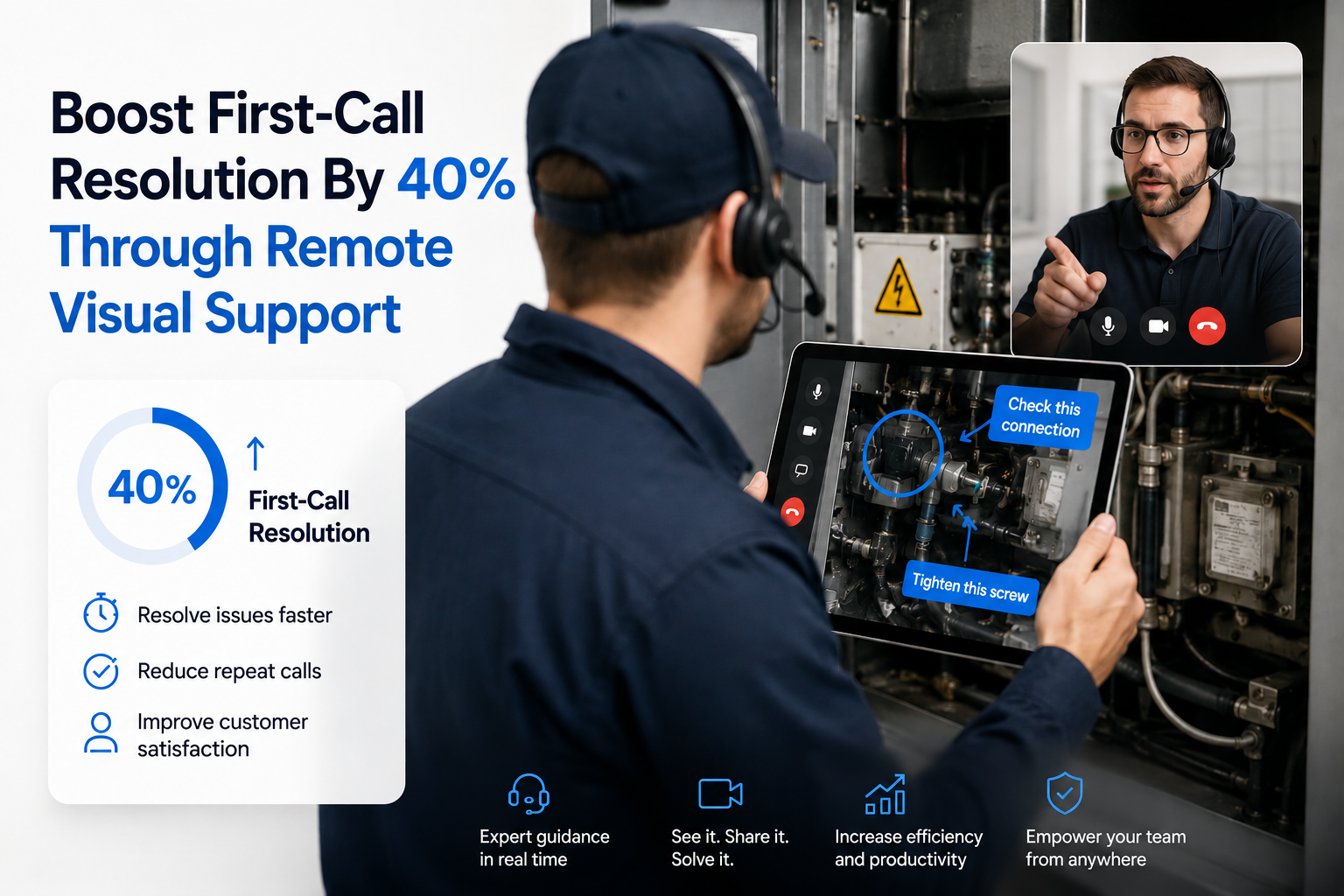
The results are concrete: Blitzz customers in telecom have improved first call resolution by around 40% and cut truck rolls by up to 30% — not by hiring better agents, but by giving existing agents eyes on the problem. More detail is in how Blitzz uses AI to transform remote support.
Real-world use cases
- Field service troubleshooting — diagnose equipment issues before dispatching a technician, often resolving remotely.
- Product installation support — guide customers through setup visually.
- Equipment diagnostics — assess machinery via remote video inspection.
- Retail product issues — confirm damage or defects from a live view.
- Technical support for complex devices — walk users through multi-step fixes with AR overlays.
Before vs. after using AI + AR support
| Before | After (with Blitzz Concierge) | |
|---|---|---|
| Diagnosis | Customer explains the issue verbally | Customer shares live visual context |
| Agent role | Guesses at the problem | AI assists diagnosis instantly |
| Resolution | Multiple follow-ups required | Agent guides resolution in real time |
| Outcome | Low FCR, repeat tickets | Higher FCR in a single interaction |
The contrast is the whole story: before, the agent works blind and the customer calls back; after, the agent sees the problem and solves it once.
Key benefits of improving FCR with AI
- Lower support costs — every 1% FCR gain cuts operating costs roughly 1%, and resolving remotely eliminates expensive truck rolls.
- Faster resolution times — visual context collapses diagnosis from minutes of questioning to seconds of seeing.
- Improved customer satisfaction — fast, one-and-done resolution is the number one thing customers want from support.
- Reduced ticket volume — issues solved once don't return as repeat contacts.
- More efficient support teams — agents spend time resolving new issues, not reworking old ones.
How to improve your FCR rate today
- Identify high-volume repeat issues — find the problem types generating the most callbacks; those are your biggest FCR opportunities.
- Add visual support capabilities — give agents a way to see the problem, not just hear about it. This is the highest-leverage change for most teams.
- Integrate AI into support workflows — automate triage, routing, and real-time knowledge assistance.
- Train teams for AR-assisted support — teach agents to lead visual sessions confidently.
- Measure and optimize continuously — track FCR alongside CSAT, handle time, and truck-roll rate, and tune over time.
Want to see it on your own use case? Book a Blitzz Concierge demo.
Frequently asked questions
What is a good FCR rate in customer support?
According to SQM Group, the industry authority on the metric, a good first contact resolution rate falls between 70% and 79%. An FCR of 80% or higher is considered world-class — a level only about 5% of contact centers reach. Anything below 70% signals room for improvement.
How does AI improve first contact resolution?
AI improves FCR by automatically triaging and routing issues to the right place, surfacing solutions to agents in real time, and detecting likely causes from customer data — reducing the guesswork and lookups that drive repeat contacts. Agent-assist tools can improve resolution accuracy by up to 25%.
What is AR visual support in customer service?
AR visual support lets an agent see a customer's problem through their device camera and annotate the live video with augmented-reality overlays — pointing to exact components and guiding the customer step by step. It replaces verbal description with direct visual understanding.
Can visual AI reduce support escalations?
Yes. By letting frontline agents see and diagnose issues accurately on first contact, visual AI reduces the need to escalate to senior specialists. Blitzz customers have cut truck rolls by up to 30% and improved first call resolution by around 40%.
How does Blitzz Concierge work?
An agent sends a secure link by SMS, email, or WhatsApp. The customer taps it and connects instantly through their phone browser — no app needed. The agent then sees through the customer's camera, annotates the live feed to guide them, and AI automatically captures and summarizes the session into the CRM.
Conclusion
Low FCR is almost always a visibility problem, not a people problem. Your agents aren't failing — they're working blind, diagnosing physical and visual problems from words alone. No amount of training or scripting fixes a missing sense.
AI improves the decision-making around resolution — smarter routing, faster knowledge, better diagnosis. But AR visual support removes the uncertainty entirely by letting agents see exactly what the customer sees. Combining the two with a platform like Blitzz Concierge transforms support efficiency: faster diagnosis, fewer escalations, and more issues closed in a single interaction.
The future of customer support isn't just faster — it's visually intelligent and resolution-focused. Fix the visibility gap, and your FCR follows.
See how Blitzz Concierge lifts first contact resolution →