
.png?width=120&height=55&name=Blitzz-Logo-right%20white%20eyes%20-%20not%20transparent%20(3).png)

On this page
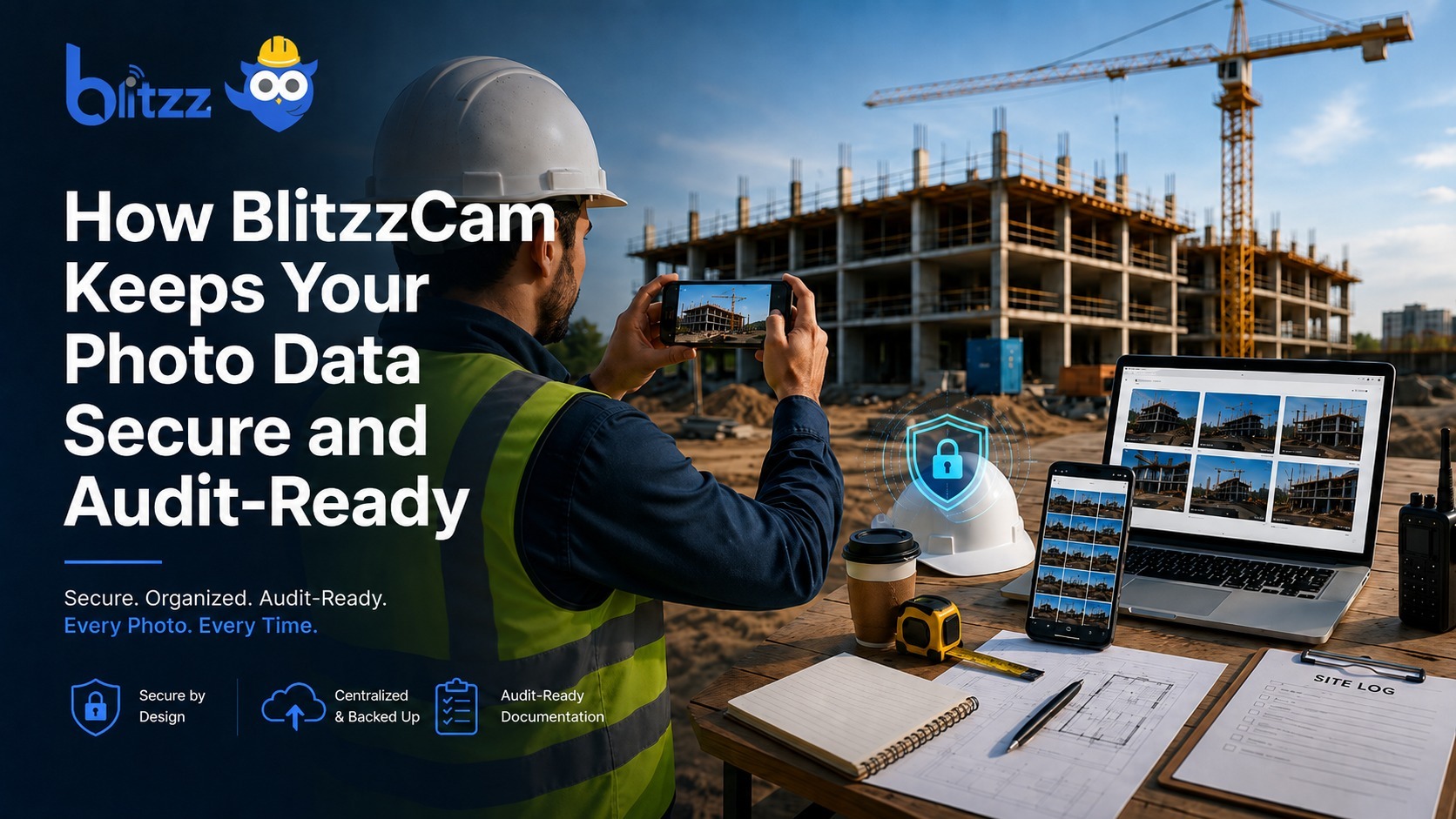
A job site photo is only useful as proof if it can survive scrutiny — if it can be produced when someone asks for it, trusted when someone questions it, and controlled so the wrong people never see it. That's a different bar than simply "having photos somewhere." Here's how BlitzzCam approaches security, storage, and access control, and what that means for a business that eventually has to produce its records under pressure.
The Core Problem: Ownership, Not Just Storage
Most conversations about photo security start with encryption and backups, and those matter. But the more fundamental issue for a field business is ownership: who actually controls the record, and does it survive changes on your team?
When job site photos live on individual crew members' personal phones — even backed up to their personal cloud accounts — the business doesn't actually own that record. It's borrowed. If that person leaves, gets a new phone, or simply deletes old photos to free up storage, the visual history of jobs they worked on can disappear along with them. That's not a hypothetical edge case; it's one of the most common ways businesses discover, usually at the worst possible moment, that they don't actually have the documentation they thought they did.
BlitzzCam's starting position is that every photo captured through the app becomes a company-owned record from the moment it's taken. It isn't tied to the device that captured it or the person who happened to be holding that device. That distinction — company-owned versus device-owned — is the foundation everything else about security and compliance is built on top of.
Where the Data Lives
Photos captured through BlitzzCam are stored in secure cloud storage rather than remaining on individual devices as the primary copy. Capture happens on the phone, but the authoritative record lives in the cloud, synced automatically the moment the device has a connection. This matters for two reasons.
First, it means the record isn't vulnerable to a single point of failure — a lost phone, a broken device, a deleted app — the way it would be if photos only existed locally. Second, it means the record is centrally accessible to the people who need it, rather than scattered across however many devices your field team happens to be carrying.
Storage is also unlimited, with no per-image fees or storage caps. That's worth mentioning in a security context specifically, because cost-driven data management (deleting old photos to save on storage, or under-documenting a job because storage is expensive) is itself a security and audit risk. A policy that discourages full documentation because of cost pressure works against the whole point of having a documentation system in the first place.
Controlled, Permissioned Access
Security isn't only about protecting data from external threats — it's also about making sure the right people internally see the right things, and no more than that. BlitzzCam's access model is built around controlled, permissioned access rather than an all-or-nothing structure where everyone with a login can see everything.
In practice, this means a business can be deliberate about who has visibility into what. A field tech doesn't need visibility into every project the company has ever run — just the ones relevant to their current work. An office administrator might need broad visibility across active jobs but not necessarily access to archived historical projects. A client, as covered separately in BlitzzCam's portal feature, gets a permissioned view scoped to exactly the records shared with them, and nothing more.
This layered approach to access matters when it comes time to answer a question about who could have seen or modified a given record — a question that comes up directly in audits, in disputes over whether documentation was altered, and in general data governance conversations that larger clients or partners increasingly ask about before signing a contract.
Verification: What Makes a Photo Defensible
Storage and access control protect the record once it exists. Verification is what makes the record itself trustworthy in the first place. Every photo captured through BlitzzCam is automatically stamped with GPS location and a timestamp at the moment it's taken — not added manually afterward, which would be far easier to dispute or falsify.
This distinction matters more than it might initially seem. A photo with no verified metadata is, legally and practically, just a picture — it shows something, but it doesn't prove when or where that something happened. In a dispute, an audit, or an insurance claim, the question is rarely "did this work happen at all," it's "can you prove exactly when and where it happened." Automatic, non-manual verification is what turns a photo from a helpful visual into something that actually holds up when that specific question gets asked.
What This Looks Like When an Audit or Claim Actually Happens
The real test of any documentation system isn't how it performs day-to-day — it's how it performs under pressure, when a client, an insurer, or a regulator asks for a complete and credible record on short notice.
Consider a scenario where a building owner requests a full visual history of a project for an insurance audit, with a tight turnaround. Without a centralized, verified system, this typically means someone spending days tracking down photos scattered across multiple people's phones, checking whether timestamps are trustworthy, and manually assembling something presentable — often discovering gaps only after it's too late to fill them.
With a verified, company-owned, centrally stored record, that same request becomes a matter of generating a report or sharing a permissioned portal link to what already exists. The record was never scattered in the first place, so there's nothing to reconstruct under deadline pressure. This is the practical difference between a documentation system built for compliance and one that merely happens to produce some photos as a byproduct of normal work.
Data Retention and the Long Game
Compliance and audit-readiness aren't just about handling today's requests — they're about whether a record from six months or two years ago is still there, still complete, and still trustworthy when someone eventually asks about it. Because BlitzzCam's records are company-owned and centrally stored rather than dependent on any individual's device or continued employment, project history is retained as a matter of course rather than something that has to be actively rescued before it disappears.
For businesses in industries with specific record-retention expectations — construction disputes that can surface years after a project closes, insurance claims with long look-back periods, warranty work with multi-year coverage windows — this kind of durability matters more than it might seem during the rush of an active job. The value of a well-documented record often isn't apparent until well after the work is finished, which is exactly why it needs to be built to last from the start rather than assembled reactively when a question finally comes up.
What to Ask Before You Rely on Any Documentation System
Regardless of which tool a business ultimately uses, it's worth asking a few pointed questions about how that system handles security and compliance in practice: Who actually owns the record if an employee leaves? Is verification (GPS, timestamp) automatic, or something that could be edited after the fact? Can access be scoped to specific people and specific records, or is it all-or-nothing? And critically — if an audit or dispute landed tomorrow, how long would it take to produce a complete, credible record?
Those questions are a reasonable way to evaluate any documentation approach, and they're the same questions BlitzzCam's security and storage model is built to answer clearly.
FAQs
Who owns the photos captured through BlitzzCam?
The company does. Every photo becomes a company-owned record the moment it's captured, independent of the device or employee who took it, so the record doesn't disappear if someone leaves the business.
Can photo metadata like GPS and timestamps be edited after the fact?
Verification happens automatically at the moment of capture, which is what makes it meaningful as proof — a record that could easily be edited after the fact wouldn't hold up to the same scrutiny.
How is access controlled across a team?
Access is permissioned and controlled, meaning visibility into specific projects and records can be scoped to the people who actually need it, rather than giving every user full visibility into everything.
How long is photo data retained?
Because storage is unlimited with no per-image fees, and records are company-owned rather than device-dependent, project history is retained as a matter of course rather than something a business has to actively manage or ration.
BlitzzCam is in early access now. Cohort 1 has 100 spots — 47 are already claimed. Join the waitlist below and we'll reach out when your spot opens. Early members lock in launch pricing and help shape the roadmap. Contact us.

Blitzz Team
The Blitzz Team writes about remote video support, virtual inspections and field service. Our guides come from working with home builders, property managers, warranty teams, contact centers and field service organizations that use Blitzz to see and solve issues without a truck roll.
.jpg)