
.png?width=120&height=55&name=Blitzz-Logo-right%20white%20eyes%20-%20not%20transparent%20(3).png)

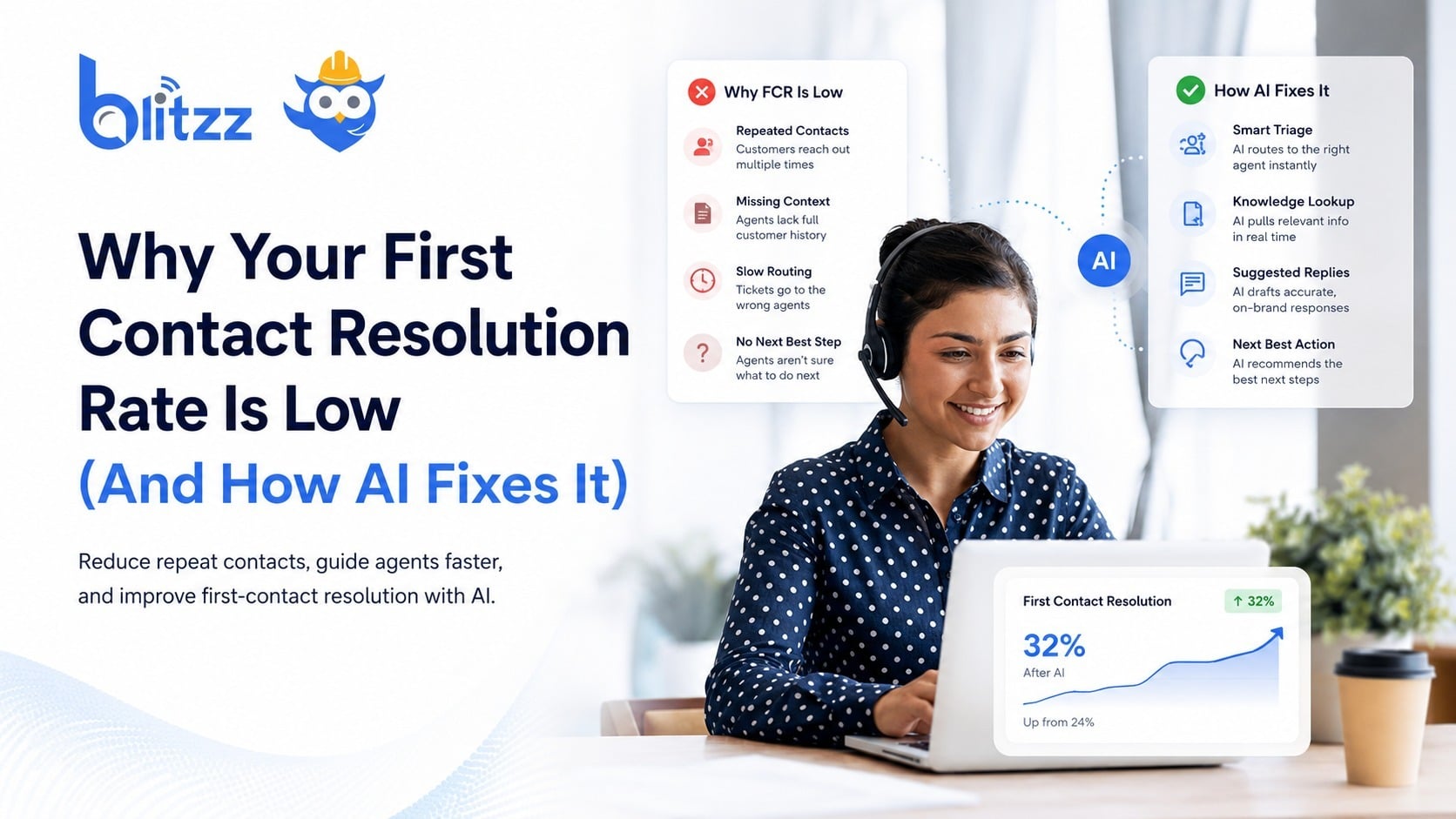
In customer support, few metrics carry as much weight as first-call resolution. It is the single clearest signal that your team is doing its job well — that when a customer reaches out with a problem, your agents have the tools, knowledge, and authority to solve it on the spot, without requiring the customer to call back, wait for a follow-up, or repeat themselves to a different agent.
When first-call resolution is high, customers are happier, agents are more confident, and operational costs go down. When it is low, the ripple effects touch everything — from customer churn and negative reviews to agent burnout and ballooning support costs.
The good news is that first-call resolution is not fixed. It is a metric that responds directly to the decisions you make about your people, your processes, and your technology. With the right approach, almost any support team can move the needle significantly. This guide walks you through the most effective, practical strategies to make that happen — including how platforms like Blitzz are helping leading support teams achieve resolution rates they never thought possible.
Understanding First-Call Resolution and Why It Matters
First-call resolution, often abbreviated as FCR, measures the percentage of customer issues that are fully resolved during the first interaction — without the customer needing to call back or be transferred to another agent or department.
It sounds simple, but it is one of the most consequential indicators of support quality. Research consistently shows that customers who have their issue resolved on the first contact are significantly more likely to remain loyal, recommend the company to others, and rate their experience positively. On the flip side, every repeat contact is a sign that something went wrong — and customers notice.
From a business standpoint, low FCR is expensive. Every callback, every escalation, every repeat ticket consumes agent time that could have been spent helping someone else. When you improve FCR, you are not just making customers happier — you are making your entire support operation more efficient.
The average FCR rate across industries hovers somewhere between 70 and 75 percent, which means that roughly one in four customer issues is not resolved on the first attempt. There is enormous room for improvement in most organizations, and the strategies below are where to start.
Equip Agents with a Comprehensive, Accessible Knowledge Base
One of the most common reasons agents fail to resolve issues on the first call is simply that they do not have fast access to the right information. They put the customer on hold while they search through outdated documentation, ask a colleague, or escalate unnecessarily — all of which eat time and frustrate the customer.
A well-built, regularly maintained knowledge base changes this entirely. When agents can instantly pull up troubleshooting guides, product specifications, policy documents, step-by-step resolution flows, and answers to common questions, they can handle a far wider range of issues without needing to transfer or escalate.
The key word here is accessible. A knowledge base buried in a slow internal system that requires five clicks to find anything is not much better than no knowledge base at all. Your documentation needs to be searchable, clearly organized, and integrated directly into the tools your agents use every day. When the answer is one search away during a live call, resolution rates go up almost automatically.
Just as important is keeping your knowledge base current. Outdated guides that lead agents to recommend steps that no longer apply are actively harmful. Build a regular review cycle into your operations to ensure that what agents are reading reflects what is actually true today.
See the Problem Clearly with Blitzz Remote Visual Support
A massive driver of unresolved first calls is the communication gap between what the customer is experiencing and what the agent can understand from a verbal description alone. A customer trying to describe a technical issue, a malfunctioning piece of equipment, or a confusing error message is working at a serious disadvantage — and so is the agent trying to help them.
This is exactly the problem that Blitzz remote visual support was built to solve.
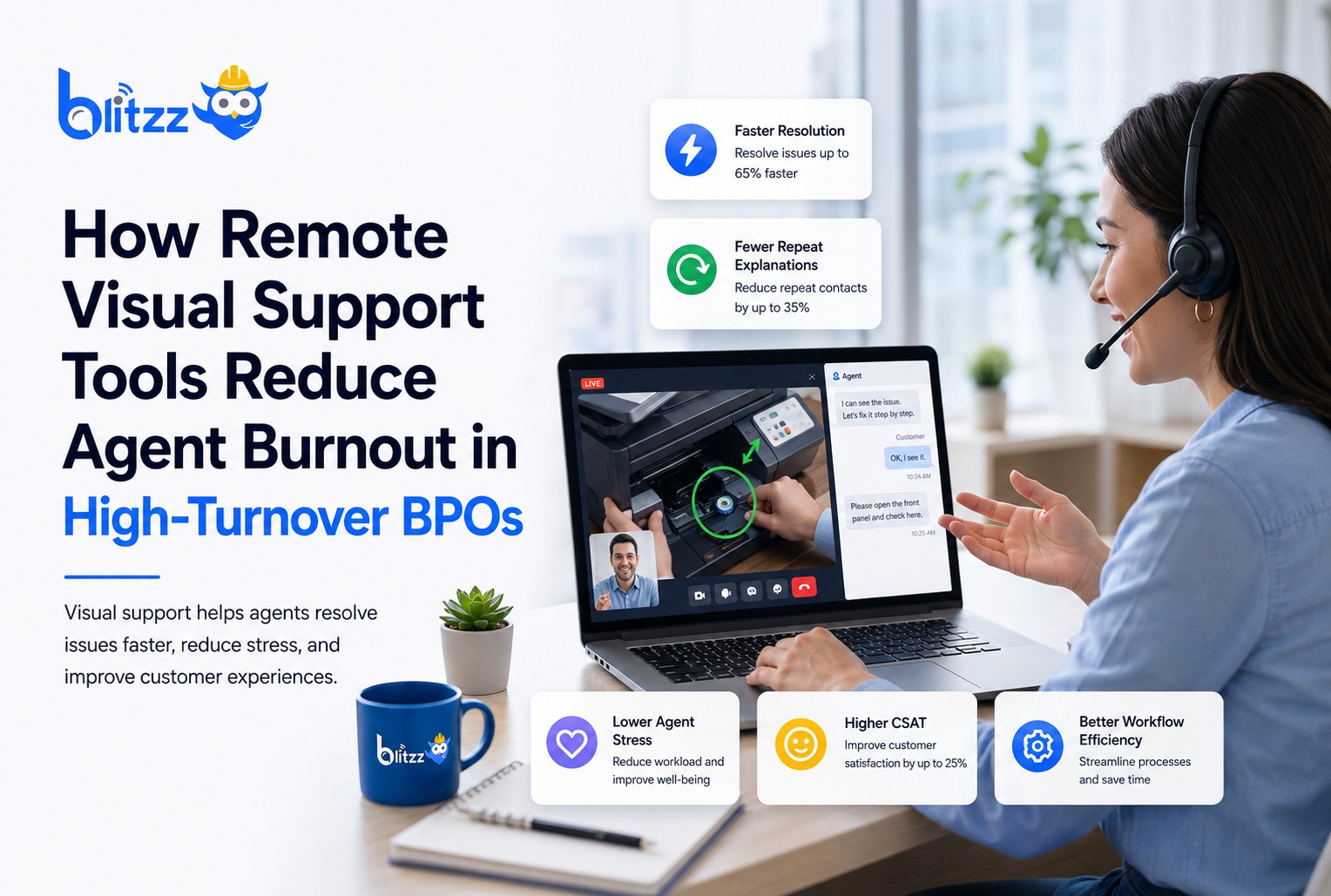
Blitzz is an AI-powered remote visual support platform that lets agents connect to a customer's live camera feed in real time — no app download required. The customer simply receives a secure link via SMS, email, or WhatsApp, taps it, and within seconds the agent is seeing exactly what the customer sees. From there, the agent can annotate the screen with arrows and highlights, zoom in on specific details, capture photos for documentation, and walk the customer through a step-by-step resolution — all from a single browser-based session.
The impact on first-call resolution is immediate and measurable. When an agent can see that a cable is plugged into the wrong port, that a device is showing a specific error code, or that an installation is missing a critical component, diagnosis becomes instant and accurate. The guesswork is eliminated. The frustrating back-and-forth of verbal descriptions disappears. And in the vast majority of cases, the issue gets resolved on the spot — during the first interaction.
Blitzz customers report resolving issues up to three times faster than with traditional support methods, and the platform consistently achieves a 95% customer connection rate. For industries like telecom, consumer electronics, automotive, healthcare devices, insurance, and field service — anywhere customers deal with physical products or environments — Blitzz remote visual support is one of the single most powerful tools available for driving FCR improvement.
Think about how much time your agents currently spend trying to interpret a customer's description of a blinking light, a broken component, or an unfamiliar error screen. Now imagine replacing all of that with a live video feed and real-time annotations. That is what Blitzz brings to your support operation.
Invest in Thorough, Ongoing Agent Training
Even the best tools and processes are only as effective as the people using them. Agent competence is foundational to first-call resolution, and building that competence requires more than a one-time onboarding program.
Ongoing training is what separates high-performing support teams from average ones. This means regular product knowledge updates as your offerings evolve, structured coaching sessions where agents review real calls and identify what went well and what could have gone better, scenario-based training that prepares agents for edge cases and unusual situations, and clear guidance on when and how to use escalation paths appropriately.
Soft skills matter just as much as technical knowledge. An agent who can quickly build rapport, ask the right clarifying questions, manage a frustrated customer's emotions, and maintain clarity throughout a complex explanation is going to resolve more issues on the first call than one who knows the product inside out but struggles to communicate effectively.
Role-playing exercises, peer shadowing, and regular one-on-one coaching with team leaders are all practical ways to build these skills. The investment pays off directly in FCR improvement and, as a byproduct, in lower agent turnover — because agents who feel competent and supported tend to stay.
Reduce Unnecessary Transfers and Escalations
Every time a customer is transferred to a different agent or department, the probability of first-call resolution drops. The customer has to re-explain their issue. Time is lost. Frustration builds. And the chain of accountability becomes blurry.
Minimizing unnecessary transfers starts with smarter call routing. When customers reach the right agent — someone with the right skills and access to the right information — from the very beginning, transfers become the exception rather than the rule. This means investing in intelligent routing systems that match customer issues to agent expertise, rather than simply sending calls to whoever is available.
It also means giving frontline agents the authority and the tools to handle a broader range of issues without needing to escalate. Many support organizations inadvertently create escalation dependency by restricting what frontline agents can do — limiting their access to certain systems, requiring manager approval for common resolutions, or training them to escalate as a default response to anything outside a narrow script. Reviewing these policies and expanding agent authority where appropriate almost always results in FCR improvement.
This is another area where Blitzz remote visual support delivers significant value. When agents can literally see the customer's issue through their camera, they no longer need to escalate simply because they cannot diagnose the problem from a description. A frontline agent armed with Blitzz has the visual context to resolve issues that would previously have required a field technician visit or a transfer to a specialist team. Blitzz customers have reported up to a 60% reduction in truck rolls — a direct result of agents being able to see, diagnose, and resolve issues remotely that would otherwise have required an in-person visit.
When a transfer is genuinely necessary, a warm handoff makes a significant difference. This means the transferring agent briefs the receiving agent on the situation before the customer is connected, so the customer does not have to start from scratch. This small practice alone can prevent a transferred call from becoming a failed first-call resolution.
Listen to What Your Repeat Callers Are Telling You
Your repeat callers are one of the most valuable sources of insight into why your FCR is where it is. Every customer who calls back about the same issue is telling you that something in your resolution process broke down — and if you pay attention, they will tell you exactly what it was.
Analyzing repeat call data should be a regular part of your operations review. Look for patterns: are certain product types driving disproportionate callbacks? Are specific agents or teams showing higher repeat contact rates? Are there particular times of day or customer segments where FCR tends to drop? Are there issues that agents consistently fail to resolve fully on the first attempt?
The answers to these questions point directly to where your training, your tools, or your processes need attention. If a particular product is generating a lot of callbacks, your troubleshooting guide for that product may be inadequate. If a specific team has lower FCR, a coaching intervention may be needed. If certain issue types are almost never resolved on the first call, it may be worth considering whether remote visual support tools like Blitzz could close the gap — particularly for product categories where verbal descriptions consistently fall short of giving agents what they need to diagnose accurately.
Do not just track FCR as a number. Dig into the stories behind the callbacks, because that is where the real improvement opportunities live.

Empower Customers with Self-Service Options for Simple Issues
Not every issue requires a live agent. Many customer inquiries — account questions, basic troubleshooting steps, status checks, simple returns or exchanges — can be fully resolved through self-service options like knowledge base articles, interactive FAQs, chatbots, or automated voice systems.
When these self-service tools work well, they handle a large volume of simple, repetitive inquiries before they ever reach a live agent. This frees your agents to focus on the more complex issues that genuinely require human judgment and expertise — which in turn makes it much easier for them to achieve first-call resolution on those harder cases.
The important word here is "work well." Self-service tools that are confusing, outdated, or difficult to navigate do not reduce agent workload — they frustrate customers into calling anyway, often more agitated than they would have been had they simply called from the start. Invest in making your self-service options genuinely useful, and audit them regularly to ensure they are keeping pace with your product and policy changes.
A well-designed self-service layer also contributes indirectly to FCR by setting clearer expectations. When customers can find basic answers on their own, the calls that do come through tend to be the ones that actually need agent support — and agents can engage with them more fully.
Capture Complete Information at the Start of Every Interaction
A significant number of calls that do not achieve first-call resolution fail not because the agent lacked the ability to resolve the issue, but because they did not gather enough information early in the conversation to understand it fully.
Training agents to ask the right questions upfront — and to listen carefully to the answers — is one of the simplest and most effective FCR improvement strategies available. Before jumping into a solution, agents should understand the full context of the issue: when it started, what the customer has already tried, what the expected outcome looks like, and whether there are any related issues in the background.
This is another area where Blitzz visual customer support adds measurable value. Rather than relying entirely on what a customer says, agents using Blitzz can visually confirm the situation themselves within the first moments of the session. They can see the product, the setup, the error, and the environment — giving them a far richer and more accurate picture of what they are dealing with before they even begin troubleshooting. This visual intake replaces minutes of back-and-forth questioning with seconds of direct observation, making the information-gathering phase faster and far more reliable.
Structured intake processes — whether delivered through a CRM prompt, a call script, or a visual support session — help agents build this habit consistently across the team. When every agent starts every interaction with the same quality of information, first-call resolution becomes much easier to achieve.
How Blitzz Transforms Visual Customer Support Across Industries
It is worth pausing to look at the broader picture of what Blitzz remote visual support makes possible across different industries, because the FCR gains are not limited to one sector.
In telecom and internet services, agents use Blitzz to visually guide customers through router setups, cable configurations, and equipment troubleshooting — resolving issues in minutes that would previously have required a technician dispatch. One major telecom provider using Blitzz reduced truck rolls by 60% while simultaneously improving customer satisfaction scores.
In insurance and claims, adjusters use Blitzz to conduct remote video inspections of damaged property, vehicles, and equipment. Rather than scheduling in-person visits that delay claim processing, they connect with policyholders via live video, assess the situation visually, and move claims forward faster — all from their desk.
In manufacturing and field service, remote experts use Blitzz to provide real-time visual guidance to field technicians. When a technician in the field encounters an unfamiliar issue, they connect to a specialist via Blitzz who can see exactly what they see and walk them through the resolution — without either person needing to travel.
In retail and consumer electronics, support teams use Blitzz to help customers with product setup, troubleshooting, and returns assessments. Rather than asking a customer to describe what is wrong with a device, agents can see it directly and make faster, more accurate decisions.
Across all of these use cases, the common thread is the same: when agents can see the problem clearly, they resolve it faster and more accurately — and first-call resolution rates reflect that directly.
Set Clear Post-Call Processes to Ensure True Resolution
Sometimes an issue appears resolved during the call but turns out not to be. The agent walked the customer through a fix, the customer said thank you, and everyone moved on — only for the customer to call back two hours later because the fix did not hold, or because there was a second part of the issue that was not addressed.
Building a brief verification step into the end of every call helps prevent this. Before wrapping up, agents should confirm with the customer that the issue is fully resolved to their satisfaction, ask whether there is anything else they need, and — where appropriate — summarize the steps taken and what the customer should do if the issue recurs.
Blitzz makes this verification step more reliable too. Because agents can see the customer's environment in real time, they can confirm visually that the resolution has been implemented correctly before ending the session. If a customer has reconnected a cable, replaced a component, or completed a setup step, the agent can see that it has been done right — not just take the customer's word for it. This visual confirmation dramatically reduces the chance that an issue will resurface and trigger a callback.
Post-call surveys are another valuable tool here. A short, automated survey asking customers whether their issue was fully resolved gives you real-time data on FCR from the customer's perspective, which is often more accurate than internally measured rates.

Use AI and Automation to Support Agents in Real Time
Artificial intelligence is increasingly playing a direct role in improving first-call resolution, and the teams that embrace it effectively are pulling ahead of those that do not.
Real-time AI assistance tools can analyze a conversation as it happens and surface relevant knowledge base articles, suggest next-best actions, flag when a customer seems escalation-prone, or identify key details the agent may have missed. This is not about replacing the agent — it is about giving them a powerful assistant that helps them perform at their best even on their hardest calls.
Blitzz integrates AI directly into the remote visual support experience. The platform's AI capabilities help agents during live sessions by enhancing what they see, supporting annotation and documentation, and ensuring that session data is automatically captured and synced to connected platforms like Salesforce, ServiceNow, and Zendesk. This means agents are not just resolving issues faster — they are doing so with better documentation and less administrative burden after the call ends.
When combined with visual support, automation, and strong training programs, AI assistance becomes part of a layered support ecosystem where every component reinforces the others — and where first-call resolution is the natural outcome rather than a target that feels out of reach.
Make FCR a Team-Wide Priority, Not Just a Metric
Finally, and perhaps most importantly, improving first-call resolution requires making it a genuine cultural priority — not just a number on a dashboard that management reviews once a month.
This means talking about FCR regularly in team meetings, celebrating wins when agents resolve difficult issues on the first contact, reviewing cases where FCR was not achieved without blame but with curiosity and a genuine desire to learn, and connecting the metric to the things that agents actually care about — customer outcomes, team performance, and their own professional growth.
When agents understand why FCR matters, not just as a KPI but as a reflection of real customer experiences, they become invested in improving it. Giving them powerful tools like Blitzz remote visual support reinforces this investment — because when agents have what they need to actually solve problems on the first call, they feel the difference too. Confidence goes up. Job satisfaction goes up. And the customers they serve feel it.
Final Thoughts
Improving first-call resolution is one of the highest-leverage investments a support organization can make. It drives customer satisfaction, reduces operational costs, strengthens agent confidence, and builds the kind of reputation that keeps customers coming back.
The strategies in this guide are practical and proven — and tools like Blitzz remote visual support are making them more achievable than ever before. By closing the gap between what a customer experiences and what an agent can understand, visual customer support transforms first-call resolution from an aspirational target into an everyday reality.
Whether you start by deploying Blitzz to your highest-volume product support team, rebuilding your knowledge base, or redesigning your escalation policy, every step in the right direction adds up. Start where your data tells you the biggest gaps are, build from there, and keep the customer at the center of every decision.
Every percentage point of FCR improvement represents real customers whose problems were solved on the first try. With the right people, the right processes, and the right technology behind them, your team can deliver that experience — every single time.
Ready to see what Blitzz remote visual support can do for your first-call resolution rates? Visit blitzz.co to start your free trial or schedule a demo today.
Related readings:
Reducing First-Visit Failures: Why Smart Glasses Are the Technician’s Best Companion
Improving First-Time Fix Rates with Fewer Truck Rolls
Elevate Efficiency: Mastering First-Time Call Resolution in Food Equipment Support