
.png?width=120&height=55&name=Blitzz-Logo-right%20white%20eyes%20-%20not%20transparent%20(3).png)

.jpg?width=1200&height=675&name=content%20(68).jpg)
On this page
.jpg?width=1527&height=1030&name=content%20(68).jpg)
The fastest way to reduce Average Handle Time with AI isn't to push agents to talk faster — it's to remove the two things that make calls long in the first place: the minutes agents lose trying to understand a problem from a verbal description, and the minutes they lose documenting it afterward. AI attacks both. When an agent can instantly see the issue through the customer's camera and let AI handle the wrap-up, a call that used to take ten minutes of back-and-forth gets resolved in one look. That's the core idea behind Blitzz: visual context plus AI collapses handle time without sacrificing quality.
You reduce AHT with AI by eliminating friction, not by rushing customers. Visual context — letting an agent see the problem in real time instead of decoding a description — removes the single biggest source of long talk time. AI-generated call summaries remove the after-call work that quietly inflates every interaction. And AI-powered guidance during the call helps agents reach the right resolution faster. Together, these can cut handle time dramatically: Blitzz reports contact centers dropping AHT by around 35%, with calls that once ran 30 minutes resolved in under 10. The deeper mechanics are in Blitzz's guide to Average Handle Time in customer support.
What is Average Handle Time (AHT)?
Average Handle Time is the average total time it takes to resolve a customer interaction from start to finish. It's a holistic metric — not just talk time. AHT includes three components:
- Talk time — the time the agent spends actively speaking with the customer.
- Hold time — time the customer waits while the agent looks something up, consults, or transfers.
- After-call work (ACW) — the wrap-up time after the call ends: writing notes, updating the CRM, logging the disposition.
The formula is simple: total talk + hold + wrap-up time, divided by the number of interactions handled. AHT matters because it directly drives cost and capacity — but it should never be optimized alone. A suspiciously low AHT can mean agents are rushing customers off the line and creating repeat contacts. That's why AHT belongs alongside First Contact Resolution (FCR) and customer satisfaction (CSAT). The goal isn't shorter calls; it's fewer, faster, fully resolved ones. We make that case in detail in Visual Customer Support vs. Traditional Call Centers.
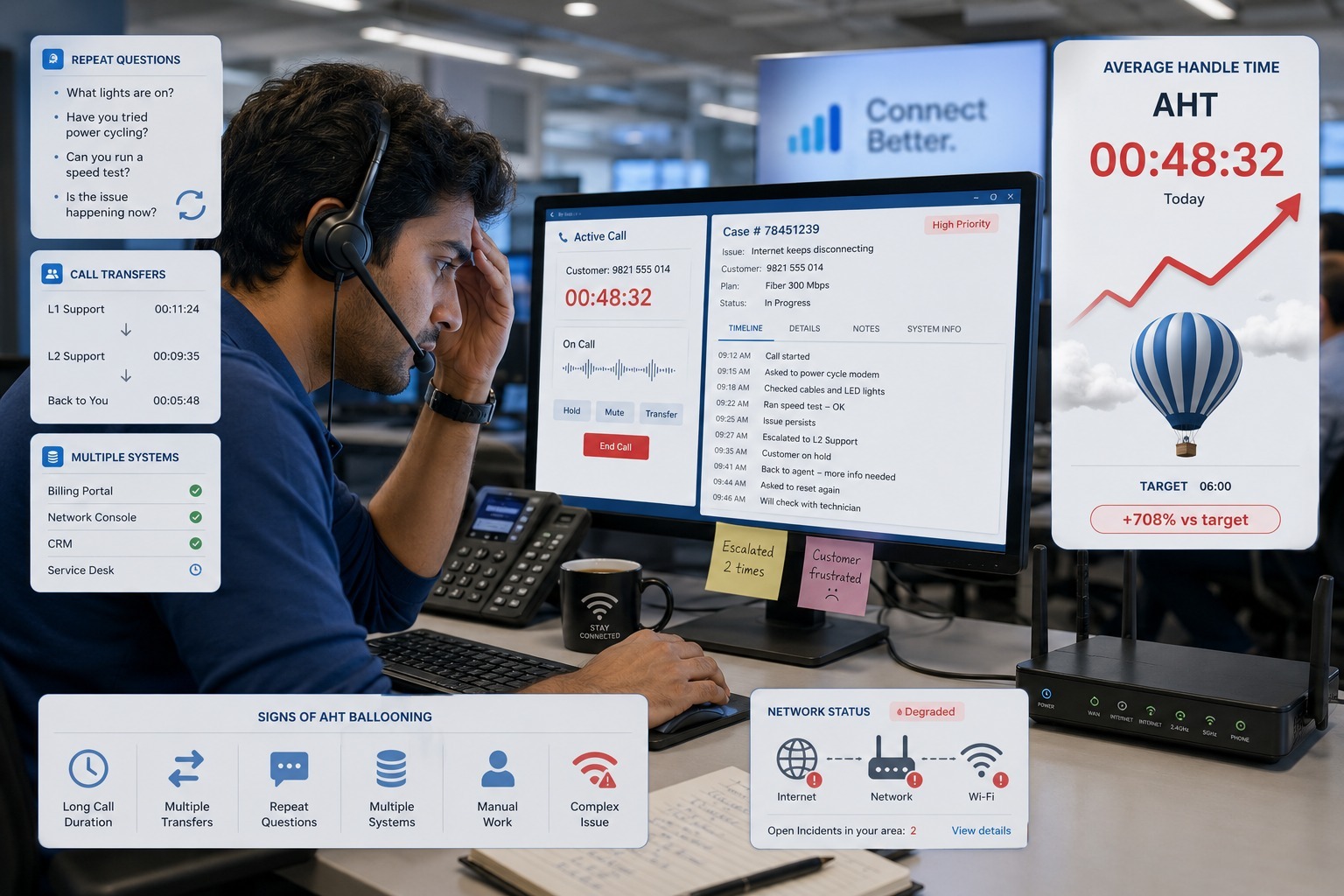
Why AHT balloons in the first place
Before you can shrink AHT, it helps to see where the minutes actually go. Four culprits dominate:
1. The verbal-description bottleneck. This is the big one. When an agent can only hear a description, diagnosing a physical problem becomes a guessing game. "Which light is blinking? Is the cable in the top port or the bottom? What does the error say?" A problem that takes four exchanges to diagnose over the phone gets resolved in a single look when the agent can see it. We unpack this throughout Blitzz's overview of remote visual support solutions.
2. Hold time and information hunting. Agents lose time toggling between systems, searching for account history, and re-entering data. Every hold adds to AHT.
3. After-call work. Documentation is supposed to happen after every interaction, but under occupancy pressure it's often rushed, incomplete, or delayed — and the seconds spent on it, multiplied across thousands of calls, add up to real capacity.
4. Transfers and repeat contacts. Every handoff resets context, and every unresolved issue becomes a second call. Both inflate AHT across the operation.
The common thread: agents are working without enough context and burdened with too much manual busywork. AI addresses both.
The AI shift: from rushing agents to removing friction
The old approach to AHT treated it as an agent-speed problem — coach people to be faster, script them tighter. The AI approach treats it as a friction problem. AI pulls three levers that shorten interactions while making them better, not worse. Here's how each works, and how Blitzz applies it.
Visual context collapses talk time
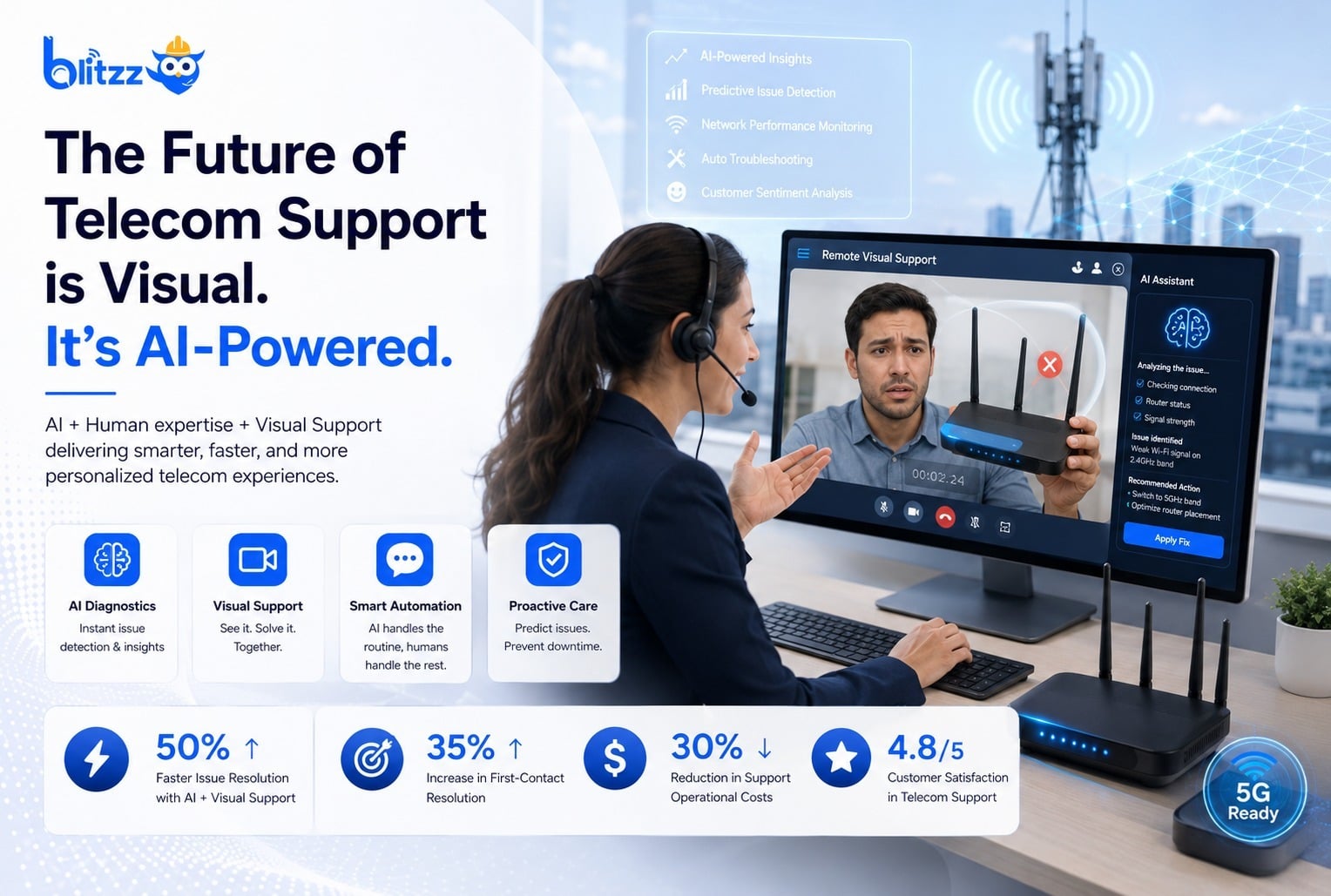
The most powerful lever is also the simplest: let the agent see the problem. Instead of spending the first several minutes of a call decoding a verbal description, the agent sends the customer a secure link by SMS, email, or WhatsApp. The customer taps it and joins a live video session from their phone browser — no app download, no account. The agent switches to the rear camera and immediately sees the equipment, the wiring, the error state, the whole situation.
Everything that depended on verbal description disappears. Augmented-reality tools make it even faster: the agent uses a live pointer and on-screen annotation to circle the exact component or show which button to press, and image recognition reads serial and model numbers off the device automatically. Blitzz reports that this real-time visual context helps agents diagnose issues about 2x faster — and it's the same mechanism that lets AR-equipped teams solve service issues dramatically faster. For field-heavy operations, the AR advantage is covered in How Augmented Reality Helps Field Service Workers.
AI removes the after-call work
The second lever targets the part of AHT nobody talks about: wrap-up. After-call work is pure overhead — necessary for records, but invisible to the customer and frustrating for agents. AI automates it.
Blitzz generates AI call summaries automatically, analyzing each session to extract the issue discussed, the troubleshooting steps taken, and the resolution reached — so agents don't spend 30 to 60 seconds (or more on complex cases) writing notes after every interaction. AI-powered optical character recognition captures VINs, serial numbers, model numbers, and barcodes during the live session, eliminating manual transcription and the errors that come with it. And because the documentation generates automatically, the CRM record is more complete and consistent than a summary typed from memory minutes later. Multiply those reclaimed seconds across thousands of interactions and the capacity gain is substantial.
AI guidance during the call
The third lever speeds up the resolution itself. Blitzz combines live video with AI-powered insights: intelligent recommendations surface likely fixes, AI works alongside AR to identify components and highlight the right area, and agents get guided toward the next best step even when the customer has never handled the equipment before. Instead of an agent improvising from memory, AI compresses the path from "what's wrong" to "here's the fix." For contact centers running Genesys, Blitzz layers directly into the workflow to cut AHT and improve FCR — agents transition from a voice call into a visual session without switching tools or losing context.
These three levers map to Blitzz's broader three-layer model: live human-guided sight, AR and visual AI augmentation, and automated documentation that flows into your systems. Applied to a contact center, that's exactly the recipe for lower handle time.
How Blitzz cuts AHT in practice
Here's how a single interaction plays out when all three levers are working together:
- Connect instantly. Mid-call, the agent sends a link from inside the CRM. The customer taps it and joins from their browser — no download, no friction, no hold time spent on setup.
- See the problem. The agent switches to the customer's camera and sees the issue directly, eliminating the verbal-description bottleneck that eats the first several minutes.
- Resolve with AI + AR. Live annotation guides the customer step by step, while AI recommendations and image recognition speed diagnosis.
- Auto-document. An AI call summary captures what happened; OCR logs any device numbers — no manual wrap-up.
- Sync everywhere. The session and its documentation flow automatically into Salesforce, ServiceNow, Zendesk, or Genesys via native integrations.
The result is shorter talk time, near-zero setup friction, and after-call work that largely takes care of itself.
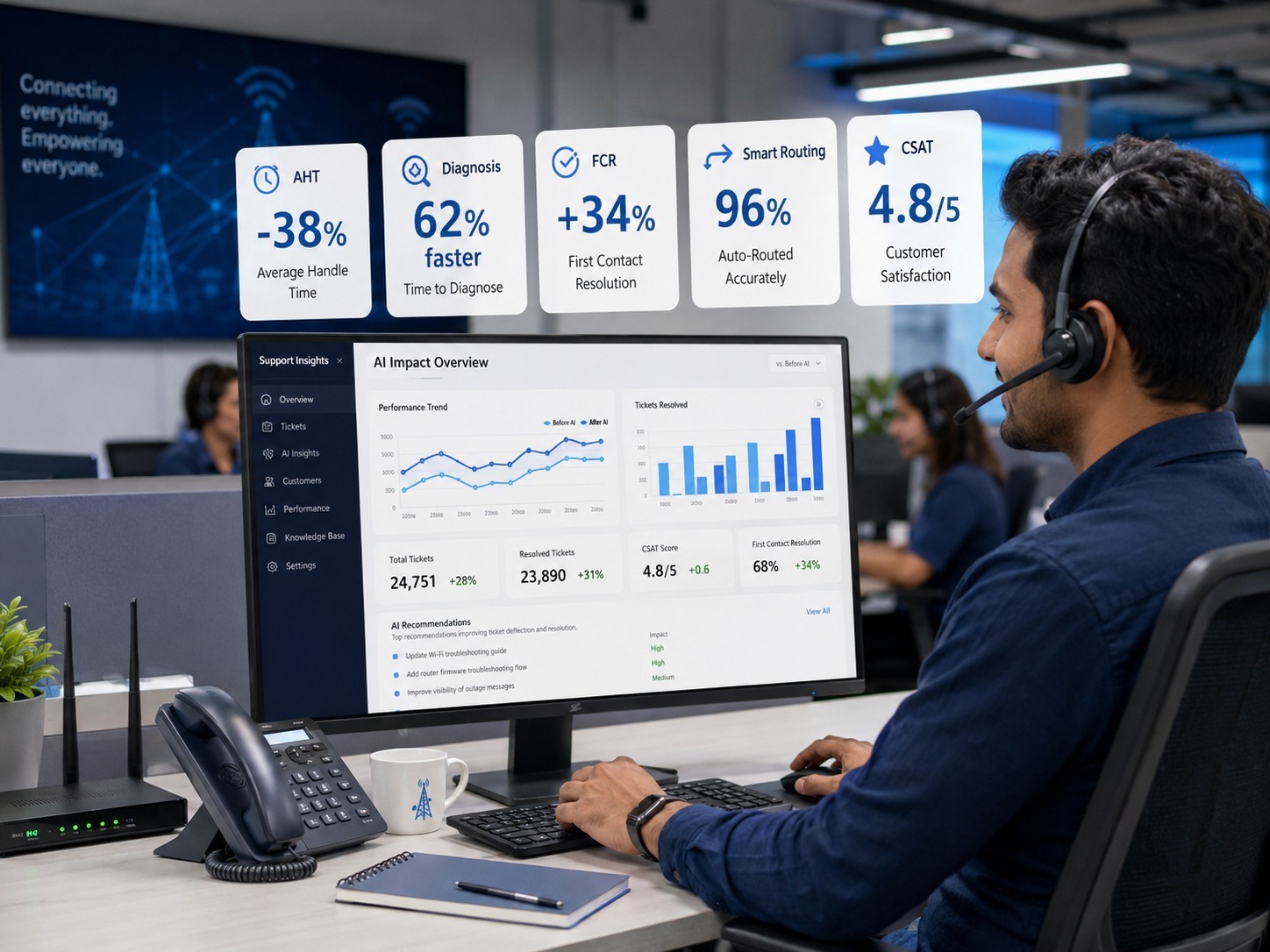
What the numbers show
Blitzz's reported results across contact center deployments make the impact concrete:
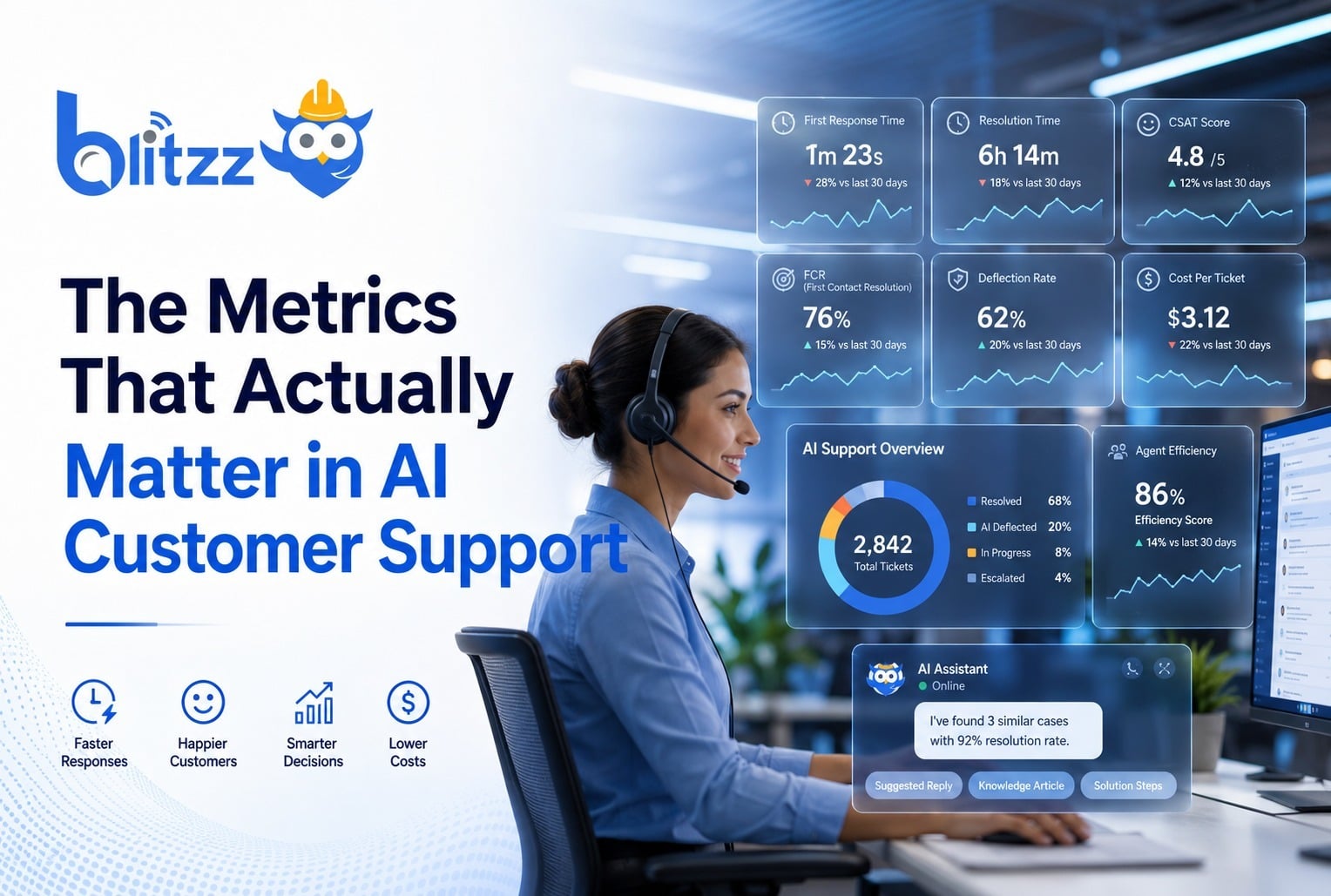
- AHT down ~35% in a contact-center deployment, with support calls that once took 30 minutes resolved in under 10.
- Issues diagnosed roughly 2x faster thanks to real-time visual context.
- First-call resolution improved by 40%, because agents fix problems correctly the first time instead of generating repeat contacts.
- Truck rolls reduced by 30% and self-install-kit success up 25%, since many issues that would have triggered a dispatch get resolved live.
- 73% of surveyed customers preferred video assistance over a voice-only call, and 78% found the tool extremely helpful — so the faster experience is also a better one.
External benchmarks point the same direction: AI agent-assist tools commonly reduce handle time by 15–30%, and wrap-up automation reclaims meaningful seconds on every interaction. The Blitzz figures sit at the upper end because visual context and AI documentation attack talk time and after-call work simultaneously. The broader business case spans field service, telecom, and insurance.
Don't optimize AHT in a vacuum
Here's the trap: chase AHT alone and you'll teach agents to rush, which tanks FCR and CSAT and floods you with callbacks — the opposite of what you wanted. The reason visual support and AI are such a strong combination is that they lower AHT while raising resolution quality. That's a rare win-win. When an agent sees the problem and AI handles the busywork, calls get shorter because they're more effective, not because anyone is being rushed off the line. Track AHT next to FCR and CSAT, and you'll see all three move in the right direction together. The trade-offs are laid out in Blitzz's piece on reducing costs without sacrificing service.
How to roll it out
You don't need a big-bang deployment to see results. Start with a pilot:
- Pick one team or use case — a single business unit or issue type with high handle time.
- Baseline your metrics — current AHT, FCR, and CSAT for that group.
- Enable visual support and AI summaries inside your existing stack; Blitzz deploys without app downloads and scales from 5 to 500 users without complex setup.
- Measure and compare after a few weeks, then expand to the wider organization.
Because Blitzz Concierge launches from the tools your agents already use and customers join in one tap, adoption is fast — one large telecom brought 1,500 agents up to speed in just two days. You can explore the support use cases or Concierge pricing to plan a rollout.
Frequently asked questions
What is Average Handle Time (AHT)? AHT is the average total time to resolve a customer interaction, including talk time, hold time, and after-call (wrap-up) work, divided by the number of interactions. It's a core contact-center efficiency metric and is best tracked alongside First Contact Resolution and CSAT.
How does AI reduce Average Handle Time? AI reduces AHT in three ways: by giving agents instant visual context so they diagnose faster, by generating automatic call summaries that eliminate manual after-call work, and by offering real-time recommendations that speed resolution. The biggest single lever is visual context, which removes the verbal-description bottleneck.
How much can visual support and AI reduce AHT? Blitzz reports AHT reductions of around 35% in contact-center deployments, with calls that once took 30 minutes resolved in under 10, plus roughly 2x faster diagnosis. External benchmarks for AI agent-assist tools commonly show 15–30% reductions.
Will reducing AHT hurt customer satisfaction? Not when you do it by removing friction rather than rushing customers. Visual support and AI lower AHT while improving first-call resolution and satisfaction, because issues get fully resolved faster. Always track AHT alongside FCR and CSAT to avoid optimizing the wrong thing.
Does the customer need to download an app to join a visual session? No. The customer taps a secure link sent by SMS, email, or WhatsApp and joins instantly from their phone browser — no app, no account.
Does Blitzz work with my contact-center platform? Yes. Blitzz integrates natively with Salesforce, ServiceNow, Zendesk, and Genesys, so agents launch visual sessions from inside their existing workflow and AI summaries sync back automatically.
What's the difference between AHT and talk time? Talk time only measures active conversation. AHT is broader — it also includes hold time and after-call work, giving a truer picture of how long the entire interaction takes to resolve.
Ready to collapse your handle time?
Long calls are rarely an agent-speed problem — they're a context-and-busywork problem, and that's exactly what AI solves. By letting agents see the issue instantly and letting AI handle the documentation, Blitzz cuts Average Handle Time while improving resolution quality and customer satisfaction. Explore the Blitzz platform, see how visual support works for contact centers, read more on the Blitzz blog, or book a demo to see how much of your AHT you can reclaim.

Blitzz Team
The Blitzz Team writes about remote video support, virtual inspections and field service. Our guides come from working with home builders, property managers, warranty teams, contact centers and field service organizations that use Blitzz to see and solve issues without a truck roll.