
.png?width=120&height=55&name=Blitzz-Logo-right%20white%20eyes%20-%20not%20transparent%20(3).png)
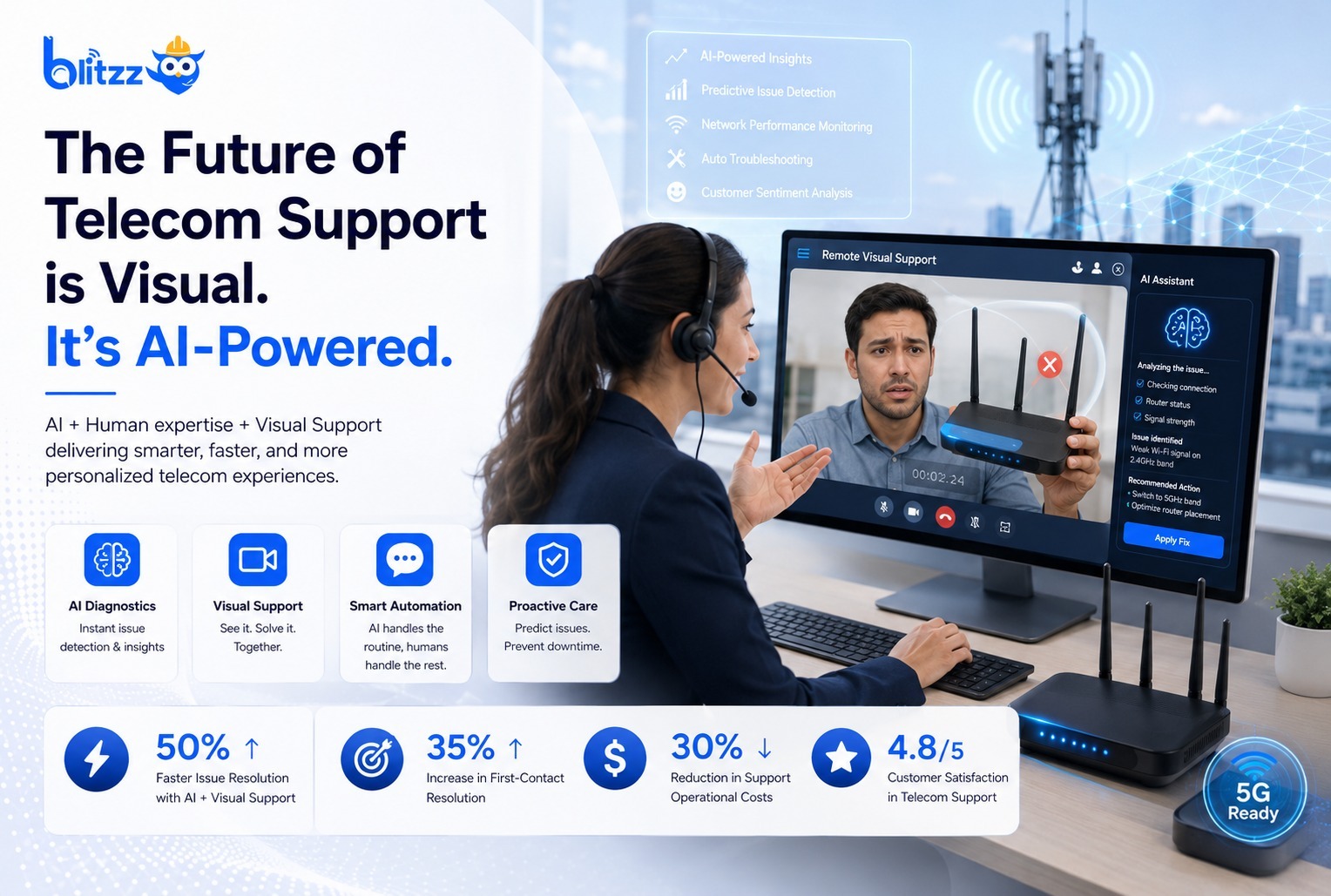
Telecom customers in 2026 expect their problems solved instantly, on the first contact, without a technician camped on their doorstep for a four-hour window. The support models that deliver this share one thing in common: they pair AI with visual troubleshooting — letting an agent see the customer's router, modem, or fibre setup in real time instead of guessing from a phone description. AI-powered customer support for telecom isn't about replacing agents with bots; it's about giving agents and customers the tools to resolve issues faster and cheaper. The single highest-impact piece of that toolkit is remote visual support, and platforms like Blitzz Concierge are showing ISPs and telcos exactly what's working.
The state of telecom customer support in 2026
Customer expectations have outpaced legacy support. Subscribers now want faster resolutions, round-the-clock availability, and digital-first experiences that don't involve sitting on hold. A PwC study found that 32% of consumers will abandon a brand they love after a single bad service experience, and nearly 80% rank speed and convenience among the most important parts of a great experience. For telecom, where switching providers is easy, that's an existential pressure.
Meanwhile, telcos face a brutal operating reality: high call volumes, increasingly complex home network setups, rising support costs, and technician shortages. Home Wi-Fi, mesh systems, fibre ONTs, and smart-home devices have made the "simple" support call anything but. And legacy, voice-only models buckle under the weight — long hold times, repeated transfers, and the maddening experience of trying to troubleshoot a blinking light over the phone. The case for modernising is laid out in Blitzz's guide to how telecom companies can use technology to transform customer support.
How AI is transforming telecom support operations
AI is reshaping telecom support across four layers of the interaction:
AI-powered chatbots and virtual agents handle the high-volume routine: billing questions, service-status updates, and basic account changes — deflecting simple tickets so human agents focus on the hard ones.
Intelligent ticket routing uses AI to direct each customer to the right team the first time, cutting the transfer-and-escalation merry-go-round that drives subscribers up the wall.
Predictive support flags issues — a degrading line, an outage forming — before the customer even calls, enabling proactive notifications that turn complaints into goodwill.
Real-time agent assistance is where AI earns its keep on complex calls: surfacing troubleshooting recommendations and retrieving knowledge mid-interaction so agents reach the right fix faster. Blitzz's broader view of this shift is in How Blitzz Uses AI to Transform Remote Support, which features telecom provider Moby cutting truck rolls and lifting first-call resolution.
But AI has a hard limit: it can't see a tangle of cables in a customer's living room. That's the gap visual troubleshooting fills.
Why visual troubleshooting is becoming essential for telecom providers
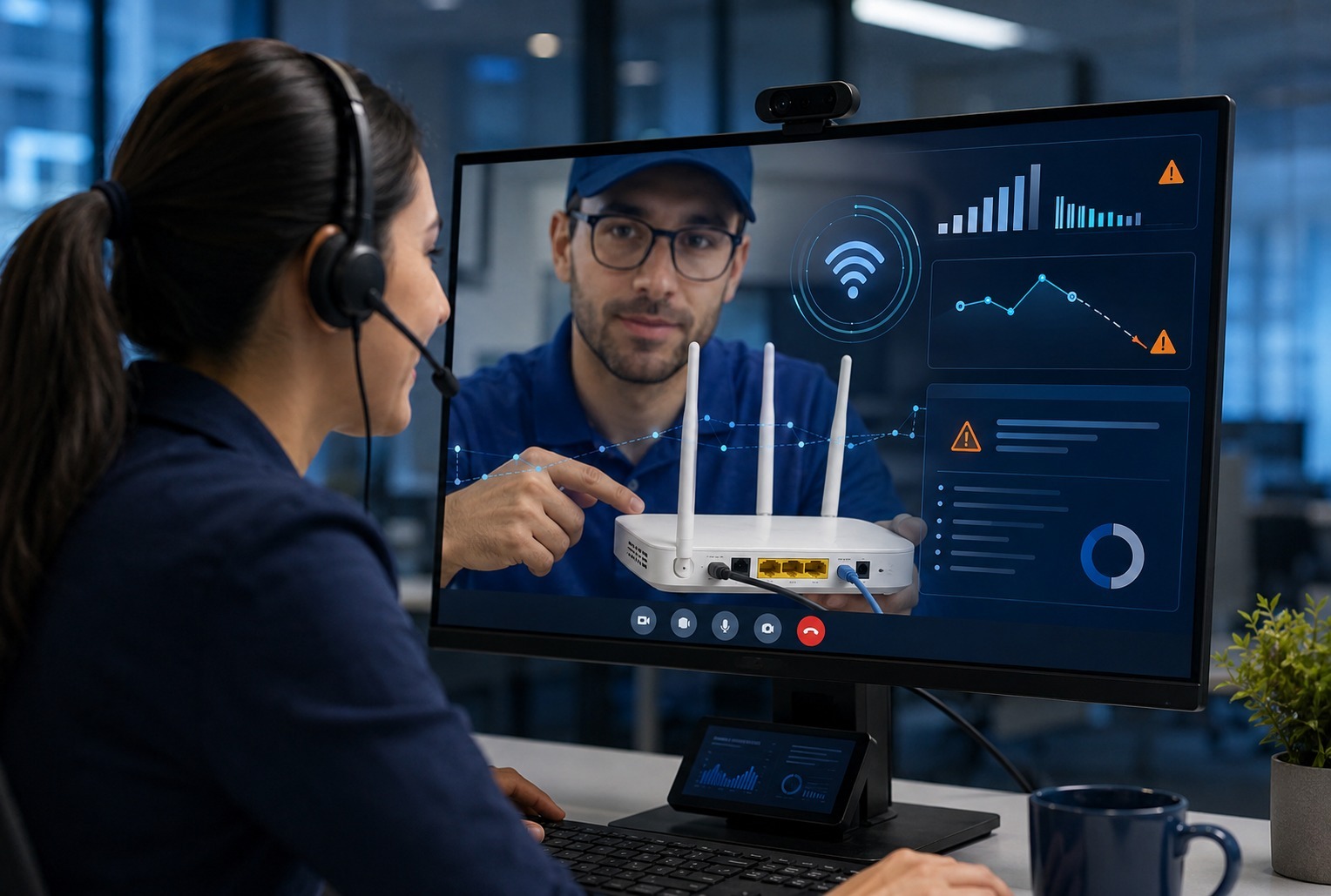
The core problem with voice-only troubleshooting is that customers can't accurately describe technical issues, and agents can't accurately diagnose what they can't see. "Is the green light flashing or solid?" becomes a five-minute negotiation — and miscommunication leads straight to repeat calls and unnecessary dispatches. Visual support eliminates the guessing game, as Blitzz details in how telcos leverage remote video support.
The telecom issues that benefit most are exactly the ones that are hardest to describe:
- Router setup problems — incorrect cable connections and configuration mistakes that are obvious on camera but invisible over the phone.
- Modem connectivity issues — signal-indicator confusion and poor hardware placement.
- Home Wi-Fi troubleshooting — coverage dead zones and equipment positioning.
- Fibre installation challenges — ONT setup verification and physical connection checks during self-installs.
When an agent can see the issue instantly, root-cause identification accelerates, customer effort drops, and the whole interaction shortens. We unpack the mechanics across remote visual support solutions.

How Blitzz Concierge helps ISPs and telecom providers resolve issues faster
Blitzz Concierge is built for exactly this. Here's what makes it work for telecom.
Instant visual assistance without app downloads. The agent sends a secure link by SMS, email, or WhatsApp; the customer taps it and joins a live session from their phone browser. No app store, no account, no setup struggle — which matters enormously when your caller is a frustrated subscriber or a less tech-savvy customer. Blitzz runs well on a standard 4G/LTE connection, with offline capture for spotty signal.
Live video-based troubleshooting. Agents visually inspect the equipment and guide customers step by step — turning "describe the back of your router" into "I can see it; move the cable from the top port to the one below."
Augmented reality guidance. On-screen annotations and a live pointer let agents draw directly on the customer's video feed, showing precisely which cable, port, or button to touch. The AR advantage is covered in How Augmented Reality Helps Field Service Workers.
Remote router and cable diagnostics. In practice that means Ethernet cable verification, router placement optimisation, fibre connection checks, and modem status-light identification — all done live, in minutes.
The payoff is measurable across the metrics telecom leaders watch: reduced Average Handle Time (see Blitzz's AHT guide), improved First Contact Resolution (covered in Cut AHT and Improve FCR with Genesys), and a sharp reduction in truck rolls — solving issues remotely before dispatching anyone.
Real benefits telecom providers are seeing from AI + visual support
The results telcos report map directly to the bottom line:
- Higher first-contact resolution. Blitzz customers consistently see FCR improvements of 20–40% once agents have visual context — more issues solved in the first interaction, fewer callbacks.
- Lower operational costs. Fewer repeat calls and fewer technician dispatches. One 20-agent telecom pilot eliminated 120 site visits and saved over $13,000 in 30 days, and a major telecom provider reduced truck rolls by 60%.
- Improved customer satisfaction. Faster, more convenient support lifts CSAT; in one contact-centre deployment, a telecom team cut truck rolls by 38% with CSAT at record highs, while another saw handle time drop 35% with 30-minute calls resolved in under 10.
- Increased agent efficiency. Less time diagnosing blind, more time resolving — issues diagnosed roughly 2x faster.
- Better scalability. Blitzz scales from 5 to 500 users without complex setup; one large telecom onboarded 1,500 agents in just two days, and self-install-kit success rates improved by 25%.
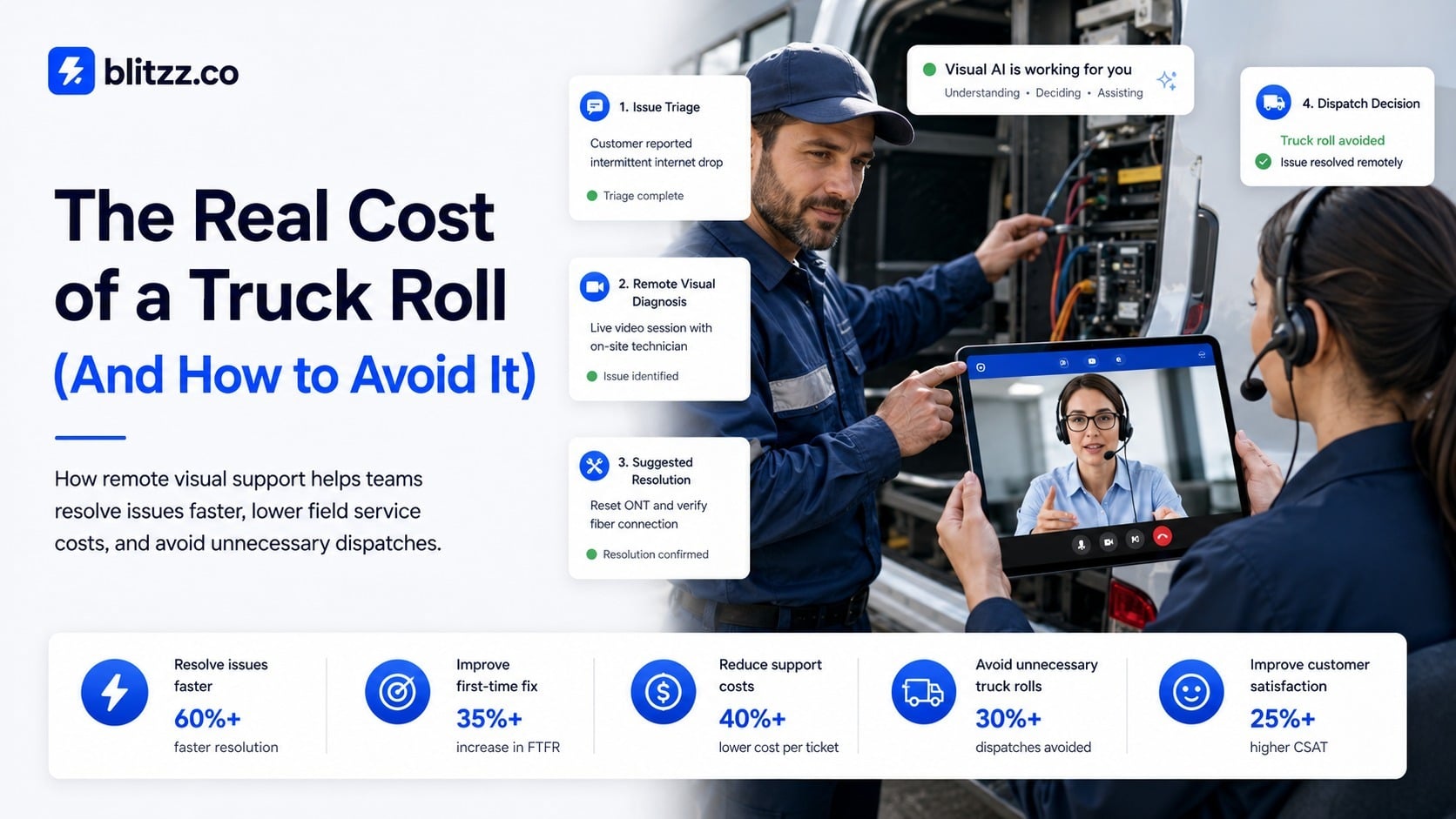
The full economics of avoided dispatches are in The Real Cost of a Truck Roll, and the broader business case in Reducing Truck Rolls at Scale for Telecom Operators.
Use cases: where AI and visual support deliver the biggest impact
Telecom providers see the strongest returns in a handful of scenarios:
- Residential internet support — router setup, Wi-Fi troubleshooting, and connectivity issues resolved live without a visit.
- Fibre installation assistance — guiding customers through self-installs and verifying ONT and physical connections on camera, dramatically improving self-install success.
- Small business connectivity — network-equipment troubleshooting and rapid outage diagnosis for higher-value accounts.
- New customer onboarding — guided setup that speeds activation and reduces early churn.
- Remote technical support teams — supporting subscribers across large service areas without sprawling field operations, the same model explored in solving service issues faster.
A practical tip from telcos that have done this well: start with the single use case where the ROI is most obvious — for most providers, that's self-install support — then expand as the savings compound.
What telecom leaders should look for in an AI support platform
When evaluating platforms, prioritise:
- Visual troubleshooting with live video and AR annotation — the feature that actually sees physical equipment.
- AI-powered guidance for real-time recommendations and automated documentation, including AI call summaries and OCR for capturing serial and model numbers (see Blitzz core features).
- CRM and contact-centre integration — native connections to Salesforce, ServiceNow, Zendesk, and Genesys so sessions launch from existing workflows (see Blitzz integrations).
- Secure communications — encryption and compliance suited to subscriber data.
- Analytics and reporting to track AHT, FCR, and truck-roll reduction.
The reason video and AR matter more than ever is simple: AI alone cannot see a customer's physical setup. Visual support bridges the gap between digital automation and real-world troubleshooting — and that's why telecom giants like Rogers and SaskTel adopted Blitzz, as covered on the Why Blitzz page.
The future of telecom customer support
Three shifts will define the next phase. First, support moves from reactive to proactive — predictive issue detection and automated engagement that resolve problems before customers notice them. Second, the winning formula is AI plus human agents: AI handles repetitive tasks and surfaces guidance, while human agents manage the complex, emotional, and high-stakes interactions. Third, visual support becomes a standard expectation — subscribers will increasingly assume they can show an agent the problem rather than describe it, just as they expect visual customer support over traditional call centres.
Frequently asked questions
What is AI-powered customer support for telecom? It's the use of artificial intelligence — chatbots, intelligent routing, predictive support, real-time agent assistance, and AI-enhanced visual troubleshooting — to resolve telecom customer issues faster and at lower cost. The highest-impact element is visual support, which lets agents see equipment in real time.
How does visual troubleshooting help ISPs and telecom providers? It lets agents see a customer's router, modem, or fibre setup live through their phone camera, eliminating the guesswork of verbal descriptions. This speeds diagnosis, improves first-contact resolution, and avoids unnecessary truck rolls.
Do customers need to download an app to use Blitzz Concierge? No. Customers tap a secure link sent by SMS, email, or WhatsApp and join instantly from their phone browser — no app, no account, and it works on a standard 4G/LTE connection.
How much can telecom providers reduce truck rolls with visual support? Blitzz reports truck-roll reductions of up to 60% for major telecom providers, with one 20-agent pilot eliminating 120 site visits and saving over $13,000 in a single month.
What telecom issues can be solved remotely? Router and modem setup, cable-connection errors, Wi-Fi coverage and placement, modem status-light confusion, and fibre self-install verification are all strong candidates for remote visual resolution.
Does AI replace human telecom agents? No. AI handles repetitive tasks and provides real-time guidance, while human agents — equipped with visual tools — handle complex troubleshooting. The most effective 2026 model combines both.
Does Blitzz integrate with telecom contact-centre systems? Yes. Blitzz integrates natively with Salesforce, ServiceNow, Zendesk, and Genesys, plus REST APIs and an embeddable SDK for custom platforms.
Ready to modernise your telecom support?
AI is reshaping telecom customer support in 2026 — and of all the innovations, visual troubleshooting delivers the highest impact for ISPs and telecom providers. By letting agents see and solve router, modem, and connectivity issues in real time, Blitzz Concierge helps telcos reduce truck rolls, improve first-contact resolution, lower costs, and create the fast, convenient experiences subscribers now demand. Explore the Blitzz platform, review Concierge pricing, read more on the Blitzz blog, or book a demo to see AI-powered visual troubleshooting in action.