
.png?width=120&height=55&name=Blitzz-Logo-right%20white%20eyes%20-%20not%20transparent%20(3).png)
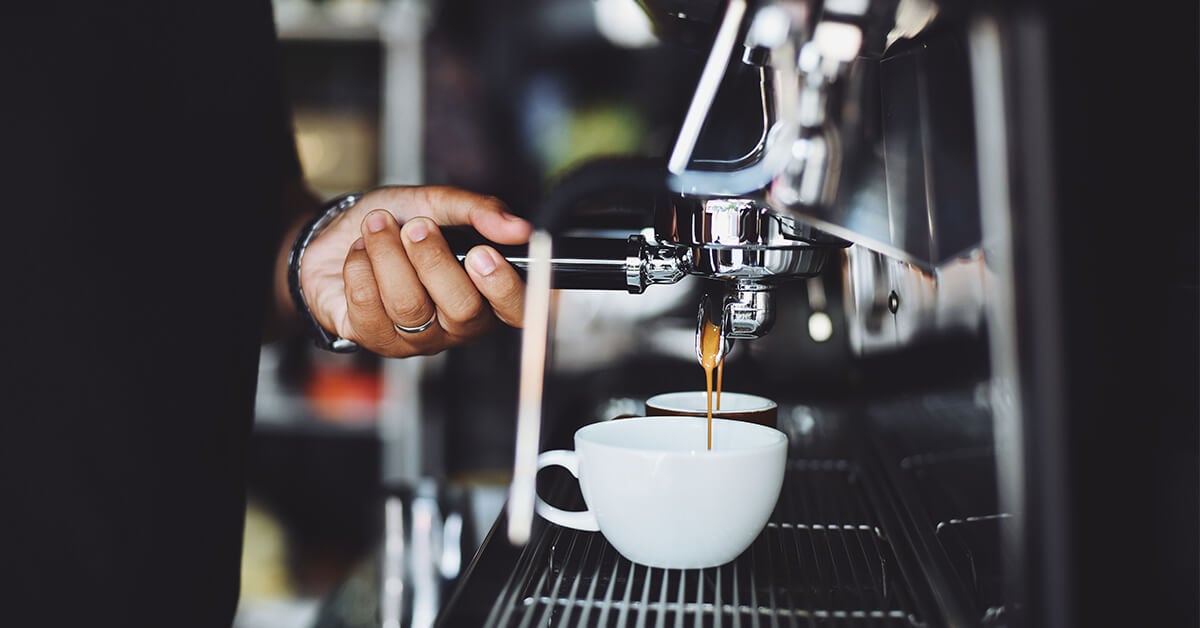
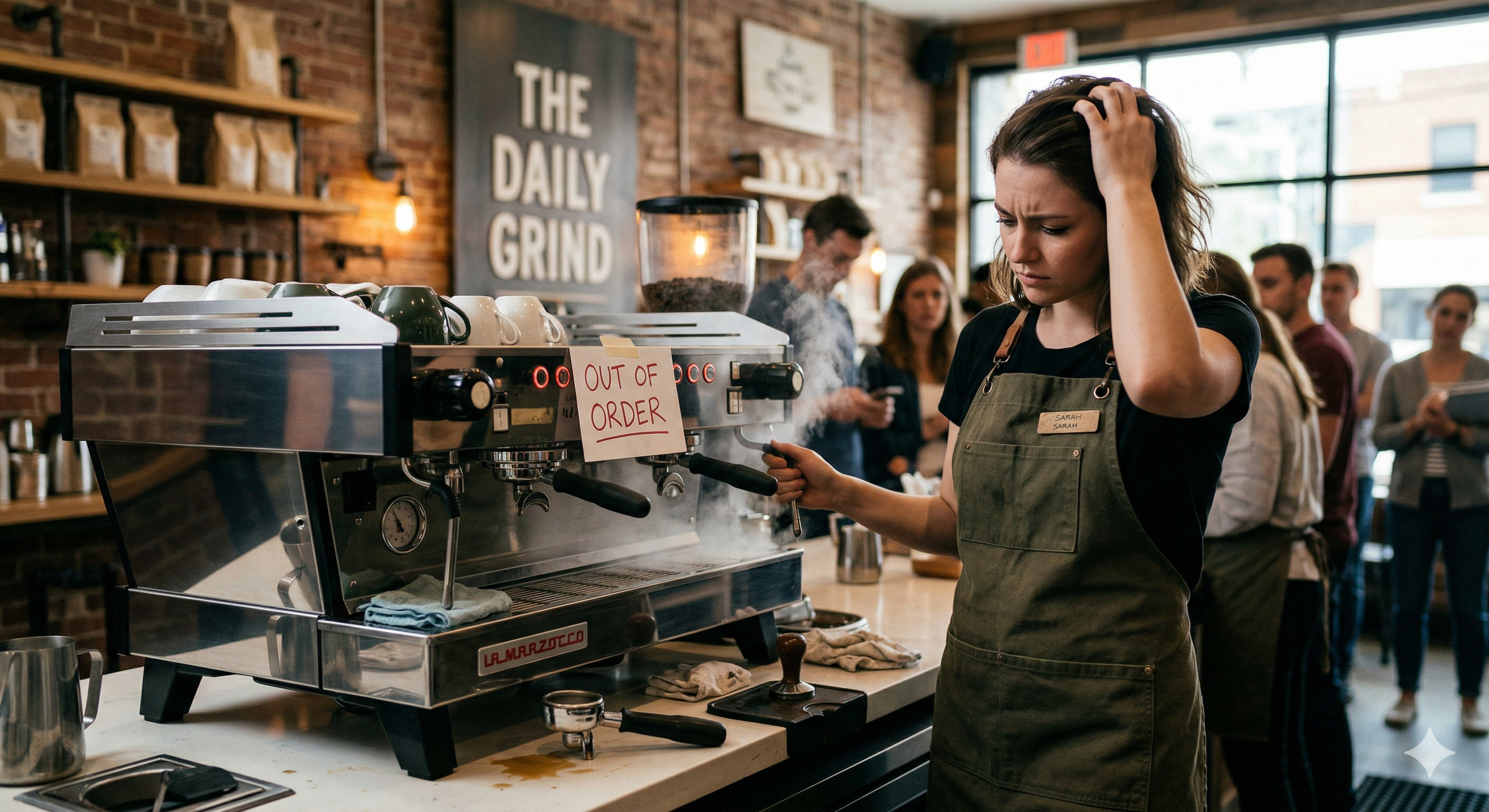
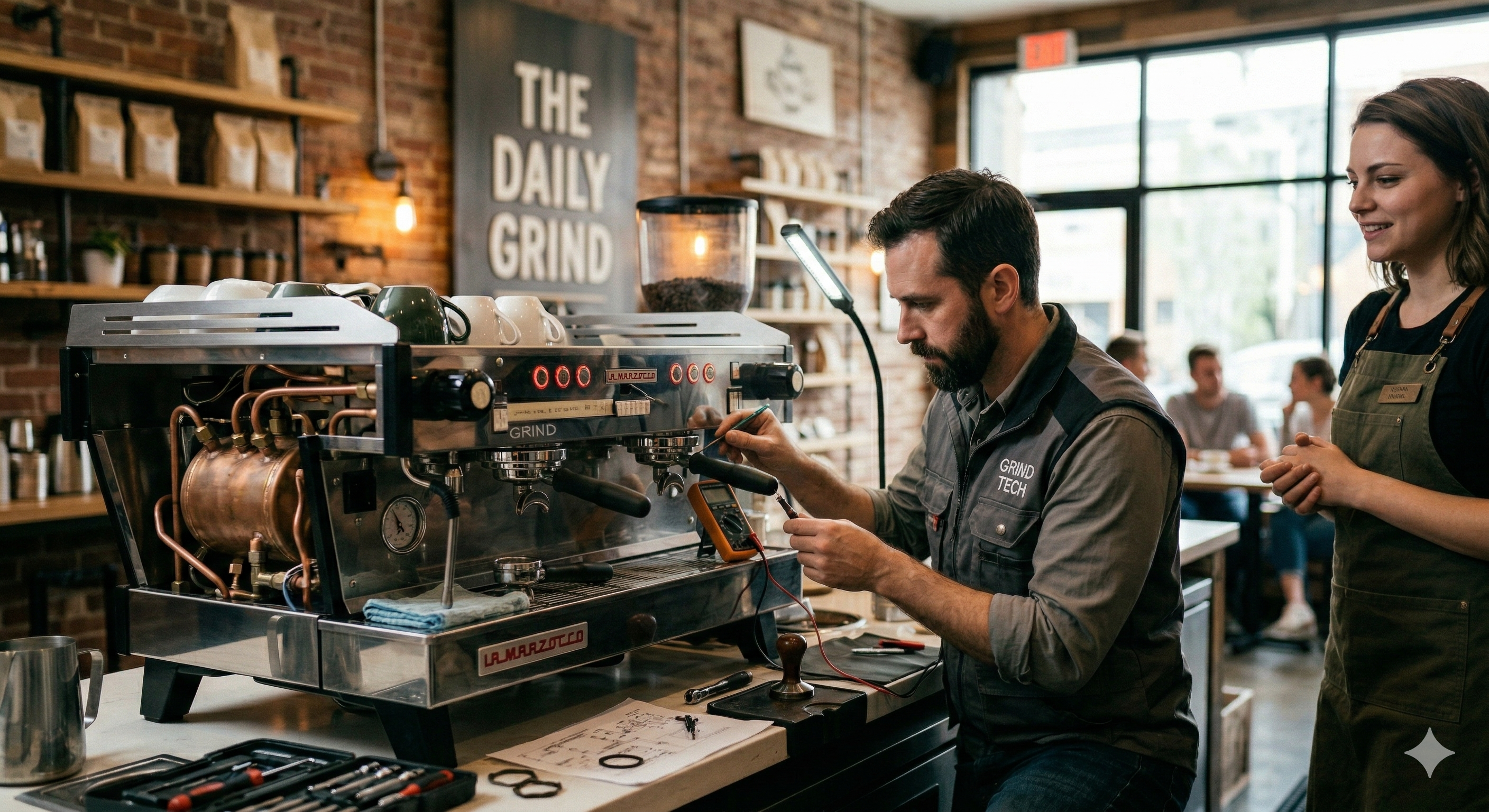
It's 8:04 on a Tuesday morning. The queue at your café is twelve deep and growing. Your head barista lifts the portafilter, tamps the grind, locks it in — and nothing happens. The group head flashes an error code no one recognises. The milk frother hisses twice and cuts out.
She calls the area manager. He calls the service desk. Someone mentions a technician could be there "sometime Thursday." By 8:45, you've turned away twenty customers, improvised with a batch brewer that can't make a flat white, and your location's Google rating is already one bad review closer to 4.1.
~ This scenario plays out thousands of times a day across restaurant chains worldwide.
For multi-location restaurant chains, the espresso machine is not just an appliance — it's a revenue engine. When it stops, everything downstream stops with it: drink sales, customer satisfaction, staff morale, and the morning-rush rhythm your whole operation depends on.
The traditional answer to equipment failure — dispatch a technician, wait, repeat — was built for a world with more slack in the system. Today's restaurant chains need something faster: Remote Visual Support (RVS) like Blitzz Concierge, a technology that lets an expert diagnose and guide repairs through live video, in real time, from anywhere.
Why Espresso Machine Downtime Is So Costly for Restaurant Chains
Coffee is your highest-margin product
Espresso-based beverages — lattes, cappuccinos, flat whites, Americanos — consistently deliver some of the highest margins in the entire food-and-beverage menu. According to the Specialty Coffee Association (SCA), 43% of American adults enjoyed an espresso-based beverage in the past week, and specialty coffee now accounts for a disproportionately large share of industry revenue. Gross margins on espresso drinks typically reach 65–85% per serving, compared to around 70–80% for drip coffee — but at significantly higher price points, meaning every espresso drink sold puts more dollars in the till. Every espresso machine that's offline is a margin gap that widens by the minute.
The morning rush is irreplaceable
Peak hours aren't just busy — they're disproportionately profitable. A machine that's down for two hours at 8am hits your daily revenue harder than a two-hour outage at 2pm. Lost sales during the morning rush can't be recovered later; those customers either left or went to a competitor. According to IBISWorld's coffee shop industry data, the US coffee shop industry generates around $343 billion in annual sales — a market where morning trade drives the lion's share of daily volume.
Customer experience damage compounds quickly
Long queues and substitute drinks translate directly into negative reviews, social posts, and lost loyalty. According to PwC's Customer Loyalty Survey, 32% of consumers say they'd drop a brand that provided inconsistent experiences — and a bad experience with a product or service was cited as the top reason customers leave, ahead of price. In a competitive high-street or food-court environment, one broken machine during peak trading is a reputation event, not just an operational one. PwC's research also found that 73% of consumers cite experience as an important factor in their purchasing decisions.
The multi-location multiplier
A single-location café absorbs equipment failure as a local problem. For a chain with 30, 50, or 200 locations, the operational fragility multiplies. Dozens of machines, each with its own service history, different models, different fault patterns — and a central support team that can't be in twenty places at once. The National Coffee Association's 2025 report found that 66% of Americans had a coffee the previous day — underscoring just how much daily customer traffic depends on equipment running reliably, at scale.
The downtime cost reality:
- $500 — Estimated revenue lost per rush hour with a machine offline
- $2,500 — Monthly cost of slow or unreliable machines at a high-volume café (industry estimate)
- 32% — Of consumers who say they'd leave a brand delivering inconsistent experiences (PwC Customer Loyalty Survey)
The Problem with Traditional Repair Models
The standard response to equipment failure — call the service desk, log a ticket, wait for a technician — was designed around a world where "tomorrow morning" was an acceptable resolution window. For modern restaurant chains running on razor-thin margins and customer experience expectations, it no longer holds up.
| The Old Approach | What Actually Happens | The Cost |
|---|---|---|
| Call the service desk | Ticket logged; technician dispatched based on availability | Hours or days of waiting |
| Technician travels to site | Arrives without seeing the issue first | Truck roll cost; lost trading hours |
| On-site diagnosis | Tech may not have the right part; second visit booked | Another day of downtime |
| Staff workarounds | Improvised service with substandard equipment | Revenue loss + reputation damage |
| Incident documentation | Manual notes, missing context | Repeat failures; harder future diagnosis |
The core problem: traditional repair models are reactive by design. They begin after failure, move slowly by default, and treat every incident as if physical presence is the only path to resolution. Most of the time, it isn't.
What Is Remote Visual Support (RVS)?
Remote Visual Support — a form of remote visual inspection built for human-guided diagnosis — uses live video to put an expert's eyes directly on the problem, wherever that problem is.
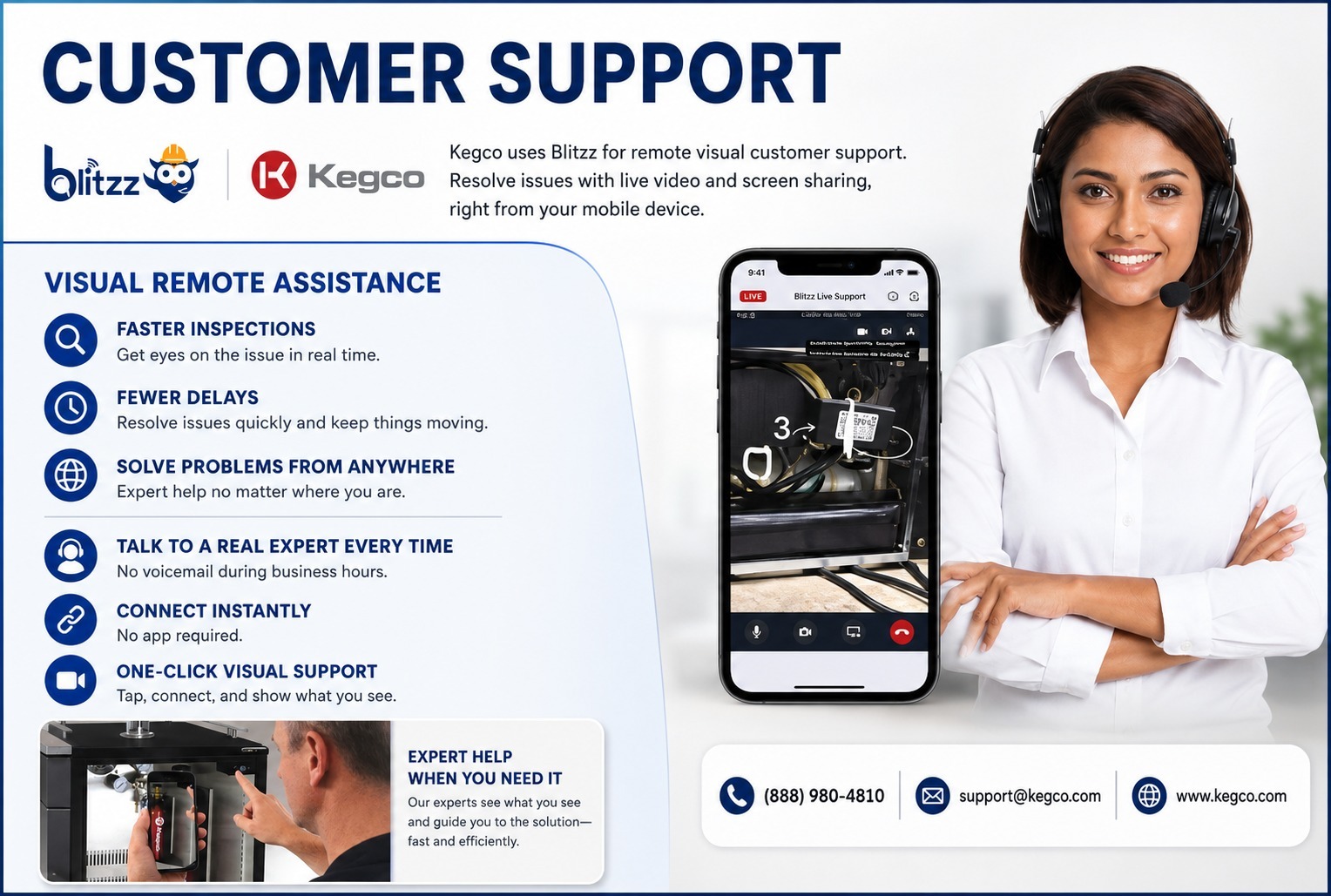
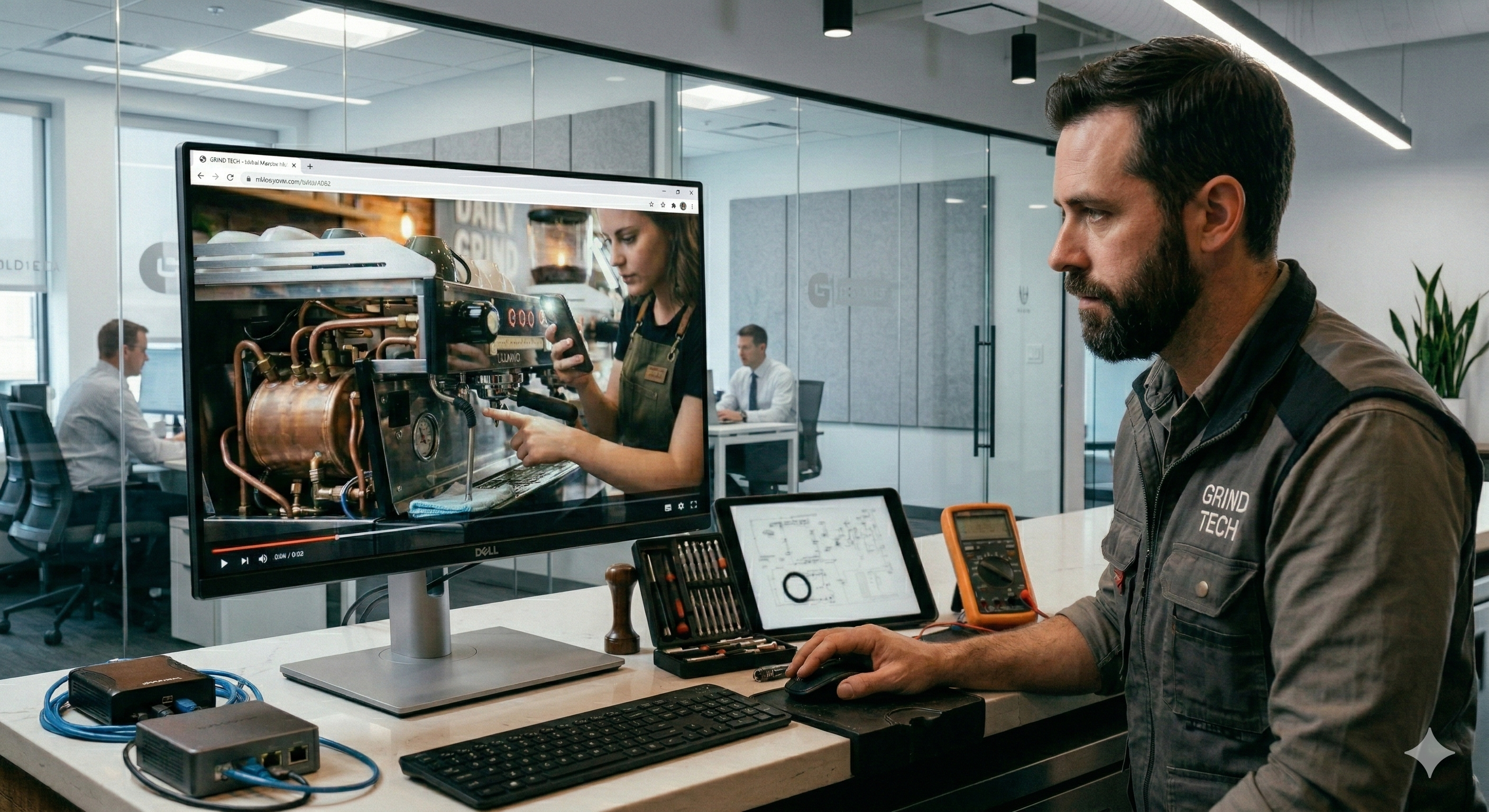
In practice, it works like this: your barista or shift manager gets a secure link by text or email. They tap it — no app to download, no account to create, no IT setup required. Their phone camera connects instantly to a remote expert who can see exactly what they see: the machine, the error code, the steam wand, the grinder. The expert guides them through diagnosis and resolution in real time, drawing directly on the video feed to point out what to check, what to adjust, and what to do next.
The session is recorded. Photos are captured with a tap. Everything — the fault, the fix, the visual evidence — is documented automatically and synced back to your service management system.
The Blitzz difference: Blitzz delivers remote visual support with a 95% first-attempt connection rate — because there's nothing to install. Staff connect through any mobile browser the moment they receive a link, even if they've never used the platform before.
How Remote Visual Support Speeds Up Espresso Machine Repairs
Step 1: Instant, accurate diagnosis: The moment the machine flags a fault, your remote expert can see it. No verbal descriptions, no guesswork about which error code means what. The expert sees the display, the steam pressure, the grind output — in real time. Diagnosis that previously took an on-site visit now takes under five minutes.
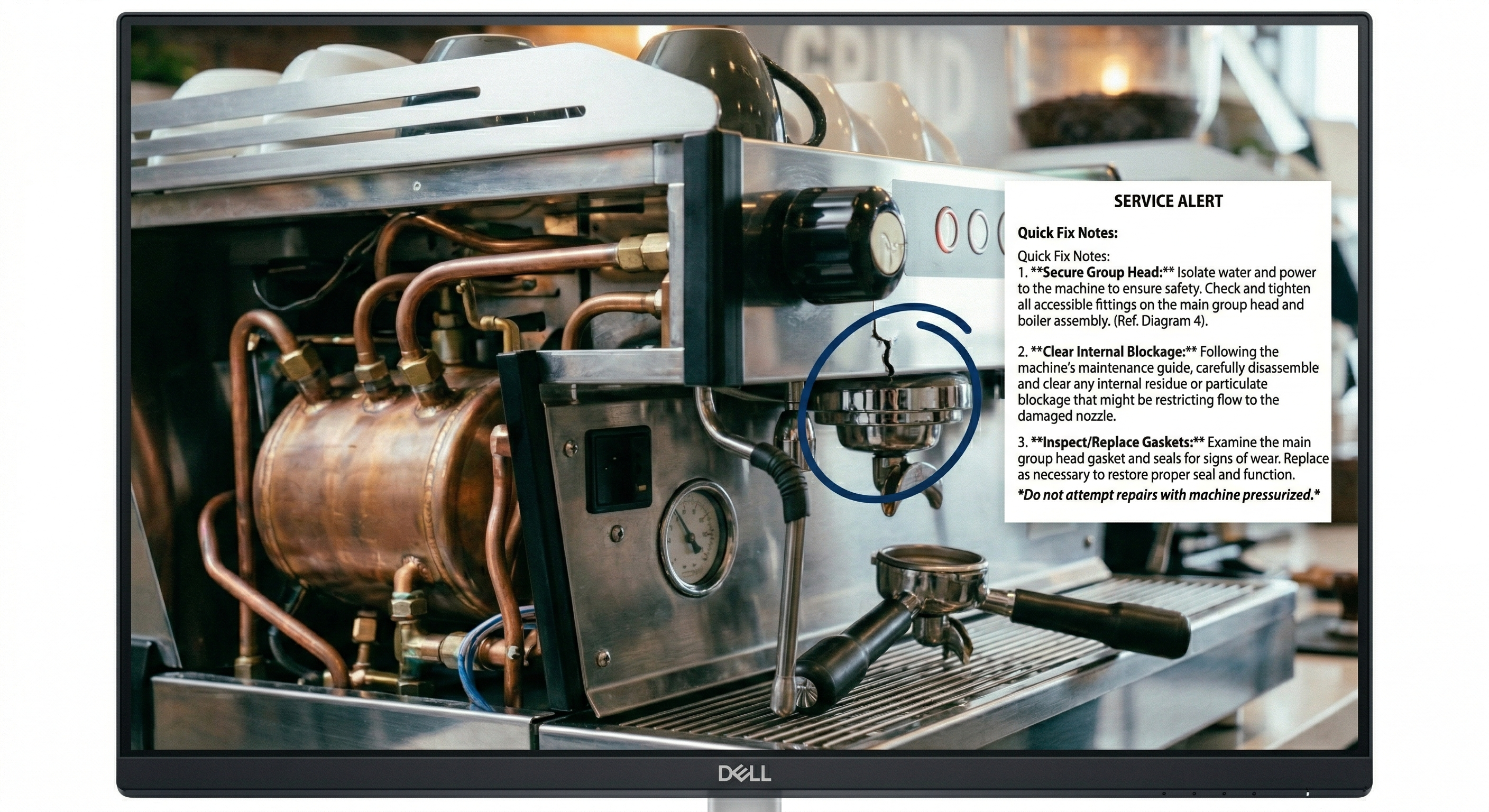
Step 2: Guided self-resolution for common faults: Many espresso machine issues — clogs, calibration drift, minor sensor resets, steam wand blockages — can be resolved by the person on-site when they have clear visual guidance. The remote expert annotates the live feed directly, pointing to the exact component, step by step. Staff who've never seen the inside of a group head can complete a fix confidently.
Step 3: Smarter escalation when a technician is genuinely needed: For faults that do require on-site repair, remote visual inspection transforms the technician dispatch. The tech arrives with a complete visual record of the fault, knowing exactly what's failed and which parts to bring. First-visit fix rates increase dramatically when the technician is prepared, not just present.
Step 4: Automatic documentation — no paperwork: Every session produces timestamped photos, annotated screenshots, the expert's notes, and an optional video recording. This creates a service history that informs future support, supports warranty claims, and gives operations managers visibility across every location without a site visit.
Step 5: Resolution in minutes, not hours: Blitzz customers consistently report that remote visual support sessions for equipment troubleshooting complete in under 15 minutes on average — compared to hours or days with a traditional dispatch model. That's the morning rush saved, not lost. Learn more about successful customer case studies.
Common Espresso Machine Issues Resolved Remotely
The range of issues that can be diagnosed and guided-to-resolution via remote visual inspection is wider than most operators expect. Here are the most common fault categories:
Machine Not Heating Properly
Boiler temperature faults, inconsistent extraction temperature, heating element indicators. Often diagnosable from the display and steam output.
Grinder Issues: Grind coarseness drift, blockages, inconsistent dosing. A visual of the grind output and burr adjustment dial is usually sufficient for diagnosis.
Milk Frother Malfunction: Steam wand blockages, inconsistent steam pressure, milk texture problems. Cleaning procedures can be guided step-by-step over live video.
Error Codes & System Resets: Most modern commercial machines display specific error codes. Remote experts can interpret them and guide the correct reset or cleaning cycle.
Calibration Problems: Shot timing, yield, pressure calibration — all visible through video. Remote experts can walk staff through machine recalibration in real time.
Water Flow & Pressure Issues Pump pressure, flow rate abnormalities, and blockages can often be traced through visual inspection of the machine's output and indicator lights.
Industry experience consistently shows that the majority of commercial espresso machine faults don't require physical component replacement — they require cleaning, recalibration, or a guided reset. Remote visual inspection addresses exactly these cases.
Business Benefits for Multi-Location Chains
Dramatically fewer truck rolls: Each technician dispatch costs not just travel and labour, but the wait time your location absorbs before they arrive. Blitzz customers report up to a 60% reduction in unnecessary on-site visits once remote visual support is in place. For a chain with dozens of locations, that's a material reduction in your service cost base.
Faster resolution times across the board: Average handling time for equipment issues drops significantly when experts can triage visually in real time. What took 24–48 hours under a traditional dispatch model routinely completes in under 15 minutes with remote visual inspection.
Consistent support quality across every location: Remote visual support standardizes the diagnostic and resolution process. Every location gets the same level of expert attention, regardless of geography, staffing experience, or whether it's the flagship store or a newer branch. Remote visual support not only reduces truck roll but also streamlines support across various locations.
Better customer experience — faster: The faster the machine is back online, the less the customer-facing impact. For most common faults, the difference between remote and traditional support is the difference between a 15-minute interruption and a half-day closure.
Rich service history, automatically created: Every remote session builds a structured record — timestamped, with photos, notes, and session logs. Over time, this creates an asset-level service history that informs maintenance schedules, warranty claims, and equipment replacement decisions.
Measurable ROI from day one: The ROI case for remote visual support in restaurant operations is straightforward: fewer truck rolls, faster resolutions, reduced downtime revenue loss, and lower cost per incident. One Blitzz customer reduced travel costs by 75% within the first year.
Real-World Scenario: A National Café Chain in Action
A national café chain operating across 80 locations was running a traditional service desk model: staff called a central number, described the fault verbally, and waited for a technician to be dispatched. Average resolution time: 18–24 hours. Average weekly truck rolls: 30+. Morning trading lost during that window: significant.
After deploying Blitzz for equipment troubleshooting, shift managers now send a single SMS link when a machine flags a fault. A remote equipment specialist connects within 90 seconds, sees the exact error on the display, and guides the barista through the resolution — annotating the live feed to show exactly which component to address.
For the most common fault types — error codes, calibration drift, steam wand blockages — average resolution time dropped to under 15 minutes. Technician dispatches fell by over half, and the chain now has a complete, searchable visual service history for every machine across every location.
Results at a glance:
- Under 15 minutes — average resolution time for common faults
- 50%+ — reduction in technician dispatches
- 90 seconds — average time for staff to connect with a remote expert
Why No-App Support Is a Non-Negotiable for Restaurant Staff
Most remote visual inspection platforms require the person on-site to download an app, create an account, or navigate a login flow. In a restaurant setting — with a queue forming, a machine down, and a stressed barista who's never used the software — that friction is a deal-breaker. Consider Blitzz differently with its no-app visual support.
Blitzz is designed around a single principle: if you can open a text message, you can connect. Staff receive a secure link via SMS or WhatsApp. One tap opens the session in their browser. No installation, no account, no IT department required.
This isn't a minor convenience feature — it's the difference between a platform your staff actually use when it matters and one that gets abandoned after the first failed attempt. Blitzz achieves a 95% first-attempt connection rate because there's nothing to get in the way.
For operations managers: zero-friction onboarding also means new staff across any location can use the platform without training. The moment they receive the link, they're connected. No implementation risk, no adoption curve. Blitzz offers various other features that can be aboslutely useful for restaurant chains.
The Future of Equipment Maintenance in Restaurants
Remote visual inspection for restaurant equipment isn't a workaround — it's the direction the industry is heading. Here's where the next few years take it:
AI-assisted diagnosis
Blitzz already uses AI to suggest resolutions during live sessions based on what the camera sees. As AI models become more capable, the platform will increasingly triage common equipment faults automatically — surfacing the most likely fix before the expert has finished reviewing the video feed.
Predictive maintenance integration
Commercial espresso machines are increasingly IoT-connected, reporting usage metrics and sensor data in real time. Combined with the visual service history that remote inspection builds over time, operations teams will be able to predict failures before they happen — scheduling preventive maintenance during low-traffic periods rather than reacting to breakdowns during the morning rush.
Centralised support hubs for multi-location chains
The logical endpoint for large chains is a centralised equipment support function: a small team of remote specialists covering every location, handling visual triage for every machine type across the estate. Remote visual inspection makes this model viable in a way that was impossible with phone-only support.
Hybrid support as standard
The future isn't fully remote or fully on-site — it's smarter triage. Remote visual inspection handles the majority of issues immediately; when a technician dispatch is genuinely required, they arrive prepared with the visual context to fix it first time. The result is a support model that's faster, cheaper, and more reliable than either approach alone.
The Bottom Line
Espresso machine downtime is expensive — not just in lost drink sales, but in customer experience, staff stress, and the long tail of reputation damage that follows a bad morning. The traditional repair model was designed for a slower world, and it shows.
Remote visual inspection changes the equation. Instead of waiting hours for a technician who may or may not have the right part, your staff connects with an expert in under two minutes — through a link, on any phone, with no app to download. Most faults are diagnosed and guided to resolution before the queue has doubled.
For multi-location restaurant chains, the ROI case is straightforward: fewer truck rolls, faster resolutions, consistent support quality across every location, and a visual service history that makes every future incident easier to handle. That's not a marginal improvement — it's a different way of running operations.
Frequently Asked Questions
What is remote visual inspection in the context of restaurant equipment?
Remote visual inspection (RVI) for restaurant equipment refers to the use of live video technology to diagnose, assess, and guide repairs on commercial equipment — like espresso machines, ovens, or refrigeration units — without requiring a technician to be physically present. A remote expert connects via the staff member's smartphone camera, sees the issue in real time, and guides the resolution through live annotation and step-by-step instructions.
Does the person on-site need to download an app to use Blitzz?
No. Blitzz is entirely browser-based for the person on-site. They receive a secure link via SMS, email, or WhatsApp and tap it to connect — no download, no account, no setup. This is one of Blitzz's core design principles, and it's why the platform achieves a 95% first-attempt connection rate even with staff who've never used it before.
Which espresso machine faults can actually be resolved remotely?
The majority of common commercial espresso machine faults — error codes, calibration drift, steam wand blockages, grinder adjustments, cleaning cycle issues, and temperature-related faults — can be diagnosed and resolved remotely when the on-site person has clear visual guidance. Faults that require physical part replacement still benefit from remote triage, since the technician arrives prepared with the right parts and context, improving first-visit fix rates significantly.
How does Blitzz integrate with our existing service management system?
Blitzz offers native integrations with Salesforce, Zendesk, and ServiceNow, as well as a comprehensive REST API library for custom integrations. Session data — including timestamped photos, annotations, notes, and recordings — syncs automatically to the relevant ticket or service record. Many customers also embed Blitzz directly within their own applications using the API.
How long does it take to implement Blitzz across multiple locations?
Typically hours, not days. Blitzz's SaaS deployment model is designed for rapid rollout — one major North American telecom onboarded 1,500 agents in two days. For restaurant chains, the typical path is a pilot with one team or department, proving the value, then scaling across locations without a re-implementation process.
Is remote visual support secure enough for commercial use?
Yes. Blitzz offers end-to-end encryption, SOC-2 certification, and configurable data storage — including options to store session data on your own AWS or Azure infrastructure, or on-premise. All sessions require a secure, time-limited link to join, and access controls are configurable by role and location.
What's the difference between remote visual inspection and a regular video call?
A regular video call lets you see something. A remote visual inspection platform lets you see it, annotate it, document it, and act on it. Blitzz adds AR annotation on the live feed, freeze frame, remote zoom control, instant photo capture, OCR for extracting text like serial numbers, automatic session logging, and CRM integration. Without these tools, you're watching, not inspecting.