
.png?width=120&height=55&name=Blitzz-Logo-right%20white%20eyes%20-%20not%20transparent%20(3).png)

On this page
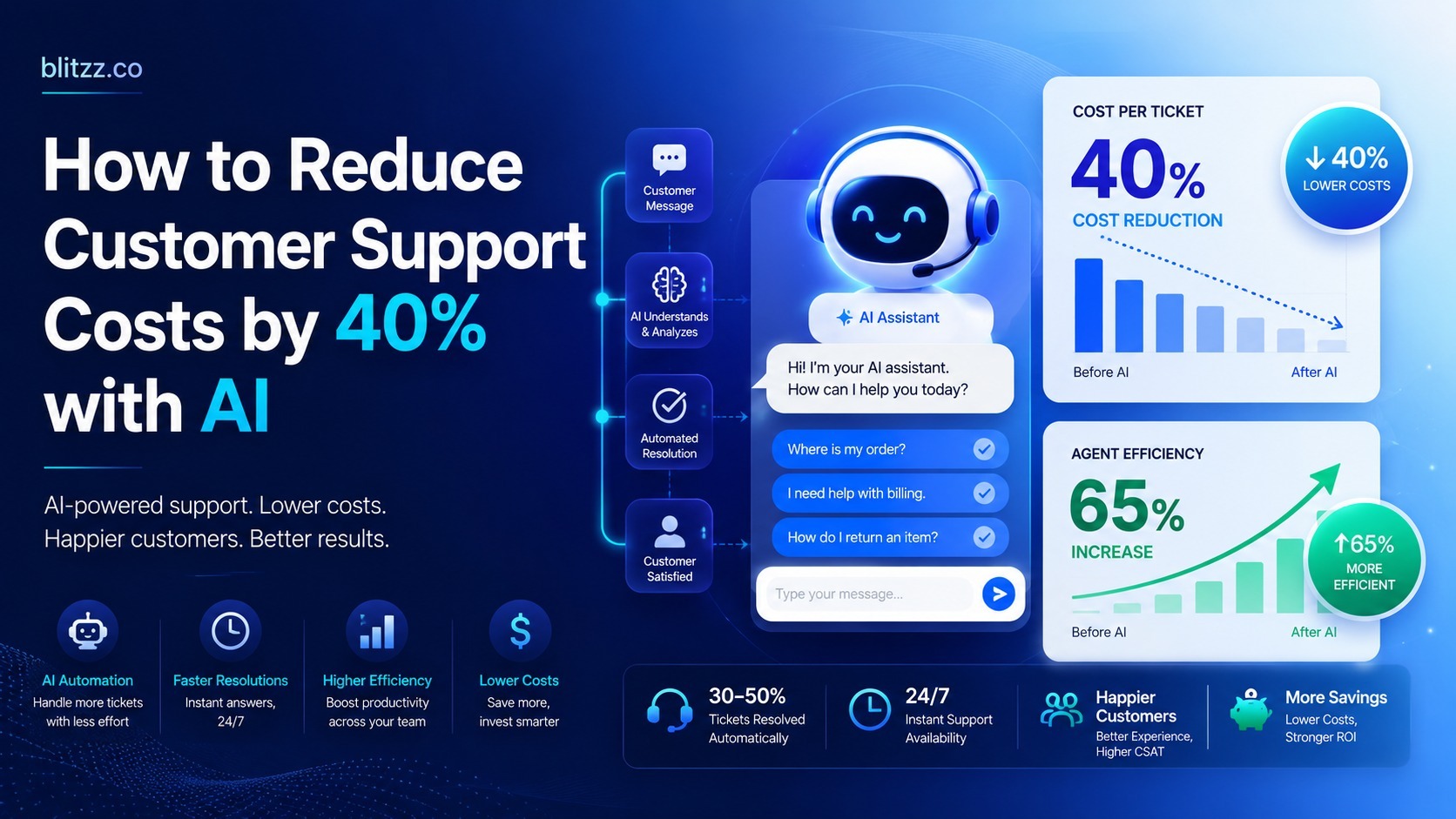
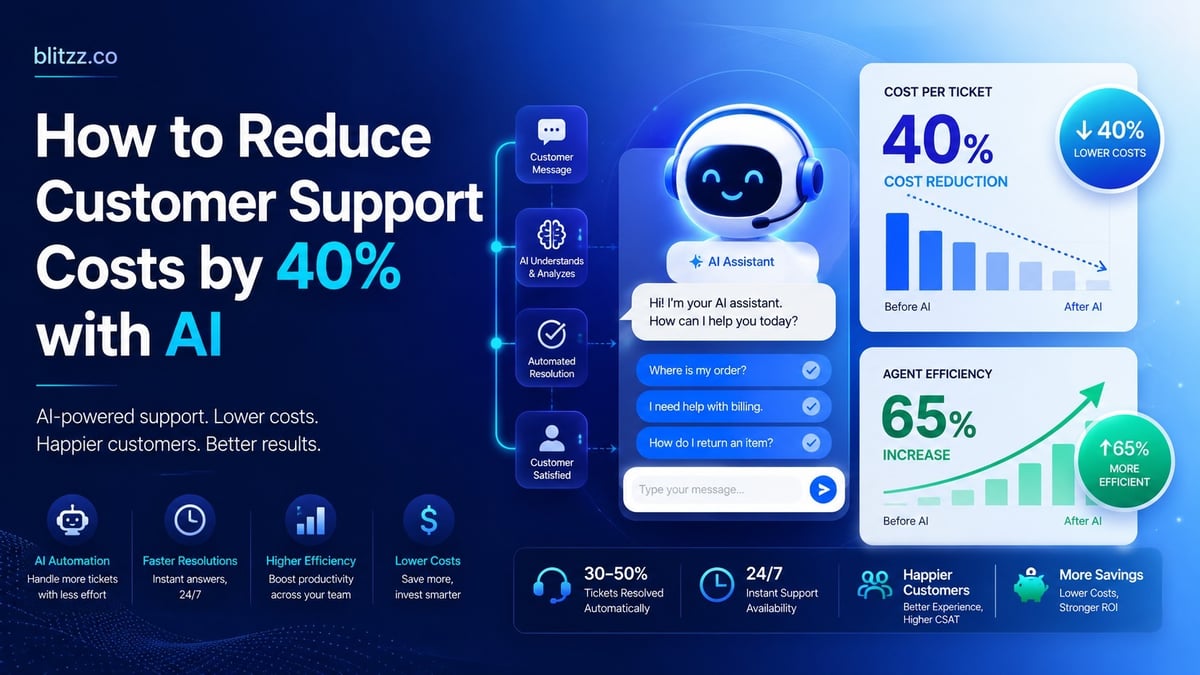
Customer support is one of the few functions where cost and quality usually move in opposite directions. Hiring more agents, dispatching more technicians, and extending hours all improve service—and all inflate the budget. AI changes that equation. Used well, it lets teams cut support costs dramatically while improving the customer experience at the same time. A 40% reduction is not a marketing fantasy; it's an achievable target for organizations that apply AI where the money actually leaks.
The catch is that most companies aim AI at the wrong place. They deploy chatbots to deflect simple tickets and call it a transformation. That helps—but it addresses the cheapest interactions while leaving the expensive ones untouched. The largest savings live in the physical world: the truck rolls, repeat visits, and failed first attempts that drain field-service and support budgets. This is where AI-powered visual triage delivers savings that chatbots alone can never match.
Where Support Costs Actually Hide
Before cutting costs, you have to find them. For most support and field-service operations, the biggest line items aren't agent salaries—they're the consequences of not resolving issues remotely. The single most expensive event in support is the truck roll: dispatching a technician to a customer site. Industry benchmarks put the fully loaded cost of a single visit between $150 and over $1,000 once you account for labor, fuel, vehicle wear, and scheduling overhead.
Worse, many of those visits never needed to happen. A large share of dispatches resolve problems a customer could have fixed in minutes with the right guidance. Then there are the repeat visits—the technician who arrives without the right part because no one could see the problem in advance, forcing a second trip at double the cost. Add long handle times, manual documentation, product returns triggered by setup confusion, and the missed-appointment fees that pile up when customers aren't home, and the true cost of "we couldn't see it" becomes staggering. Most organizations underestimate it because these expenses are scattered across departments rather than sitting in a single budget line. The first step toward controlling support costs is making them visible: track dispatch volume, repeat-visit rate, and average resolution time, and the leaks become obvious.
What Chatbots Can and Can't Save
Conversational AI earns its keep. Modern chatbots resolve a large portion of routine, text-based queries around the clock, and the broader AI revolution in customer service has shown measurable reductions in average handle time and meaningful gains in satisfaction. For password resets, billing questions, and order status, automation is genuinely cheaper than a human.
But chatbots operate within a hard boundary: language. They can answer "where is my order?" They cannot see why a router won't connect, why an appliance throws an error code, or why an installation failed. These are the interactions that lead to dispatches—and they're precisely the ones a text bot escalates rather than resolves. As Blitzz explains in its look at AI and AR in customer support, automation reaches its limit the moment a problem becomes visual. Deflecting a $5 ticket is useful. Preventing a $300 truck roll is transformative. A cost-reduction strategy built on chatbots alone leaves the bigger prize on the table.
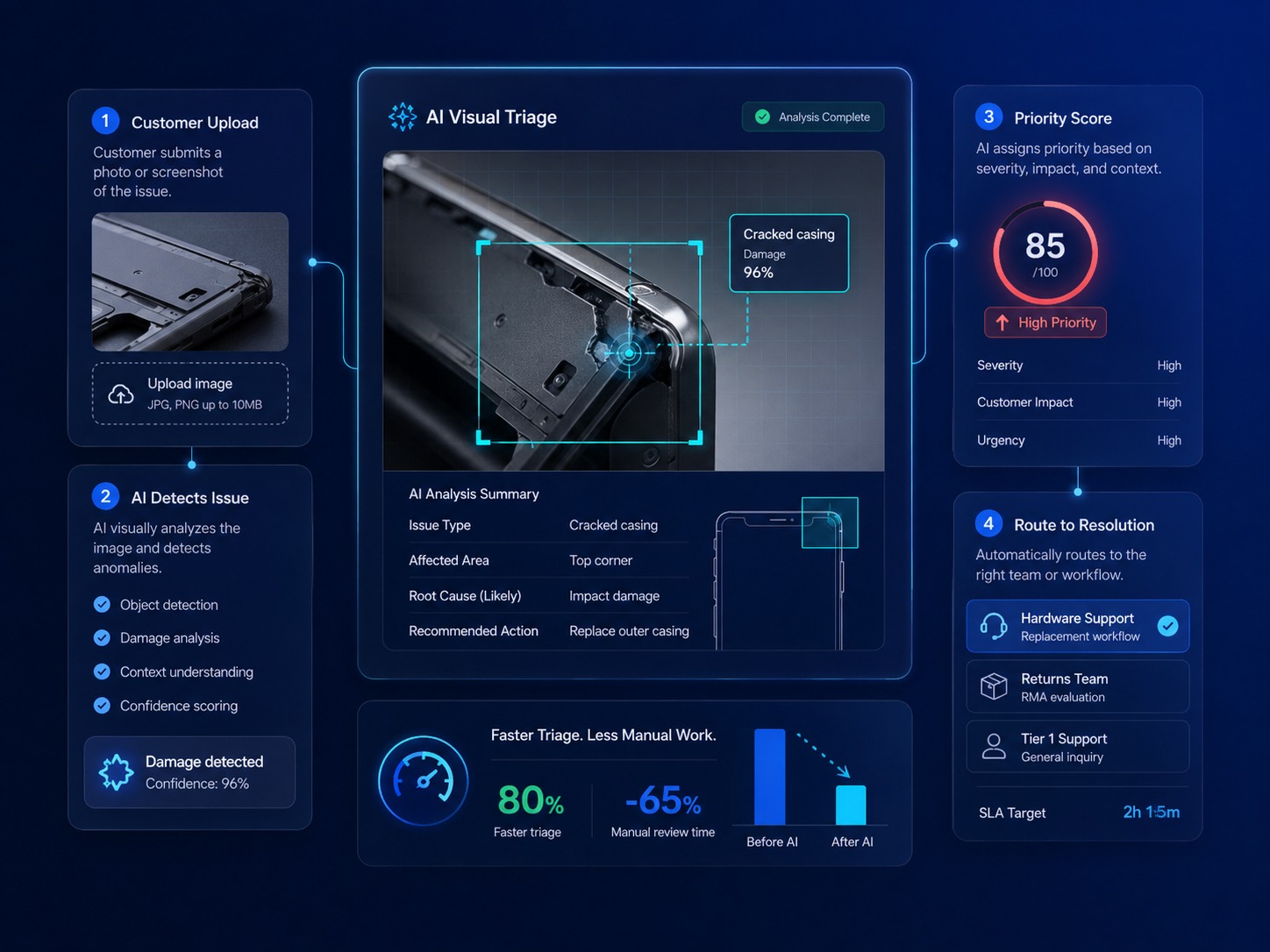
The Bigger Lever: AI Visual Triage
Visual triage is the practice of having an agent—augmented by AI—see the problem through the customer's smartphone camera before any decision to dispatch is made. Instead of guessing from a verbal description, the agent diagnoses the actual issue, guides the customer through a fix when possible, and dispatches a technician only when one is genuinely required.
The impact on cost is immediate and structural. When agents can see what the customer sees, ambiguity disappears and first-call resolution improves by up to 40%. Blitzz describes this shift as the difference between visual support and a traditional call center: one resolves on the first contact with full visual context, the other relies on the customer to narrate a problem they can't accurately describe.
Triage also acts as a filter. Not every issue can be solved remotely, but visual context lets an agent instantly sort the ones that can from the ones that genuinely need a technician. That filtering is where the cost curve bends—because every dispatch you avoid is the single most expensive event in your support process removed from the ledger. AI strengthens the filter further by identifying components on the video feed, surfacing relevant troubleshooting steps, and flagging when a fix is within the customer's reach.
Eliminating Truck Rolls: The Core of the 40%
This is where the headline savings come from. Blitzz customers report reducing truck rolls by up to 60%, and surveyed customers saved an average of five to six trips per service rep every month—roughly $533 per rep in avoided dispatch costs. The math scales fast. Consider the example Blitzz cites in its breakdown of truck-roll costs and efficiency: a mid-sized company performing 1,000 dispatches a year at $300 each spends $300,000 annually. Resolving even 30–40% of those remotely returns six figures straight to the bottom line.
A real deployment makes it concrete. One large telecom provider piloted visual support with just 20 technicians for 30 days, eliminated 120 site visits, and saved over $13,000 in a single month. That is the kind of number a chatbot rollout simply cannot produce, because the savings come from the physical visits that text automation never touches.
Killing Repeat Visits and Raising First-Time Fix Rates
Avoiding unnecessary dispatches is only half the story. When a visit truly is required, visual triage ensures it succeeds on the first attempt. By diagnosing the issue in advance, the team knows exactly which parts, tools, and expertise to send—dramatically improving first-time fix rates and eliminating the costly second trip. Every avoided repeat visit removes a full truck roll from the budget. For operations running thousands of dispatches a year, even a modest lift in first-time fix rates compounds into substantial annual savings. The customer experience improves in lockstep: nobody enjoys taking a second day off work to wait for a technician who should have finished the job the first time, and the goodwill earned by getting it right once translates into higher retention and fewer escalations.
Cutting Handle Time and Documentation Costs
Labor is the other major cost center, and AI attacks it from two directions. First, visual context shortens conversations: an agent who can see the problem solves it faster than one trading descriptions back and forth. Second, AI eliminates the documentation tax. The AI Call Summary feature generates a structured record of every session automatically—issue, steps taken, resolution—so agents skip the manual note-taking that quietly consumes minutes after every interaction.
Those minutes add up. As Blitzz notes in its guide to automating remote support workflows, a five-minute administrative task per session becomes hours of wasted labor per week across a team. Connecting visual sessions to your existing systems through native CRM and contact-center integrations removes that overhead entirely, letting recordings, photos, and summaries flow into the customer record without re-keying. The downstream effect is cleaner data and fewer follow-up contacts caused by lost context—another quiet but real source of savings.
Lowering Onboarding and Connection Costs
Two more savings often go unmeasured. The first is onboarding. App-free visual support communication means customers join a session by tapping a link—no downloads, no second login—which raises connection success rates and shortens every call. Blitzz reports a 95% connection rate, eliminating the wasted minutes agents spend walking customers through app installations.
The second is staff ramp time. Recorded, AI-summarized sessions create a training library that helps new hires reach productivity faster and lets experienced agents handle more complex work. New agents learn from real customer scenarios rather than scripted role-plays, and supervisors spend less time on manual call review. When weighing platforms, the smartest buyers evaluate total cost of ownership—connection rates, resolution speed, and labor saved—rather than license price alone, because a tool that resolves more issues per agent pays for itself many times over.
Putting the 40% Together
No single feature delivers a 40% cut—the figure is the sum of compounding reductions. Truck rolls fall by half or more. Repeat visits shrink as first-time fix rates climb. Handle time drops with visual context, and documentation labor disappears with AI summaries. Chatbots deflect the cheap, high-volume tickets at the top of the funnel; visual triage prevents the expensive field events at the bottom. Layered together across a support organization, these reductions routinely reach—and often exceed—the 40% mark.
The sequencing matters too. Each improvement reinforces the others: faster resolutions free agents to handle more sessions, automated documentation feeds cleaner data back into routing and self-service, and higher first-time fix rates reduce the inbound volume that drove costs in the first place. This is why companies across telecom, insurance, healthcare, and field service now treat remote visual support as a cost imperative rather than a nice-to-have—and why the savings tend to grow over the first year rather than plateau.
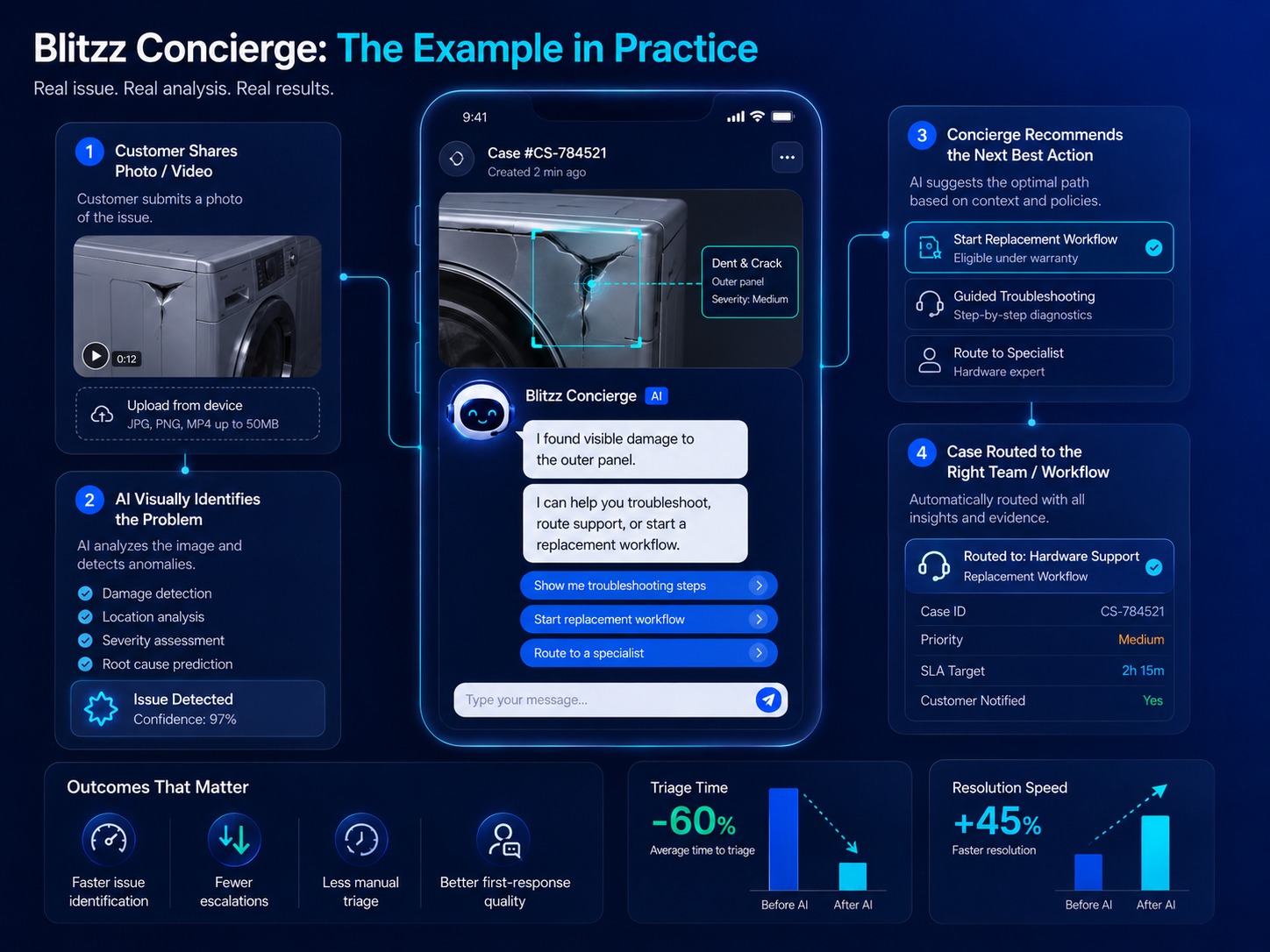
Blitzz Concierge: The Example in Practice
Blitzz Concierge is purpose-built for exactly this kind of cost reduction. It pairs app-free live video with AI so agents can triage visually, guide customers with augmented-reality annotations, and let the system handle documentation. Blitzz reports that Concierge customers see up to 10x ROI in the first month and reduce average issue resolution time by 48%, while sending technicians only when a problem genuinely requires one.
Because it deploys as SaaS, a business can onboard 5 or 500 users without a complicated rollout—one telecom brought 1,500 agents up to speed in two days—and transparent pricing scales with the team. Concierge serves contact center support teams drowning in call volume, broader customer support use cases from equipment troubleshooting to sales, and inspection and audit teams capturing documentation remotely. For digital journeys, cobrowsing adds the same see-and-guide efficiency to web and app support.
How to Start
Begin by measuring your baseline: dispatch volume, average truck-roll cost, repeat-visit rate, and handle time. Identify your single biggest cost driver, then pilot visual triage against it—often app-free contact-center support or a high-dispatch field team. Track the same KPIs over 30 days and the savings will speak for themselves.
The path to a 40% cost reduction isn't about replacing humans with bots. It's about giving your team the ability to see, so they resolve more issues remotely, dispatch fewer trucks, and fix problems right the first time. To model the impact for your own operation, explore why visual support pays for itself and book a Blitzz demo to see the savings in action.


Blitzz Team
The Blitzz Team writes about remote video support, virtual inspections and field service. Our guides come from working with home builders, property managers, warranty teams, contact centers and field service organizations that use Blitzz to see and solve issues without a truck roll.