
.png?width=120&height=55&name=Blitzz-Logo-right%20white%20eyes%20-%20not%20transparent%20(3).png)
On this page
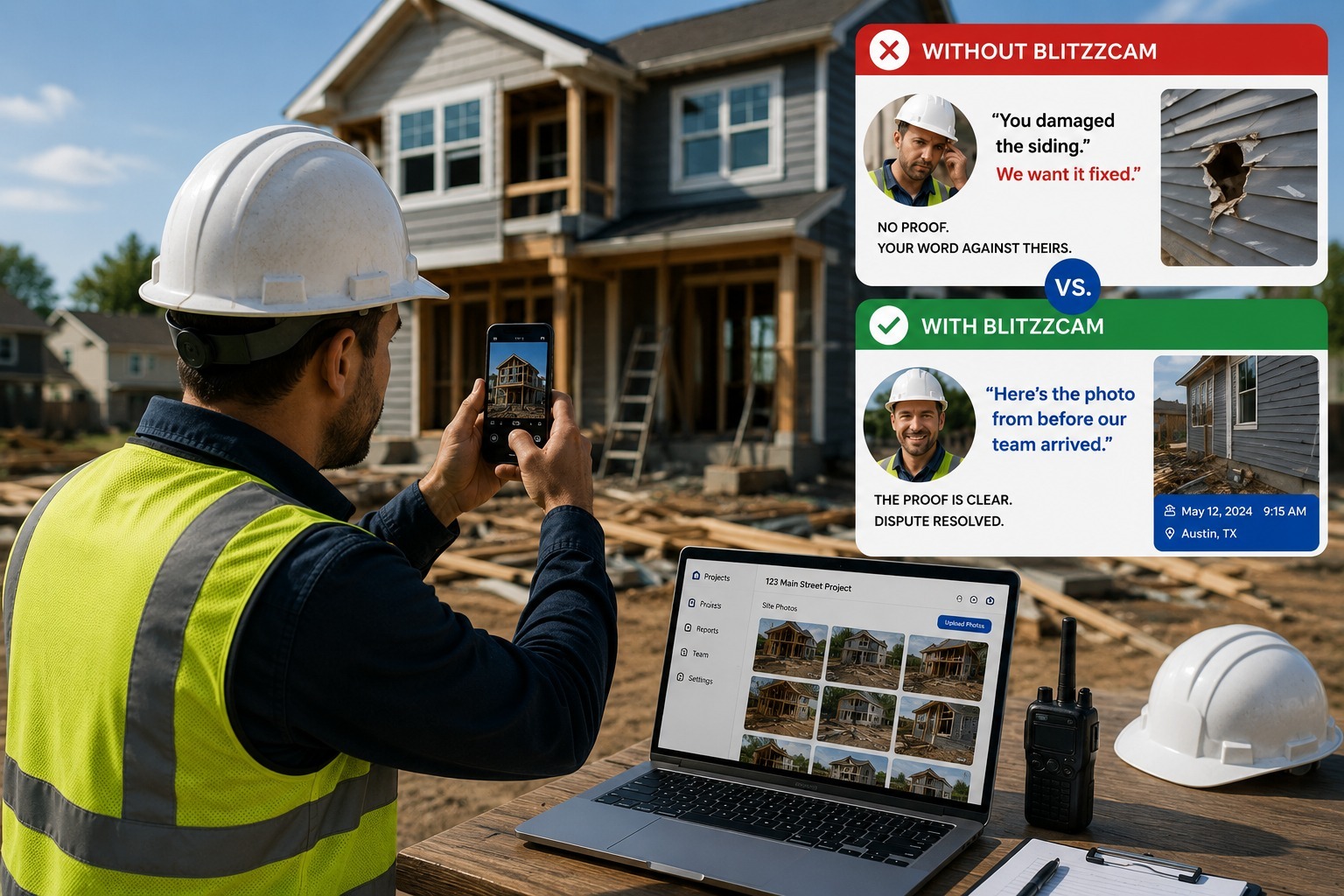
A subcontractor says the damage was already there when they arrived. The general contractor says it wasn't. A client says a wall was damaged during the renovation; the contractor says it was already cracked before work began. These disputes are some of the most common — and most frustrating — situations a contractor deals with, because they usually come down to memory and credibility rather than clear evidence.
BlitzzCam exists to remove that ambiguity. Every photo taken through it is automatically stamped with GPS location and a timestamp, creating a verified record of exactly what a space looked like, where, and when — turning a dispute that would otherwise be a matter of conflicting accounts into something that can be settled by looking at the documented record.
This piece walks through the specific disputes contractors run into most often, and how a verified photo habit changes how those conversations go.
Why Damage Disputes Are So Hard to Resolve
Most damage disputes in construction share a common structure: something is found damaged, and two or more parties disagree about when it happened and who's responsible. Without clear documentation, resolving this usually comes down to whoever's account sounds more credible — which is a bad position for a contractor to be in, since credibility disputes are unpredictable and often expensive to resolve through legal channels.
The frustrating part is that most of these disputes are actually simple, factual questions that could be settled instantly with the right documentation. Was that crack in the drywall there before the plumber started work? A time-stamped, location-verified photo taken before the plumber arrived answers that question definitively. Without it, it's a matter of opinion.
What Makes a Photo Record Defensible
A photo alone isn't strong evidence in a dispute — anyone can question when it was actually taken or whether it really shows the location in question. What makes a photo record defensible is verified metadata: proof of the exact location and exact time the photo was captured, which is precisely what BlitzzCam attaches automatically.
This is a meaningfully different standard of evidence than a photo pulled from a phone's camera roll, where the metadata can be incomplete, altered, or simply absent depending on how the photo was shared. A contractor presenting a BlitzzCam photo in a dispute isn't just showing a picture — they're presenting a verified record that's much harder to challenge on the basis of timing or location.
Documenting Pre-Existing Conditions
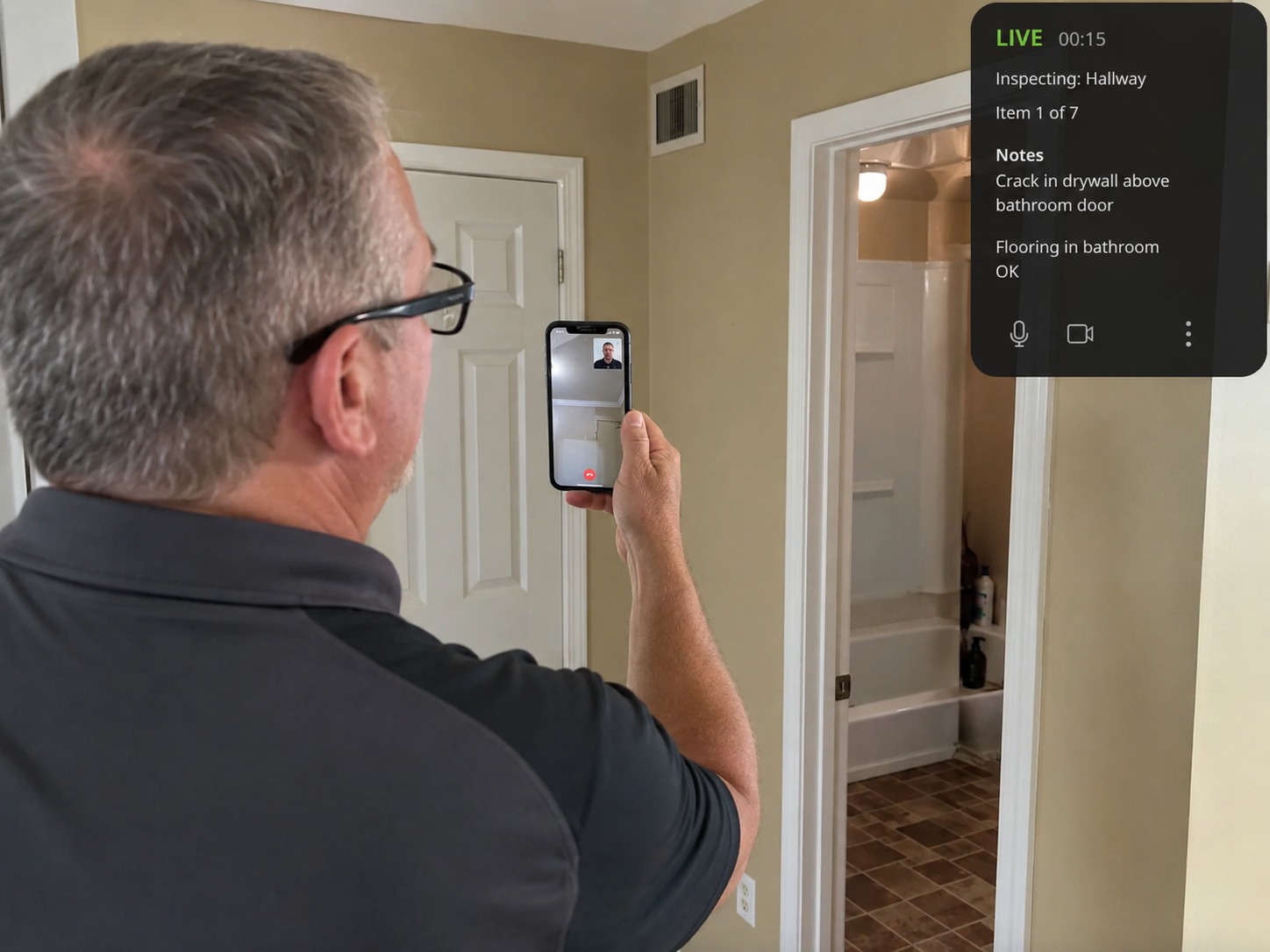
The single most valuable habit for avoiding damage disputes is documenting site or property conditions before any work begins. A contractor who walks a site with BlitzzCam before starting work — photographing existing conditions room by room, wall by wall — creates a verified baseline that protects them from being blamed for damage that was already there.
This matters most on renovation and remodel projects, where a client may not remember or may genuinely not have noticed existing wear, cracks, or damage before work started. A dated, verified photo record removes the need to rely on the client's memory or the contractor's word alone.
Trade-to-Trade Handoffs
Multi-trade projects create a specific kind of dispute risk: when one trade finishes and another begins, it's not always clear which trade is responsible for damage discovered later. A plumber blames the electrician; the electrician blames the framer. Without documentation at each handoff, this becomes nearly impossible to sort out after the fact.
Contractors who use BlitzzCam to photograph the space at the start and end of each trade's work build a clear chain of custody for site conditions — creating a documented record that shows exactly what condition the space was in before and after each trade worked, which removes most of the ambiguity in a later dispute.
Client Walkthroughs and Milestone Documentation
Client-facing milestones — a walkthrough before a payment is released, a final walkthrough before closeout — are common flashpoints for disputes about work quality or completeness. A BlitzzCam-documented walkthrough at each milestone creates a shared, verified reference point: what the space looked like, confirmed by both location and time, at the moment the client signed off.
This protects contractors from later claims that work wasn't actually complete or that damage occurred after a milestone was approved, since the documented record shows the condition of the space at the specific moment the client accepted it.
What Happens When a Dispute Reaches Arbitration
When a damage dispute escalates beyond a conversation on-site and into arbitration or litigation, documentation quality becomes the deciding factor far more often than either party's initial account. A contractor with a consistent, verified BlitzzCam photo record across the life of the project has a straightforward story to tell: here is what the space looked like, at this location, at this time, throughout the project.
Legal counsel representing contractors increasingly ask about documentation practices early in a dispute, and a verified, organized photo record from BlitzzCam is generally treated as considerably stronger evidence than a handful of undated photos pulled from a phone, since the GPS and timestamp data removes the most common grounds for challenging the documentation's accuracy.
Building This Into Standard Practice
Contractors who get the most protective value from BlitzzCam aren't using it only once a dispute is already brewing — they're building it into standard practice at predictable points: pre-work walkthroughs, trade handoffs, and client milestones. Using BlitzzCam's checklist feature to define exactly what needs to be photographed at each of these points means the habit doesn't depend on any one person remembering to do it — it becomes part of how the job runs.
Over time, this consistency builds a company-wide standard rather than a practice that varies by which superintendent happens to be running a given project — which matters because disputes often surface long after the original project team has moved on to other work.
A Real-World Pattern: The Renovation Dispute
One of the most common damage disputes in residential renovation follows a predictable pattern: a client walks through their home after a project wraps up and points to a scuff, a crack, or a scratch they don't remember seeing before, asking the contractor to fix it at no charge. Without documentation, the contractor has no way to prove the mark was there before work began, and ends up either absorbing the cost of a repair they didn't cause or having an uncomfortable conversation about who's responsible.
A contractor with a BlitzzCam-documented pre-work walkthrough has a straightforward answer in this exact situation: here is the verified photo, at this location, dated before your project began, showing the same mark. This doesn't just resolve the immediate dispute — it prevents the conversation from becoming adversarial in the first place, since the documentation speaks for itself rather than requiring the contractor to argue their case.

Why This Also Protects Good-Faith Clients
It's worth noting that verified documentation doesn't only protect contractors — it protects clients acting in good faith too. A client who genuinely believes a contractor caused damage deserves a clear answer, not just the contractor's assurance that it didn't happen. A verified photo record settles the question definitively for both parties, which tends to preserve the relationship rather than leaving lingering doubt on either side.
This framing matters when introducing BlitzzCam to clients and subcontractors: documenting site conditions isn't about assuming bad faith from the other party, it's about removing ambiguity so that disagreements — which happen even between people acting honestly — can be resolved quickly and factually rather than through prolonged back-and-forth.
Insurance and Bonding Considerations
General liability insurers and bonding companies increasingly ask contractors about their documentation practices as part of underwriting and renewal conversations. A contractor who can demonstrate a consistent, verified photo documentation habit — using a tool like BlitzzCam at predictable project milestones — represents a lower risk profile than one relying on memory and scattered, unverified photos.
This is a secondary benefit rather than the primary reason to adopt verified photo documentation, but for contractors carrying significant liability exposure across a large volume of active projects, even a modest reduction in dispute frequency or severity can affect the overall cost and availability of coverage over time.
Setting a Company-Wide Standard
Contractors who get the most protective value from a tool like BlitzzCam typically formalize its use as company policy rather than leaving it to individual project managers' discretion — specifying which milestones require documented photos, who is responsible for capturing them, and how the resulting record should be organized so it's retrievable across every active and completed project.
This consistency matters because damage disputes often surface long after a project has closed out and the original staff have moved to other jobs. A company-wide standard, applied the same way on every project, means the documentation exists regardless of which superintendent ran a particular job or whether that person is still with the company by the time a dispute eventually comes up.
The Cost of Not Documenting
It's worth being direct about what's actually at stake when a contractor doesn't maintain verified documentation: a disputed damage claim without clear evidence often gets resolved based on who has more leverage in the relationship, not who's actually correct. A contractor might absorb the cost of a repair they didn't cause simply because arguing the point isn't worth damaging the client relationship or risking a negative review, even when they're confident the damage was pre-existing.
Over the course of a year, these absorbed costs add up in ways that are easy to overlook because each individual instance feels small — a few hundred dollars here, a free touch-up there. Contractors who start tracking how often this happens, and estimating what it would have cost to dispute each instance with proper documentation, often find the cumulative number is larger than expected, and more than enough to justify the modest habit change of documenting site conditions at key points throughout every project.
Getting Buy-In From the Whole Team
Introducing verified photo documentation works best when the whole team — superintendents, foremen, and subcontractors — understands why it's being introduced, rather than experiencing it as an added administrative task imposed from above. Framing it around protection rather than surveillance tends to land better: the goal is a documented record that protects everyone's account of what happened, not a way to catch someone doing something wrong.
Contractors who introduce this successfully typically start with a clear, simple explanation of when photos need to be taken — pre-work walkthroughs, trade handoffs, client milestones — rather than leaving it to individual judgment about when documentation feels necessary. A simple, consistently applied rule is easier for a team to adopt than a vague expectation to "document things when it seems important."
Frequently Asked Questions
How is a BlitzzCam photo more useful in a dispute than a regular phone photo?
BlitzzCam automatically verifies every photo with GPS location and a timestamp, which is harder to challenge than a phone camera roll photo, where that metadata is often incomplete or missing.
When should contractors document pre-existing conditions with BlitzzCam?
Before any work begins — a walkthrough photographing existing conditions creates a verified baseline that protects the contractor from being blamed for damage that was already present.
Does BlitzzCam help with disputes between different trades on the same project?
Yes. Photographing the space at the start and end of each trade's work creates a documented chain of custody for site conditions, making it clear which trade was responsible for a given condition.
Is a BlitzzCam photo record useful if a dispute goes to arbitration or litigation?
Yes. A verified, organized photo record is generally treated as stronger evidence than undated photos, since GPS and timestamp verification removes common grounds for disputing when and where a photo was taken.
Do subcontractors need to use BlitzzCam themselves, or just the general contractor?
This varies by company, but many GCs have subcontractors document their own handoffs as well, since a verified record from the trade itself is useful evidence for everyone involved, not just the GC.
How long should a documented photo record be kept for a project?
Retention periods vary by contract and jurisdiction, but many contractors keep project documentation for the length of the applicable statute of limitations for construction claims in their state.
Does verified documentation only benefit the contractor, not the client?
No. A verified photo record settles disputed questions definitively for both parties, which protects clients acting in good faith just as much as it protects the contractor, and tends to preserve the working relationship.
Can documentation practices affect a contractor's insurance terms?
Some insurers and bonding companies view a consistent, verified documentation practice as a lower-risk signal during underwriting and renewal, though this is a secondary benefit rather than the primary reason to adopt it.
See how BlitzzCam helps contractors build a defensible, verified photo record on every project — schedule a demo to see it in action.