
.png?width=120&height=55&name=Blitzz-Logo-right%20white%20eyes%20-%20not%20transparent%20(3).png)

On this page
What Happens During an Insurance Claims Video Inspection?
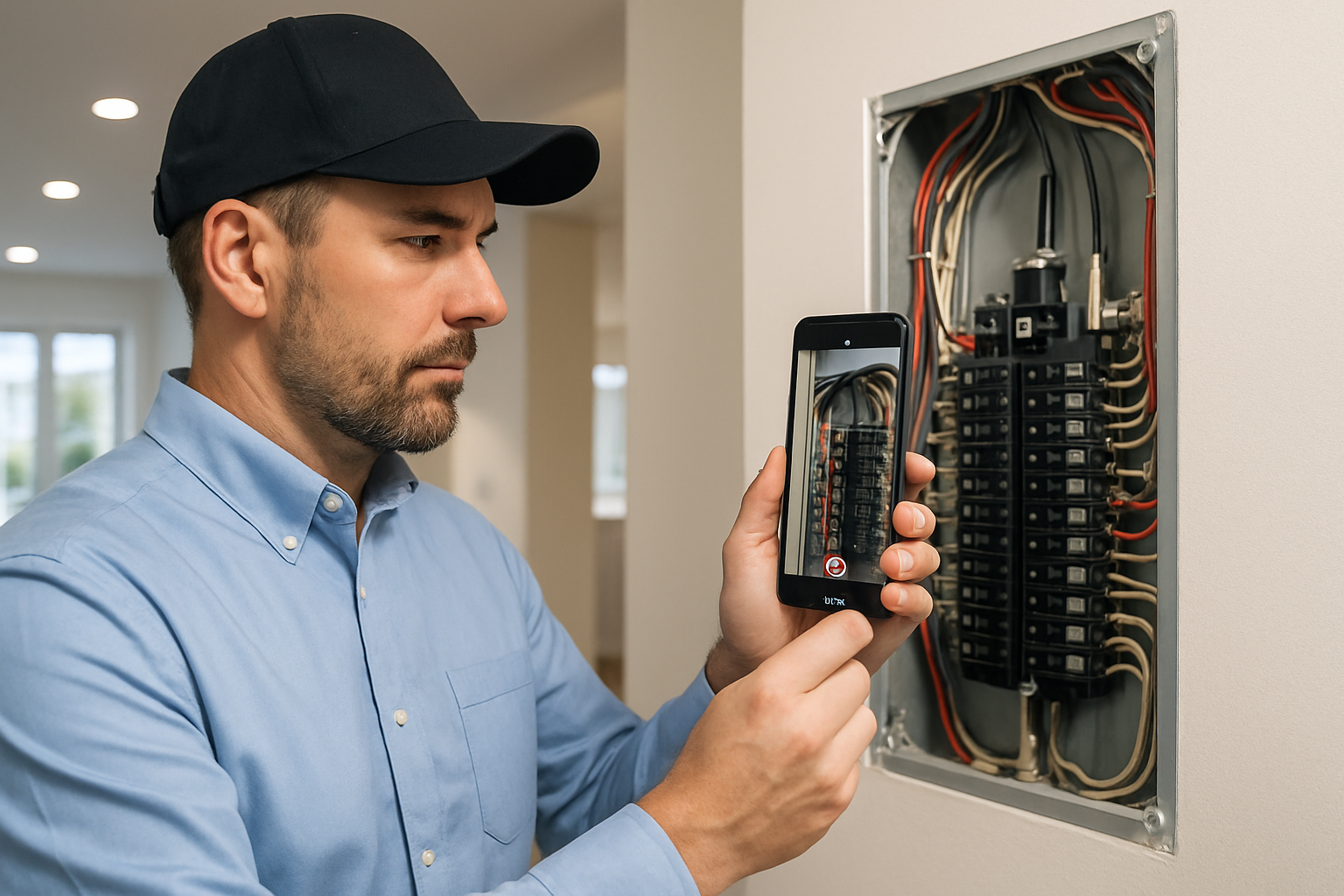
An insurance claims video inspection is a live, remote assessment where an adjuster connects with you via video — usually through a simple link on your phone — to document and evaluate damage without visiting in person.
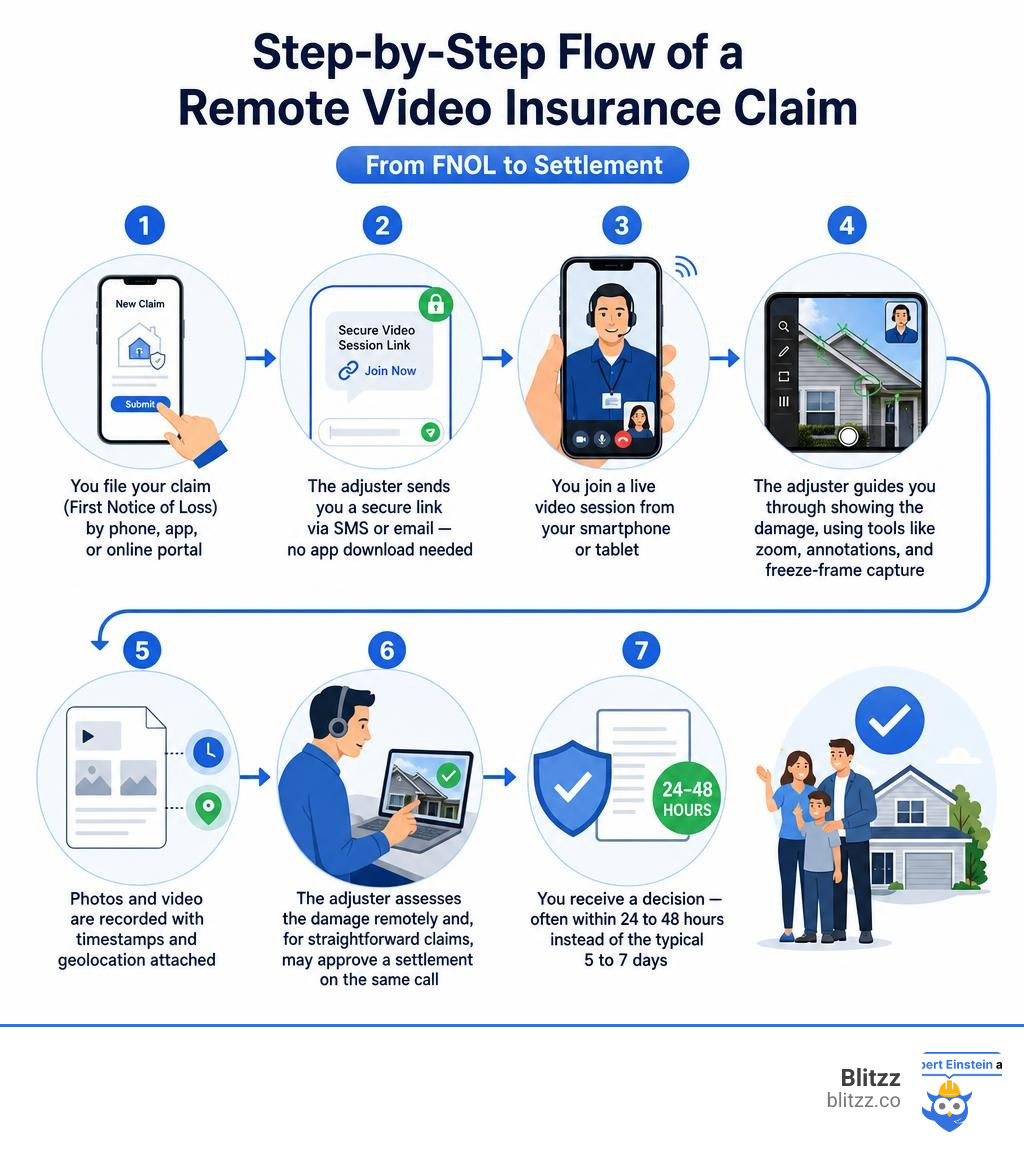
Here is what typically happens, from start to finish:
- You file your claim (First Notice of Loss) by phone, app, or online portal
- The adjuster sends you a secure link via SMS or email — no app download needed
- You join a live video session from your smartphone or tablet
- The adjuster guides you through showing the damage, using tools like zoom, annotations, and freeze-frame capture
- Photos and video are recorded with timestamps and geolocation attached
- The adjuster assesses the damage remotely and, for straightforward claims, may approve a settlement on the same call
- You receive a decision — often within 24 to 48 hours instead of the typical 5 to 7 days
This process is now mainstream. According to LexisNexis, roughly 60% of auto claims are handled virtually in 2026, up from less than 15% just a few years ago. And it is not just auto — property, commercial, and equipment claims are all moving in the same direction.
If you have never done one before, the process can feel unfamiliar. This guide walks you through exactly what to expect, how to prepare, and how to get the best outcome from your inspection.
What is an Insurance Claims Video Inspection?
At its core, an insurance claims video inspection is an interactive, adjuster-guided virtual walkthrough designed to replace or supplement traditional manual site visits. Instead of waiting days or weeks for a field adjuster to drive out to your home or inspect your vehicle, we leverage standard smartphone technology to bring the adjuster directly to the scene of the loss in real time.
Unlike passive photo submissions — where policyholders snap a few pictures and hope they captured the right angles — a video inspection is dynamic. The remote adjuster guides you to show specific details, adjust the lighting, or zoom in on structural or mechanical elements. It often begins at the very moment you report a loss, a concept known as Video First Notice of Loss (FNOL).
With tools like Remote Video Inspections for Insurance, there is no need to navigate complicated software. The session runs directly inside your mobile browser. The adjuster can take high-definition snapshots, read barcodes or serial numbers via optical character recognition (OCR), and verify the exact location of the damage using built-in GPS capabilities.
How to Prepare for Your Insurance Claims Video Inspection
While remote inspections are designed to be simple and stress-free, taking a few minutes to prepare ensures the session runs as smoothly as possible. Here is a quick checklist we recommend:
- Charge Your Device: A live video stream with flashlight usage can drain your battery quickly. Make sure your smartphone or tablet is charged to at least 50%, or keep a portable charger handy.
- Test Your Connection: A stable internet connection is vital. If you are inspecting property damage inside your home, connect to your local Wi-Fi. If you are outdoors assessing vehicle damage, ensure you have strong cellular data.
- Clear the Path and Improve Lighting: Open blinds, turn on overhead lights, and clear away clutter around the damaged areas. If you are inspecting a dark basement or attic, the adjuster can remotely trigger your phone's flashlight, but starting with good ambient light makes a big difference.
- Gather Key Documents: Have your policy number, any initial repair estimates, receipts, or pre-damage photos ready. The adjuster may ask you to hold these up to the camera or upload them during the call.
By taking these basic steps, you can drastically reduce the time spent on the call. To learn more about how this technology simplifies property and auto evaluations, check out our guide on Insurance Inspections: How Remote Video Support Simplifies the Process.
Traditional Manual Site Visits vs. Remote Video Inspections
The insurance industry has historically relied on physical site visits to verify claims. However, this model introduces significant bottlenecks, high travel costs, and frustrating delays for policyholders.
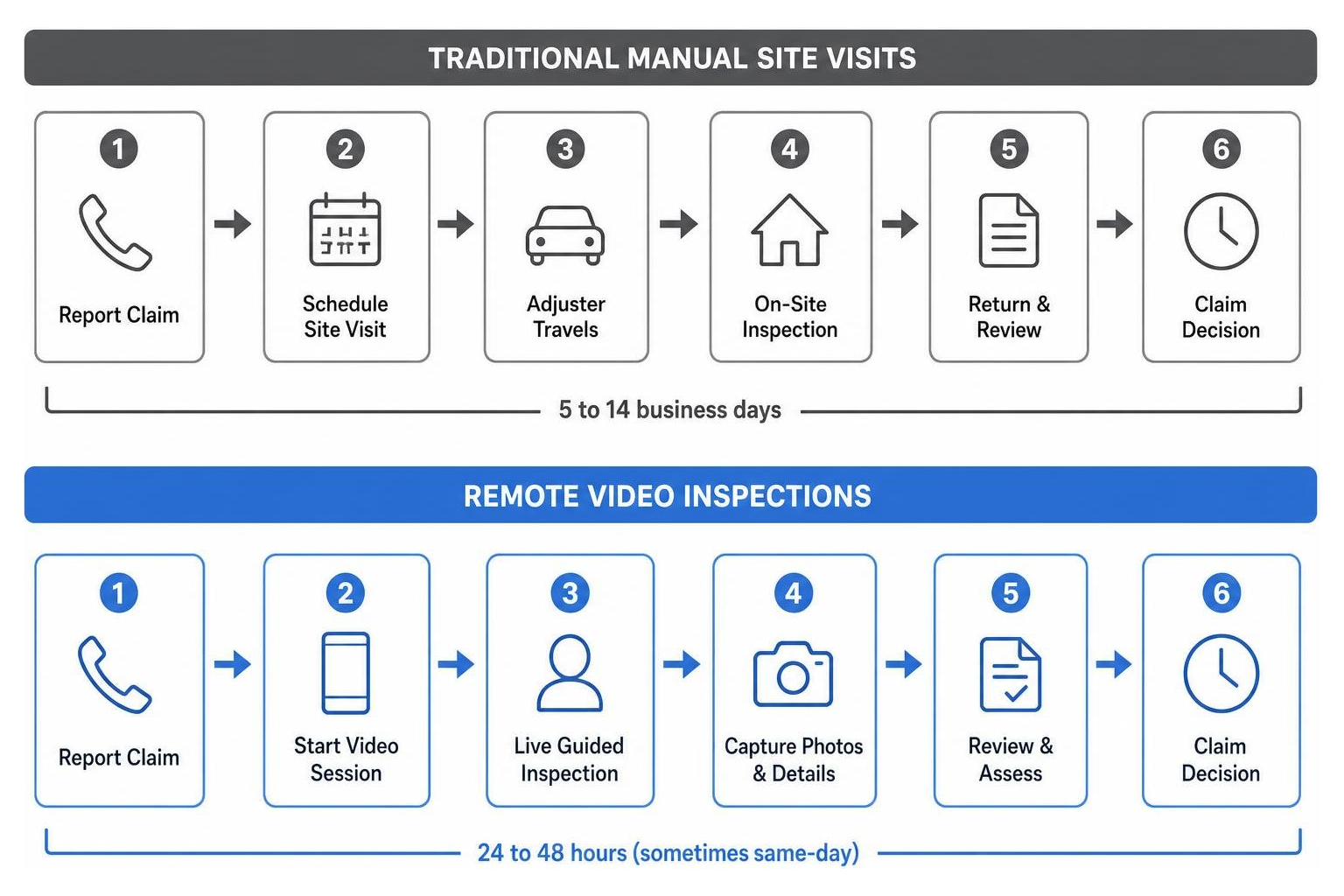
To understand why so many carriers are making the transition, let's look at how these two methods compare across key operational and customer experience metrics:
| Feature/Metric | Traditional Manual Site Visits | Remote Video Inspections |
|---|---|---|
| Average Cycle Time | 5 to 14 business days | 24 to 48 hours (sometimes same-day) |
| Travel & Adjuster Costs | High (mileage, hotel, field adjuster fees) | Extremely low (reduced by up to 60%–80%) |
| Safety Risks | Risk of falls, hazardous travel, structural collapses | Zero physical risk to the remote adjuster |
| Carbon Footprint | Significant due to vehicle travel | Minimal (highly sustainable) |
| Customer Convenience | Requires taking time off work to wait for adjusters | Flexible scheduling, completed in 15–20 minutes |
| Evidence Accuracy | Subjective notes, manual photos | Geotagged, timestamped, high-def video and AR records |
By shifting to virtual workflows, insurers can dramatically lower their Loss Adjustment Expenses (LAE) while delivering the rapid service that modern consumers expect. For a deeper dive into these operational advantages, explore the Benefits of Remote Video Inspections.
The Challenges of Traditional Claims Inspections
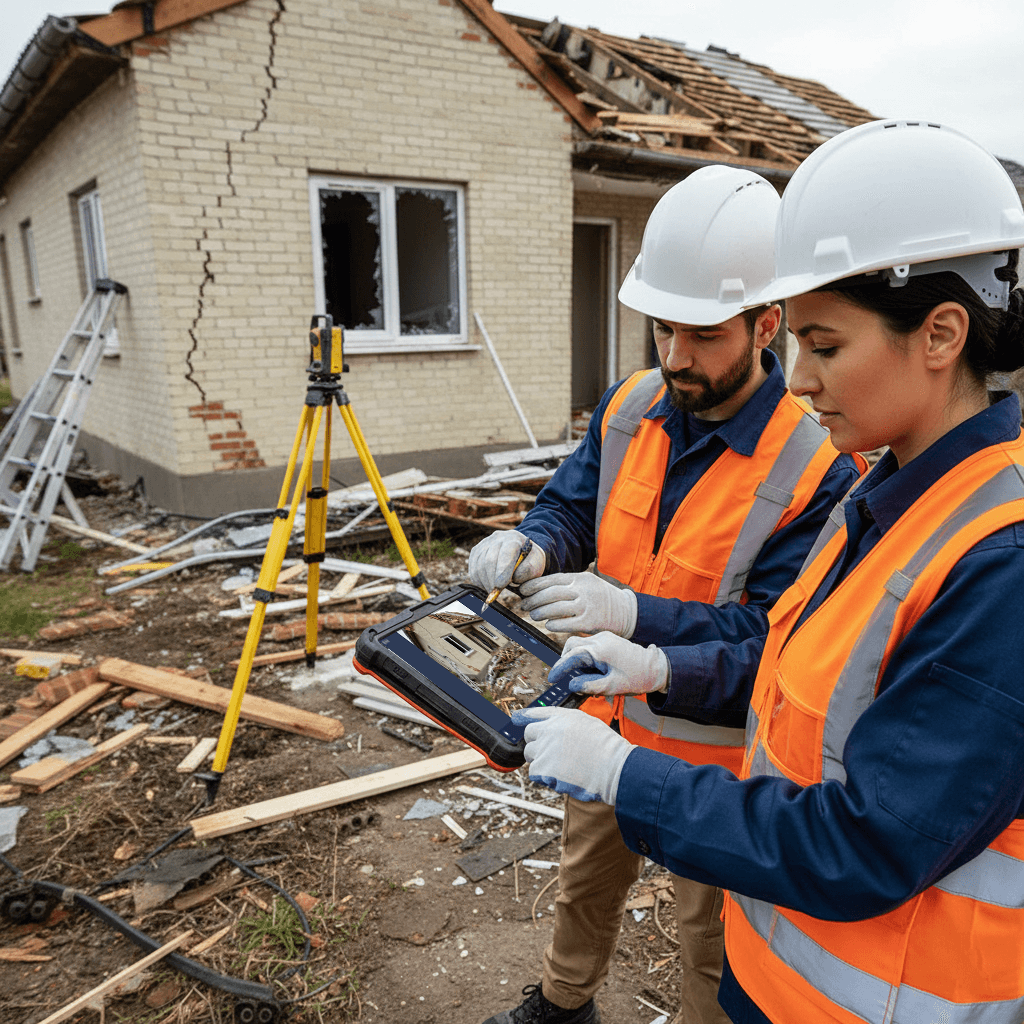
The traditional claims process is often a slow, expensive puzzle. When a major storm hits, field adjusters are stretched thin. Scheduling a physical inspection can take weeks, leaving policyholders living in damaged homes or driving compromised vehicles.
This delay has a direct impact on customer loyalty. According to J.D. Power, there is a massive gap in customer retention based on digital experiences: policyholders who receive a poor digital claims experience face a 52% switch/non-renewal risk, compared to just a 4% risk for those who receive an excellent digital experience.
Furthermore, traditional inspections carry a heavy financial burden. Insurers must pay for travel, accommodation, and third-party adjusting services, which can add hundreds of dollars to the cost of processing even a minor claim. There are also physical safety risks to consider; adjusters frequently have to climb onto damaged roofs or enter structurally unstable buildings.
From an environmental perspective, the constant driving contributes to massive carbon emissions. According to McKinsey research on claims digitization, digitizing these workflows can lead to a 25% to 30% potential reduction in loss adjustment expenses, while also helping carriers meet their corporate sustainability goals.
How Remote Video Inspections Solve These Pain Points
Remote video technology directly addresses these challenges by replacing windshield time with screen time. Instead of spending five hours a day driving between properties, an adjuster can handle 10 to 12 claims daily from the comfort of their office or home.
The numbers speak for themselves:
- 69% reduction in claims handling time, allowing adjusters to resolve issues in minutes rather than days.
- 60% to 80% reduction in field inspection expenses, saving insurers between $100 and $200 per claim.
- 25% increase in Customer Satisfaction (CSAT) scores when remote visual support is utilized.
By triaging claims virtually at the First Notice of Loss, insurers can instantly determine the severity of a claim. Simple cases can be settled on the spot, while complex cases that truly require an in-person expert can be prioritized and dispatched quickly. This hybrid approach ensures resources are used efficiently. According to the J.D. Power digital claims study, providing immediate, transparent visual validation is one of the single most effective ways to build trust and boost policyholder satisfaction.
Step-by-Step: What to Expect During Your First Virtual Assessment
If you are preparing for your first insurance claims video inspection, you might be wondering what the actual call looks like. The process is designed to be highly collaborative and takes only about 15 to 20 minutes.
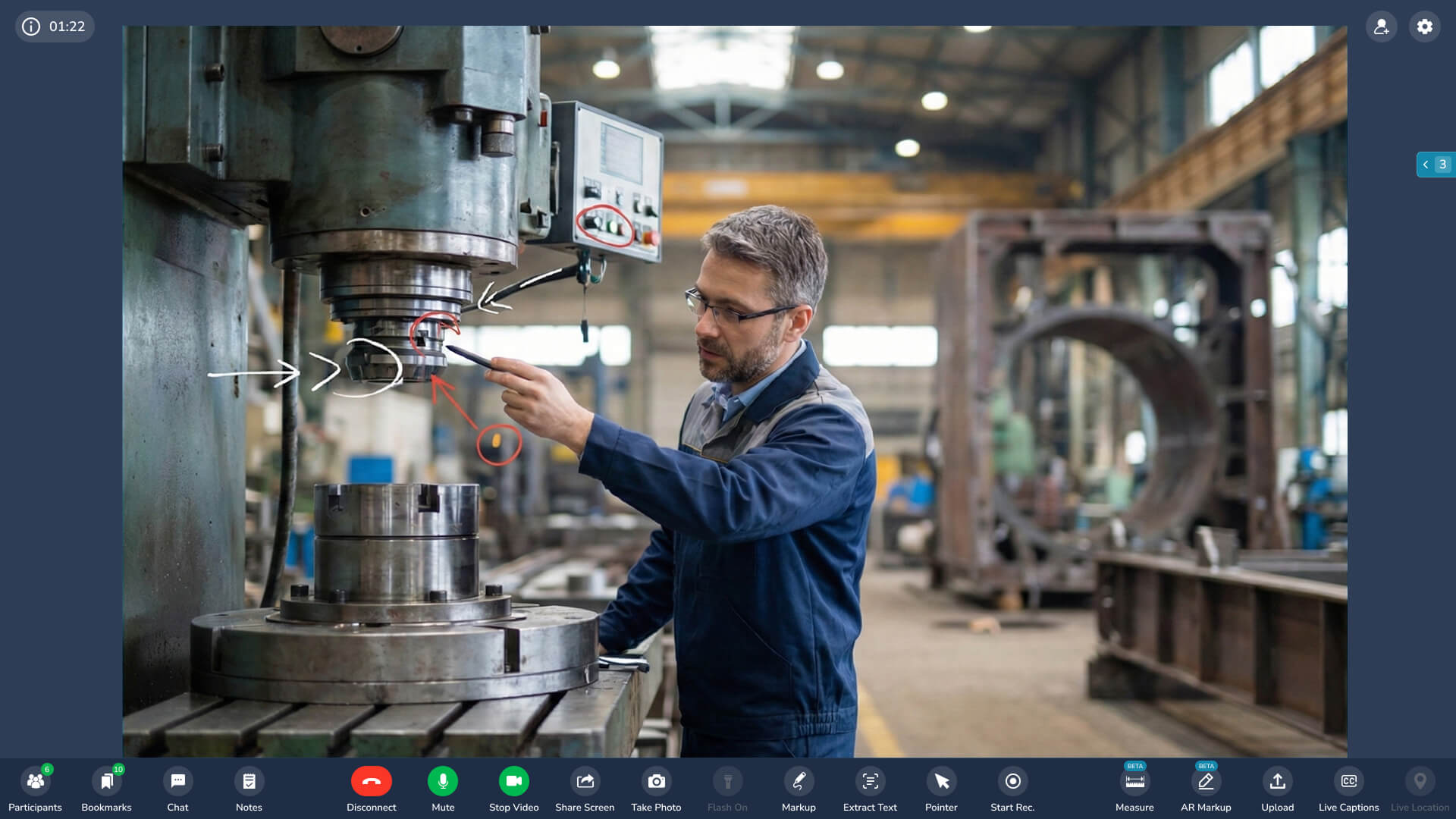
Here is a step-by-step breakdown of how a typical session unfolds:
- The Invitation: The adjuster sends a secure link to your smartphone via SMS text message or email.
- One-Click Connection: You tap the link. Your phone's default web browser opens, and a prompt asks for permission to access your camera and microphone. You do not need to download or install any apps.
- The Live Walkthrough: Once connected, the adjuster will introduce themselves. They will see your live camera feed on their screen. They will ask you to walk slowly toward the damaged area.
- Guided Documentation: The adjuster will guide your movements. They might say, "Please hold the camera steady right there," or "Let's zoom in on that water stain on the ceiling."
- Interactive Tools: The adjuster can use on-screen tools to highlight areas of interest. They can draw arrows or place markers on your screen using Augmented Reality (AR) annotations to show you exactly what they need to see.
- Capturing Evidence: During the live stream, the adjuster will take high-resolution, timestamped, and geotagged photos. They may also record portions of the call to build a permanent, verifiable record of the damage.
- Wrap-Up & Next Steps: Once all necessary evidence is captured, the adjuster will discuss the next steps, explain your coverage, and in many cases, initiate the settlement process before you hang up.
Real-Life Example: Water Damage in Florida
To see how this works in practice, consider the case of Sarah Martinez, a homeowner in Florida who suffered sudden water damage from a burst pipe in her kitchen. Under traditional circumstances, Sarah would have had to wait 5 to 7 business days for an adjuster to travel to her home, leaving her kitchen in disarray and risking mold growth.
Instead, her insurer initiated an insurance claims video inspection. Within two hours of filing her claim, Sarah received an SMS link. She tapped it, connected with a remote adjuster, and spent 20 minutes guiding her phone's camera under her kitchen sink and along the damaged baseboards.
The adjuster used remote zoom to capture the pipe's serial number and AR annotations to point out where temporary mitigation equipment should be placed. Thanks to the real-time visual evidence, Sarah’s water damage claim was approved, and her mitigation funds were released within 24 hours—allowing repairs to begin immediately.
The Advanced Technology Powering Remote Inspections
What makes a modern insurance claims video inspection so much more effective than a simple FaceTime or Zoom call is the underlying spatial intelligence and software built specifically for insurance workflows.
Today's remote inspection platforms leverage advanced technologies to ensure that every pixel captured is accurate, verifiable, and structured:
- 3D Scanning and LiDAR: Newer smartphones equipped with LiDAR sensors can generate precise 3D spatial meshes of a room or vehicle. This allows adjusters to calculate exact square footage, measure the depth of dented metal, or assess hail damage with millimeter accuracy.
- AI-Powered Image Analysis: Artificial intelligence models can analyze live video feeds to automatically detect damage types, classify vehicle parts, and cross-reference them with repair cost databases. This speeds up the estimation process and reduces human error.
- Geotagging and Cryptographic Verification: Every photo and video snippet captured during a remote session is automatically embedded with metadata, including GPS coordinates, compass direction, and a precise network timestamp. This ensures the evidence is legally defensible and tied directly to the loss location.
To explore how these cutting-edge tools are reshaping underwriting and claim resolutions, read our detailed analysis on The Future of Insurance Claims: AI Visual Inspection.
Augmented Reality (AR) and Live Annotations
One of the most valuable features of a dedicated video inspection tool is the ability to use Augmented Reality (AR) overlays in real time.
During a call, the adjuster isn't just a passive observer. They can interact with your physical environment through your screen:
- Freeze-Frame Capture: If you are moving the camera too quickly or the connection temporarily dips, the adjuster can freeze the frame on their end to capture a perfectly clear, high-resolution image.
- AR Annotations & Pointer Tools: The adjuster can draw circles, arrows, or text instructions directly onto their console, which instantly appear on your mobile screen. This makes it easy to guide you to look behind appliances, check specific pipes, or inspect vehicle tires.
- Remote Hardware Control: If you are inspecting a dark area, the adjuster can remotely turn on your phone's flashlight. They can also adjust the camera's zoom and focus settings to capture clear serial numbers or structural cracks without you having to manually fiddle with your screen.
These interactive features ensure that the inspection is thorough and that no critical evidence is missed. If you are interested in how these features apply specifically to automotive claims, see our post on Remote Insurance Inspection Software for Auto Claims.
The Future of Insurance Claims Video Inspection
Looking ahead, the adoption of remote video technology is set to accelerate even further. By combining ultra-fast 5G networks with mature machine learning algorithms, the virtual claims process will become even more automated and seamless.
In the near future, we can expect:
- Automated Content Inventory: AI tools that can instantly catalog damaged personal property (like furniture, electronics, and appliances) from a quick video walkthrough, automatically generating a detailed claims packout list in minutes.
- Predictive Damage Modeling: Systems that compare live video of structural damage against historical storm data to predict hidden structural issues before they become safety hazards.
- Widespread Regulatory Approval: More jurisdictions establishing clear frameworks that recognize remote video evidence as the primary standard for claims settlement.
To stay ahead of these industry trends and compare the leading platforms on the market, check out our guide on the 15 Best Remote Insurance Inspection Software.
Integrating Remote Inspection Tools with Claims Management Systems
For insurance companies, the true power of an insurance claims video inspection is unlocked when the video software is seamlessly integrated with existing core systems. If adjusters have to manually download video files from one app and upload them to another, the efficiency gains are lost.
Modern remote inspection tools solve this through robust API connectivity, linking directly with claims management platforms and CRM software (such as Salesforce, Guidewire, and Duck Creek):
- REST API Integration: Allows the video platform to automatically trigger an inspection link directly from the claim file.
- Single Sign-On (SSO): Adjusters can launch, conduct, and document virtual sessions without ever leaving their primary dashboard, using their existing corporate credentials.
- Automated Data Synchronization: Once a video call ends, the recorded video, high-definition snapshots, AR-marked images, and geolocation metadata are automatically synced back to the specific claim file. This creates a secure, centralized audit trail that is immediately accessible to underwriters, supervisors, and fraud investigators.
This seamless data flow eliminates manual entry, speeds up internal workflows, and ensures compliance with strict data security standards.
Frequently Asked Questions
Do I need to download a special app for a remote video inspection?
No, you do not. Leading platforms prioritize app-free, one-click browser access. When the adjuster initiates the inspection, you will receive a secure link via SMS text message or email. Tapping this link opens the session directly in your phone’s native mobile web browser (like Safari or Google Chrome). You simply need to grant the browser temporary permission to use your camera and microphone.
How do remote video inspections prevent insurance fraud?
Insurance fraud costs the U.S. economy an estimated $308.6 billion annually. Remote video inspections serve as a powerful deterrent by capturing live, verified evidence directly at the scene of the loss.
Because the session is conducted in real time under the direct guidance of an adjuster, policyholders cannot submit pre-existing damage, stock photos, or manipulated images. Furthermore, every snapshot and video recording is embedded with unalterable cryptographic metadata, including the exact GPS coordinates (geotagging) and network-verified timestamps, proving precisely when and where the damage was documented.
What happens if the remote inspection misses hidden damage?
A virtual inspection is highly accurate, but some types of damage (like structural rot behind drywall or internal engine issues) simply cannot be seen through a camera. If hidden damage is discovered later during repairs, there is no need to worry.
Your contractor or mechanic can easily coordinate with the adjuster to submit a supplemental claim. This can be handled through a quick follow-up video call to document the newly exposed damage, ensuring your settlement is updated and you are fully compensated.
Conclusion
The shift toward the insurance claims video inspection represents a major leap forward for the insurance industry. By replacing slow, costly, and inconvenient physical site visits with real-time, interactive visual support, insurers can settle claims in hours rather than weeks, slash operational expenses, and dramatically improve customer retention.
For policyholders, the process is simple: no apps to download, no long wait times, and a clear, transparent path to a fair settlement.
As we move through 2026, embracing digital-first claims processing is no longer just an option—it is a competitive necessity. Platforms like Blitzz Inspect are leading this transformation, proving that visual remote assistance can make claims processing faster, safer, and more accurate for everyone involved.
Learn more about redefining customer care with remote visual assistance and see how easy it is to modernize your claims workflow today.

Blitzz Team
The Blitzz Team writes about remote video support, virtual inspections and field service. Our guides come from working with home builders, property managers, warranty teams, contact centers and field service organizations that use Blitzz to see and solve issues without a truck roll.