
.png?width=120&height=55&name=Blitzz-Logo-right%20white%20eyes%20-%20not%20transparent%20(3).png)
Policyholders no longer measure a good claims experience in days. They measure it in hours. The same person who can deposit a check, book a flight, and approve a mortgage from their phone now expects a damage claim to move at the same speed — and grows frustrated fast when it doesn't.
That expectation collides with the reality inside most claims operations. Carriers are under relentless pressure to cut costs while improving customer experience, yet traditional claims handling remains slow, manual, and resource-intensive. Adjusters spend hours on the road, documentation gets stuck in email threads, and simple losses wait behind complex ones in the same queue.
This is where artificial intelligence and remote video inspection are rewriting the playbook. Together, they let carriers see damage instantly, document it accurately, and move claims toward settlement without dispatching a single adjuster. This guide walks through the challenges teams face today, how AI-powered visual inspection solves them, the real-world use cases driving adoption, and what the next era of claims looks like.
The Current Challenges Facing Insurance Claims Teams
Most claims delays trace back to four root causes that compound one another.
Long processing times. Scheduling an on-site inspection can add days before assessment even begins. Add the back-and-forth between adjusters and policyholders to clarify details, plus documentation bottlenecks, and a straightforward claim stretches into weeks.
Rising operational costs. Field adjusters generate travel expenses, vehicle costs, and lost productivity on every dispatch. A single field visit — what the industry calls a truck roll — typically runs $150 to $500, and the fully loaded cost can climb far higher once administrative overhead is included. Multiply that across rising claim volumes and the budget impact is enormous.
Customer frustration. Policyholders dislike opacity. Slow settlements, unclear timelines, and poor communication during the claims journey erode trust at the exact moment loyalty is decided.
Fraud detection difficulties. Verifying damage from a distance is hard when documentation is inconsistent and assessment depends on human interpretation. Gaps in evidence create openings for inflated or fabricated claims.
What Is AI-Powered Visual Inspection?
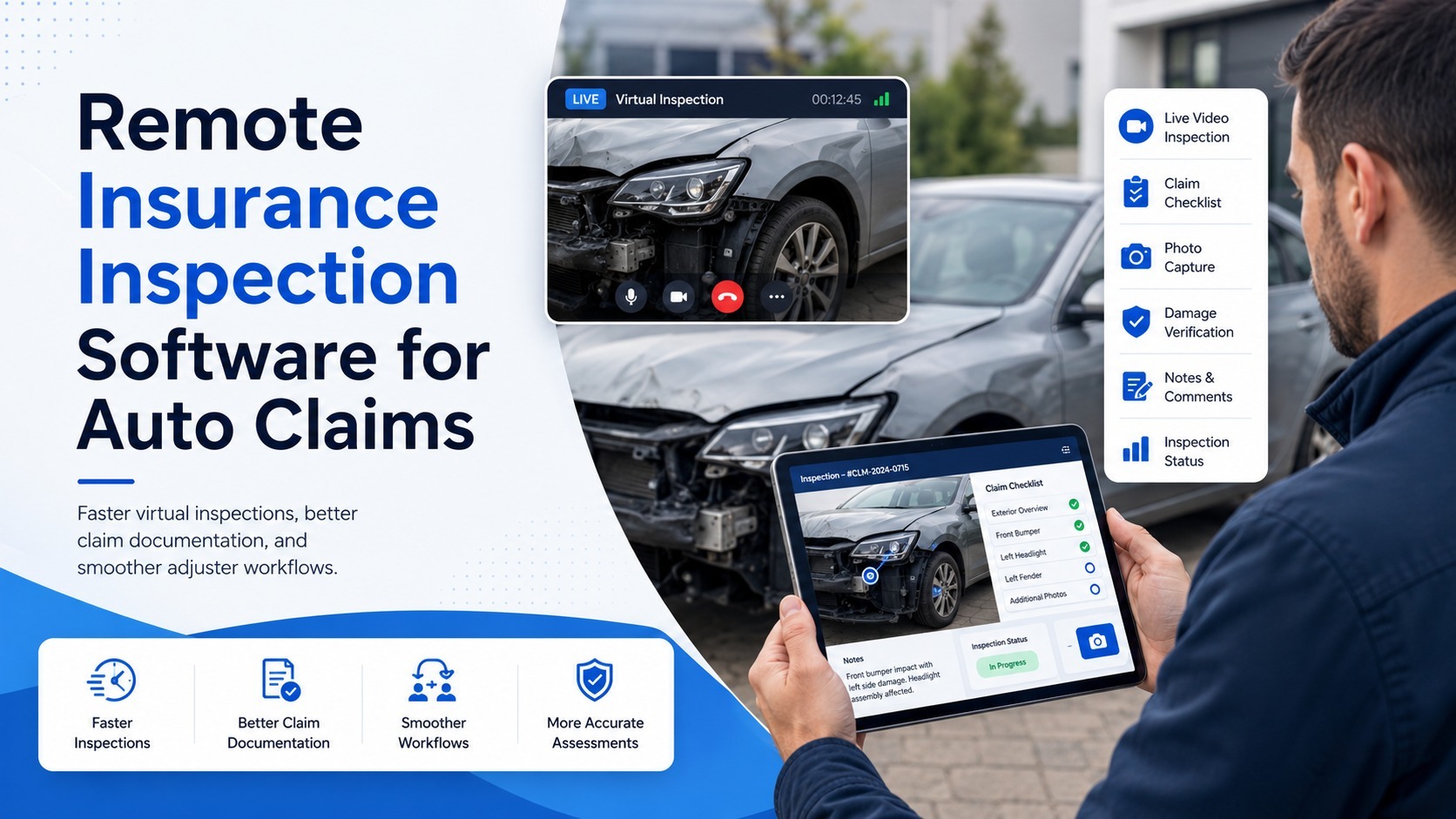
AI-powered visual inspection is the combination of live video assessment and machine intelligence that lets a claims professional see, document, and evaluate damage remotely. Instead of relying on a policyholder's verbal description, the adjuster sees exactly what the policyholder's camera sees — in real time.
The visual layer covers live video inspections, photo-based assessments, and fully remote claims evaluation. The AI layer adds image recognition, damage detection, automated documentation, and data extraction that turns raw footage into structured, searchable claim records.
A complete platform brings these together through mobile device integration, real-time video collaboration, AI-driven analytics, and secure cloud storage. The core feature set matters here: capabilities like timestamped photo capture, on-screen annotation, and OCR that pulls VINs, policy numbers, and serial codes directly from the video stream are what separate insurance-grade software from a generic video call.
Why Traditional Claims Inspections Are Becoming Obsolete
On-site assessments carry structural limitations that technology now removes. Scheduling delays, geographic constraints, and adjuster shortages all cap how many claims a team can handle. Every dispatch into the field consumes vehicle costs, travel time, and productivity that could go toward resolving more claims.
Customer expectations have shifted just as decisively. Policyholders want digital-first experiences, instant communication, and faster resolutions — and they shouldn't have to download an app or navigate complicated setup during an already stressful moment. That's why remote video inspections for insurance increasingly start with a single secure link sent by SMS or email, connecting the policyholder instantly through any smartphone browser.
How AI and Visual Inspection Improve Claims Processing
Accelerating First Notice of Loss (FNOL)
The earliest stage of a claim sets the tone for everything that follows. With guided image capture and video-assisted reporting, carriers collect cleaner data the moment a loss is reported. A visual remote assistant for insurance lets claims specialists triage property and auto losses at FNOL, verify severity, and route claims correctly the first time.
That accuracy from day one means fewer missing fields, standardized documentation, and far less rework downstream. For carriers building this directly into their own systems, a developer REST API can launch a session and process FNOL from a single call.
Faster Damage Assessment
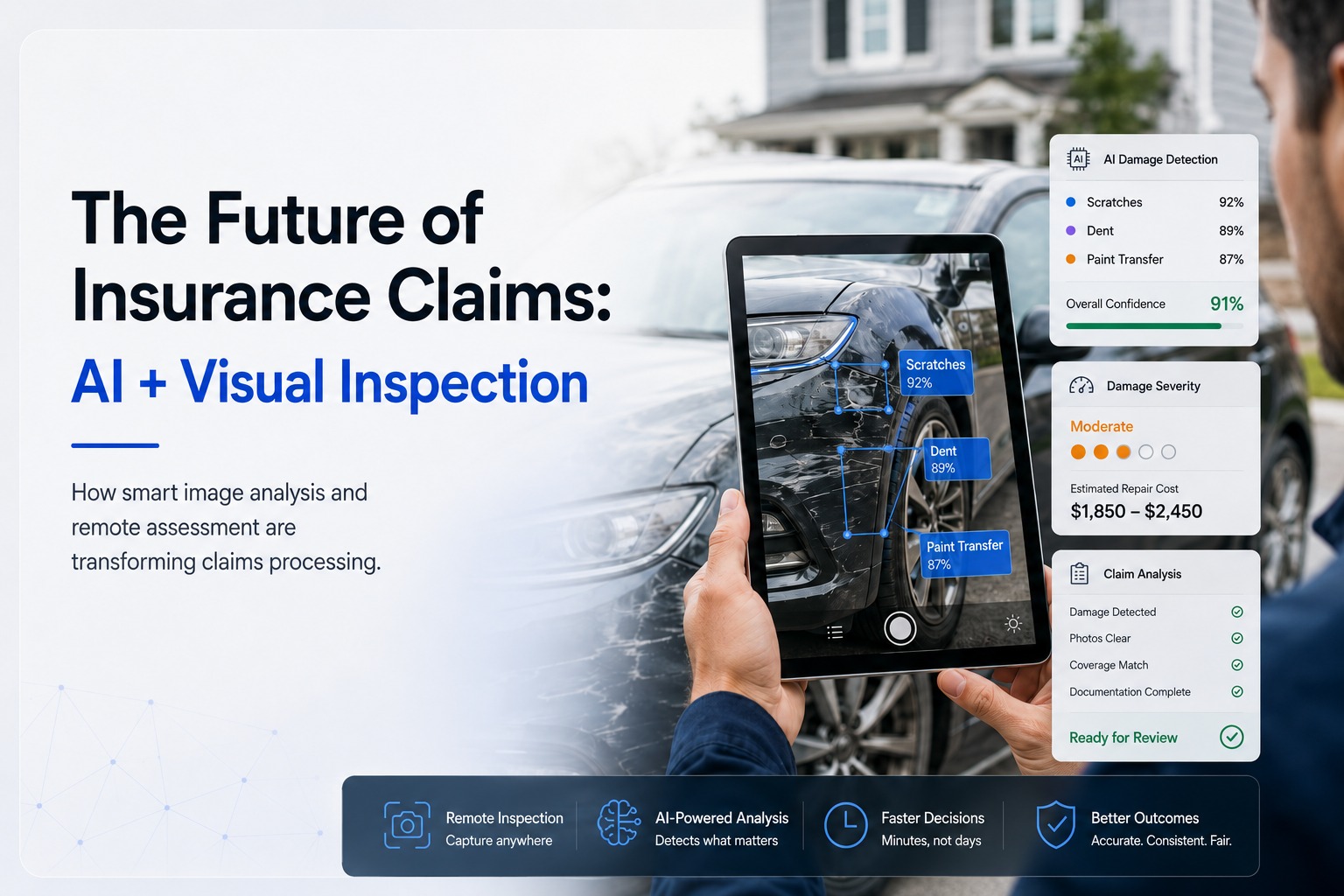
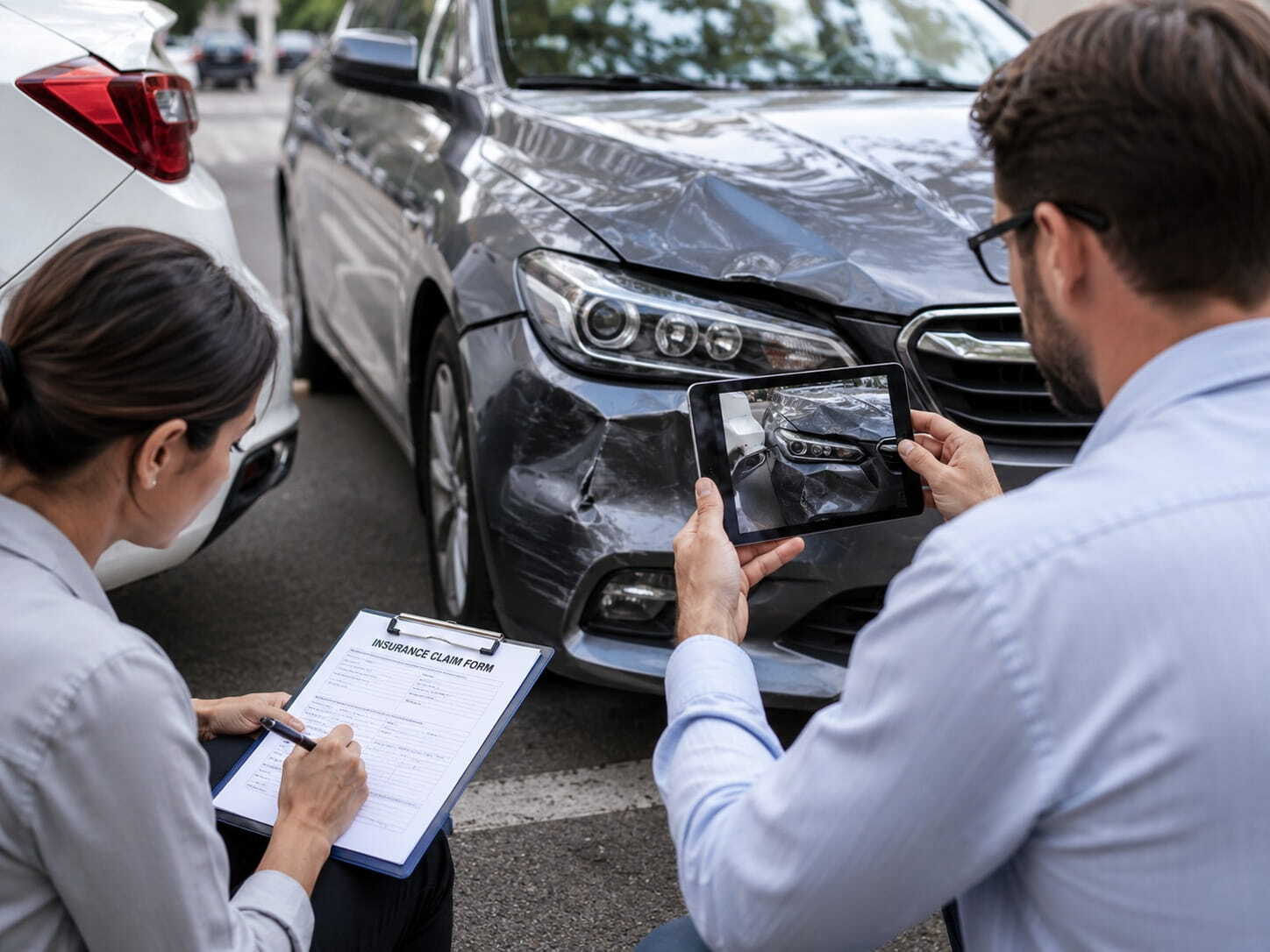
AI-assisted damage recognition helps identify visible damage, categorize severity, and prioritize urgent claims automatically. When a specialist's eye is needed, remote expert collaboration lets them join the inspection virtually rather than scheduling a second visit. The step-by-step remote inspection workflow shows how a session ends with a report already assembled — markups, notes, and timestamped images included.
Streamlined Claims Decisions
When visual evidence is organized automatically, adjusters review claims faster and approve them with more confidence. Shorter cycle times translate directly into faster settlements. Carriers using these tools to lift first-contact performance report meaningful gains — see how remote visual support boosts first-call resolution for the underlying economics.
Real-World Insurance Use Cases for AI Visual Inspection
Property insurance claims. Roof, storm, water, and fire damage are ideal for live visual assessment, where a policyholder can walk their camera across affected areas while the adjuster directs angles and captures evidence. The top building inspection platforms for 2026 show how property-focused workflows are evolving.
Auto insurance claims. Vehicle damage assessment, accident documentation, and repair validation all benefit from guided photo and video capture that standardizes evidence across every claim.
Commercial insurance claims. Equipment damage, facility inspections, and business interruption assessments often involve sites that are difficult or costly to reach — exactly where remote inspection delivers the largest savings. A roundup of the best remote insurance inspection software breaks down platform fit by line of business.
Catastrophe and disaster response. During large-scale events, physical access is often limited and claim volume spikes overnight. Remote inspection lets carriers scale operations rapidly and assess losses even when roads are impassable.
The Role of AI in Fraud Detection
AI strengthens fraud detection without replacing human judgment. It flags inconsistencies in claims evidence — duplicate submissions, altered images, and suspicious reporting patterns — that are easy to miss at volume. Enhanced verification adds timestamp validation, location data, and image analysis, so every piece of evidence carries a verifiable provenance.
Capabilities like GPS-tagged photos and timestamped documentation, detailed in the platform feature set, make tampering far harder. Crucially, AI here is a decision-support tool. It surfaces risk signals for human adjusters to investigate, keeping expert oversight at the center of every consequential call.
Benefits for Insurance Carriers
The carrier case is straightforward. Eliminating unnecessary field visits cuts the single largest variable cost in claims handling — and reducing truck rolls compounds into significant annual savings. Adjuster productivity rises because each professional handles more claims per day and reserves their time for genuinely complex cases.
Claims resolution accelerates across the board, shortening lifecycles and improving outcomes. And the model scales naturally during peak demand — seasonal surges, natural disasters, and large loss events no longer overwhelm a fixed field workforce. Blitzz reports that visual claims support can resolve claims up to 60% faster, with high-volume operations averaging substantial monthly savings; a look at how these solutions perform across field service, telecom, and insurance puts those figures in context.
Connecting this into existing systems is equally important. Native integrations with platforms like Salesforce, Zendesk, and Genesys mean session data, recordings, and AI-generated summaries flow straight into the claim file — and a dedicated Guidewire integration plugs visual claims directly into the core insurance suite.
Benefits for Policyholders
For the customer, the improvement is immediate. Faster assessments mean shorter waiting periods and quicker settlements. Better communication and real-time updates replace the silence that breeds frustration. There's no need to wait for an in-person visit — evidence can be submitted from anywhere, on the device already in the policyholder's hand. The cumulative effect is increased trust: faster responses and clearer decisions signal that the carrier is on the policyholder's side.
Challenges and Considerations
Adoption isn't without considerations. Data privacy and security are paramount; sensitive customer information demands enterprise-grade protection and full regulatory compliance. AI accuracy must be balanced with human oversight — automation should accelerate expert judgment, never replace it. And change management matters: teams need training, and the technology has to integrate cleanly into existing workflows rather than bolting on as one more disconnected tool. Comparisons like how leading platforms stack up against legacy remote-access tools help teams evaluate fit before committing.
What the Future of Insurance Claims Looks Like
The trajectory points toward AI-powered claims triage that prioritizes losses instantly, and predictive intelligence that forecasts claim complexity and allocates resources before a single adjuster is assigned. Expect fully integrated digital claims journeys that carry a loss from FNOL to settlement inside one platform, and visual collaboration becoming standard practice rather than a novelty. A survey of the best remote visual support software in 2026 and the leading digital inspection platforms shows how quickly video-first handling is becoming the default.
How Blitzz Supports the Future of Insurance Claims
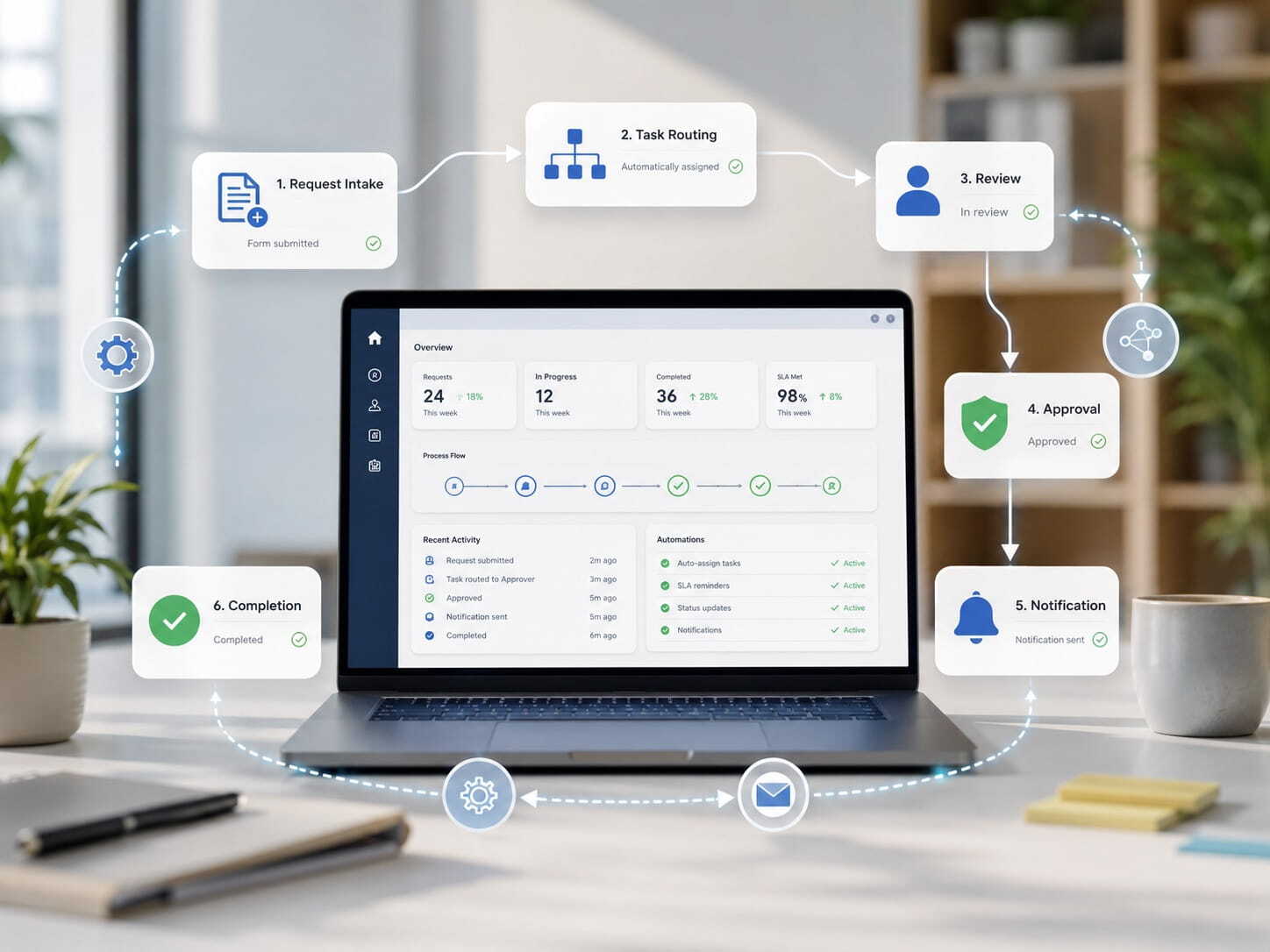
Blitzz brings these capabilities together in a single, app-free platform built for insurance-grade work. Real-time visual assistance lets claims teams see exactly what policyholders see in seconds. Remote claims inspections handle property, auto, and commercial lines without dispatching adjusters. AI-powered documentation turns every session into an organized, timestamped record — and workflow automation pushes that data into the tools your team already uses. The result is faster resolution, a better customer experience, and meaningfully lower operational costs. For a broader view of where the category is headed, the Blitzz Insights blog tracks best practices across visual remote assistance and inspection.
Conclusion
Insurance claims are entering a genuinely new era. AI and visual inspection address the industry's most stubborn problems at once — slow assessments, high field costs, weak fraud detection, and frustrated customers — and replace them with speed, accuracy, and transparency. Carriers that adopt visual claims technology today won't just trim costs; they'll be structurally better positioned for the volume, expectations, and competition of the years ahead.
The fastest way to see the difference is to watch it work on your own use cases. Schedule a demo to explore how modern visual inspection fits your claims operation.
Frequently Asked Questions
What is AI-powered visual inspection in insurance? It's the combination of live video assessment and artificial intelligence that lets claims professionals see, document, and evaluate damage remotely. The policyholder's smartphone camera streams the loss in real time, while AI handles damage recognition, automated documentation, and data extraction.
How does remote video inspection speed up claims? It removes the scheduling, travel, and back-and-forth that slow traditional inspections. Adjusters connect with policyholders within hours instead of days, assess damage live, and finish the session with a report already assembled — compressing claim lifecycles dramatically.
Does AI replace human adjusters? No. AI acts as a decision-support tool that flags risk signals, organizes evidence, and accelerates documentation. Human adjusters retain oversight and make the final call on every consequential decision.
How does visual inspection help with fraud detection? Timestamped photos, GPS location data, and image analysis create verifiable evidence that's far harder to tamper with. AI also flags inconsistencies like duplicate submissions or altered images for human review.
Do policyholders need to download an app? With browser-based platforms, no. The policyholder receives a secure link by SMS or email and connects instantly from any smartphone browser, which keeps completion rates high during stressful claim moments.