
.png?width=120&height=55&name=Blitzz-Logo-right%20white%20eyes%20-%20not%20transparent%20(3).png)
Why Insurance Damage Assessment Determines Everything About Your Claim

Insurance damage assessment is the process insurers use to evaluate the extent, cause, and cost of loss — whether to a home, vehicle, or commercial property — so they can determine a fair settlement.
Here is a quick overview of how it works across the most common claim types:
| Claim Type | Who Assesses It | Key Threshold or Formula |
|---|---|---|
| Flood / Property | NFIP-authorized adjuster | Repair cost ≥ 50% of market value = substantial damage |
| Vehicle damage | Collision estimator | Visual inspection + diagnostic scan = repair estimate |
| Total loss (auto) | Insurer using TLF | Repair cost > fair market value minus salvage value |
| Automated / AI | Computer vision model | Confidence score + bounding box detection |
The stakes are high. In the U.S. alone, the insurance industry loses an estimated $18 billion every year due to claims leakage — inefficiencies that stem largely from slow, manual, and inconsistent damage assessments.
And the pressure is not just financial. Adjusters face tight timelines. Field protocols require initial contact within 24 hours of assignment and a physical inspection within 48 hours after that. Miss those windows, and you risk compliance failures, customer complaints, and inflated costs.
Meanwhile, the tools available to assessors are changing fast. Drones, AI-powered image recognition, remote video inspection, and guided photo-capture apps are reshaping how adjusters work — especially when a physical site visit is dangerous, slow, or simply unnecessary.
I'm Keyur Patel, and in this guide I'll walk you through every major layer of the damage assessment process — from federal flood insurance regulations to AI-driven car damage detection — so you can understand exactly how modern assessments work and where technology is making them faster and more accurate.
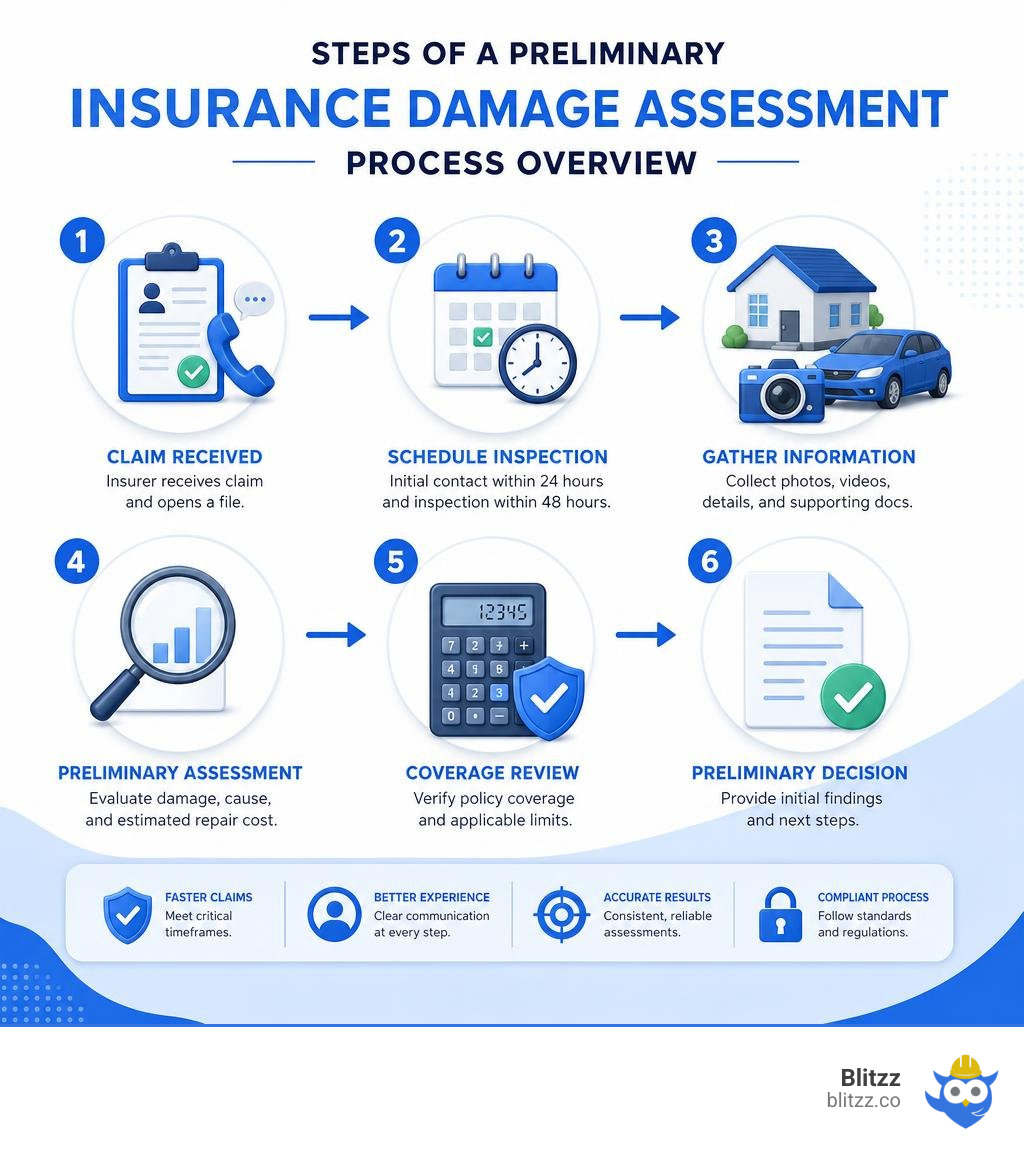
Handy Insurance damage assessment terms:
Regulatory Frameworks in Property and Flood Insurance Damage Assessment
Property damage evaluation is not a free-for-all; it is highly regulated. For windstorms, hurricanes, and general property damage, adjusters must align their work with strict standard operating procedures. Under guidelines like the TWIA & TFPA Property Damage Evaluation Guidelines, adjusters operate under strict timelines. For example, they must establish same-day initial contact and submit initial reports within 72 hours of inspection.
Furthermore, when evaluating repairs, adjusters must apply cumulative calculations for Overhead and Profit (O&P)—typically 21% (10% overhead and 10% profit, calculated cumulatively)—when a general contractor is required to coordinate three or more trades. To manage these massive portfolios efficiently, global leaders deploy advanced Property loss adjusting and claims solutions | Sedgwick to standardize how complex losses are documented and resolved.
When we look at federal flood insurance, the regulatory environment becomes even more rigid.
Understanding Substantial Damage and the 50% Rule
In the context of the National Flood Insurance Program (NFIP), "substantial damage" is a specific legal definition. It refers to flood damage where the cost of restoring the structure to its pre-flood condition equals or exceeds 50% of the market value of the structure before the damage occurred.
Calculating this is a highly standardized process:
- Determine the Pre-Flood Market Value: Adjusters must isolate the value of the structure itself, excluding the land value, landscaping, or detached buildings. This is typically done using property tax assessments (adjusted for market changes) or professional appraisals.
- Estimate the Full Cost of Repair: The repair estimate must include all costs necessary to repair the structure to its pre-damage condition. This includes labor, materials, clean-up, and contractor overhead/profit.
- Compare the Two: If the repair cost is 50% or more of the market value, the structure is officially designated as "substantially damaged."
This classification triggers strict local floodplain management ordinances. Substantially damaged buildings must be brought into full compliance with current local floodplain laws, which often means elevating the entire structure above the Base Flood Elevation (BFE). Because of these major financial implications, completing these assessments accurately is critical. To see how these expectations are shifting, check out our analysis on How Insurance Inspections Changed This Year and What It Means for 2026.
NFIP Adjuster Protocols and the APDA Form Submission
When an NFIP-authorized adjuster suspects a building has sustained substantial damage, they cannot simply write it in a standard report. They must use the Adjuster Preliminary Damage Assessment (APDA) form.
The authority to collect this information is legally mandated under Title 42, U.S. Code, Sections 4001-4028. To complete and submit this form successfully, adjusters must follow a precise protocol:
- Software Compatibility: The APDA form has known technical compatibility issues. Adjusters must download the PDF directly to their local device and open it using Adobe Reader. Opening the form directly inside modern web browsers like Microsoft Edge or Google Chrome will corrupt the interactive fields and prevent proper submission.
- Standards and Requirements: All steps must align with the current NFIP Claims Manual.
- Submission Pipeline: Once completed, the APDA form must be emailed immediately to NFIPClaimsMailbox@fema.dhs.gov with the exact subject line: "APDA Enclosed".
Vehicle Insurance Damage Assessment and Total Loss Evaluations
Evaluating vehicle damage after a car crash is a race against time and storage fees. The goal is to determine whether a vehicle can be safely repaired or if it should be declared a total loss. This process requires a blend of physical inspection, diagnostic technology, and remote collaboration. To see how companies are modernizing this, look at our guide on Remote Insurance Inspection Software for Auto Claims.
Post-Crash Vehicle Damage Assessment and Compensable Losses
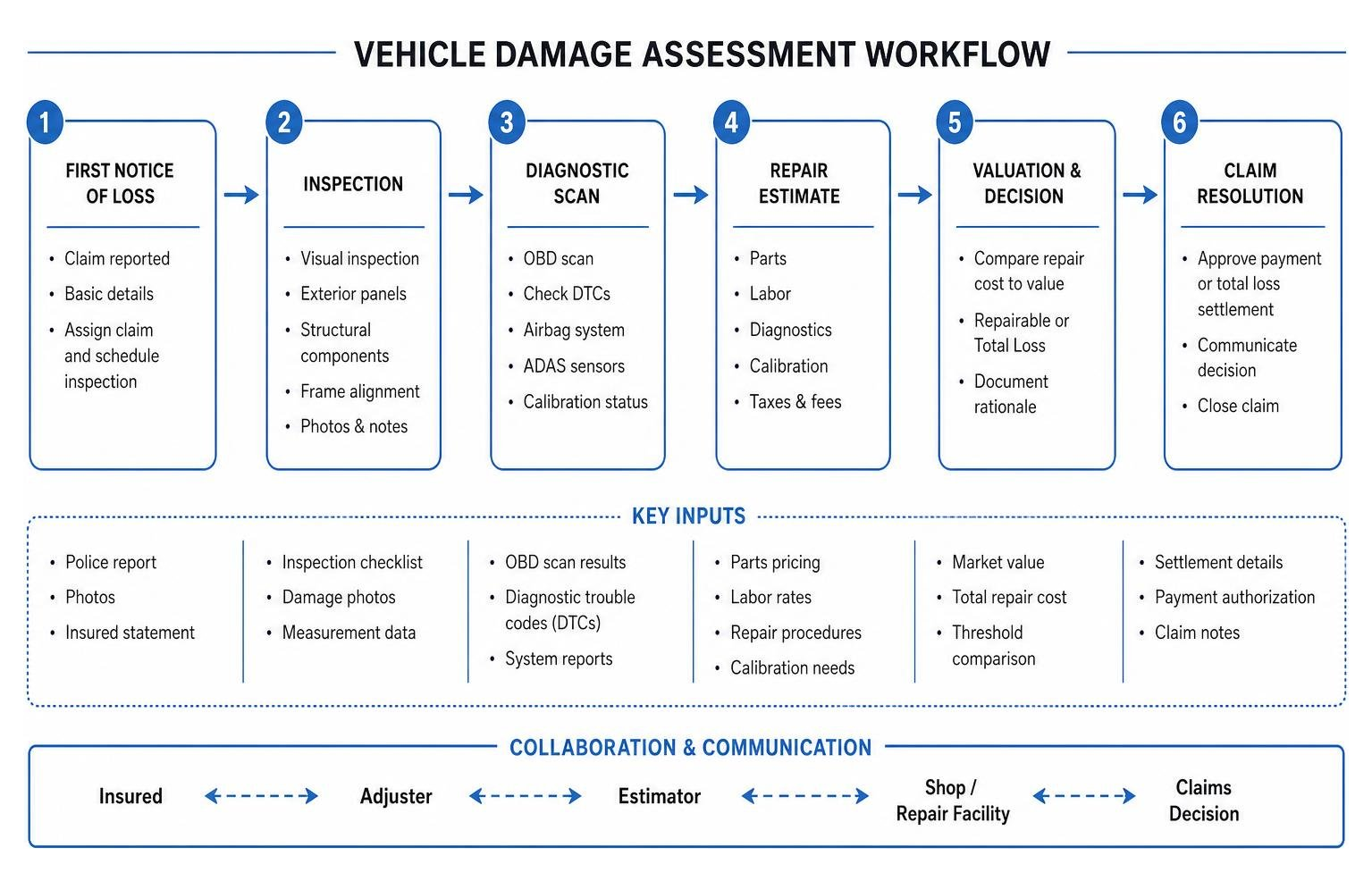
A modern vehicle damage assessment goes far beyond looking for dented bumpers. Today, a certified collision estimator must perform two distinct steps:
- Visual and Physical Inspection: Documenting exterior panels, suspension components, and structural frame alignment.
- Diagnostic Computer Scans: Connecting directly to the vehicle's On-Board Diagnostics (OBD) system. This is crucial because modern safety features (like ADAS sensors, lane-departure cameras, and airbag sensors) can suffer internal calibration damage even in low-speed accidents with zero visible exterior damage.
When the assessment is complete, the policyholder or claimant can seek compensation for several categories of property damage:
- Repair Expenses: The cost to fix the vehicle. Policyholders have the legal right to choose their own repair shop and are not obligated to use the insurer's preferred network. It is highly recommended to select manufacturer-certified shops that use Original Equipment Manufacturer (OEM) parts rather than cheaper, non-certified aftermarket alternatives.
- Towing and Storage Fees: The cost of transporting and housing the damaged vehicle.
- Rental Car Reimbursement: The cost of a temporary vehicle while repairs are underway.
- Personal Property: Compensation for items damaged inside the vehicle during the crash, such as car seats, laptops, or smartphones.
Total Loss Assessments and Valuation Formulas in Illinois
If the vehicle is severely damaged, the insurer must run a total loss assessment. In states like Illinois, insurance companies generally use one of two methods to determine if a vehicle is a total loss:
| Method | How It Works | Formula / Rule |
|---|---|---|
| Total Loss Threshold (TLT) | A simple percentage rule set by state regulation or the insurance policy. | Repair Cost ≥ (typically) 70% to 80% of Fair Market Value |
| Total Loss Formula (TLF) | A dynamic formula that factors in the salvage value of the vehicle's remaining parts. | Repair Cost + Salvage Value > Fair Market Value |
Under the Total Loss Formula (TLF), if a car has a fair market value of $10,000, a salvage value of $3,000, and estimated repairs of $7,500, the formula is calculated as:
- $7,500 (Repairs) + $3,000 (Salvage) = $10,500
- Since $10,500 is greater than the $10,000 market value, the vehicle is declared a total loss, even though the repair cost itself ($7,500) was only 75% of the vehicle's value.
Computer Vision and AI-Driven Automation in Claims Processing
To combat the massive $18 billion annual loss caused by claims leakage, insurers are turning to computer vision and machine learning. Automating the initial stages of visual inspection allows companies to triage claims in minutes rather than days. For a deeper look into this shift, explore The Future of Insurance Claims: AI Visual Inspection.
Optimizing Automated Car Damage Assessment with YOLOv5 Ensemble Models
While individual deep learning models have made great strides, a single model often struggles with the high-stakes accuracy required by insurance companies. For example, a single YOLOv5l model operating at a low (10%) confidence threshold can suffer from a massive 69% false positive rate, mistakenly identifying reflections, shadows, or dirt as structural damage.
To solve this, researchers and insurtech developers deploy YOLOv5 ensemble models.
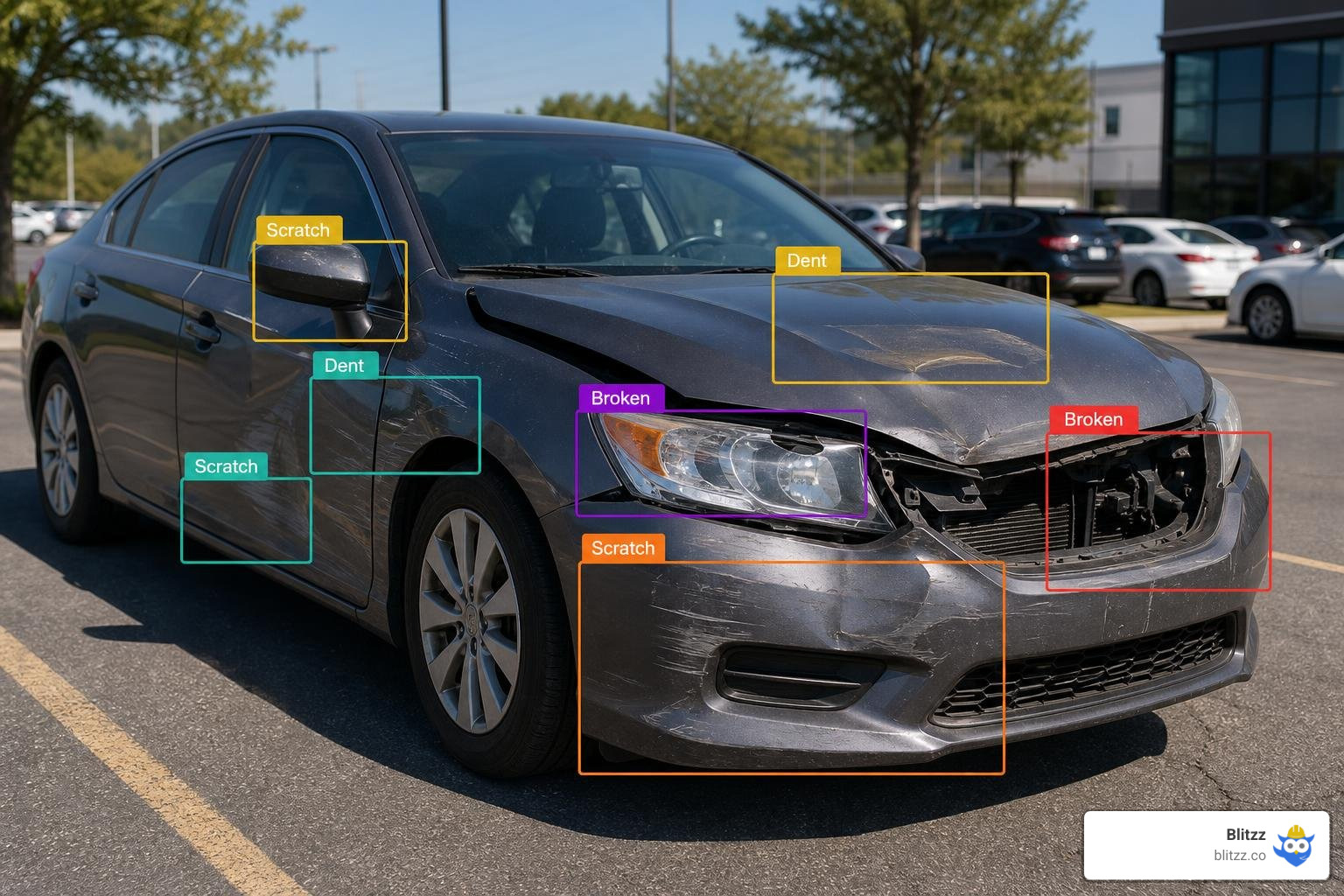
By combining an ensemble of multiple YOLOv5 models (using different depths, resolutions, and configurations) and optimizing them with Particle Swarm Optimization (PSO), the performance gains are dramatic:
- False Positive Reduction: The YOLOv5 ensemble model reduces the false positive rate to just 9% (down from 69%).
- Precision Boost: The ensemble approach improves precision to 74%, compared to just 34% for the best individual YOLOv5l model at default thresholds.
- Confidence Optimization: PSO is used to dynamically find the perfect confidence thresholds for each model in the ensemble, ensuring they work in harmony to filter out noise while capturing real damage.
Comparing Object Detection Models and Training Datasets
In production environments, insurance companies must balance model accuracy with computational speed and training costs.
- Inference Speed: Two-stage detectors like Faster R-CNN or highly complex models like DCN+ can take up to 12 seconds per image on a standard CPU. This is far too slow and expensive for high-volume, real-time claims processing. In contrast, the YOLOv5 ensemble of detectors achieves a CPU inference time of just 2.82 seconds—making it over 4 times faster than DCN+ while remaining highly scalable.
- Model Performance (YOLOv5 vs. YOLOv8): While YOLOv8 is newer, studies show that YOLOv5 is often preferred for enterprise insurance pipelines because it exhibits lower standard deviation in recall and more reliable consistency when deployed across highly varied consumer-shot photos.
- Training Datasets: To train these models, developers rely on specialized datasets. The most notable public benchmark is TartesiaDS, which consists of vehicle damage images labeled under the direct, rigorous supervision of professional insurance appraisers. This expert supervision ensures the AI learns to distinguish between cosmetic blemishes and actual, claim-worthy structural damage.
Frequently Asked Questions about Insurance Damage Assessment
What is the 50% rule for substantial damage in flood insurance?
Under NFIP regulations, the 50% rule states that if the cost to repair a flood-damaged building to its pre-flood condition equals or exceeds 50% of the structure's market value (excluding land) at the time of the flood, it is classified as "substantially damaged." This requires the building to be brought up to current local floodplain management standards, which may include elevating the structure.
How do insurers calculate a total loss using the Total Loss Formula (TLF)?
Insurers calculate a total loss under the TLF by adding the estimated repair costs to the vehicle's salvage value. If this combined sum is greater than the vehicle's actual fair market value before the accident, the vehicle is declared a total loss.
Why do insurance companies prioritize precision over recall in automated damage detection?
In automated claims processing, false positives (low precision) are incredibly costly. If an AI incorrectly flags dirt, shadows, or reflections as vehicle damage, it triggers unnecessary manual reviews by human appraisers, driving up operational costs and defeating the purpose of automation. High precision ensures that when the AI flags damage, it is highly likely to be real.
Conclusion
Mastering the insurance damage assessment process requires balancing strict regulatory frameworks, precise mathematical formulas, and cutting-edge technology. Whether you are calculating the 50% substantial damage threshold for a flooded home, applying the Total Loss Formula to a crashed vehicle, or running a high-precision YOLOv5 ensemble model to automate claims triage, accuracy and speed are everything.
At Blitzz, we help insurance companies eliminate claims leakage and speed up inspections through our enterprise remote visual assistance platform. Our browser-based video support allows adjusters to collaborate instantly with policyholders in real-time, using interactive AR annotations, screen sharing, and optical character recognition—all without requiring the customer to download an app.
Ready to see how remote video can transform your claims workflow? Check out our guide on What is the Best Insurance Inspection Software, or Schedule a Demo with Blitzz today to see our platform in action.
.jpg)