
.png?width=120&height=55&name=Blitzz-Logo-right%20white%20eyes%20-%20not%20transparent%20(3).png)


On this page
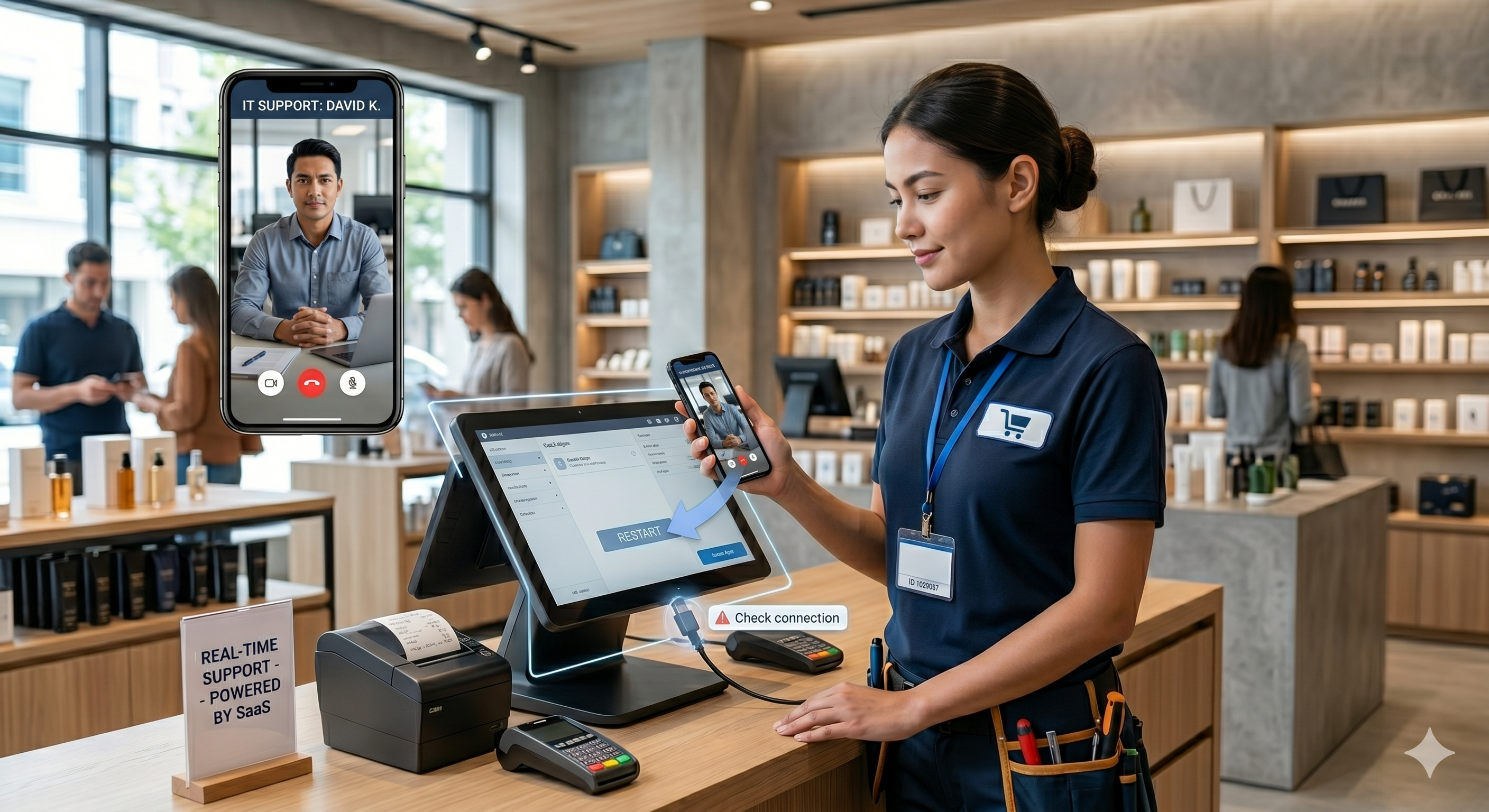
Modern retail operations depend heavily on in-store technology to deliver fast, seamless customer experiences. From point-of-sale (POS) systems and payment terminals to kiosks, scanners, and digital displays, these systems are essential to daily store performance. When even a single component fails, the impact is immediate and often visible to customers.
Minor technical issues can quickly escalate into operational disruptions. Checkout delays affect revenue and throughput, long lines diminish the customer experience, and store staff are forced to shift focus from service to troubleshooting. In high-traffic environments, even short interruptions can result in lost sales and reduced efficiency.
Common in-store technology challenges include:
- POS system errors that interrupt transactions
- Payment terminal issues that delay or prevent checkout
- Self-checkout malfunctions that require staff intervention
- Digital display or kiosk failures that impact customer engagement
While many of these issues are relatively simple to resolve, the lack of real-time visibility and immediate support often turns minor problems into prolonged disruptions.
Why In-Store Tech Issues Take Too Long to Resolve
The delay in resolving in-store technology issues is rarely due to the complexity of the problem itself. More often, it stems from limitations in how issues are communicated, diagnosed, and escalated across distributed retail environments.
Key factors contributing to slow resolution include:
- Limited visibility for support teams
IT teams rely on store staff to describe the issue, which can lead to incomplete or inaccurate information. - Dependence on on-site technicians
Many issues automatically trigger technician dispatches, even when they could be resolved remotely. - Inconsistent technical expertise in-store
Store associates may not have the knowledge or confidence to troubleshoot technical issues effectively. - Fragmented communication
Ongoing back-and-forth between store staff and IT support slows down diagnosis and resolution. - High volume across locations
Multi-store operations create support bottlenecks, making it difficult for central teams to respond quickly to every issue.
These challenges highlight the need for a faster, more scalable approach—one that provides immediate visibility and enables real-time collaboration between store teams and support experts.
What Is Remote Visual Support in Retail
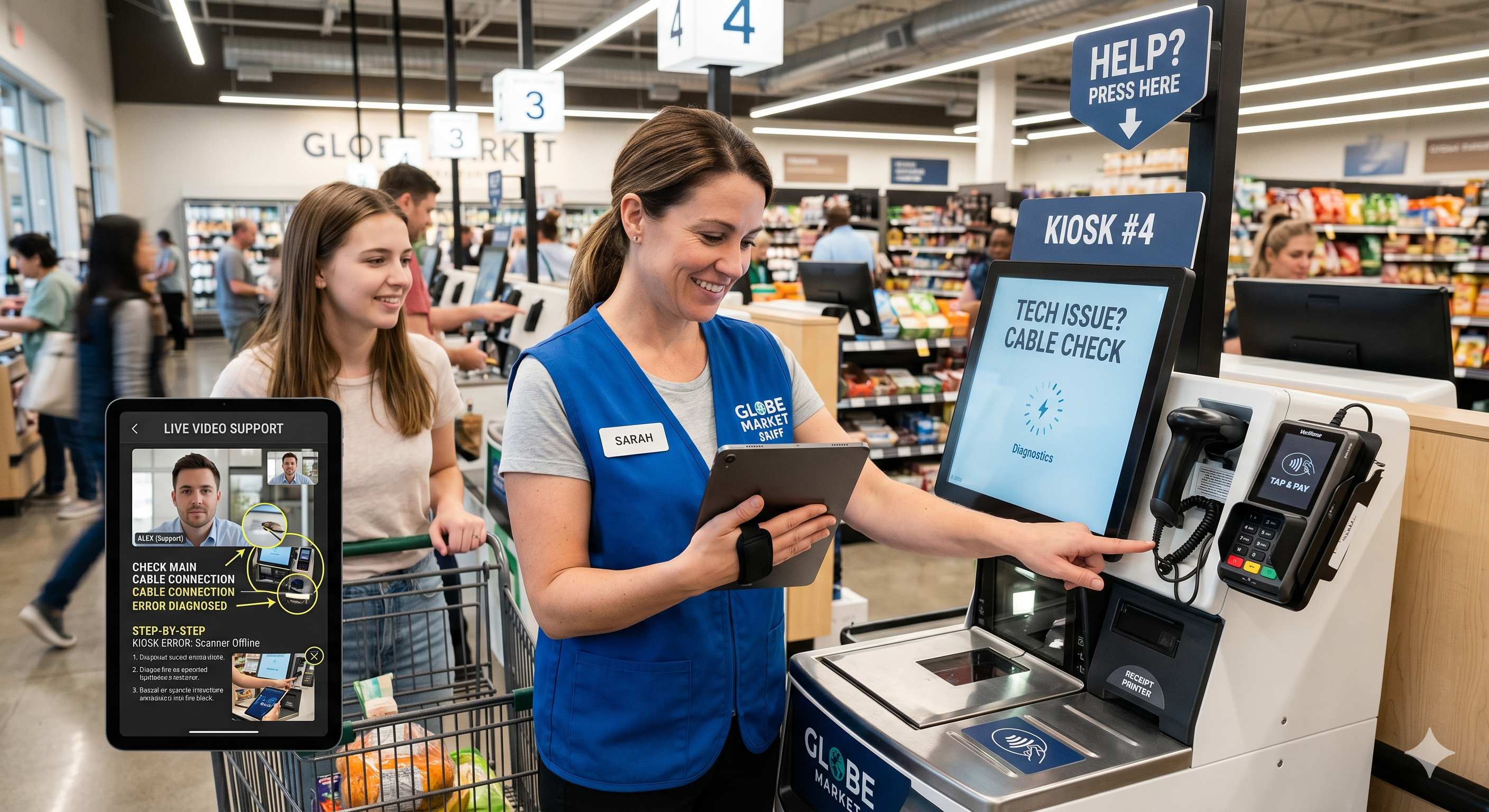
Remote visual support enables retail teams to resolve in-store technology issues in real time through live video collaboration. Instead of relying on descriptions or delayed escalations, store staff can instantly connect with IT or support teams, allowing problems to be seen and addressed as they occur.
In practice, this includes:
- Store staff and IT/support teams connecting via live video so support teams can directly view devices such as POS systems, payment terminals, kiosks, or scanners
- Field technicians and remote experts collaborating in real time, reducing the need for on-site visits
This approach allows for immediate visual troubleshooting of devices and systems. Support teams can observe the issue, ask precise questions, and guide staff through the necessary steps to resolve it—without delays.
Advanced capabilities may also include AI-powered features such as:
- Annotations, enabling support teams to highlight specific buttons, cables, or components
- Guided instructions, providing clear, step-by-step direction during troubleshooting
- Issue identification, helping detect or surface potential problems more quickly
The result is a practical, store-friendly solution that empowers staff to resolve issues faster while reducing dependence on external support.
How Remote Visual Support Speeds Up Issue Resolution
Remote visual support accelerates issue resolution by introducing real-time visibility and guided assistance at the moment a problem occurs. This eliminates delays associated with miscommunication, escalation, and technician dispatch.
Faster Issue Identification
Support teams can immediately see the issue through live video, removing guesswork and enabling faster, more accurate diagnosis.
When a POS system freezes or a payment terminal goes down during peak hours, every second matters. With Blitzz Concierge, IT teams connect to store staff instantly via a browser-based video session — no app download required on either end. The agent sees the exact error state, the device indicators, and the physical environment in real time, and can identify the fault in seconds rather than minutes. There's no verbal back-and-forth, no misinterpretation, no delay waiting for a technician to arrive and assess the situation from scratch.
OCR tools built into the platform also allow agents to capture serial numbers, error codes, and model numbers directly from the live video feed — eliminating manual transcription and accelerating the path to the right fix.
Real-Time Guided Troubleshooting
Store staff receive step-by-step visual guidance, allowing them to resolve issues confidently without requiring deep technical expertise.
This is where Blitzz's AR annotation tools change the dynamic entirely. Rather than reading instructions over the phone or waiting for an email with a screenshot, a store associate can receive live, on-screen guidance: arrows pointing to the correct cable, circles highlighting the component to check, annotations drawn directly on their live camera feed. The expert's instructions are visible exactly where the staff member is looking — on the actual equipment in front of them.
The result is that non-technical staff resolve issues they would previously have escalated or waited on IT to fix in person. That's not just faster. It's a fundamentally more scalable support model for multi-location retail environments.
For digital touchpoints — a kiosk running a customer-facing app, a self-checkout with a software glitch, a digital signage display with a content error — Blitzz Co-Browse adds another layer: agents can navigate directly alongside the store associate on-screen, guiding them click-by-click through configuration menus and software interfaces without touching a device remotely. Unlike screen sharing, Co-Browse restricts visibility to the active browser tab, keeping sensitive data protected throughout the session.
Reduced Need for Technician Dispatch
Many common issues can be resolved remotely, eliminating unnecessary site visits and reducing downtime.
Every technician dispatch in a retail environment carries a real cost: scheduling overhead, travel time, labor, and the window of downtime between when the issue is reported and when the technician arrives. Blitzz helps customer support teams save 5–6 unnecessary trips per rep every month, saving an average of $533 per rep per month — and those numbers compound quickly across a network of stores.
The most common in-store technology issues — POS errors, payment terminal misconfigurations, scanner connectivity problems, device resets — are exactly the type of problems that don't require a person to be physically present. They require someone to see the situation accurately and guide a fix. Remote visual support delivers that without sending anyone anywhere.
For the issues that genuinely do require an on-site visit, the pre-visit assessment eliminates the guesswork: the IT team has already seen the problem, identified what's needed, and dispatched the right technician with the right parts. First-visit resolution rates improve because the diagnosis happened before the dispatch.
Improved First-Time Fix Rates
With accurate, real-time diagnosis and guided resolution, problems are more likely to be fixed correctly on the first attempt.
The compounding cost of repeat visits and repeat contacts is one of the most underappreciated expenses in retail IT support. A technician who arrives without a clear picture of the problem, diagnoses it, leaves to get parts, and comes back is a two-visit resolution for what should have been one. A contact center agent who troubleshoots via phone, closes the ticket as resolved, and then receives a callback 20 minutes later hasn't resolved anything — they've deferred the cost.
Visual diagnosis through live video closes the loop on first contact. The agent sees the actual fault. The fix is applied with visual confirmation that it worked. The session is automatically documented with AI-generated summaries, captured photos, and timestamped records that sync to your ticketing or ITSM platform. When a follow-up is needed, the next agent or technician has the full context — not a vague note.
Scalable Support Across Locations
Centralized support teams can assist multiple stores simultaneously, ensuring consistent and efficient support across all locations.
This is the structural advantage that remote visual support delivers to multi-location retail that phone-based support never could. A single expert IT team — based centrally — can run simultaneous video sessions across a store network, addressing issues in real time without anyone getting in a car. Geographic distance becomes irrelevant.
Blitzz Concierge's SaaS deployment model is built for exactly this scale. Adding 5 or 500 new users requires no complicated setup — administrators create accounts, users log in with an ID and password, and the full platform capability is immediately available. For large retail organizations onboarding support teams across multiple locations, this means days to deployment rather than months.
Together, these capabilities transform in-store tech support from a reactive, delay-prone process into a fast, scalable, and efficient operation.
Workflow: In-Store Tech Support With vs Without Visual Support
The difference between traditional support models and a visual support–enabled approach becomes clear when comparing how quickly issues are identified and resolved.
Traditional workflow: Issue occurs → staff reports problem → IT interprets the issue → technician scheduled → on-site visit → diagnosis performed → fix implemented → possible follow-up visit
This process is often delayed by miscommunication, scheduling constraints, and the need for physical intervention — even for relatively simple issues.
With visual support: Issue occurs → live video session initiated → issue identified instantly → guided fix provided → resolution
By enabling real-time visibility and collaboration, Blitzz's visual support platform removes unnecessary steps, reduces delays, and accelerates the path to resolution.
Business Impact for Retailers
For retailers, faster issue resolution translates directly into improved operational performance and customer experience. Remote visual support helps minimize disruption while optimizing both cost and efficiency.
Reduced downtime at the point of sale Faster fixes keep checkout systems running, preventing lost sales and long customer wait times. Every minute a POS system is offline during peak hours is revenue lost — and with visual-guided resolution, that window collapses from hours to minutes.
Increased revenue protection Minimizing disruptions ensures that transactions continue smoothly, especially during peak hours. For e-commerce teams managing checkout flows and digital shopping experiences, Blitzz Co-Browse for e-commerce and retail guides customers through complex purchases in real time — directly addressing the 70% cart abandonment rate caused by checkout confusion and product complexity.
Lower operational and support costs Reducing technician dispatches and repeat visits lowers overall support expenses. According to PwC, 32% of American consumers will leave a brand they love after just one bad experience — meaning the cost of a delayed or mishandled support interaction isn't just the truck roll. It's the customer.
Faster issue resolution times Real-time troubleshooting shortens the time from problem identification to resolution. Documented Blitzz deployments across retail and adjacent industries show resolution time reductions of up to 46–50% compared to voice-only support.
Improved store staff productivity Staff can resolve issues quickly with guided support, allowing them to return focus to serving customers. With Blitzz's no-app, browser-based connection, initiating a session takes a single click — there's no friction in the moment an issue occurs, and no training burden on store associates.
These outcomes make remote visual support a valuable capability for retailers aiming to maintain high performance across multiple locations.
Real-World Retail Use Cases
Remote visual support can be applied across a wide range of in-store technology scenarios, enabling faster and more effective resolution for both common and complex issues.
POS system troubleshooting Diagnose and resolve transaction errors, connectivity issues, or system glitches in real time. Live video and AR annotation let IT teams guide store staff through fixes without setting foot in the store.
Payment terminal support Quickly address card reader issues, payment failures, or configuration problems without delaying checkout. Session data is automatically documented and synced to your Salesforce, Zendesk, or ITSM platform.
Self-checkout issue resolution Assist staff in resolving scanner errors, payment issues, or system freezes during peak store hours. For software-layer issues on self-checkout kiosks, Blitzz Co-Browse lets agents navigate the interface alongside staff in real time.
Digital signage and kiosk fixes Identify and correct display issues, content errors, or hardware malfunctions remotely. A live video session gives IT teams direct visual access to the affected display without sending anyone to the store.
Inventory scanner and device support Troubleshoot handheld devices used for stock management, pricing, and inventory tracking. With OCR-enabled serial number and barcode capture, agents can identify the exact device and configuration in seconds.
These use cases highlight how visual support enables store teams to resolve issues on the spot, reducing downtime and maintaining a smooth customer experience.
Why Integration Matters
For retail organizations, the effectiveness of remote visual support depends on how seamlessly it fits into existing systems and workflows. New tools must enhance operations without adding complexity or disrupting store-level processes.
To deliver real value, remote visual support should integrate with:
- Retail POS systems, where transactions and device operations are managed
- IT service management (ITSM) tools, used to track, prioritize, and resolve technical issues
- Ticketing platforms, where support requests and workflows are coordinated
Blitzz integrates natively with Salesforce, Zendesk, Genesys, and ServiceNow — meaning agents can initiate sessions directly from the platforms they already work in, and all session data syncs back automatically when the session closes. For teams using other platforms, Blitzz's Zapier integration can trigger automated workflows — create tickets, update records, notify teammates — without any engineering work.
When properly integrated, visual support becomes a natural extension of the support process. Store staff can initiate sessions directly from existing tools, issues are documented automatically, and IT teams maintain full visibility without switching systems.
This approach ensures minimal disruption to store workflows and enables fast, intuitive adoption for both store staff and IT teams — allowing retailers to scale support efficiently across all locations.
How Blitzz Supports Retail Workflows
Blitzz enables retailers to resolve in-store technology issues faster by bringing real-time visual support directly into existing workflows. With instant, browser-based video sessions, store staff can connect with IT or support teams immediately — without needing to download or install any applications. This removes friction at the moment an issue occurs and accelerates the path to resolution.
The platform is designed for ease of use in busy retail environments. Store associates can quickly initiate a session and receive guided assistance in real time. AI-assisted features, such as live annotations and step-by-step instructions, help ensure issues are diagnosed accurately and resolved efficiently, even by non-technical staff.
Blitzz also integrates seamlessly with existing support systems, allowing video sessions and captured insights to be logged within current workflows. This ensures continuity, reduces manual effort, and gives IT teams full visibility into issues across all locations.
The result is a faster, more streamlined support process — enabling quicker fixes, minimizing downtime, and delivering a better customer experience in-store.

From Store Disruptions to Real-Time Resolution
Retailers are moving away from reactive, delay-prone support models toward faster, more responsive operations powered by real-time visual support. By enabling immediate visibility and guided troubleshooting, in-store tech issues can be resolved before they escalate into larger disruptions.
This shift leads to more efficient support operations, where problems are identified and fixed quickly without unnecessary escalation or delays. It also reduces reliance on on-site technicians, allowing organizations to resolve many issues remotely while optimizing support resources.
Most importantly, remote visual support enables scalable support across multi-location retail environments. Central teams can assist stores in real time, ensuring consistent performance and customer experience across every location.
Review The FAQs
What is remote visual support in retail?
Remote visual support in retail is a real-time video-based solution that allows store staff to connect with IT or support teams instantly. Instead of relying on descriptions, support teams can see the issue directly and guide staff through troubleshooting steps, enabling faster and more accurate resolution.
How does remote visual support reduce in-store downtime?
By providing immediate visibility into technical issues, remote visual support eliminates delays caused by miscommunication and technician scheduling. Support teams can diagnose problems instantly and guide fixes in real time, significantly reducing the time systems remain offline.
Do store employees need technical expertise to use remote visual support?
No. Blitzz is designed for ease of use. Store staff simply initiate a session and follow step-by-step guidance from support teams. Features like live AR annotations and guided instructions make it easy for non-technical users to resolve issues confidently.
Can remote visual support replace on-site technicians completely?
Not entirely, but it can significantly reduce the need for on-site visits. Many common in-store tech issues — such as POS errors, payment terminal problems, and device misconfigurations — can be resolved remotely with Blitzz Concierge. On-site technicians are then reserved for more complex cases.
How does remote visual support integrate with existing retail systems?
Blitzz integrates natively with POS systems, IT service management tools, and ticketing platforms including Zendesk, Genesys, and ServiceNow. This allows teams to initiate video sessions directly within existing workflows, automatically document interactions, and maintain full visibility without switching systems.
Ready to see how Blitzz transforms in-store tech support?
Schedule a demo and we'll walk through exactly how remote visual support fits into your retail workflow — or start your free 30-day trial and start resolving in-store issues faster this week.
Related Reading:
- Boost E-Commerce Conversion and Stop Cart Abandonment With Co-Browse
- Cut Resolution Time by 50% With Visual Remote Assistance
- How Blitzz Uses AI to Transform Remote Support and Customer Experience
- Cobrowse vs Screen Share: Understanding the Differences
- Automating Remote Video Support: Unlocking the Power of Blitzz with Zapier
- What Is AI Video Support? (And Why It's Changing Customer Support)

Blitzz Team
The Blitzz Team writes about remote video support, virtual inspections and field service. Our guides come from working with home builders, property managers, warranty teams, contact centers and field service organizations that use Blitzz to see and solve issues without a truck roll.