
.png?width=120&height=55&name=Blitzz-Logo-right%20white%20eyes%20-%20not%20transparent%20(3).png)

On this page
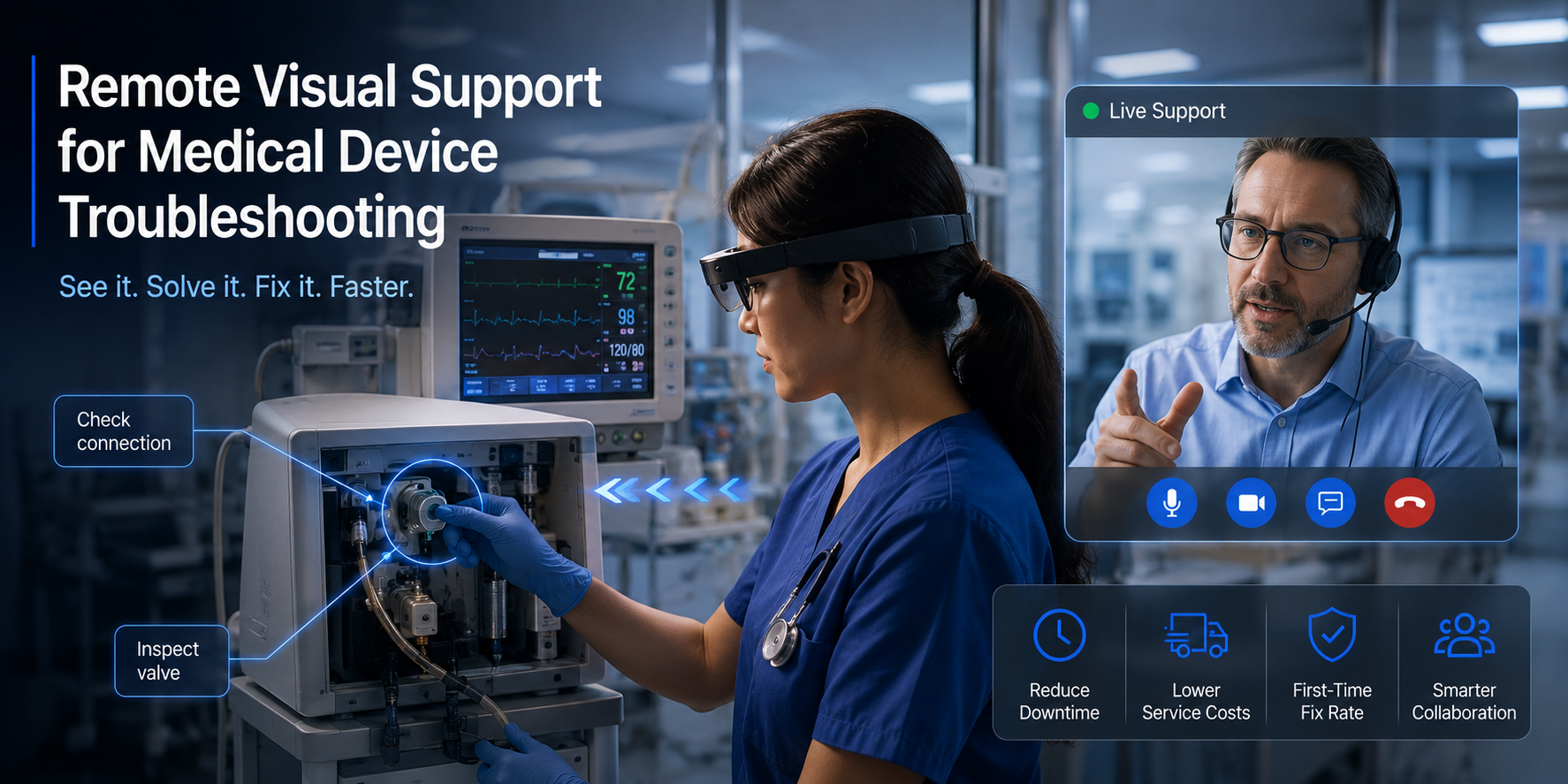
Medical devices play a central role in delivering timely and effective patient care. From diagnostic imaging systems to bedside monitoring equipment, these technologies are essential to clinical decision-making and treatment. When a device becomes unavailable, the impact is immediate and extends far beyond technical inconvenience.
Downtime directly affects patient safety and continuity of care, particularly in time-sensitive environments where delays can disrupt diagnosis or treatment. It also places pressure on hospital operations, forcing staff to reschedule procedures, reallocate resources, or rely on limited backup equipment. In addition, healthcare providers must navigate strict regulatory and compliance requirements, where prolonged outages or improper handling of device issues can increase risk exposure.
Several common challenges contribute to these disruptions:
- Delays while waiting for field technicians or vendor support to arrive on-site
- Miscommunication between clinical staff and support teams during troubleshooting
- Repeated service visits due to incomplete or inaccurate initial assessments
These inefficiencies not only slow down resolution but also increase operational strain across clinical and technical teams.
In many cases, these delays are not caused by the complexity of the device itself — but by a lack of real-time visibility and immediate access to expert support. Visual remote assistance for healthcare devices addresses exactly this gap.
How Remote Visual Support Improves Troubleshooting
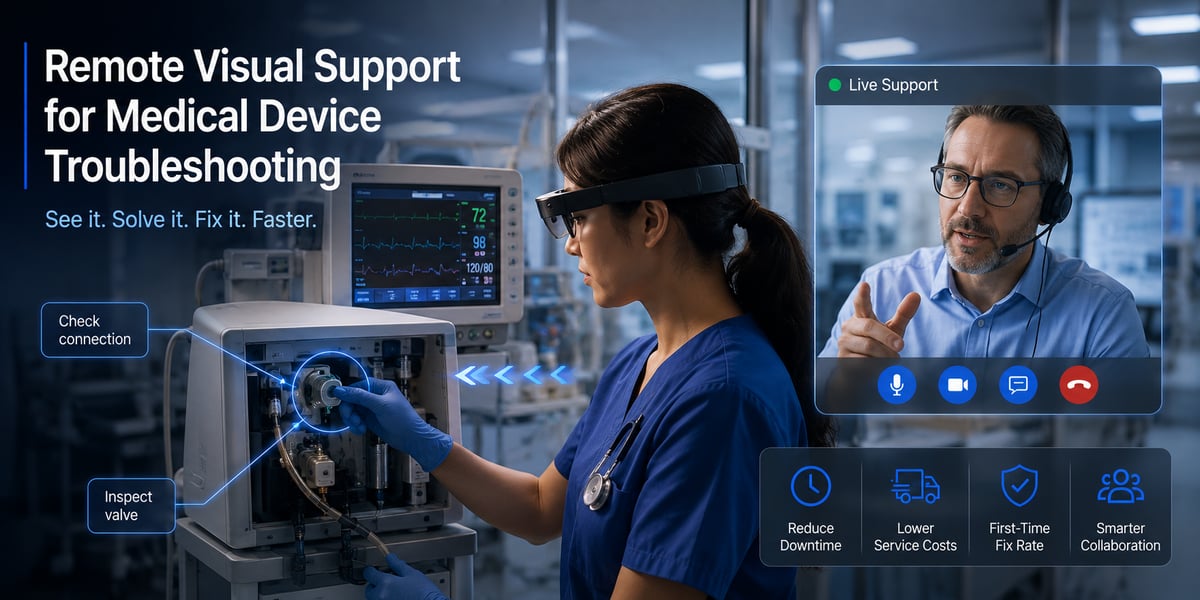
Remote visual support transforms medical device troubleshooting by introducing real-time visibility and guided collaboration at the moment an issue occurs. Instead of relying on delayed, step-by-step escalation, healthcare teams can resolve problems quickly and accurately through direct visual interaction.
Faster Issue Identification
Experts can immediately assess the device through live video, observing error messages, configurations, and physical setup in real time. This eliminates guesswork and accelerates diagnosis.
With Blitzz Concierge, service engineers simply send a secure link via SMS or email. Hospital staff click to connect instantly from any smartphone or tablet browser — no app downloads, no IT security approvals required. The engineer sees exactly what the clinical staff sees: the device's error state, indicator lights, cable configuration, and physical setup — in real time, from anywhere. OCR tools built into the platform can also capture serial numbers and model numbers directly from the live video feed, eliminating manual transcription and accelerating the path to the right fix.
Real-Time Guided Resolution
Clinical staff receive step-by-step guidance during the troubleshooting process. Experts can direct actions clearly, ensuring that procedures are followed correctly without trial and error.
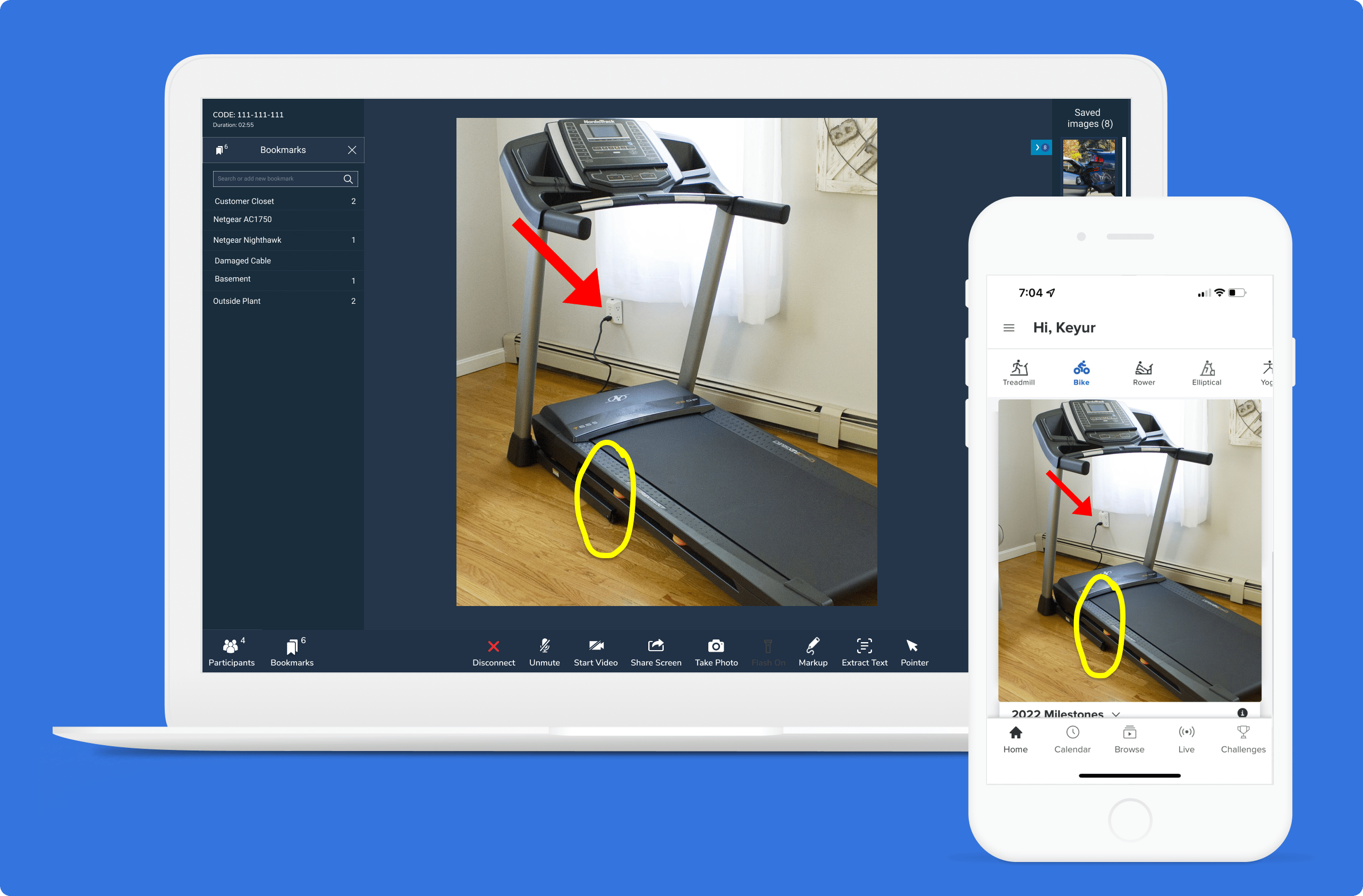
Blitzz's AR annotation tools make this guidance precise and unambiguous: engineers draw directly on the live video feed — circling the component to check, drawing an arrow to the correct port, highlighting the configuration setting that needs to change. Clinical and biomedical staff see these overlays in real time, on the actual device in front of them. This is what eliminates the miscommunication that makes phone-based device support so slow and so often inconclusive.
Reduced Need for On-Site Visits
Many device issues can be resolved remotely, removing the need to wait for a technician to arrive. This reduces delays and minimizes disruption to clinical operations.
Healthcare facilities using Blitzz report faster resolutions, reduced equipment downtime, and significantly improved customer experience scores across healthcare accounts — because hospital staff can demonstrate device issues from their location and receive expert guidance without waiting days for a service engineer visit.
Improved First-Time Fix Rates
Accurate, real-time diagnosis increases the likelihood that issues are resolved on the first attempt, reducing repeat interventions and follow-up visits.
Visual diagnosis through live video closes the loop on first contact. The engineer sees the actual fault. The fix is applied with visual confirmation that it worked. The session is automatically documented with AI-generated summaries, captured photos, and timestamped records that sync to your service management platform. When a follow-up is needed, the next engineer has the full context — not a vague note.
Continuous Expert Access
Healthcare teams gain immediate access to specialized support when needed, regardless of location. This ensures consistent service levels across departments and facilities.
This is particularly critical for rural or satellite clinics and facilities with limited on-site biomedical resources. A centralized team of device specialists can support multiple locations simultaneously — without traveling to any of them.
Together, these capabilities enable faster, more reliable troubleshooting while maintaining the high standards required in healthcare environments.
Workflow: Device Troubleshooting With vs Without Visual Support
The benefits of remote visual support become clear when comparing traditional troubleshooting workflows with a real-time, video-enabled approach.
Traditional workflow: Issue occurs → staff reports problem → vendor contacted → technician scheduled → on-site visit → diagnosis performed → repair executed → possible follow-up visit
This process is sequential and often delayed by scheduling constraints, limited information, and repeated interactions.
With visual support: Issue occurs → live video session initiated → expert assesses the situation instantly → staff receives guided resolution → issue resolved
By introducing real-time visibility at the start of the process, visual support reduces dependency on physical visits and shortens the time to resolution — improving both efficiency and patient care continuity.
Business & Clinical Impact
For healthcare organizations, remote visual support delivers measurable improvements across both operational performance and clinical outcomes. By enabling faster, more accurate troubleshooting, hospitals and providers can reduce disruption while maintaining high standards of care.
Reduced device downtime Faster diagnosis and resolution keep critical equipment available when it's needed most. Every minute of unplanned equipment downtime affects patient care, productivity, and operational costs — visual-guided resolution collapses that window dramatically.
Improved patient care continuity Minimizing delays ensures that diagnostics, monitoring, and treatments proceed without interruption. For telehealth teams managing post-operative care, rapid device support also means patients stay on track with recovery — fewer complications, fewer readmissions.
Lower service and maintenance costs Fewer on-site visits reduce expenses related to vendor support, travel, and external resources. Blitzz helps support teams save 5–6 unnecessary trips per rep every month — a number that compounds quickly across large healthcare networks.
Faster resolution times Real-time collaboration shortens the time from issue identification to resolution. Documented deployments across healthcare-adjacent industries show resolution time reductions of up to 50% compared to voice-only support.
Increased staff efficiency Clinical and technical teams can resolve issues more quickly, allowing them to focus on patient care and higher-value tasks. AI-assisted features including live annotations, automatic session summaries, and photo capture mean staff spend less time on documentation and more time on care delivery.
These outcomes position remote visual support as a strategic capability for healthcare providers seeking to improve both operational efficiency and patient experience.

Real-World Healthcare Use Cases
Remote visual support can be applied across a wide range of healthcare scenarios, enabling faster and more effective troubleshooting for both routine and complex device issues.
Imaging equipment troubleshooting Diagnose and resolve issues with MRI, ultrasound, and other diagnostic systems through real-time visual guidance. Blitzz supports remote setup and troubleshooting of diagnostic imaging equipment including CT, X-ray, and ultrasound systems — guided by AR annotations that leave no ambiguity about which component or setting is in question.
Bedside device support Assist with monitors, infusion pumps, and other critical care devices directly at the point of use. Hospital staff connect via a browser link — no app download, no IT security barrier — and receive live expert guidance from a service engineer who sees exactly what they see.
Device setup and configuration guidance Ensure equipment is properly installed and configured, reducing errors and delays. Blitzz's HD video with live annotation allows remote engineers to guide precise setup procedures with the same accuracy they'd achieve in person — without traveling to the site.
Remote support for rural or satellite clinics Extend expert support to locations with limited on-site resources, improving access to specialized knowledge. Blitzz's telehealth-grade visual support ensures that a clinic 300 miles from the nearest service center gets the same quality of device support as a major urban hospital.
Biomedical engineering support escalation Enable collaboration between on-site biomedical teams and remote experts for complex or high-priority cases. Multiple participants can join a single Blitzz session — a biomedical engineer on-site, a remote device specialist, and a clinical lead — all with shared visual context and real-time AR guidance.
These use cases demonstrate how remote visual support enhances responsiveness, consistency, and quality of care across healthcare environments.
Compliance, Security, and Integration Considerations
In healthcare, the adoption of any new technology must meet strict standards for data privacy, security, and operational continuity. Remote visual support is no exception — it must be designed to operate within regulated environments while maintaining the integrity of clinical workflows.
To be viable in healthcare settings, solutions must align with:
HIPAA and data privacy requirements Ensuring that patient information is protected and handled in compliance with regulatory standards. Blitzz meets HIPAA compliance standards, with end-to-end encryption, SOC-2 Type II certification, comprehensive audit trails, and Business Associate Agreements (BAA) available to support your organization's regulatory requirements.
Secure video and data handling Encrypted communication, controlled access, and secure storage are essential to maintain confidentiality and trust. All Blitzz session recordings are securely stored and accessible only to authorized personnel — meeting security requirements for healthcare and other regulated industries.
Beyond compliance, integration is critical to ensure that visual support enhances rather than disrupts existing processes. This includes:
- Integration with hospital systems, where patient data and device information are managed — Blitzz integrates with leading EHR/EMR systems, ensuring session data flows directly into existing clinical workflows without manual re-entry
- Integration with service management platforms, where issues are tracked, escalated, and resolved — Blitzz integrates natively with Salesforce, Zendesk, ServiceNow, and Genesys, with session data syncing automatically on close
When implemented correctly, remote visual support becomes part of the existing workflow. Clinical staff can initiate sessions within familiar systems, documentation is captured seamlessly, and no additional steps are introduced into already time-sensitive processes.
The goal is clear: deliver advanced capabilities without adding complexity — ensuring minimal disruption to clinical operations while improving responsiveness and efficiency.
How Blitzz Supports Medical Device Workflows
Blitzz is designed to bring secure, real-time visual support into healthcare environments without adding friction for clinical teams. With browser-based video sessions, staff can connect instantly with support teams or experts — without needing to download or install any applications. This is especially important in clinical settings where speed and simplicity are critical, and where hospital IT security policies often restrict app installations.
The platform enables healthcare professionals to receive guided assistance in real time. AI-assisted features, such as live annotations and step-by-step guidance, help ensure that troubleshooting is accurate and consistent, even in high-pressure situations. AR overlays guide clinical and biomedical staff through exact procedures — with the same precision as having an expert physically present.
Blitzz also integrates seamlessly with existing support and service management systems, allowing video interactions and captured insights to be incorporated directly into established workflows. This ensures continuity, reduces manual effort, and maintains a complete record of each interaction.
The outcome is a more efficient and reliable support process — faster issue resolution, reduced device downtime, and improved continuity of care — without compromising on security or compliance.
Ready to see how Blitzz supports medical device teams?
Schedule a demo and we'll walk through exactly how remote visual support works in healthcare device environments — or start your free 30-day trial and start reducing device downtime this week.

Related Reading:
- Visual Remote Assistance for Healthcare Devices
- HIPAA-Compliant Telehealth Video Support for Post-Operative Care
- Visual Remote Assistance for Telehealth
- How Blitzz Uses AI to Transform Remote Support and Customer Experience
- Get Your Eyes on the Problem With AI & AR Remote Customer Support
- How Visual Remote Assistants Are Redefining Customer Support

Blitzz Team
The Blitzz Team writes about remote video support, virtual inspections and field service. Our guides come from working with home builders, property managers, warranty teams, contact centers and field service organizations that use Blitzz to see and solve issues without a truck roll.