



On this page
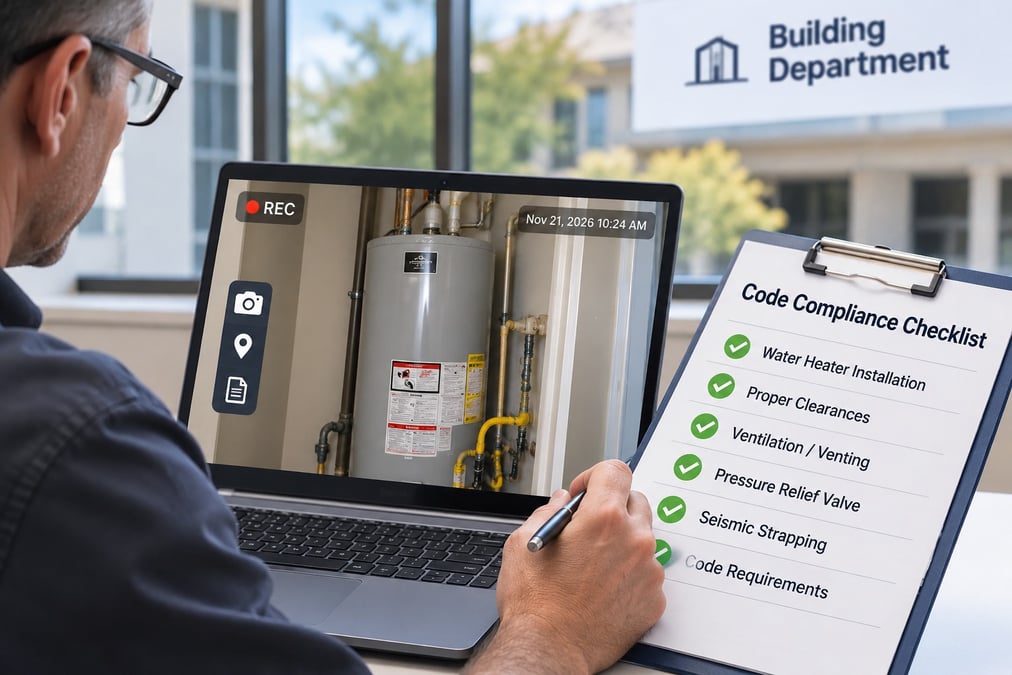
A remote water heater inspection lets a building inspector verify a water heater installation over live video, with the homeowner, property manager or contractor holding the camera. For most replacement permits, an inspector can check the strapping, venting, expansion tank and relief valve line in a few minutes, capture time stamped photos of each item and close the inspection without a site visit.
Water heater replacements are one of the most common residential permits a building department handles, and one of the best suited to remote inspection. The installation is compact, the code items are visual, and most of them can be confirmed from a few well-directed camera angles. This guide sets out a code compliance checklist for homes and apartments, the camera sequence that makes it work over video, and how Blitzz Inspect helps departments run it.
A note on codes and local amendments
Section references in this checklist follow the International Residential Code (IRC) and its fuel gas chapters, with matching International Plumbing Code (IPC) sections where relevant. Jurisdictions adopt different code editions, many use the Uniform Plumbing Code (UPC) instead, and local amendments are common. For example, the IRC allows a relief valve to discharge to the water heater pan, while some California jurisdictions prohibit it. Departments should adapt this checklist to the codes and amendments they enforce.
Key takeaways
- Most water heater code items are visual, which makes replacement permits strong candidates for remote video inspection.
- The core items are seismic strapping, relief valve and discharge piping, thermal expansion control, venting, combustion air, gas or electrical connections, location and drain pans.
- A consistent camera sequence turns a remote inspection into a fast, repeatable process the person on site can follow.
- Inspectors should require an in-person visit whenever video cannot clearly confirm a code item, or local policy calls for one.
- Data plate visible and legible: manufacturer, model, serial number, capacity, fuel type and input rating.
- Appliance listed and labeled, and installed per the manufacturer’s instructions.
- For gas units in garages, the flammable vapor ignition resistant (FVIR) label where elevation is not provided.
- Fuel-burning water heaters not installed in bedrooms, bathrooms or closets opening to them unless permitted, such as direct-vent units or dedicated enclosures meeting code (IRC G2406.2).
- Access and working space in front of the appliance for service (IRC M1305.1).
- In garages, ignition sources at least 18 inches above the floor unless the appliance is listed as FVIR (IRC G2408.2).
- Protection from vehicle impact where the water heater is in the normal path of a vehicle (IRC M1307.3.1 and G2408.3).
- Required in jurisdictions where seismic anchorage applies (IRC M1307.2; UPC 507.2).
- Straps located within the upper one-third and lower one-third of the water heater’s vertical dimension.
- Lower strap at least 4 inches above the controls.
- Straps secured to framing as the jurisdiction requires. Some jurisdictions require a third strap on larger tanks.
- Is not directly connected to the drainage system, and discharges through an air gap in the same room as the water heater.
- Is not smaller than the valve outlet and runs full size to the air gap.
- Serves a single relief device only.
- Is not trapped and drains by gravity, with no sags.
- Terminates not more than 6 inches above the floor or waste receptor, at a point readily observable by occupants.
- Has no threaded connection at the outlet end, and no valve or tee installed in the line.
- Is made of an approved material rated for the purpose.
- Thermal expansion control, typically an expansion tank, provided where a backflow preventer, check valve or pressure-reducing valve creates a closed system (IRC P2903.4).
- Expansion tank installed and supported per the manufacturer’s instructions.
- Shutoff valve on the cold water supply to the water heater (IRC P2903.9.2).
- Connections secure, with no visible leaks.
- Vacuum relief valve on bottom-fed tank-type water heaters (IRC P2804.7).
- Pan provided where leakage would cause damage, such as installations over finished spaces or wood floors (IRC P2801.6).
- Pan drain routed to an approved location. Where the drain terminates outdoors, verify the termination height above grade the jurisdiction requires.
- Vent type appropriate for the appliance and its listing, such as atmospheric, power vent or direct vent.
- Draft hood in place on atmospheric units.
- Vent connector joints secure, with upward slope toward the vent as required.
- Clearances to combustibles maintained per the listing and fuel gas code.
- Termination location and cap correct for the vent type, where it can be safely shown.
- Adequate combustion air for fuel-burning appliances in confined spaces (IRC G2407).
- Where openings are used, one within 12 inches of the top and one within 12 inches of the bottom of the enclosure, sized as required.
- Gas: accessible shutoff valve serving the appliance, sediment trap where required, approved appliance connector of permitted length, and no visible damage to piping.
- Electric: disconnecting means and wiring per the electrical code adopted by the jurisdiction, with covers in place.
- The connection or lighting is too poor to see details clearly.
- A code item cannot be shown safely, such as a vent termination on a roof.
- The installation is complex, such as a new location, new gas line or new venting route.
- Video raises concerns about workmanship or safety that need closer examination.
- Local policy, the code official or the permit type requires an on-site inspection.
- Fewer drives for routine permits. Inspectors clear replacement permits without travel and spend site time on inspections that require it.
- Faster scheduling. Remote sessions are easier to fit into the day, which shortens the wait between installation and approval.
- A consistent record. Every inspection produces time stamped photos and a written report tied to the permit.
- Fewer missed items. Checklists and Owlbert AI help confirm every item is captured before the call ends.
- ICC Building Safety Journal: Water heater safety in the International Codes
- LADBS: How to brace your water heater
- Blitzz Inspect
Why are water heaters well suited to remote inspection?
Water heaters are well suited to remote inspection because nearly every code item can be confirmed by looking at it. Strap positions, discharge pipe termination, vent connections, valve locations and clearances are all visible from a phone camera held at the right angle. Labels and data plates can be read on a zoomed-in photo.
The installation is also confined to one location. Unlike a framing or electrical rough-in inspection that spans a whole house, a water heater inspection typically covers one closet, garage corner or utility room. That keeps the call short and the camera sequence simple, even for a homeowner who has never taken part in an inspection before.
For departments, the volume makes the time savings meaningful. A routine replacement permit that requires a drive across the jurisdiction can instead be cleared in a short video session, freeing inspectors for the work that genuinely needs them on site.
Remote water heater inspection checklist
1. Equipment identification and listing
Ask for a close-up photo of the data plate first. It confirms the equipment matches the permit and gives the information needed to check clearances and venting against the listing.
2. Location, access and protection
3. Seismic strapping
Strapping is one of the most common correction items on replacement permits. Ask the person on site to show the full height of the tank, then each strap and its wall attachment. Many departments publish their own bracing details, such as the Los Angeles Department of Building and Safety bracing bulletin.
4. Temperature and pressure relief valve and discharge piping
Relief valve discharge piping is detailed in IRC P2804.6.1 and IPC 504.6. The ICC’s water heater safety guidance walks through each requirement. Over video, confirm that the discharge pipe:
Where the discharge extends outdoors, confirm the termination height required locally. Ask the person on site to follow the pipe with the camera from the valve to the termination in one continuous shot.
5. Thermal expansion control
Ask the person on site to show the incoming water line and any pressure-reducing valve or check valve, then the expansion tank and its connection.
6. Water connections and valves
7. Drain pan
Pan requirements for replacements vary. Confirm local rules for existing installations without a pan.
8. Venting (fuel-burning units)
Venting often needs more than one camera position. Ask for the connection at the draft hood or appliance, the full run of the connector, and the point where it enters the wall, ceiling or chimney.
9. Combustion air
10. Gas or electrical supply
What camera sequence works best?
A consistent camera sequence makes remote water heater inspections faster and easier for the person on site. The table below is a practical order that covers the checklist with minimal repositioning.
|
Shot |
What to show |
What it confirms |
|
1. Wide view |
The full water heater and its surroundings from several feet back |
Location, access, clearances, pan, vehicle protection |
|
2. Data plate |
Close-up of the label until text is readable |
Listing, capacity, fuel, input rating, FVIR |
|
3. Strapping |
Top-to-bottom view, then each strap and wall attachment |
Strap positions, 4-inch clearance above controls |
|
4. Relief valve line |
Continuous shot from the valve to the termination |
Size, slope, air gap, termination height, end condition |
|
5. Water piping |
Cold supply, shutoff valve, expansion tank, any PRV or check valve |
Shutoff, thermal expansion control |
|
6. Venting |
Draft hood or appliance connection, connector run, wall or ceiling penetration |
Connections, slope, clearances |
|
7. Fuel or power |
Gas shutoff, sediment trap and connector, or electrical disconnect |
Supply connections |
|
8. Combustion air |
Openings in the enclosure, if applicable |
Combustion air provision |
Send this sequence to the permit holder before the appointment, so they know what to prepare. A clear, well-lit space and a charged phone make the session shorter for everyone.
How does Blitzz Inspect support remote water heater inspections?
Blitzz Inspect is built for this kind of guided inspection. The inspector sends a link by text or email, and the permit holder taps it to join from their phone’s browser, with no app download. During the session, the inspector directs the camera, zooms in on labels and connections, and captures high resolution photos stamped with location and time.
Owlbert AI helps the inspector stay on the checklist and flags missing items before the call ends, so a strap or relief valve photo is not forgotten. When the session finishes, Owlbert writes the notes and inspection report. The inspector reviews the findings and makes every decision. Records can sync to permitting and records systems through Blitzz integrations.
For departments serving multilingual communities, Live Chat Translation translates chat messages between the inspector and the permit holder during the session, which helps when instructions need to be exact. Blitzz is built with enterprise-grade security; see Blitzz security. Learn more about Blitzz for government building departments.
When should a water heater inspection be done in person?
Remote inspection works when video can clearly confirm every required item. Inspectors should schedule an in-person visit when:
Departments adopting remote inspections should set clear eligibility rules, so permit holders know in advance which inspections qualify. Florida departments preparing for virtual inspection requirements may find our HB 667 virtual inspection compliance checklist useful.
What are the benefits for building departments?
For a broader introduction, see our guide to remote video inspections and remote video inspection for commercial and residential buildings.
FAQ
Can water heater inspections be done remotely?
Many can. Replacement permits with visible code items, such as strapping, relief valve piping, expansion tanks and venting, are well suited to remote video inspection where the jurisdiction allows it.
What do inspectors check on a water heater?
Typical items include equipment listing, location and access, seismic strapping, relief valve and discharge piping, thermal expansion control, water connections, drain pans, venting, combustion air and gas or electrical supply.
Does the homeowner need to download an app?
No. With Blitzz Inspect, the permit holder taps a link and joins from a phone browser.
Who writes the inspection report?
Owlbert AI writes the notes and report when the call ends. The inspector reviews and approves the findings.
Which code applies?
It depends on the jurisdiction. This checklist references the IRC and IPC, but many jurisdictions use the UPC or local amendments. Always apply the codes your department has adopted.
How much does Blitzz Inspect cost?
Blitzz Inspect offers a free account or a 30-day pilot; see the Blitzz Inspect pricing page.
Clear water heater permits without the drive
See how Blitzz Inspect handles remote water heater inspections from link to report. Start free or book a demo.
Sources

Blitzz Team
The Blitzz Team writes about remote video support, virtual inspections and field service. Our guides come from working with home builders, property managers, warranty teams, contact centers and field service organizations that use Blitzz to see and solve issues without a truck roll.