


On this page
A water heater swap is a short job with a surprisingly long tail. The plumber finishes in a few hours, then the customer waits for an inspector to confirm the vent, the gas connection, the relief valve, and the shutoffs. Until the inspection passes, the job isn't really closed.
That is why water heater replacements are among the inspections many agencies already allow remotely. The installation is compact, everything an inspector needs to see sits within a few feet of the unit, and a phone camera shows it clearly. Done right, a remote inspection saves the inspector a drive and saves you a return trip.
Done wrong, it leads to rejected photos and a rescheduled visit. This step-by-step guide walks through how remote water heater inspections work, the exact photos and views to capture, how to run the session, and the mistakes that trigger a failed inspection.
Why water heater inspections go remote first
Water heaters show up on many agencies' remote inspection lists, and the reasons are practical. The work is small and self-contained, and the items an inspector cares about are easy to show on camera. A growing number of programs and laws reflect that:
- Los Angeles County lists storage tank and tankless water heaters among the inspections that qualify for remote inspection. According to pv magazine, building officials there say 20% to 40% of inspections are handled remotely, mostly for things like water heaters and solar batteries, with no safety issues reported over seven years.
- Sacramento says virtual inspections are required for Minor Water Heater permits starting January 12, 2026.
- Henderson, Nevada, identifies water heater replacement as one of just two inspections eligible for virtual inspection, and Hillsborough County, Florida, offers a virtual plumbing final for water heater replacement, live or offline.
Law is adding momentum for the newest equipment. California's AB 1738 covers heat pump water heaters, and SB 222 requires agencies to offer asynchronous inspections for heat pump water heaters by July 1, 2027. Both bills were signed on September 30, 2026.
Steps 1 to 3: confirm, request, and prepare
The process starts before you touch the unit. Three steps set up a smooth inspection.
Step 1: Confirm the job is eligible. Agencies set their own limits. The City of Tampa's water heater checklist, for example, applies to replacements excluding relocations and conversions. Los Angeles County treats relocated water heaters as a special case, requiring a gas pipe pressure test and possibly a gas pipe schematic. Check the permit and your agency's page before you plan the install.
Step 2: Request the inspection the way your agency requires. Methods differ:
- In Los Angeles County, you request the inspection in the permit system and note in the comment line that you want a virtual inspection.
- In Dunwoody, Georgia, you schedule through the inspections portal and then submit a video.
- In Tampa, once photos are submitted through the VuSpex app, the inspection is automatically scheduled for the following business day.
Step 3: Prepare the host, the gear, and the paperwork. Los Angeles County asks for a host who is familiar with the trade and the project, usually the responsible contractor. Dunwoody goes further: the installing technician, not the property owner, must provide the video. Charge the phone, have a flashlight and tape measure ready, and keep the permit and any required documents at hand. If the agency uses a live stream, send the link or phone number to the inspector before the scheduled start.
The water heater photo and video checklist
This checklist combines the views in Los Angeles County's storage tank water heater guide, the City of Tampa's offline field report checklist, and Dunwoody's video instructions. Not every item applies to every unit, and your agency's list governs.
Location and identification
- The front of the building, showing the street address, and the permit
- A zoomed-out view of the water heater location
- The manufacturer's data plate or faceplate, close enough to read
Venting and combustion air (gas units)
- The entire vent connector, and the screws securing it to the draft hood
- Vent adapters, the ceiling or wall thimble, and any vent passing through an attic
- Clearance from the vent to combustibles: 6 inches for single wall, 1 inch for B-vent
- The vent roof penetration with its storm collar
- The combustion air openings or source
Relief valve, drains, and expansion
- The temperature and pressure relief valve and its drainpipe, along the entire exposed length
- A tape measure showing the drain termination, greater than 6 inches and less than 24 inches above grade where it terminates outside
- The drain pan and its drainpipe, including the termination, where required
- The thermal expansion device, where required
Shutoffs and connections
- The water shutoff valve, shown in both the on and off positions
- The gas shutoff valve in both positions, and the sediment trap
- Hot and cold water connections, and insulation on the hot water outlet
- Water pipe insulation
Protection and clearances
- The seismic strap and spacer between the water heater and the wall
- The flammable vapor ignition resistant label, or the unit elevated 18 inches, if it is in a garage
- Impact protection, such as a bollard or wheel stop, and the stand, where required
- Clearances, with a tape measure
Electrical (electric units)
- The electrical connection and wire size
- The disconnecting means
- The breaker and panel schedule
Steps 4 to 8: run the inspection
Whether you stream live or record a video, the best structure follows Dunwoody's instructions, which are among the clearest published. The sequence works for photos and live sessions too.
Step 4: Start outside. Show the address first, then the permit. Los Angeles County also asks live-stream hosts to start at the street, showing the address, and then advance to the location of the water heater.
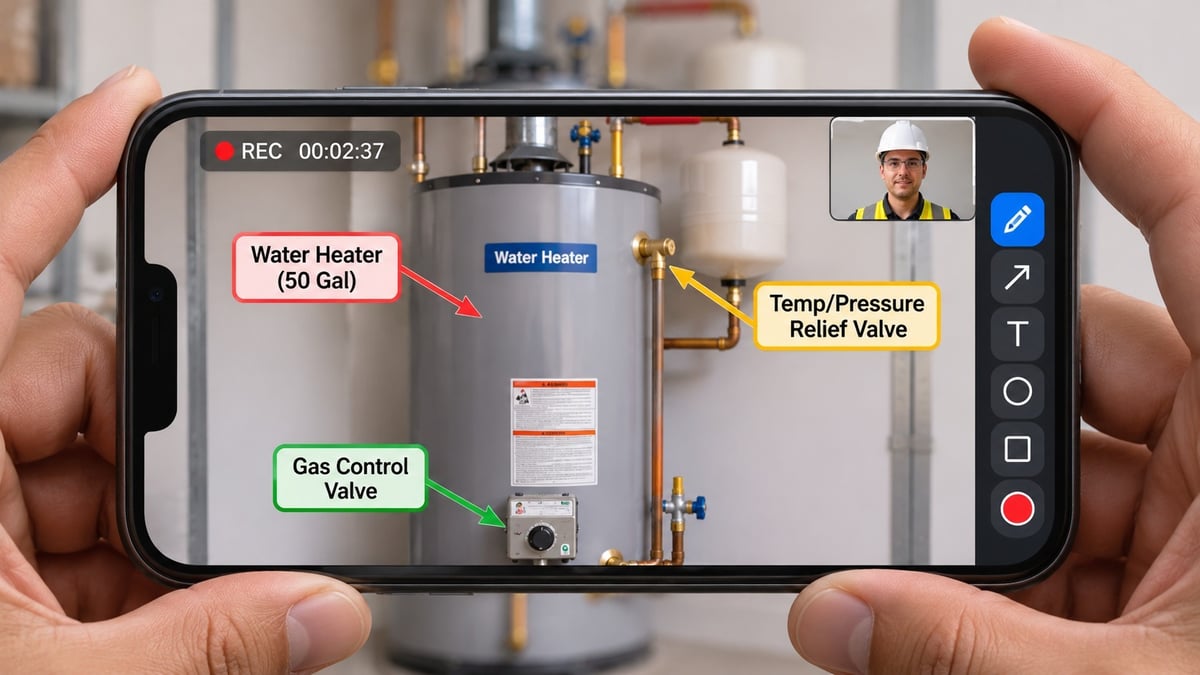
Step 5: Show the whole unit, top to bottom. Dunwoody asks you to start where the flue penetrates the ceiling or exterior wall and move slowly down to the floor, with nothing obstructing the view. Keep the full unit in frame: flue, gas line or electrical service, thermal expansion device, water lines, relief valve, sediment trap, drain valve, shutoff valve, drain pan, disconnecting means, and control valve.
Step 6: Call out the details that need proof. Use a tape measure for clearances and the relief drain termination, and show shutoff valves in both positions, as Los Angeles County requires. For a gas unit, show the combustion air source.
Step 7: Zoom in on the faceplate. The data plate must be legible to the inspector.
Step 8: Submit and track the result. Dunwoody wants the video uninterrupted and unedited, in landscape mode. Dark or unclear video results in a failed inspection and must be resubmitted. In Los Angeles County, results arrive in writing by email after the inspection, and any questions about corrections go through email or phone the next morning.
Heat pump, tankless, and relocated units
Standard tank replacements are the easiest case. Other types need extra care, because requirements are still evolving.
- Heat pump water heaters. California's AB 1738 includes them among the upgrades homeowners and contractors can ask to have inspected remotely, and SB 222 requires asynchronous inspections for them by July 1, 2027. In an asynchronous inspection, you document the work and the inspector reviews it later, so your capture has to answer every question in advance. SB 222 also creates a unified permit type and caps permit fees at $150 for heat pump water heaters, according to Blitzz's SB 222 explainer.
- Tankless units. Los Angeles County lists tankless units alongside storage tank water heaters among its qualifying inspections, but the detailed views it publishes are written for storage tanks. Ask your agency what it expects for a tankless install.
- Relocations and conversions. Tampa excludes them from its water heater checklist, and Los Angeles County requires a gas pipe pressure test for relocated units, with a 15 psi maximum test gauge set at 8 psi or higher, and possibly a gas pipe schematic. Plan on a more detailed review, and possibly an in-person visit.
As a rule, treat each equipment type as its own checklist. When your agency doesn't publish one, ask the inspector which views they need before you schedule.
Capture as you install, not after
The fastest remote inspections are the ones where the evidence is already collected when the install ends. Some details are easier to photograph in the middle of the job than at the end:
- Before you close up. Capture the relief valve and discharge pipe, the expansion device, and any pipe insulation before panels, drywall, or covers hide them.
- While the unit is open to view. Photograph the vent connector, draft hood screws, and thimble before any finishing work.
- At the end of the install. Shoot the strap, the pan and drain, the shutoff valves in both positions, the electrical disconnect, and the faceplate.
A checklist keeps every tech consistent. Build one template for storage tank replacements, another for heat pump units, and have each tech work through it on every job. Add a quick narration while you walk the unit: the inspector hears what you're showing, and you create a record of what you said at the time.
BlitzzCam is built for this. Every photo and video is stamped with GPS and time at capture and filed to the right job. Checklists attach required photos to each step, AI Walkthrough turns spoken notes into written ones, and crews can keep shooting offline and sync later. At the end you can share a permission-based link or branded PDF report, so the evidence is ready for any agency's process.
Common reasons a remote water heater inspection fails
Most failures come from a handful of avoidable mistakes.
- Dark or unclear video. Dunwoody states that video that is dark or unclear results in a failed inspection and must be resubmitted. Light the area and hold steady.
- An unreadable faceplate. If the inspector can't read the data plate, they can't verify the unit matches the permit.
- Edited or interrupted footage. Dunwoody requires uninterrupted, unedited video in landscape mode. Record one continuous take.
- Skipping the detail shots. Missing relief drain measurements, pan drains, or shutoff valves in both positions are easy items to forget.
- Treating a relocation like a replacement. Relocations and conversions are excluded from some programs and require extra items, like a gas pressure test, in others.
FAQ
Can the homeowner record the video instead of the installer?
It depends on the agency. Dunwoody requires the installing technician, not the property owner, to provide the video. Los Angeles County says the host should be familiar with the trade and the project, usually the contractor.
Do I need a live call, or can I submit photos?
That is set locally. Los Angeles County allows live stream, pictures, video, or any combination, while Tampa's offline field report is built on photos taken in the VuSpex app.
What if the inspector wants to see more?
An inspector can require an in-person visit for any part of a project, so keep your evidence complete and your schedule flexible.
The bottom line
A remote water heater inspection is quick when you show the right things in the right order, and slow when you don't. Confirm eligibility, follow your agency's checklist, shoot one clear take from the flue to the floor, and capture the details as you install. Start a free BlitzzCam trial to capture GPS and time stamped photos and checklists on your next job, or book a Blitzz Inspect demo if you run an inspection program.

Blitzz Team
The Blitzz Team writes about remote video support, virtual inspections and field service. Our guides come from working with home builders, property managers, warranty teams, contact centers and field service organizations that use Blitzz to see and solve issues without a truck roll.