
.png?width=120&height=55&name=Blitzz-Logo-right%20white%20eyes%20-%20not%20transparent%20(3).png)

On this page
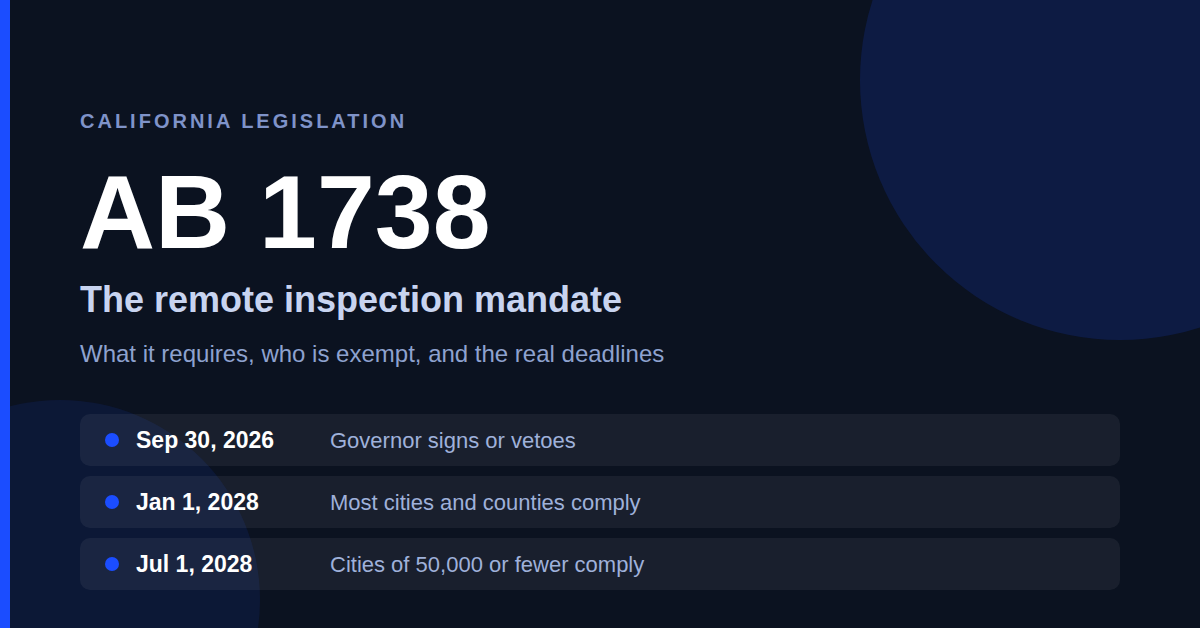
Most California building departments planning for remote inspections are working backward from January 1, 2028. That is the AB 1738 date.
For heat pump work, it is the wrong date.
SB 222, authored by Senator Wiener, requires cities and counties to adopt and offer asynchronous inspections beginning July 1, 2027. That is roughly six months earlier, and it lands on the same heat pump water heater and heat pump HVAC work that AB 1738 also covers.
The bill passed the Assembly 60 to 8 on August 24, 2026, the Senate concurred 32 to 5 on August 25, and it was enrolled and presented to the Governor on August 30. He has until September 30 to act. You can follow the vote history on LegiScan.
What SB 222 requires of a building department
SB 222 adds Chapter 7.5 to the Government Code, starting at Section 51297.50, plus Section 4737 to the Civil Code. Four obligations land on local agencies.
Asynchronous inspections by July 1, 2027. Cities and counties must adopt and offer inspections that do not require the licensed contractor and the building inspector to be simultaneously present. The inspector may contact the contractor by telephone or real time video conferencing during the inspection. If something does not check out, the inspector can require a follow up inspection where both parties are present.
Automated online permitting by July 1, 2028. For heat pump swapouts, agencies must implement an online, automated permitting process that issues permits in real time, with load calculations certified under penalty of perjury.
Permit fee caps. Heat pump water heater permits are capped at $150. Heat pump HVAC permits are capped at $200. Fees must correspond to the typical reasonable cost and be set at a regular fixed amount. Third party technology fees are excluded from the cap.
Publication and electronic filing. Fees and requirements go on the agency website, and electronic applications and signatures must be accepted.
Cities under 5,000 population and counties under 150,000 are exempt from the automated permitting, fee cap, and website provisions.
The bill also restricts what planning and zoning conditions a city may impose on a heat pump installation, and blocks homeowners associations from prohibiting installations or charging fees for them. Those provisions do not fall on the inspection division.
Asynchronous is not the same as remote video
This is the distinction that catches people out.
An asynchronous inspection means the contractor and the inspector are not on site at the same moment. The contractor documents the work and moves on. The inspector reviews it later and calls or video conferences the contractor if something needs clarification.
A live remote video inspection, the kind AB 1738 contemplates, means both parties are present at the same time, just not in the same place.
These are different workflows with different tooling requirements. Asynchronous inspection depends on the quality of what the contractor captured, because the inspector cannot ask them to move the camera in the moment. That puts the weight on structured capture: timestamped photos and video, location proof, and a defined shot list per permit type.
A department that has only run live video inspections is not automatically compliant with SB 222, and a department that has only accepted photo submissions is not automatically compliant with AB 1738.
How SB 222 and AB 1738 stack
Both bills are sitting on the Governor's desk right now. If both are signed, California building departments face three dates, not one.
The overlap matters. Heat pump water heaters and heat pump HVAC systems appear in both bills. For that work, the operative deadline is July 1, 2027 under SB 222.
A department that budgets and procures against January 1, 2028 will be roughly two quarters late on the busiest category of residential mechanical permits in the state.
The argument on the other side
The California State Association of Counties and the League of California Cities opposed SB 222. Their position is that research shows high upfront equipment costs and emergency replacement situations drive consumer decisions, not permitting friction, and that the mandate's costs are not justified by the benefit.
The supporting coalition, over 70 organizations, points at the arithmetic. California has a goal of 6 million heat pumps installed by 2030. Roughly 1.9 million were installed as of December 2024, and the state is projected to reach about 4 million by 2030. Permitting and inspection friction is one of the few levers available in the time remaining.
Whichever reading you find more persuasive, the compliance question is the same.
What this looks like when it works
More than a dozen California municipalities already run some form of remote inspection program. Two examples show the operating numbers.
City of Berkeley, Building & Safety Division. Berkeley moved routine inspections to app free mobile video. Property owners get an SMS link and share their camera with no download. The division reported a 50% reduction in scheduling wait times, a 24 minute average virtual inspection, and 2x daily inspection capacity without adding staff.
"Blitzz is easy to work with and use. It is a great tool to have for inspections. A good Wifi or Internet connection and the virtual Blitzz app can be used in any part of the house for an inspection."
Keith T., Building Inspector, City of Berkeley
Read the full City of Berkeley case study.
Aoka Engineering. Aoka delivers contract inspection services to municipalities, including jurisdictions hours from the nearest inspector. Remote video inspection moved them from days of waiting to same day inspections, often within an hour, with timestamped video and annotated photos on every job.
"Contractors click a link, our certified inspector sees exactly what they see, and the project keeps moving."
Aoka Engineering Virtual Inspections Team
Read the full Aoka Engineering case study.
A working timeline
You have roughly nine months of planning runway before the July 2027 date, and procurement is the long pole.
- Now through Q1 2027: pull your heat pump water heater and heat pump HVAC permit volumes. That number is the size of the problem
- Q1 2027: define the asynchronous capture standard. What the contractor must submit per permit type, how location is proven, what triggers a follow up
- Q2 2027: pilot on heat pump water heaters, the simplest of the two, and train inspectors on reviewing submissions rather than conducting them
- By July 1, 2027: asynchronous option live for both heat pump categories
- Through 2027: extend the same capture standard to the AB 1738 categories ahead of January 1, 2028
- By July 1, 2028: automated online permitting for swapouts
What to look for in a platform
SB 222 and AB 1738 together mean you need both modes in one system. A few criteria matter more than the feature lists suggest.
Recorded submission and live session in one platform. Two tools means two records, two training curves, and two vendors to answer for at audit.
A defined capture standard per permit type. The asynchronous case fails when the contractor sends four blurry photos. Look for the ability to require a specific set of captures before a submission can be sent.
Location and time proof. Geotagged, timestamped capture removes the question of whether the media shows the permitted address.
No app download. Adoption dies at the app store. Contractors should be able to submit from a text message link in whatever browser their phone already has.
A retained record. Timestamped video, still capture, inspector notes, and a standardized inspection report that matches your records retention schedule.
Permitting system integration. Results that do not write back to Accela, Tyler, or CentralSquare become a data entry problem. Check the vendor's integration list before the pilot, not after.
Language support. Live chat translation is often the difference between a completed inspection and a rescheduled one.
General purpose video tools clear none of these bars. They produce no structured record, no location proof, and no permit linkage.
Where Blitzz fits
Blitzz Inspect runs both modes. Inspectors can hold a live session, or a contractor can capture and submit a documented inspection for review later, which is the asynchronous workflow SB 222 requires. Everything is recorded, timestamped, and geotagged, inspectors can annotate and pull high resolution stills, and the record can be pushed into your permitting system.
California agencies are running this today. Berkeley did it without adding headcount.
Start before the deadline forces you to
See a remote inspection run end to end.
Agencies that start now will be past the learning curve well before July 2027, and will collect the wait time savings in the meantime. In 20 minutes we will show you both workflows, the record each produces, and how it holds up for audit.
Prefer to look at numbers first? See Blitzz Inspect pricing.
This article summarizes SB 222 as enrolled and presented to the Governor on August 30, 2026. It is not legal advice. Confirm the final chaptered text and consult your agency counsel before adopting a compliance plan.