
.png?width=120&height=55&name=Blitzz-Logo-right%20white%20eyes%20-%20not%20transparent%20(3).png)

On this page
California is on the verge of becoming the first state to give homeowners a legal right to request a remote building inspection.
AB 1738 passed the Senate on August 20, 2026, cleared Assembly concurrence on August 24, was enrolled on August 26, and was presented to the Governor on August 28. He has until September 30, 2026 to sign or veto it. You can track the full vote history on LegiScan.
If you run a building department, plan check operation, or permit center in California, the practical question is not whether remote inspections are coming. It is what the statute actually obligates you to do, and how much runway you have.
Here is the plain reading of the enrolled text.
What AB 1738 adds to the law
AB 1738 adds Section 17970.9 to the Health and Safety Code. The core obligation is one sentence long in substance:
A local agency must offer a homeowner, or a contractor who has the homeowner's written consent, the option of requesting a remote inspection for all or a subset of the inspections required by a building permit on a single or two family dwelling.
"Local agency" means a city, a county, or a city and county. The Legislature declared permitting and inspection oversight a matter of statewide concern, so charter cities are covered too.
Which projects are covered
The mandate is scoped to five categories of work in one and two family dwellings:
- Residential heat pump water heaters, including alteration, extension, or replacement of existing electrical components needed to support the installation
- Residential heat pump HVAC systems, including the supporting electrical work
- Residential reroofs
- Photovoltaic systems with an AC nameplate rating of 15 kW or less, and energy storage systems
- Smoke and carbon monoxide detectors
New or upgraded main electrical services are carved out. You are not required to inspect those remotely, though you may choose to.
The inspector picks the method. The statute allows either live videoconferencing or recorded photos and videos, at the construction inspector's discretion.
The deadlines everyone is getting wrong
There are two compliance dates, and neither one is 2027.
- January 1, 2028 for local agencies that are not "qualifying" cities or counties
- July 1, 2028 for qualifying cities, defined as a city with a population of 50,000 or fewer that is not otherwise exempt
Exemptions: the section does not apply to a city with a population under 5,000, or a county with a population under 150,000, including every city within that county.
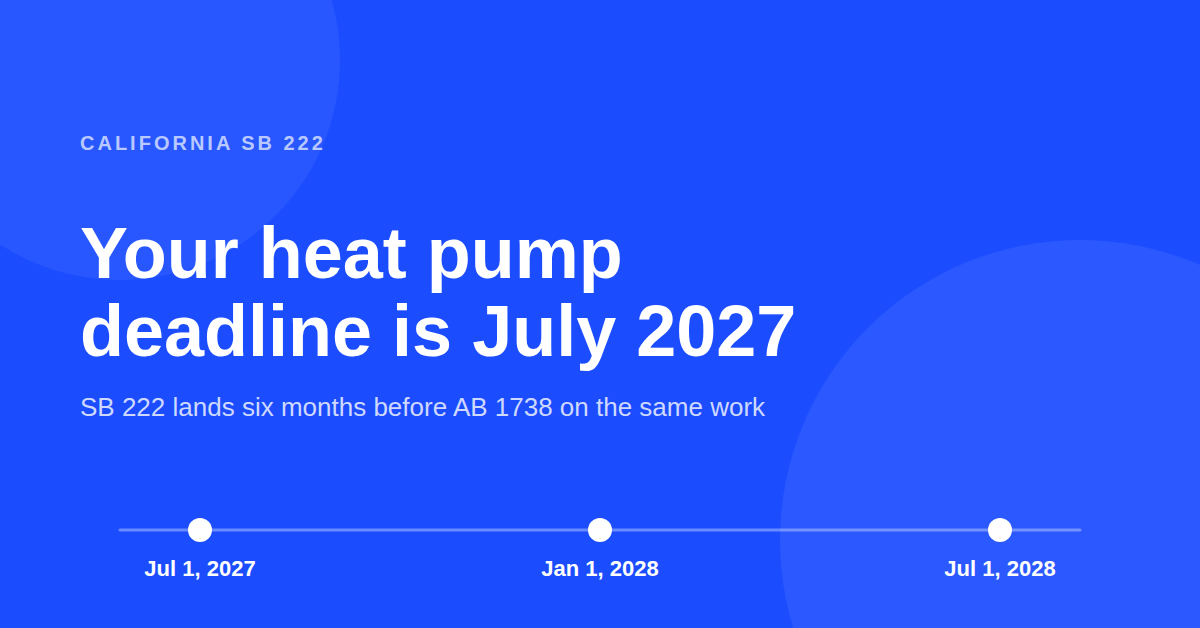
If you have seen a July 1, 2027 date attached to AB 1738, that came from an earlier version of the bill. The same goes for the HCD annual reporting requirement and the onsite audit language that circulated in spring. Neither survived into the enrolled text. Check the August 26, 2026 enrolled version before you build a compliance plan around a vendor page or a summary written six months ago.
What the bill does not take away
Most of the opposition to AB 1738, including CALBO's formal opposition, centered on inspector authority. The final text keeps that authority largely intact.
An inspector can terminate a remote inspection mid stream and require an in person inspection if compliance cannot be verified through the camera. If an applicant fails a remote inspection, the inspector decides whether the remaining inspections on that permit happen remotely or in person.
Agencies can adopt reasonable technical protocols. The statute explicitly contemplates rules covering field of view, image quality, camera coverage, broadband sufficiency, and proof that the work shown is the actual permitted work at the permitted address. It even names the practice many departments already use: the video or photo record has to start at the street, showing the property address at the front of the building.
Existing public entity immunities under Government Code sections 818.4, 818.6, and 821.2 apply to remote inspections the same way they apply to in person ones.
And if someone willfully misrepresents the work, the agency can ban them from remote inspections for up to six months on a first offense and twelve months after that. Agencies can also agree to enforce each other's bans, which turns a local penalty into a regional one.
The provision that will cause the most operational pain
Subdivision (f) is one line: a local agency shall offer a remote inspection at no greater cost and with no greater delay than an in person inspection.
That is the requirement to plan around. It rules out treating remote inspection as a premium service with its own fee. It also rules out a workflow where remote requests sit in a separate queue that clears more slowly than the truck route.
Practically, it means your remote inspection program has to live inside your existing scheduling and permitting system, not beside it in a spreadsheet.
What this looks like when it works
The Legislature's own findings note that more than a dozen California municipalities already offer remote inspections for at least one permit type. Two examples show what the operating numbers look like.
City of Berkeley, Building & Safety Division. Berkeley moved routine inspections to app free mobile video. Property owners get an SMS link and share their camera without downloading anything. The division reported a 50% reduction in scheduling wait times, a 24 minute average virtual inspection, and 2x daily inspection capacity without adding staff.
"Blitzz is easy to work with and use. It is a great tool to have for inspections. A good Wifi or Internet connection and the virtual Blitzz app can be used in any part of the house for an inspection."
Keith T., Building Inspector, City of Berkeley
Read the full City of Berkeley case study.
Aoka Engineering. Aoka provides contract planning and development services to municipalities, including jurisdictions hours away from the nearest inspector. Using remote video inspection, Aoka moved from days of waiting to same day inspections, often within an hour, kept working through weather that would have canceled site visits, and produced timestamped video with annotated photos for every job.
"Contractors click a link, our certified inspector sees exactly what they see, and the project keeps moving."
Aoka Engineering Virtual Inspections Team
Read the full Aoka Engineering case study.
Note what Berkeley's numbers mean under subdivision (f). A department that cuts wait times in half on the remote track does not have a parity problem. A department that bolts remote inspection onto a separate, slower queue does.
A reasonable timeline to work backward from
You have roughly 16 months until the January 2028 date. That sounds generous until you map it against procurement.
- Now through Q1 2027: confirm which of the five project types you already inspect remotely, if any. Pull volume counts so you know what share of your inspection load is in scope
- Q1 to Q2 2027: draft the technical protocol allowed under subdivision (d). Address identification, image quality, connectivity, and when an inspector can convert to in person
- Q2 to Q3 2027: run a pilot on one permit type. Reroofs and detector inspections are usually the easiest starting point
- Q3 to Q4 2027: procurement, integration with your permitting system, and inspector training
- By January 1, 2028: full offering across all five categories, with scheduling parity
Departments that already run a remote program for one permit type will spend most of this on scope expansion and documentation. Departments starting from zero should treat procurement as the long pole.
What to look for in a remote inspection platform
The statute is technology neutral, which means the burden of proving a remote inspection was legitimate falls on your records. A few criteria matter more than the feature lists suggest:
No app download. Adoption dies at the app store. Homeowners and small contractors should be able to join from a text message link in whatever browser their phone already has. Low participation is the most common reason pilot programs stall.
Both live and recorded modes. The statute permits videoconferencing or recorded photos and videos. A platform that only does live sessions forces you to schedule around bandwidth and homeowner availability. Recorded submissions handle the rural and low signal cases.
Location verification built in. Geotagged, timestamped capture that starts at the street satisfies the address verification protocol without asking the inspector to narrate it.
A retained record. Subdivision (c) lets you keep a digital record for review, training, and compliance. That record is also your defense if a remote inspection is ever challenged. Look for timestamped video, still capture, inspector notes, and a standardized inspection report you can match to your existing records schedule.
Permitting system integration. If results do not write back to Accela, Tyler, CentralSquare, or whatever you run, the parity requirement in subdivision (f) becomes a data entry problem. Check the vendor's integration list before the pilot, not after.
Language support. Contractor crews in California are not uniformly English speaking. Live translation in chat is the difference between a completed inspection and a rescheduled one.
General purpose video conferencing tools clear none of these bars. They produce no structured record, no location proof, and no permit linkage.
Where Blitzz fits
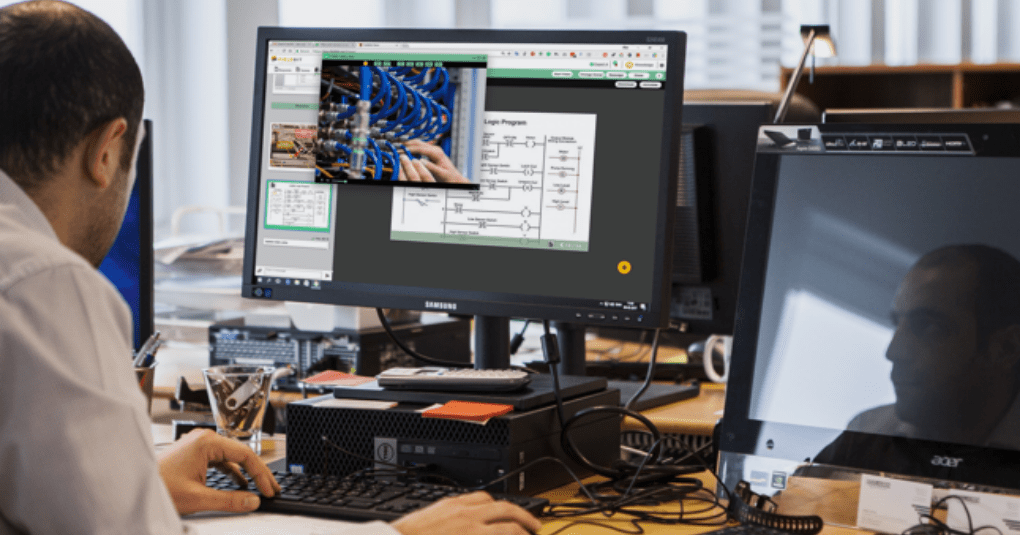
Blitzz Inspect is a remote video inspection platform built for exactly this workflow. Inspectors send a link, the homeowner or contractor joins from their phone browser with no app download, and the session is recorded, timestamped, and geotagged. Inspectors can annotate live, capture stills, pull high resolution images, and use live chat translation when the crew on site is not English speaking. Everything lands in a searchable record that can be pushed into your permitting system.
California agencies are already running this today. Berkeley did it without adding headcount.
Start before the deadline forces you to
See a remote inspection run end to end.
Agencies that stand up a program now will be past the learning curve well before January 2028, and will collect the wait time savings for a full year in the meantime. In 20 minutes we will show you a live inspection, the record it produces, and how it holds up for audit.
Prefer to look at numbers first? See Blitzz Inspect pricing.
This article summarizes the enrolled version of AB 1738 dated August 26, 2026. It is not legal advice. Confirm the final chaptered text and consult your agency counsel before adopting a compliance plan.