



On this page
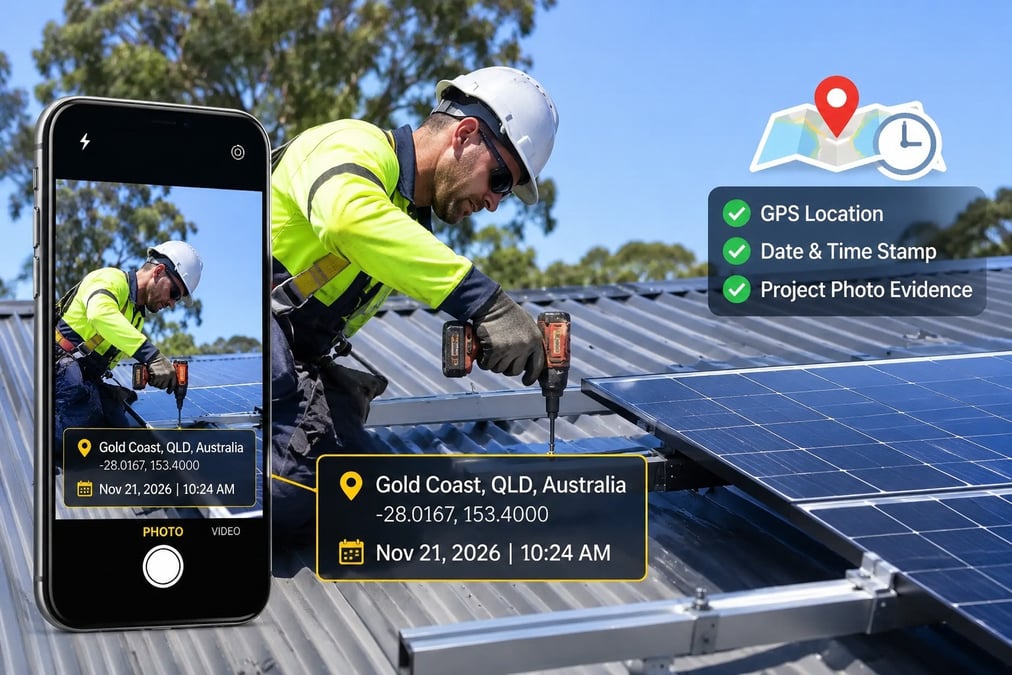
GPS and time stamped photos give solar installers proof of where and when every part of an installation was completed. That proof matters because most of a solar install disappears from view once it is finished: roof attachments sit under the array, conduit runs through attics, and wiring is closed inside panels and junction boxes. BlitzzCam stamps every photo with GPS location and time at the moment of capture and files it to the right project automatically, so the record of each install is complete, organized and verifiable.
This guide covers why location and time matter for solar documentation, where installers feel the pain when they are missing, what to photograph at each stage, and how BlitzzCam helps solar installers build a record that holds up.
Key takeaways
- A solar install is mostly hidden once complete. Photos taken during the work are often the only proof of how attachments, flashing and wiring were installed.
- GPS confirms the photo was taken at the right property and on the right array. Time confirms the sequence of work and when each stage was completed.
- Ordinary phone photos can lose their location and time data when they are texted, emailed or downloaded. Capture-time stamping keeps that context attached.
- BlitzzCam stamps every photo with GPS and time, files it to the job, and keeps that verification with the photo as it is stored and shared.
- GPS and time on every photo and video. Each image is stamped at capture through photo documentation and filed to the correct project automatically.
- Works without signal. Rural sites and remote roofs often have weak coverage. Crews can keep capturing photos, which sync once the device reconnects with the original GPS and time intact.
- A timeline for every install. The project timeline shows every job day by day, from site survey to commissioning.
- Find any photo by asking. AI photo tagging and search labels photos automatically, so the office can search for “south roof flashing” instead of scrolling. Read more in why AI photo tagging is important for contractors.
- Notes without typing. With AI Walkthrough, installers talk while they shoot and AI writes the notes, linked to the photos they describe.
- Reports in a few clicks. AI reports assemble photos, notes and checklist results, and reports and sharing sends them as a branded PDF or a live link that clients can open without an app or login.
- Company-owned records. Every photo belongs to the company, with roles, groups and a full activity log through admin controls.
- Every job on one map. Map view shows each install and its photos by location, which helps operations teams manage installs across a wide service area.
Why do GPS and time stamps matter for solar installers?
GPS and time stamps matter because they turn a picture into documentation. A photo of a roof attachment shows what was installed. A photo stamped with GPS coordinates and a timestamp shows where it was installed and when, which removes the most common reasons a photo can be questioned.
Solar installers answer to more parties than most trades. A single residential system can involve the homeowner, a sales organization, a financing partner, the authority having jurisdiction, the utility, equipment manufacturers and sometimes a roofer or subcontractor. Each of them may ask for proof at a different point, and each will want to know that the photo they are looking at belongs to that address and that stage of the job.
Location and time also protect the installer. When a homeowner reports a roof leak two years after installation, or a lender asks whether a milestone was really complete on a certain date, the company that can produce verified photos from the day of the work is in a much stronger position than one relying on memory or an unlabeled camera roll.
What problems do solar installers face without verified photos?
Photos that cannot prove which property they came from
Many residential roofs look alike in photos, especially close-ups of rails, attachments and flashing. When an installer runs several jobs in the same week, a photo without location data can be filed to the wrong project or challenged as belonging to a different home. GPS coordinates settle that question immediately.
Missing proof of work that is now covered
Once panels are mounted, the attachments and flashing beneath them are difficult to inspect without removing modules. Once walls and panels are closed, the wiring behind them is hidden. If those stages were not photographed at the time, there is no practical way to show how they were done. Time stamped photos taken before cover provide that evidence.
Roof leak and roof damage disputes
Roof penetrations are one of the most sensitive parts of a solar install. If a homeowner reports a leak or damaged shingles, the installer needs to show what the roof looked like before work began and how each penetration was sealed. Before and after photos with GPS and time make it possible to separate pre-existing roof conditions from anything related to the install.
Delays in permitting, interconnection and payment
Inspections, utility interconnection and financing milestones often depend on photo documentation. Requirements vary by jurisdiction, utility and financing partner, but incomplete or unclear photos are a common reason for resubmissions. Each resubmission adds days to the time between installation and the system being switched on, and to the time before the installer is paid.
Photos scattered across phones and group chats
On many solar crews, photos live on installers’ personal phones and are shared through text threads. Messaging apps and email can strip location and time data from images, and personal phones leave the company when the employee does. The photos exist, but they are hard to find, hard to verify and not owned by the business.
Inconsistent documentation across crews
Different crews photograph different things. One records every attachment, another photographs only the finished array. That inconsistency makes it harder to meet documentation requirements, review quality control across jobs or onboard new installers.
What should solar installers photograph at each stage?
The exact list depends on the jurisdiction, utility, financing partner and equipment manufacturer, so installers should always confirm the requirements that apply to each project. The table below shows a common baseline.
|
Stage |
What to photograph |
Why it matters |
|
Site survey |
Roof condition on every plane, main service panel, meter, attic structure where accessible |
Records pre-existing conditions before any work begins |
|
Roof attachments |
Each attachment and its flashing before rails or modules cover it |
Proof of proper installation for warranties and leak disputes |
|
Racking and modules |
Rails, grounding, module layout and labels |
Supports inspections and manufacturer warranty claims |
|
Electrical |
Conduit runs, junction boxes, inverter, disconnects, labeling, panel and breaker |
Shows wiring before it is closed up and supports inspections |
|
Equipment details |
Serial number and nameplate labels for modules, inverters and batteries |
Needed for warranty registration and future service |
|
Commissioning |
Inverter or monitoring display showing the system operating, finished array from the ground |
Confirms completion for closeout, utility and financing steps |
Turning this baseline into a photo checklist makes the required shots part of every job of that type. Crews see exactly what to capture, required photos cannot be skipped, and any item that fails can be assigned as a follow-up task.
Why aren’t regular phone photos enough?
A phone camera does record location and time in a photo’s metadata, but that data is fragile. Depending on settings and how the photo is shared, location data may not be recorded at all, and messaging apps, email and some upload processes can remove it. Once a photo has been forwarded a few times, it is often just a picture again, with no reliable way to show where or when it was taken.
BlitzzCam is designed to avoid that problem. Every photo is stamped with GPS location and a timestamp at the moment it is taken, not added afterward, and that verification stays with the photo as it is stored and shared. For a deeper comparison, see BlitzzCam vs. a phone camera and how BlitzzCam keeps photo data secure and audit ready.
How does BlitzzCam help solar installers?
BlitzzCam is Blitzz’s field photo documentation app for contractors and crews. Installers take photos the way they already do, and BlitzzCam handles the rest.
BlitzzCam is built for the jobsite, with glove-friendly apps for iOS and Android and a web app for the office, and connects to other systems through integrations including Zapier and a REST API.
Where do verified photos make the biggest difference?
Inspections and closeout
A complete, verified photo record makes inspections and project closeout faster. When every required photo is captured, stamped and filed under the job, assembling the package for an inspector, utility or financing partner becomes a matter of selecting photos rather than chasing crews for them.
Warranty claims and service calls
Equipment warranties and workmanship warranties both depend on evidence. Serial number photos speed up warranty registration and replacement, and attachment and flashing photos support the installer’s position if a roof issue is reported years later. Service technicians can also review the original install photos before they arrive on site.
Homeowner disputes
When a homeowner questions a charge, a delay or a roof condition, a shareable link to the verified photo record often resolves the issue faster than a phone call. BlitzzCam’s proof of work and damage documentation use cases are built for exactly these situations.
Remote verification
For checks where a supervisor or third party needs to see something live, Blitzz Inspect adds remote video inspection with Owlbert AI writing the notes. BlitzzCam handles the photo record the crew builds on site.
What does BlitzzCam cost?
BlitzzCam starts with a free 14-day trial. Monthly plans are $49.99 per month with 3 users included, plus $14.99 per month for each additional user. Annual plans are $39.99 per month with 3 users included, plus $11.99 per month for each additional user, billed annually. Photo capture is unlimited. See the BlitzzCam pricing page for current details.
FAQ
Why do solar installers need GPS and time stamped photos?
Because most of a solar install is hidden once complete. GPS and time stamps prove where and when attachments, flashing, wiring and equipment were installed, which supports inspections, warranties and dispute resolution.
Does BlitzzCam add GPS and time automatically?
Yes. BlitzzCam stamps every photo with GPS location and a timestamp at capture and files it under the project automatically.
What happens if there is no cell signal on the roof?
Crews can keep taking photos. They sync once the device reconnects, with the original GPS and time intact.
Can I share photos with homeowners, utilities or lenders?
Yes. Photos can be shared as a branded report or a live link, and recipients do not need an app or login.
Do GPS and time stamped photos meet every permit or utility requirement?
Requirements vary by jurisdiction, utility and financing partner. GPS and time stamped photos provide a strong foundation, but installers should confirm the specific photos each project requires and build them into a checklist.
Build a verified record of every install
See how BlitzzCam fits your solar workflow alongside before and after photos and project timelines. Start a free 14-day trial or book a demo.

Blitzz Team
The Blitzz Team writes about remote video support, virtual inspections and field service. Our guides come from working with home builders, property managers, warranty teams, contact centers and field service organizations that use Blitzz to see and solve issues without a truck roll.