
.png?width=120&height=55&name=Blitzz-Logo-right%20white%20eyes%20-%20not%20transparent%20(3).png)

On this page
Artificial intelligence has moved from buzzword to backbone. In 2026, AI no longer sits at the edge of the customer support function as a novelty chatbot or an autocomplete suggestion—it shapes how teams route tickets, document conversations, predict churn, and resolve issues before a customer ever picks up the phone. Support leaders who once asked whether AI belonged in their workflow are now asking how fast they can scale it, and how to measure the return.
The pressure is real. Customers expect instant, accurate, around-the-clock help across every channel, and they have little patience for repeating themselves or waiting days for a resolution that should take minutes. AI has emerged as the only practical way to meet that expectation at scale without ballooning headcount. Yet the organizations seeing the strongest results aren't simply bolting AI onto old processes—they're rethinking the entire support journey around what intelligent systems make possible.
But the most important shift this year isn't any single capability. It's the recognition that text and voice AI have a ceiling—and that visual AI is the layer that breaks through it. Below are ten ways AI is reshaping customer support in 2026, building toward the missing piece most roadmaps still overlook.
1. Conversational AI Has Grown Up
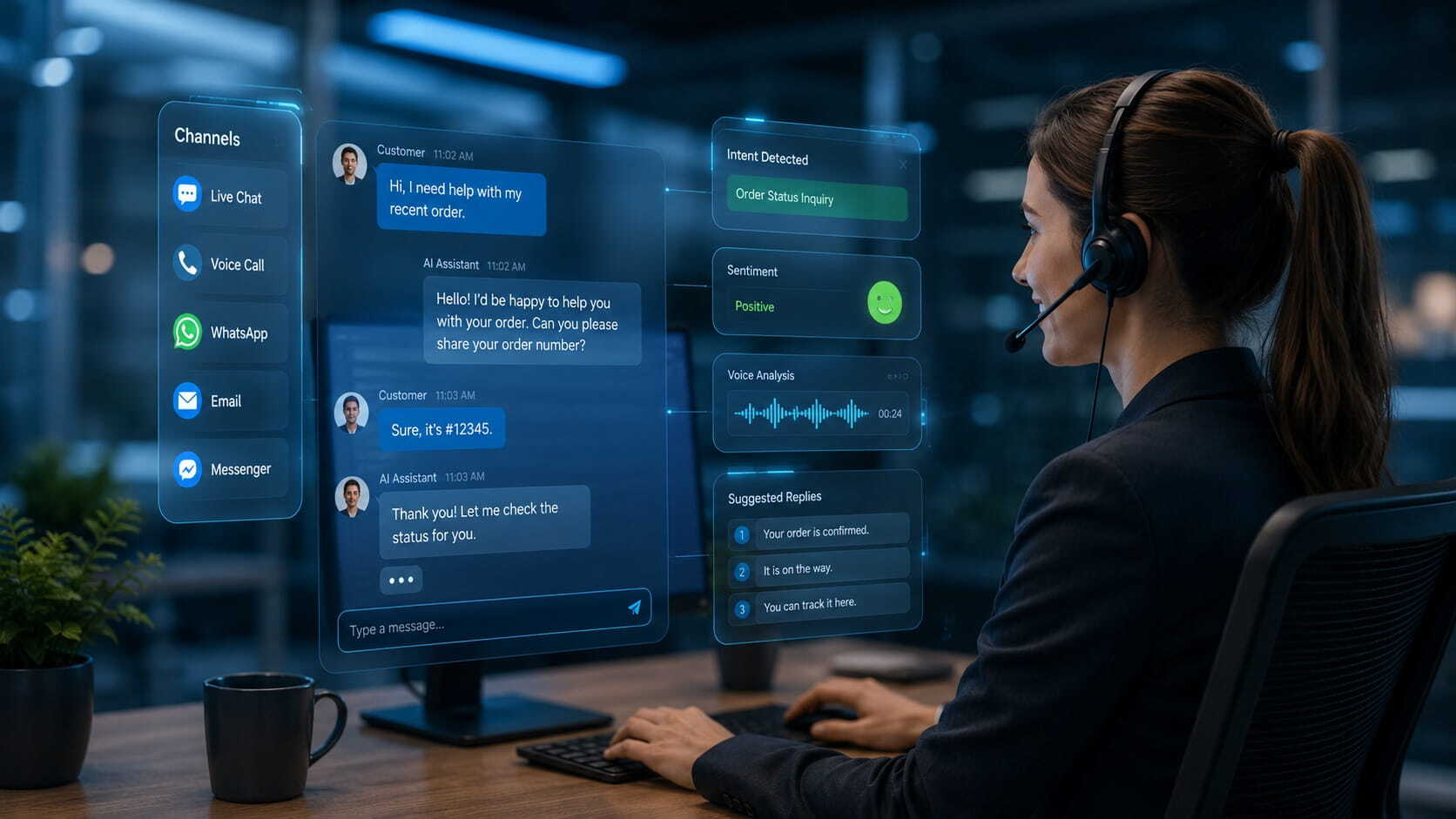
The chatbots of 2026 bear little resemblance to the rigid decision trees of a few years ago. Modern conversational AI understands context, sentiment, and intent, resolving a large share of routine queries without human involvement. As Blitzz has explored in its analysis of AI and AR in customer support, these systems now operate around the clock with consistent accuracy, freeing agents to focus on complex, high-value interactions. The result is a support layer that absorbs volume rather than simply deflecting it. Crucially, the best implementations know their own limits—handing off gracefully to a human, with full context attached, the moment a conversation exceeds what language alone can solve.
2. Predictive Routing Sends Issues to the Right Place First
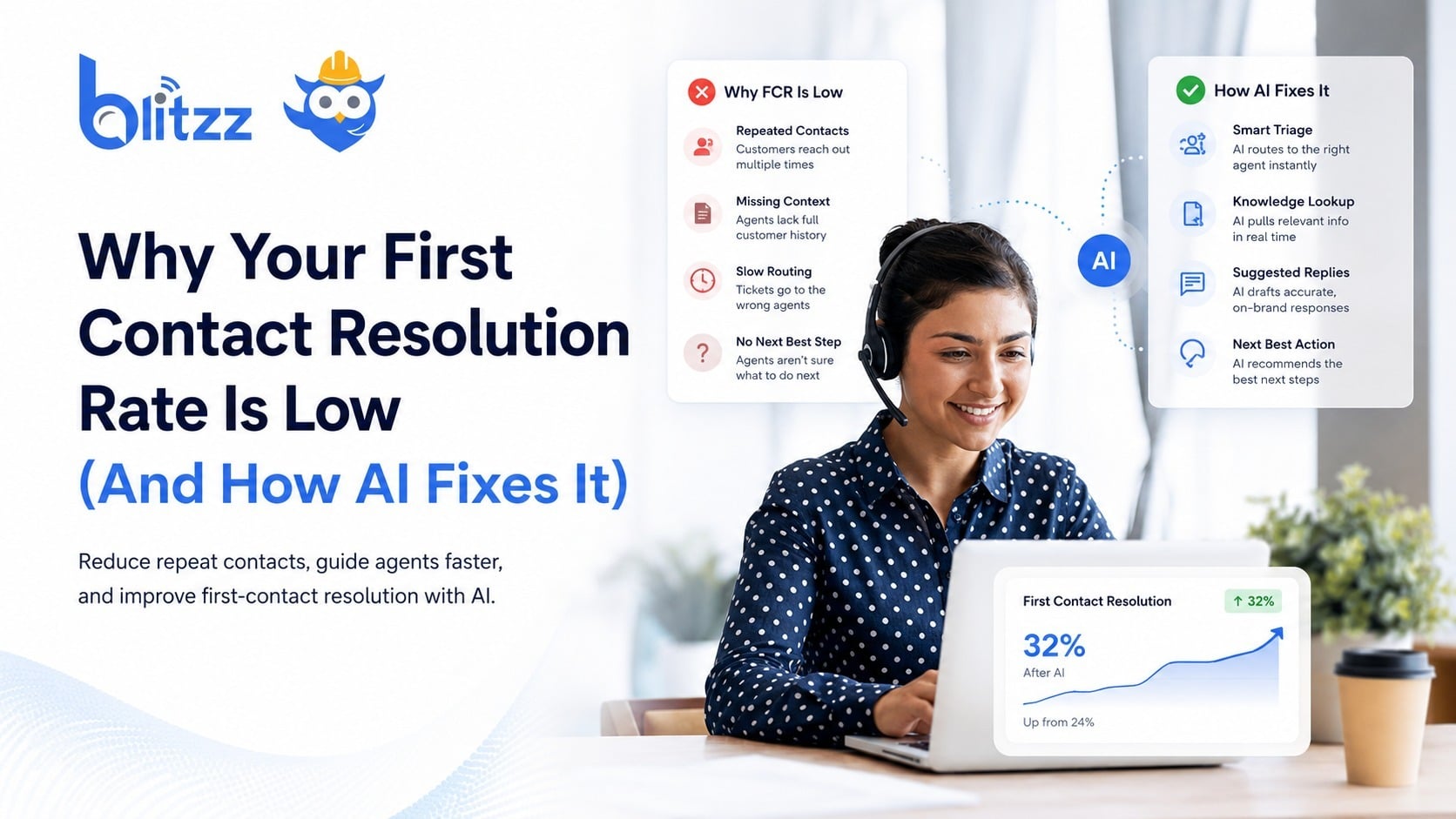
One of AI's quietest but most impactful contributions is intelligent routing. Instead of pushing every inquiry through the same queue, AI analyzes historical data, customer history, and issue type to direct each case to the agent most likely to resolve it. This directly improves first contact resolution—the metric that most reliably predicts customer satisfaction. When the right expertise meets the right problem on the first attempt, repeat contacts fall, handle times shrink, and trust rises. Predictive models also forecast volume spikes, helping managers staff proactively instead of scrambling to catch up.
3. Automated Documentation Eliminates the Note-Taking Tax
Post-call documentation has always been a hidden drain on agent productivity. Notes get written hastily, important details slip through, and CRM records grow inconsistent. AI now generates structured summaries automatically. Blitzz's own platform includes AI Call Summary as a core feature, analyzing each session to capture the issue discussed, the troubleshooting steps taken, and the resolution reached—creating searchable, reliable records without manual effort.
4. Sentiment Analysis Surfaces Risk in Real Time
AI can now read the emotional temperature of an interaction as it happens. Sentiment models flag frustration, confusion, or escalation risk, prompting agents or supervisors to intervene before a routine ticket becomes a churn event. The same signals feed quality assurance, letting teams review the conversations that matter most instead of sampling at random. This shift turns support from a reactive cost center into a proactive retention engine—a theme that runs throughout the AI revolution in customer service reshaping team performance in 2026.
5. Self-Service Has Become Genuinely Useful
Customers increasingly prefer to solve problems themselves—when self-service actually works. AI-powered knowledge bases now interpret natural-language questions and surface precise answers rather than long lists of articles. Pairing intelligent self-service with the right digital customer experience tools lets growing teams deflect simple issues while reserving human attention for the cases that need it. The best self-service experiences feel less like searching and more like being guided.
6. Workflow Automation Connects the Entire Stack
AI is only as valuable as the systems it touches. In 2026, automation platforms stitch support tools together so that data flows without manual entry. Blitzz's integration with Zapier illustrates the principle: when a session ends, its data can automatically create a ticket, update a CRM record, or populate a reporting sheet. Combined with native CRM and contact-center integrations across Salesforce, ServiceNow, and Genesys, AI becomes the connective tissue of the support operation rather than another silo.
7. Proactive Support Anticipates Problems
Rather than waiting for customers to report failures, AI now monitors usage patterns and device telemetry to predict issues in advance. A connected appliance signaling abnormal behavior, a software account approaching a limit, a piece of equipment trending toward failure—each can trigger an outreach before the customer experiences disruption. This proactive posture is becoming a competitive differentiator, especially in industries like telecom, insurance, and field service where downtime carries real cost.
8. AI Is Reshaping Agent Productivity and Training
AI doesn't just assist customers; it accelerates agents. Real-time suggestions, knowledge retrieval, and automated coaching shorten ramp time for new hires and lift the performance of experienced staff. Recorded and summarized sessions create a living training library, allowing teams to scale onboarding without scaling headcount. New agents learn from real scenarios rather than scripted role-plays, and supervisors spend less time on manual review. For organizations weighing platforms, comparisons such as Blitzz versus LogMeIn increasingly turn on how intelligently a tool supports the people using it, not just the customers being served.
9. Cobrowsing Adds Intelligence to Digital Journeys
For web and app-based support, AI-enhanced cobrowsing lets agents see and guide a customer's screen in real time—pointing, highlighting, and navigating without taking control. This is transformative for high-friction digital moments like checkout, where confusion drives the roughly 70% cart-abandonment rate that plagues online retail. By resolving uncertainty instantly and masking sensitive payment fields automatically, cobrowsing keeps customers moving forward instead of dropping off. Modern solutions extend this to mobile, as Blitzz details in its guide to safe and secure mobile cobrowsing, where only the relevant page is shared and every session is encrypted and logged for compliance.
10. Visual AI Is the Missing Layer
Here is where the story turns. Every capability above shares a limitation: it operates through text, voice, or a shared screen. The moment a problem lives in the physical world—a blinking router light, a misconfigured appliance, a damaged component, a piece of equipment a customer has never handled—text and chat AI hit a wall. The customer can't describe what they don't have the vocabulary for, and the AI can't see what it can't access.
This is the gap visual AI closes. When text-based support reaches its limits, live visual support takes over. By connecting an agent to the customer's smartphone camera, visual AI lets the support team see exactly what the customer sees—then layer intelligence on top of that view. As Blitzz argues in its complete guide to seeing what your customer sees, visual context removes the ambiguity that slows every voice-only interaction. Problems that took four exchanges to diagnose get resolved in a single look.
The data makes the case plainly. Blitzz reports first-call resolution improving by up to 40% once teams can see the issue directly, alongside truck roll reductions of up to 60%—each avoided dispatch saving $150 to $300 or more. Visual support doesn't replace the AI layers that came before it; it completes them.

Blitzz Concierge: Visual AI in Practice
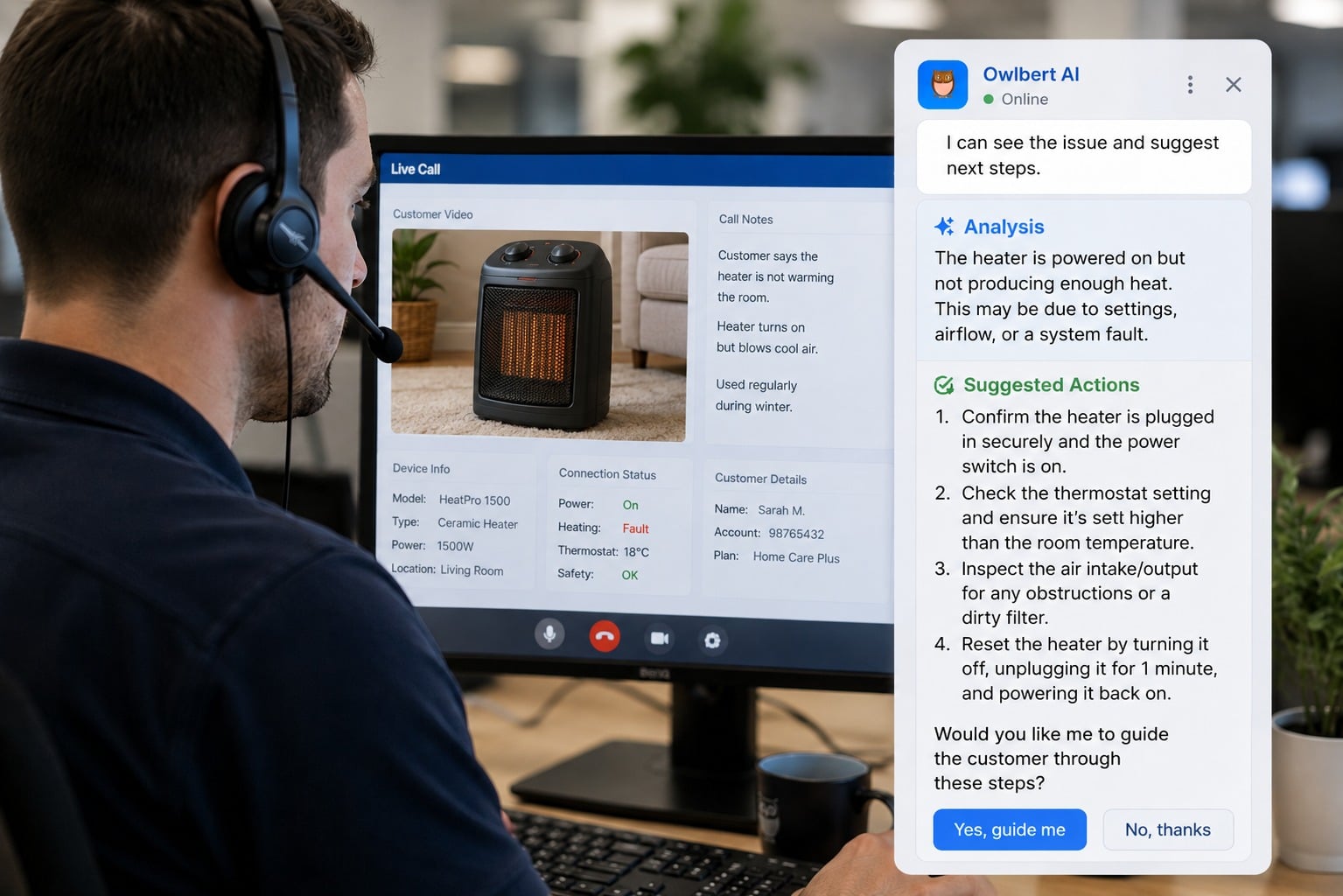
The clearest example of this missing layer in action is Blitzz Concierge. It pairs app-free live video with artificial intelligence so agents can see a customer's problem, annotate the live feed with augmented-reality guidance, and let AI handle the documentation automatically. The customer simply taps a secure link—no app store, no download, no second login—and connects from their browser in seconds. Behind the scenes, AI acts as a digital co-pilot: identifying components, surfacing relevant guidance, and writing the session summary so the agent can stay focused on the customer.
The results reported by Blitzz customers are striking. One large telecom provider piloted Concierge with just 20 technicians for 30 days, eliminated 120 site visits, and saved over $13,000 in a single month. Another reduced its average issue resolution time by 48%. Across deployments, 78% of customers serviced with Concierge called the experience "extremely helpful," the majority preferred video assistance to a voice-only call, and teams report saving five to six trips per rep every month—roughly $533 per rep. The platform also achieves a 95% customer connection rate and helps businesses resolve issues up to three times faster than traditional methods, all while meeting SOC 2, GDPR, and HIPAA standards for regulated industries.
Because the platform connects directly to the tools teams already use—including a native Zendesk video support integration—visual sessions slot into existing workflows rather than disrupting them. Recordings, photos, and AI-generated summaries sync back automatically, so no agent has to re-key data after the call ends.
What makes Concierge a fit for 2026 is its adaptability. It serves contact center support teams handling high call volumes, broader customer support use cases from equipment troubleshooting to video-powered sales, and even inspection and audit teams capturing documentation remotely. Its SaaS model means a business can add 5 or 500 users without a complicated rollout, and transparent pricing scales with the team rather than against it.
The Takeaway for Support Leaders
The lesson of 2026 is not that AI will replace human support—it's that AI works best when it can see. Conversational bots, predictive routing, automated summaries, and intelligent self-service each move the needle, but they all operate within the boundaries of language. Visual AI extends support into the physical world, where so many real problems actually live. A homeowner describing a circuit breaker, a technician troubleshooting a conveyor, an insurance claimant documenting damage—each is trying to translate something inherently visual into words, and each loses precision in the attempt. Remove that translation step and resolution accelerates dramatically.
Teams that treat app-free visual support as the natural next layer of their AI strategy—rather than a separate initiative—are the ones pulling ahead. They resolve faster, dispatch fewer trucks, document more reliably, and leave customers with the sense that someone genuinely understood the problem. The competitive gap between teams that can see and teams that can only listen will only widen as the year progresses.
If you're mapping your support roadmap for the year ahead, it's worth exploring why visual support has become a competitive necessity and seeing the technology in action through a Blitzz demo. The AI layers you've already built are powerful. Visual AI is what lets them finally see.


Blitzz Team
The Blitzz Team writes about remote video support, virtual inspections and field service. Our guides come from working with home builders, property managers, warranty teams, contact centers and field service organizations that use Blitzz to see and solve issues without a truck roll.
.jpg)