
.png?width=120&height=55&name=Blitzz-Logo-right%20white%20eyes%20-%20not%20transparent%20(3).png)

On this page
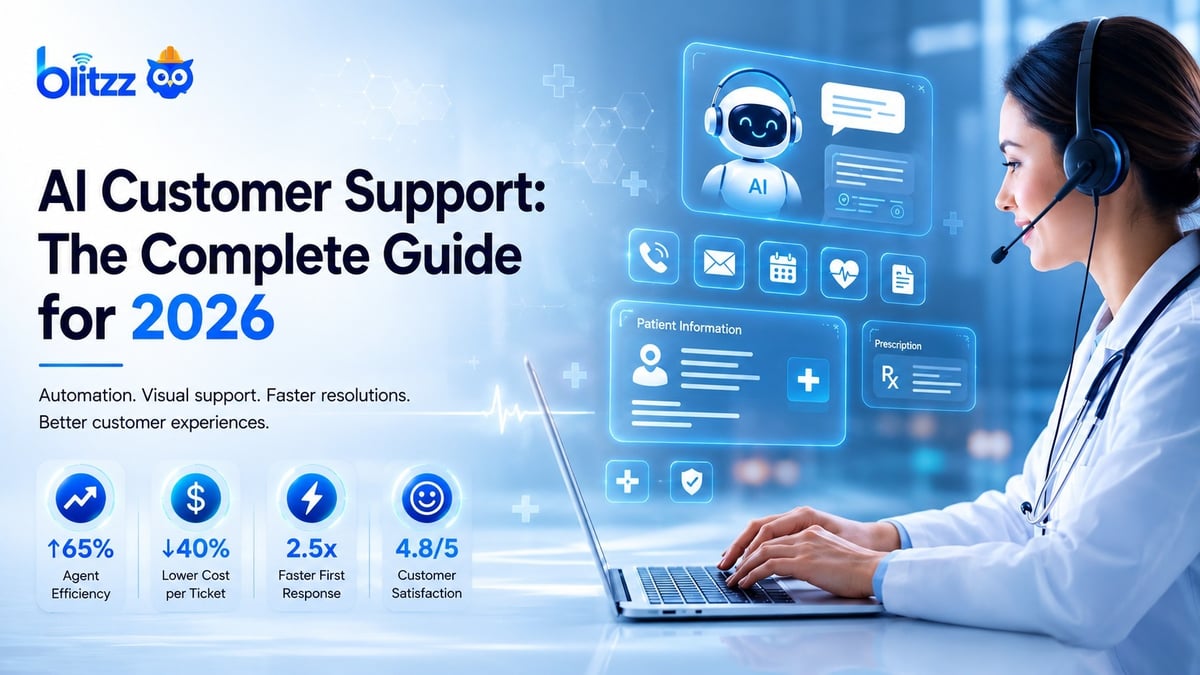
AI customer support is the use of artificial intelligence — chatbots, agent-assist copilots, and visual AI — to resolve customer issues faster, cheaper, and at greater scale than human-only teams. In 2026 it has moved from competitive advantage to baseline expectation: 91% of companies with 50 or more employees now run AI somewhere in the customer journey, and the global AI customer service market has reached roughly $15.1 billion, on track to more than $117 billion by 2034.
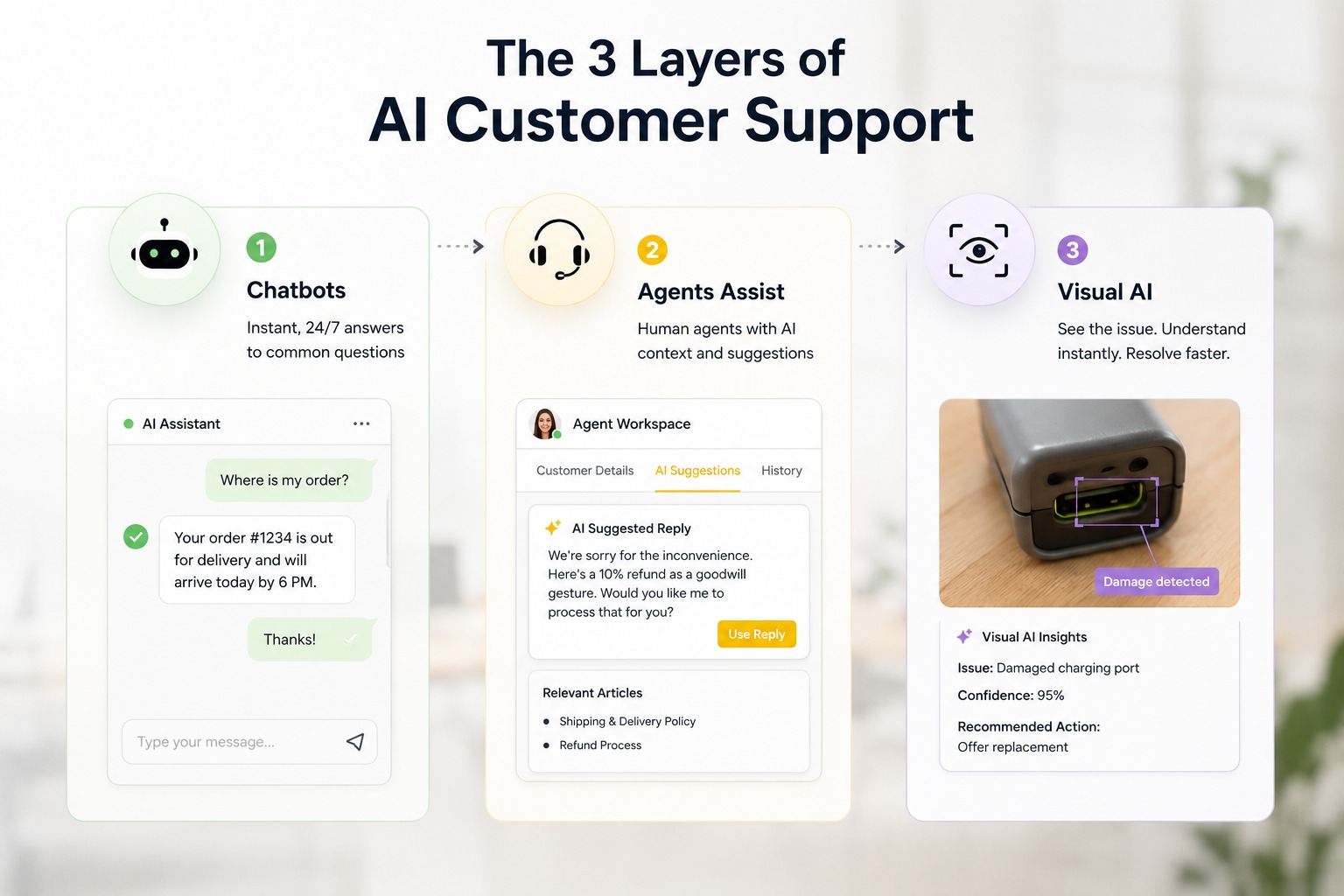
But "AI customer support" is not one thing. It's three distinct layers, each solving a different problem — and most buyers conflate them. This guide breaks down all three: text and voice chatbots, agent-assist copilots, and the fastest-emerging category of all, visual AI. Understanding where each one wins (and where each one quietly fails) is the difference between a support stack that deflects tickets and one that actually resolves problems.
The state of AI customer support in 2026
The headline numbers make the trajectory obvious. Adoption has crossed the tipping point — among contact centers specifically, around 88% now use AI in some form, though only about a quarter have fully integrated it into their workflows. Telecom leads every vertical at roughly 95% adoption, with banking and finance close behind.
The economics explain the rush. Gartner pegs the median cost per contact at about $1.84 for self-service versus $13.50 for an agent-assisted interaction — a 7x gap. At the per-message level, an AI interaction runs near $0.50 against $6.00 for a live agent. Gartner has projected that conversational AI will strip roughly $80 billion in contact center labor costs out of the global market in 2026 alone.
Customers, for the most part, are on board for routine work. Most consumers now prefer an instant AI answer to waiting in a queue for simple questions like order tracking or account lookups, and satisfaction with AI-assisted support has climbed sharply over the past three years.
Here's the catch that the adoption statistics hide: AI-powered customer service fails at roughly four times the rate of other AI-assisted tasks. Complaint handling is the lowest-performing category for autonomous AI, and re-contact rates on AI-resolved tickets run measurably higher than on human-resolved ones. The failures cluster in one place — complex, emotional, or visual problems that a script-driven bot was never built to handle. That gap is exactly where the three-layer model matters.
The three layers of AI customer support
Think of modern AI support as a stack, not a single tool. Each layer handles a different tier of complexity, and a mature strategy uses all three together rather than betting everything on one.
| Layer | What it does | Best for | Where it breaks down |
|---|---|---|---|
| 1. Chatbots or Conversational AI | Autonomously answers questions and completes simple workflows | High-volume, repetitive, text-answerable queries | Anything requiring judgment, empathy, or physical context |
| 2. Agent Assist or Copilots | Supports human agents in real time with suggestions and summaries | Mid-complexity issues where a human stays in the loop | Doesn't help when the problem itself can't be described |
| 3. Visual AI | Lets agents see the customer's physical problem and guide them through it | Complex, technical, or hardware issues | Emerging category — not yet on most buyers' radar |
The first two layers are mature and widely deployed. The third is where the real 2026 opportunity sits — and where most support stacks have a blind spot.
Layer 1: Chatbots and conversational AI
This is the layer everyone means when they say "AI customer support," and it's the most mature. Modern chatbots have evolved well past the scripted decision trees of a decade ago. The leading systems are now AI agents — they understand context, pull from backend systems, and complete multi-step tasks rather than following rigid flows.
The performance numbers from category leaders are genuinely impressive. Intercom's Fin resolves around 81% of support volume for many deployments. Klarna's AI assistant took over two-thirds of its customer service chats, cutting average resolution time from about 11 minutes to under 2 and driving a reported $40 million profit improvement.
Where chatbots win
- Volume. A single deployment can handle thousands of routine conversations a month with zero human touch.
- Speed. Instant answers, 24/7, with no queue.
- Cost. That ~$0.50-per-interaction figure is the entire business case in one number.
- Tier-1 deflection. Order status, password resets, FAQ lookups, billing questions — the repetitive long tail.
Where chatbots break down
The honest data is sobering: the average chatbot resolution rate across industries is only about 44.8%. "Handle" is not the same as "resolve" — AI can route, triage, and summarize an interaction without ever actually fixing the customer's problem. And the moment a query needs human judgment, emotional intelligence, or — critically — an understanding of something physical the customer is looking at, the chatbot is out of its depth.
A chatbot cannot see the blinking router light. It cannot tell which of three identical-looking cables is plugged into the wrong port. It can only work with what the customer can put into words, and frustrated customers are notoriously bad at describing technical problems.
Layer 2: Agent assist and AI copilots
Layer 2 keeps a human in the driver's seat and puts AI in the passenger seat. Instead of replacing the agent, the AI listens to the live interaction and feeds the agent suggested answers, relevant knowledge-base articles, next-best actions, and automatic post-call summaries.
The efficiency gains here are concrete. Around 45% of support calls involve the agent stopping mid-conversation to search for information — agent-assist tools eliminate that pause, and teams combining front-of-call and back-of-call automation report 25–50% reductions in average handle time. Agents overwhelmingly report that this kind of decision support improves the quality of their work.
This is also where the "AI replaces humans" narrative falls apart. About 69% of consumers say it's important that AI and human agents work together rather than one replacing the other — and Gartner expects half the companies that cut staff to swap in AI will be rehiring people by 2027. Agent assist is the architecture that reflects how customers actually want to be served.
Where agent assist hits its ceiling
Agent assist makes a human agent faster and better informed — but it still operates on the same input the chatbot had: words. If the customer can't describe the problem accurately, a smarter copilot just helps the agent respond more efficiently to incomplete information. The bottleneck isn't the agent's knowledge. It's that neither the agent nor the AI can see what the customer sees.
That limitation is precisely what defines the third layer.
Layer 3: Visual AI — the emerging category
Text and voice AI have transformed Tier-1 support. But for complex, visual, or technical issues — the kind where a customer says "I don't know how to describe it" — AI still needs eyes. This is visual AI support, and it's the fastest-emerging category in the field precisely because it solves the failures the first two layers can't touch.
Visual AI combines live video, augmented-reality (AR) annotation, and AI triage so an agent can see exactly what the customer is looking at, mark up the live camera feed to guide them, and resolve the issue in a single session. Where a chatbot works from a typed description and an agent-assist copilot works from a verbal one, visual AI works from the actual problem.
Blitzz Concierge is the clearest example of this category in production. The agent sends a secure link by SMS, email, or WhatsApp; the customer taps it and connects instantly through their phone browser — no app download. The agent then sees through the customer's camera, annotates in real time to point to the exact button or cable, and the session is automatically summarized by AI and synced into Salesforce, Zendesk, ServiceNow, or Genesys.
Why visual AI is a distinct category — not a chatbot feature
It's tempting to file "video support" under the chatbot umbrella, but the architecture is fundamentally different:
- Chatbots process language. Visual AI processes the physical world.
- Chatbots deflect tickets. Visual AI resolves the tickets that chatbots escalate.
- Chatbots scale Tier-1 volume. Visual AI collapses Tier-2 and Tier-3 complexity — the expensive, truck-roll-triggering problems.
The results back up the distinction. In telecom — the most AI-saturated vertical of all — Blitzz Concierge customers have reduced truck rolls by up to 30% and improved first-call resolution by around 40%, not by hiring smarter agents but by giving existing agents eyes on the problem. One large North American telecom onboarded 1,500 agents in two days; another customer documented over $13,000 in savings in under 30 days. In customer surveys, 73% preferred video assistance to a voice-only call, and 78% rated the experience "extremely helpful." You can see a fuller breakdown in how Blitzz uses AI to transform remote support.
How to build a tiered AI customer support strategy
The mistake most teams make is treating these layers as competing options — picking a chatbot or investing in video support. The mature approach routes each issue to the layer built to solve it:
- Tier 1 → Chatbot / conversational AI. Let autonomous AI absorb the repetitive, text-answerable volume. This is your deflection engine.
- Tier 2 → Agent assist. When an issue needs a human, equip that human with a copilot so they resolve it faster and document it automatically.
- Tier 3 → Visual AI. When the problem is physical, technical, or "I-can't-describe-it" visual, escalate to a live visual session instead of dispatching a technician.
The key is making escalation between layers fast and context-carrying — the customer should never have to re-explain the problem from scratch when they move from bot to human to video. The quality gap in AI support concentrates exactly at these handoffs, so smooth transitions are where strategy is won or lost.
Done well, this tiered model is why customer-focused organizations consistently outperform on retention and profit growth: the cheap layer handles scale, and the premium layer handles the moments that actually decide whether a customer stays. For a deeper look at how visual support compares to traditional handling, see visual customer support vs. traditional call centers.
The metrics that actually matter
Vanity metrics like "tickets handled" obscure more than they reveal. The numbers that tell you whether your AI stack is working:
- First Contact Resolution (FCR) — the single best signal of whether issues are truly being solved, not just touched. 85% of CX leaders say customers will abandon a brand that fails to resolve on first contact.
- Average Handle Time (AHT) — where agent assist and visual context both deliver measurable cuts.
- Truck roll rate — for any business that dispatches technicians, the most expensive metric on the list, and the one visual AI moves most dramatically.
- Re-contact rate — how often a "resolved" ticket comes back. AI-resolved tickets re-contact more often than human-resolved ones, so watch this closely.
- CSAT and NPS — the experience scores that ultimately drive retention.
A healthy AI strategy improves all of these at once. A stack that only moves cost-per-contact while FCR and re-contact rates quietly worsen is automating the wrong things.
AI Support in Remote Video Inspection
AI support in remote video inspection
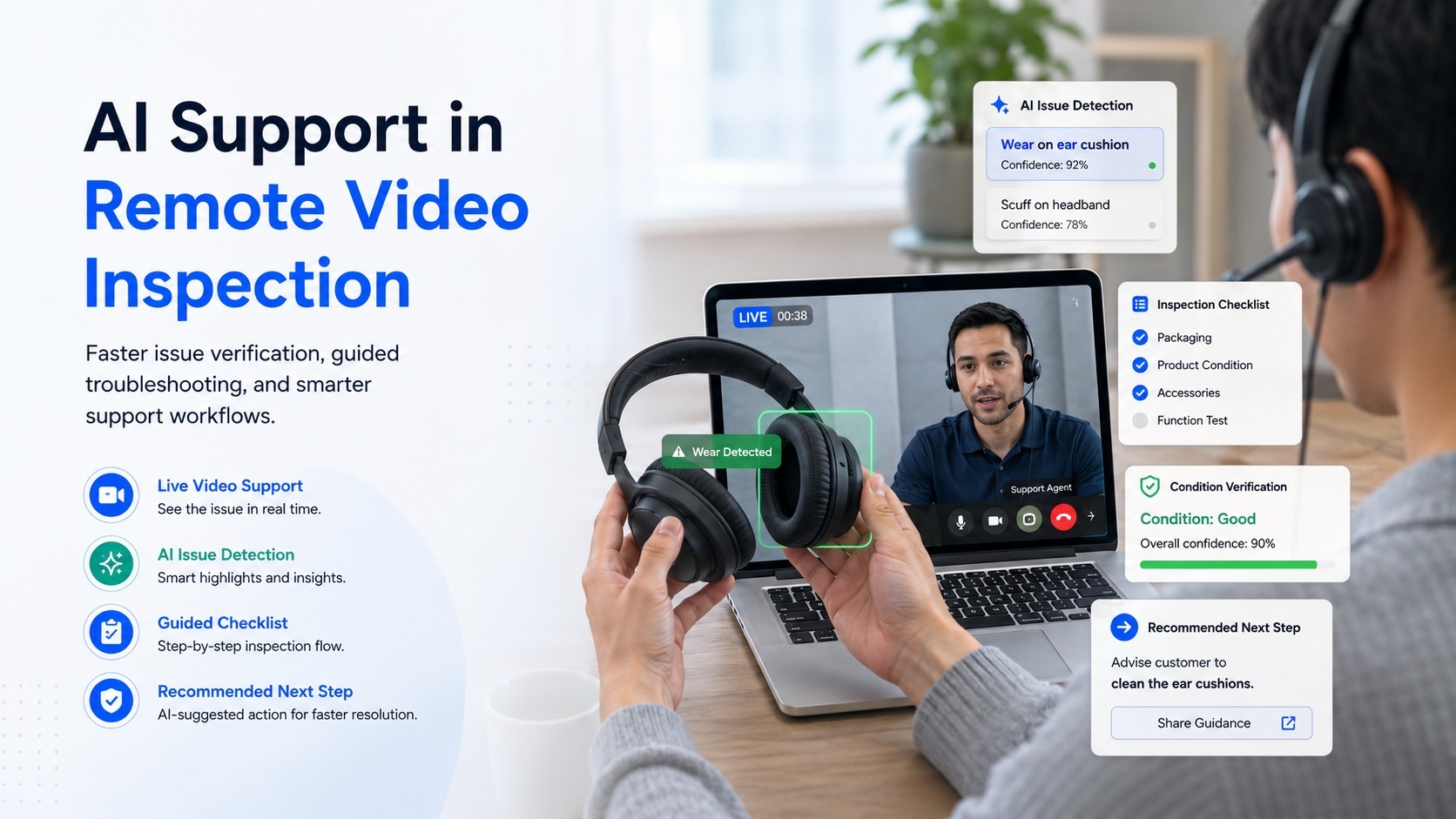
Remote video inspection (RVI) is visual AI applied proactively — using live video, timestamped capture, and AI-generated reporting to assess assets, property, and equipment without sending anyone on-site. If Layer 3 visual support is about resolving a problem the customer is looking at, RVI is about documenting and verifying one before it becomes a problem. It's the same eyes-on-the-issue capability, redirected from the support queue to the inspection workflow.
The mechanics mirror a visual support session: an inspector sends a secure link by SMS or email, the on-site contact taps it and connects through their browser with no app download, and the inspector sees through their camera — zooming, annotating, and capturing photos that are automatically location-, date-, and time-stamped. The difference is what the AI does with the session. Instead of just summarizing a conversation, Blitzz Inspect captures images, extracts the relevant data, and auto-generates a complete inspection report with every markup and note attached — turning a live call into a compliance-ready paper trail the moment it ends.
Where AI earns its keep in inspection
The reporting layer is where RVI pulls ahead of a plain video call. AI handles the documentation burden that makes traditional inspections slow and error-prone: extracting readings, organizing timestamped evidence, and producing audit-ready records automatically. That matters most in regulated, evidence-driven workflows where the gap between what happened and what got documented is where disputes and delays live.
The results track across verticals:
- Insurance — adjusters assess property, auto, and commercial damage remotely, processing more claims in a fraction of the time with timestamped photo evidence.
- Construction — project managers run progress monitoring and OSHA compliance checks without travel; one global construction firm saved hundreds of QA hours.
- Manufacturing — engineers conduct supplier audits and equipment checks remotely; one smartphone manufacturer cut audit costs by nearly 100%.
- Field service — a tank-inspection business reduced travel costs by 75%, and a government organization nearly doubled efficiency across 1,500 inspectors.
All of it runs on the same SOC-2-compliant, end-to-end-encrypted foundation as the support side, with sessions recorded and stored for audit readiness — and companies running 1,000 inspections a month avoid an average of roughly 69 metric tons of CO₂ a year by skipping the drive.
In short: the visual AI layer isn't only a support tool. The moment you can see what's on the other end of a link, inspection becomes the second high-value use case — and the Blitzz inspection platform is built for exactly that crossover.
Frequently asked questions
What is AI customer support?
AI customer support is the use of artificial intelligence to resolve customer issues — spanning chatbots that answer questions autonomously, agent-assist copilots that support human agents in real time, and visual AI that lets agents see and guide customers through physical problems.
Will AI replace human customer support agents?
No. The evidence points to AI changing agent roles rather than eliminating them. Most consumers want AI and humans working together, and Gartner expects half the companies that replaced staff with AI to resume hiring by 2027. AI absorbs repetitive volume so humans can focus on complex, high-value interactions.
What's the difference between a chatbot and an AI agent?
A chatbot follows scripts and answers within a defined flow. An AI agent understands context, accesses backend systems, and completes multi-step workflows autonomously. The distinction is architecture, not branding.
What is visual AI customer support?
Visual AI support combines live video, AR annotation, and AI triage so an agent can see exactly what the customer sees, guide them by marking up the live camera feed, and resolve complex or technical issues in a single session — without dispatching a field technician.
How much can AI customer support actually save?
Per-interaction costs drop from roughly $6.00 (human) to about $0.50 (AI) for routine queries, and Gartner projects $80 billion in global contact center labor savings in 2026. For field-service businesses, the bigger savings come from visual AI eliminating truck rolls — one documented Blitzz deployment saved over $13,000 in under 30 days.
How do I choose the right AI support tools?
Map your ticket types to the three layers: chatbots for repetitive Tier-1 volume, agent assist for Tier-2 issues that need a human, and visual AI for Tier-3 technical or physical problems. Most teams already have Layer 1 and are missing Layer 3 — the layer that resolves their most expensive tickets.

The bottom line
AI customer support in 2026 isn't a single tool you buy — it's a stack you architect. Chatbots have proven they can deflect volume. Agent assist has proven it can make humans faster. But the failures that frustrate customers and drive up costs live in the third layer: the complex, visual, technical problems that words alone can't solve.
That's the category most support strategies are still missing — and it's where the next wave of measurable wins is hiding. If your chatbots are deflecting Tier-1 tickets but your truck rolls and re-contact rates aren't moving, the gap is visual.
See how Blitzz Concierge handles the issues your chatbot can't →

Blitzz Team
The Blitzz Team writes about remote video support, virtual inspections and field service. Our guides come from working with home builders, property managers, warranty teams, contact centers and field service organizations that use Blitzz to see and solve issues without a truck roll.