
.png?width=120&height=55&name=Blitzz-Logo-right%20white%20eyes%20-%20not%20transparent%20(3).png)
When Your Vehicle Needs Help: Making Sense of Automotive Service Support

Automotive service support covers every resource, tool, and system that helps vehicle owners, repair shops, and fleet operators diagnose problems, complete repairs, and keep vehicles running safely.
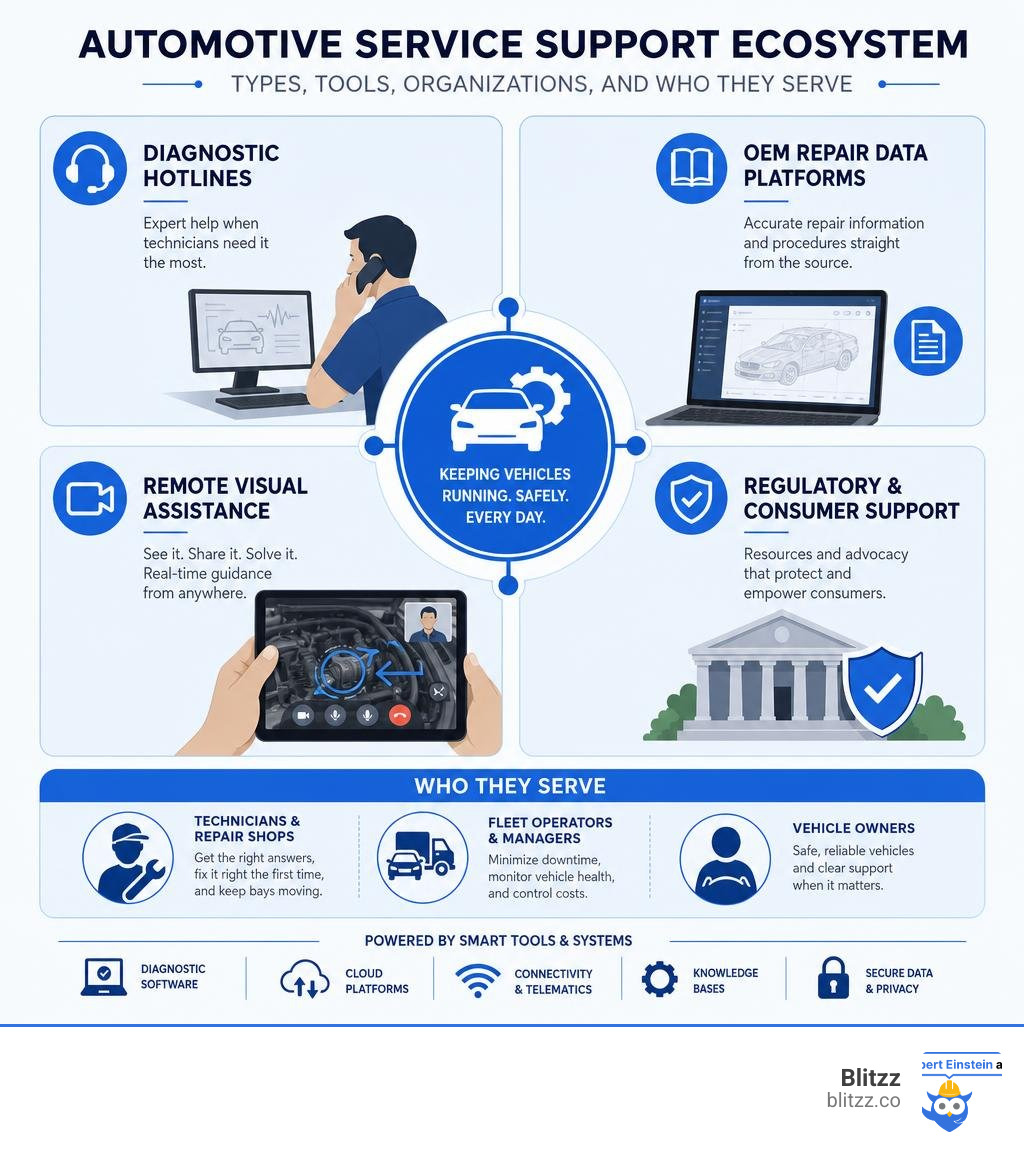
Here's a quick overview of what it includes:
| Type of Support | Who It's For | Examples |
|---|---|---|
| Diagnostic hotlines | Technicians | ALLDATA Tech-Assist, Bosch technical support |
| OEM repair data platforms | Shops & fleets | MOTOR TruSpeed Repair, vService |
| Remote visual assistance | Shops & field teams | Live video + AR annotations |
| Regulatory & consumer support | Vehicle owners | Bureau of Automotive Repair (BAR), ASA |
| OTA software updates | OEMs & fleet operators | Wireless ECU updates, fleet health monitoring |
The U.S. automotive service market is on track to hit $75 billion by 2026. Vehicles are more complex than ever — packed with software, sensors, and electronic systems that even experienced technicians can find challenging. At the same time, shops face pressure to fix cars faster and right the first time, while customers expect clear communication and quick turnarounds.
The result? A growing need for better support systems — from expert hotlines and OEM repair data to remote diagnostics and real-time visual assistance.
This guide breaks down exactly how automotive service support works, what tools and organizations are involved, and how shops and fleet operators can make smarter choices to reduce downtime and improve results.
What is Automotive Service Support and Why Does It Matter?
At its core, automotive service support is the safety net that keeps the transportation world spinning. For vehicle owners, it is the difference between a minor afternoon inconvenience and a week-long logistical nightmare. For independent repair shops and fleet operators, it is the vital pipeline of technical knowledge, troubleshooting help, and regulatory compliance that prevents bays from getting backed up with "unfixable" vehicles.
The necessity of robust support systems has skyrocketed alongside vehicle complexity. Gone are the days when a mechanic could diagnose almost any issue with a keen ear, a set of wrenches, and a timing light. Today’s vehicles are essentially supercomputers on wheels. A modern electric or internal combustion vehicle contains dozens of Electronic Control Units (ECUs), miles of wiring, and millions of lines of code. When a sensor misbehaves, it can trigger a cascade of warning lights that leave even seasoned professionals scratching their heads.
This technological leap is occurring during a massive industry shift:
- The Market is Booming: The U.S. automotive service market is expected to reach a massive $75 Billion USD by 2026.
- A Critical Talent Shortage: The industry is facing a severe labor squeeze, with around 67,700 job openings for automotive service technicians projected each year from 2022 to 2032.
- Regional Demands: Texas currently employs the most automotive service technicians in the United States, but shops nationwide are feeling the pinch.
With fewer technicians available to work on increasingly complex vehicles, shops cannot afford to waste hours guessing which part to replace. They need reliable, fast, and accurate automotive service support to maintain high customer satisfaction, optimize workshop throughput, and keep their businesses profitable.
The Core Pillars of Modern Automotive Service Support
To survive and thrive in this landscape, service providers must leverage several support channels. These channels can be broadly categorized into static database platforms, real-time human assistance, and remote hardware diagnostics.
To see how the industry is shifting, let's look at how traditional support methods compare to modern remote and digital alternatives:
| Support Dimension | Traditional Automotive Support | Modern Remote & Digital Support |
|---|---|---|
| Data Access | Hardcopy manuals or slow local desktop installations | Cloud-based, real-time OEM data platforms (updated instantly) |
| Problem Solving | Trial-and-error parts swapping and manual circuit testing | Advanced remote diagnostics, telemetry, and live guided help |
| Technical Assistance | Waiting days for a regional field engineer to visit the shop | Instant diagnostic hotlines, AR video calls, and remote desktop sharing |
| Software Updates | Physical vehicle drop-off at a dealer for wired ECU flashing | Over-the-Air (OTA) software updates completed anywhere |
| Customer Experience | Opaque phone updates and "take our word for it" invoices | Transparent digital vehicle inspections and real-time video proof |
Digital Platforms for Automotive Service Support
When a technician encounters an unfamiliar model or a complex electrical fault, their first line of defense is a digital repair data platform. These platforms serve as centralized repositories of original equipment manufacturer (OEM) repair data, wiring diagrams, step-by-step repair procedures, and diagnostic trouble code (DTC) definitions.
Two prominent examples of these platforms in 2026 are:
- TruSpeed Repair | MOTOR : This white-label SaaS solution delivers verified, direct OEM service and repair content quickly. It covers domestic and import light-duty vehicles from 1985 onward. Because it updates in near-real-time, technicians always have access to the latest manufacturer revisions. Its API integration allows technology providers and fleet operators to pull precise wiring diagrams, torque specifications, and component locations directly into their existing software workflows.
- vService | Intelligent Aftersales Diagnostics, Software Updates and Vehicle Fleet Monitoring | Vector : This platform bridges the gap between engineering and aftersales operations. It converts complex diagnostic data into usable workshop content. It supports both legacy and Software-Defined Vehicles (SDVs) by enabling workshop diagnostics, fleet health monitoring, and secure software update rollouts.
Without these digital backbones, independent repair shops would find it nearly impossible to service the diverse array of vehicles that roll into their bays each day.
Diagnostic Hotlines and Technical Assistance
Sometimes, even the best wiring diagrams aren't enough to solve an intermittent electrical ghost. That is where diagnostic hotlines and dedicated technical assistance services step in. These services connect shop technicians with highly experienced ASE-Certified Master Technicians who specialize in specific vehicle makes and models.
These hotlines use a mix of phone support, remote desktop connections, and live video feeds to guide local mechanics through complex troubleshooting trees. The impact of these services is well-documented:
- High Customer Satisfaction: Leading technical assistance services achieve workshop satisfaction ratings as high as 98.4%, with average response times under 45 minutes.
- Proven Track Records: Well-established hotlines, such as ALLDATA Tech-Assist, have solved more than 115,000 complex diagnostic cases since 2014, giving shops a massive database of real-world fixes to draw from.
- Global Infrastructure: Companies like Bosch operate technical support centers across 24 global locations, solving more than 200,000 customer problems per year.
- Comprehensive CX Solutions: Platforms like Automotive CX & Customer Support Solutions | OneSupport offer unified support across the entire automotive lifecycle, achieving a 91.4% CSAT and an 87.1% first contact resolution (FCR) rate for owner and dealer network operations.
These services act as an on-demand brain trust, allowing smaller, independent shops to confidently accept difficult diagnostic work that they might otherwise have to turn away.
Next-Gen Support: Remote Diagnostics, AR, and OTA Updates
We are living in an era where physical distance is no longer a barrier to expert mechanical help. The integration of remote diagnostics, augmented reality (AR), and over-the-air (OTA) software updates has transformed how vehicles are maintained and repaired.

These technologies drastically reduce vehicle downtime by ensuring that problems are identified and resolved in minutes rather than days.
Remote Visual Assistance as the Future of Automotive Service Support
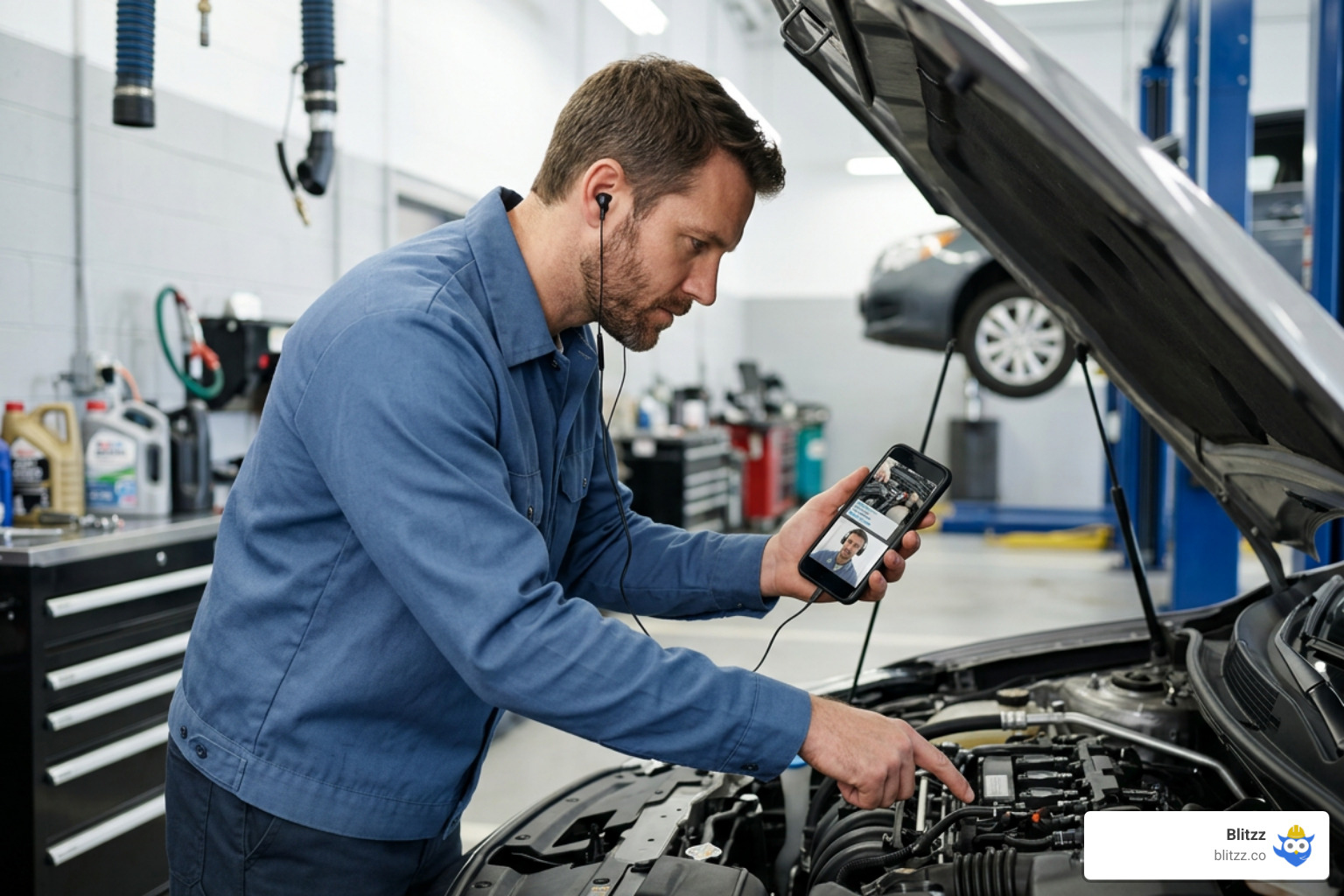
One of the most exciting advancements in automotive service support is the rise of remote visual assistance. When a local technician gets stuck, they no longer have to wait for a physical factory representative or a senior diagnostic specialist to drive to the shop.
Instead, they can use browser-based remote visual support tools to launch an instant, high-definition video call. The remote expert can see exactly what the local technician is looking at, utilizing advanced features to guide the repair:
- AR Annotations: The expert can draw directly on the technician’s screen, circling a specific sensor, highlighting a wire to test, or pointing out a hidden bolt.
- Screen Sharing: Sharing wiring schematics or diagnostic software screens in real-time ensures both parties are looking at the exact same data.
- Zero App Friction: Because the technology is browser-based, the local technician doesn't need to download a bulky app or create an account; they simply click a text link and start sharing their camera.
This level of real-time visual collaboration is revolutionizing the industry. To understand how car brands leverage these tools to assist drivers, read about How Car Brands Use Remote Visual Support to Assist Drivers in Real-Time. Additionally, fleet operators can discover how these tools cut down on field dispatch costs by exploring Remote Visual Assistance for Automotive: Reducing Truck Rolls and Accelerating Repairs.
Over-the-Air (OTA) Updates and Fleet Monitoring
For fleet operators managing hundreds of vehicles, keeping software up to date is a monumental task. Traditionally, a software recall or ECU update meant pulling vehicles off the road, driving them to a dealership, and waiting hours for a wired flash.
Modern remote support platforms solve this with wireless OTA updates and continuous fleet health monitoring. These systems allow operators to:
- Monitor live vehicle telemetry to catch minor anomalies before they turn into major mechanical failures.
- Push critical software patches and firmware updates to entire fleets simultaneously overnight.
- Maintain strict regulatory compliance, such as adhering to the UNECE R156 software update management system requirements.
- Protect independent repair rights by utilizing open, secure standards that comply with Right-to-Repair legislation.
By shifting from reactive repairs to proactive, remote software management, fleet operators can maintain peak operational efficiency and keep their vehicles on the road where they belong.
Elevating Workshop Operations and Customer Experience
While having the right technical data is crucial, a shop's ultimate success depends on how it manages its customer relationships. Excellent customer service is the engine that drives repeat business and long-term profitability.

Achieving Automotive Service Excellence through Communication
Great customer service in the automotive world is built on a foundation of trust and transparency. Historically, vehicle owners have felt vulnerable at repair shops, often worrying that they are being upsold on unnecessary repairs.
Shops can break this cycle of distrust and achieve true service excellence by implementing modern communication strategies:
- Active Listening: Letting customers fully explain their vehicle's symptoms without interruption, asking clear clarifying questions, and summarizing their concerns before starting work.
- Digital Vehicle Inspections (DVIs): Instead of just calling a customer to say, "Your brake pads are worn out," technicians can send a quick video inspection showing the exact measurement of the pads next to a digital gauge. Seeing is believing.
- Multi-Channel Communication: Giving customers the option to receive updates, approve estimates, and pay their bills via text, email, or a dedicated customer portal.
- Proactive Updates: Automatically notifying customers of manufacturer recalls, upcoming maintenance intervals, or parts tracking statuses.
To dive deeper into modern customer support strategies, check out our guide on Driving Customer Support Excellence: Best Practices for the Automotive Industry in 2026. If you run a dealership network, you can learn how to modernize your entire service lane by reading Transform Your Automotive OEM Dealership Operations in 2026.
Technician Training, Certifications, and Regulatory Compliance
You can have the most advanced software in the world, but it is only as good as the hands holding the tools. Continuous education and professional certification are non-negotiable for modern automotive technicians.
Several organizations and certifications play a massive role in maintaining industry standards:
- The Automotive Service Association (ASA): This national, non-profit trade association is dedicated exclusively to independent repair professionals. It provides vital education, affordable healthcare benefits for members, and heavy legislative advocacy (such as pushing for the landmark Motor Vehicle Modernization Act of 2026).
- The Bureau of Automotive Repair (BAR): State-level regulatory bodies like California's BAR protect consumers by licensing auto shops, mediating customer complaints, conducting safety inspections, and administering emissions programs like the Smog Check.
For technicians looking to prove their expertise and shops looking to build consumer trust, several core credentials are vital:
- ASE Certifications: Administered by the National Institute for Automotive Service Excellence, these exams test a technician's knowledge across various areas (engine repair, electrical systems, brakes, etc.). Achieving "Master Tech" status requires passing multiple exams and documenting years of hands-on experience.
- EPA Section 609 Certification: A mandatory federal certification required for any technician who opens a vehicle's A/C system to handle, recover, or recycle regulated refrigerants.
- Advanced Hybrid/EV Certifications: Specialized training focused on safely de-energizing high-voltage battery systems, diagnosing electric drivetrains, and working with complex thermal management systems.
Shops that invest in their technicians' continuous training and display these credentials prominently build a reputation for quality that attracts high-value, loyal customers.
Frequently Asked Questions About Automotive Service Support
How do OEM repair data platforms improve repair accuracy?
OEM repair data platforms provide technicians with the exact factory specifications, wiring schematics, and step-by-step procedures created by the vehicle's original manufacturer. Instead of relying on generic, third-party instructions that may contain errors or omit crucial details, technicians get model-specific guidance.
This includes precise torque limits, fluid capacities, component locations, and diagnostic trouble code (DTC) troubleshooting trees. Accessing this level of detail prevents trial-and-error parts swapping, minimizes installation errors, reduces expensive part returns, and ensures the vehicle is repaired safely and correctly on the first attempt.
What role do regulatory bodies play in automotive service support?
Regulatory bodies, such as the Bureau of Automotive Repair (BAR) and trade groups like the Automotive Service Association (ASA), act as vital neutral parties in the automotive ecosystem. They protect consumers by licensing repair facilities, verifying technician credentials, and providing formal complaint mediation services when disputes arise.
On the industry side, they administer safety and emissions compliance programs (like Smog Checks) and advocate for legislative modernization. For example, they support Right-to-Repair and data access bills that ensure independent mechanics have the same access to vehicle diagnostic data as proprietary dealership networks.
How does remote visual assistance reduce vehicle downtime?
Remote visual assistance allows an on-site mechanic to instantly share their live camera feed with an off-site master technician or engineering specialist. Rather than trying to describe a complex mechanical or electrical layout over a standard voice call, the local technician can show the problem in real-time.
The remote expert can use augmented reality (AR) tools to draw on the screen, circle specific wires, point out hidden fasteners, and share schematics. This immediate visual collaboration solves complex diagnostic puzzles in minutes rather than days, eliminates the need to wait for a physical field specialist to travel to the shop, and gets the vehicle back on the road incredibly fast.
Conclusion
The automotive landscape is evolving at a breakneck pace. As vehicles transition into highly connected, software-defined machines, relying on outdated diagnostic methods is a recipe for operational bottlenecks and frustrated customers. Navigating automotive service support successfully requires a shift toward modern, digital, and visual solutions.
At Blitzz, we provide enterprise-grade remote visual assistance and video inspection software designed specifically to meet these modern challenges. Our platform enables instant, browser-based video support equipped with interactive AR annotations, real-time screen sharing, and seamless CRM integrations. By allowing off-site experts to guide on-site technicians visually, we help automotive businesses drastically reduce on-site visits, minimize truck rolls, and accelerate repair times.
Major global brands have already proven the power of this technology. For a real-world look at how visual support transforms automotive operations, explore our Case Study: BMW.
If you are ready to modernize your service operations, learn more about our Visual Remote Assistant for Automotive or see how we streamline inspections with Remote Video Inspections for Automotive OEMs & Dealerships.
Don't let complex diagnostics slow your business down. Schedule a demo with Blitzz today and discover how simple, browser-based visual support can revolutionize your workshop's efficiency.