

.png?width=120&height=55&name=Blitzz-Logo-right%20white%20eyes%20-%20not%20transparent%20(3).png)
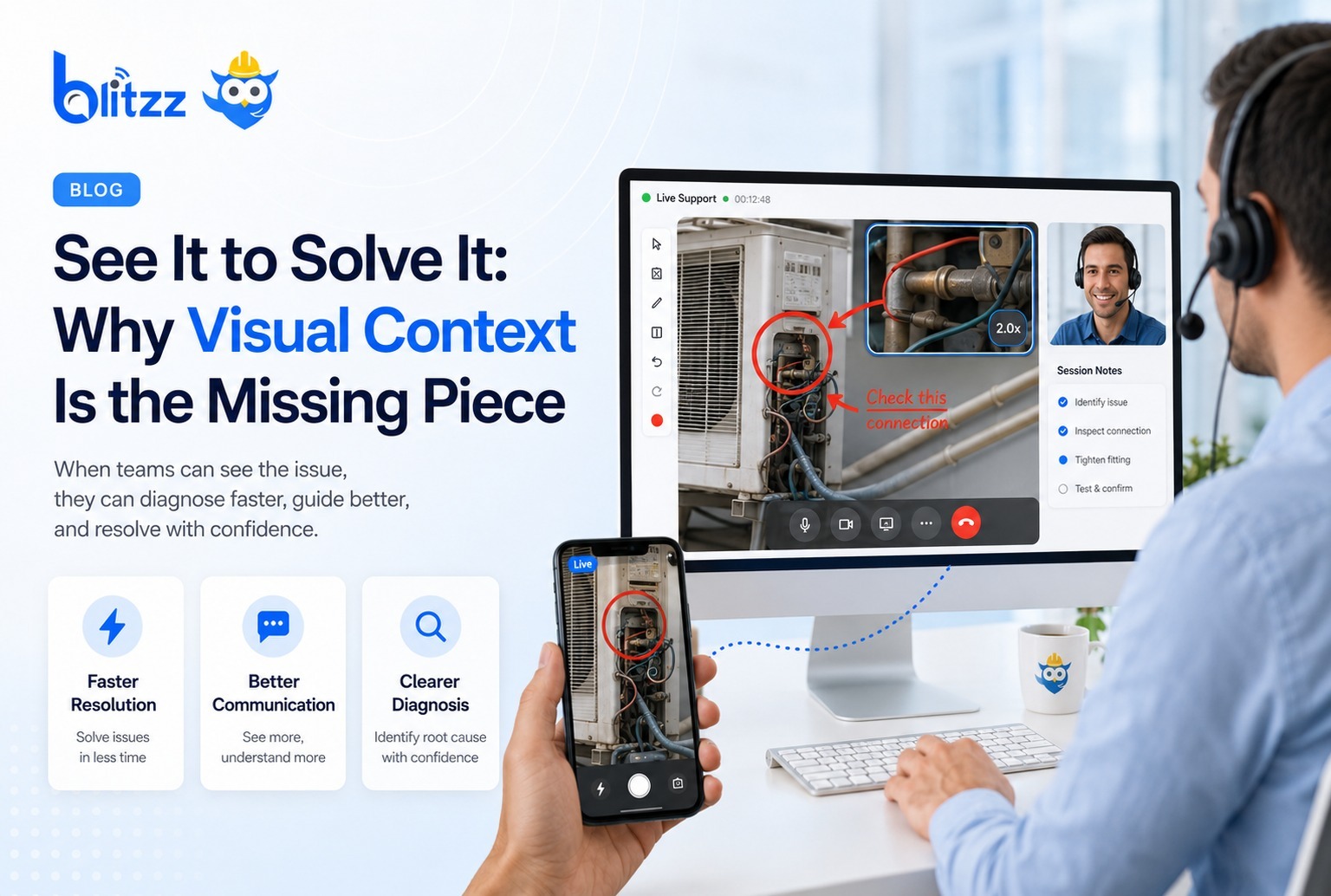
Customer support has gotten faster, but not necessarily better. Chatbots answer in seconds, automation routes tickets instantly, and AI drafts replies before an agent even reads the question. Yet too many issues still drag on for days. The problem isn't speed — it's context. When an agent can't see what the customer sees, every fast tool in the stack is still guessing.
That's the gap "See It to Solve It" closes. It's the next evolution in customer experience: giving agents real visual context so they diagnose from evidence instead of assumptions. The shift toward remote visual support and remote video inspection software isn't about replacing the human touch — it's about finally letting support teams see the problem they're being asked to solve.
The Hidden Problem in Modern Customer Support
The biggest bottleneck in support isn't response time — it's the moment an agent has to understand a problem they can't see.
Customers can't describe what they see. Most technical issues are visual, not verbal. A blinking router light, a hairline crack, a misconnected cable — these are easy to point at and nearly impossible to put into words. Customers under stress, or unfamiliar with technical terms, describe symptoms inaccurately through no fault of their own.
Agents are working blind. When support teams rely on text descriptions alone, they're missing the key visual cues that would resolve the issue immediately. Every diagnosis becomes second-hand, filtered through the customer's interpretation. Remote visual support removes that information asymmetry by letting the agent see through the customer's camera.
The cost of misunderstanding. The result is repeat tickets, escalations, frustrated customers, and longer resolution times. Each unresolved interaction generates another, and the cost compounds — especially when the fix ends up requiring an expensive field visit that visual context could have avoided. Studies of contact-center performance consistently find that the diagnosis gap, not agent skill, is the root cause of low first-contact resolution, and remote visual support is the most direct way to close it.
What Is Visual Context?
Visual context is real-time visual information that lets an agent see a customer's issue directly rather than inferring it from a description. It turns a support conversation into a shared view of the actual problem.
It takes several forms: live video, image uploads, screen sharing, and AI-analyzed visuals that surface what matters automatically. A remote visual support platform brings these together so the agent can watch, capture, annotate, and document in one session.
Why it matters is simple. Visual context eliminates guesswork, replaces assumptions with evidence, and speeds up decision-making. The agent stops asking "what does it look like?" and starts saying "I see it — here's the fix."

Why Text Alone Fails in Complex Support Scenarios
Text is excellent for simple, repeatable queries, but it breaks down the moment a problem turns physical or technical.
Lack of clarity. Descriptions vary wildly from one customer to the next. The same fault gets described five different ways, and none of them give the agent a reliable picture.
Misinterpretation of issues. Small but critical details get lost in translation — the difference between two ports, two error codes, or two damage patterns. Those details often determine the entire resolution.
Inefficient troubleshooting. Without visual context, agents fall into a loop of repeated clarifying questions, each one adding time and frustration. This is exactly the friction that escalating into a remote visual support session eliminates the instant a chat gets complicated.
The Power of "Seeing" the Problem
When an agent can see the issue, the entire dynamic of the interaction changes.
Instant understanding. Agents identify the problem visually in seconds, the way an in-person technician would — except without the travel. The principle behind remote video inspection software is the same: see the loss, understand it immediately.
Faster diagnosis. With the problem in view, there's no need for back-and-forth clarification. The diagnostic phase that used to consume most of the call collapses into moments.
More accurate solutions. Seeing the issue reduces trial-and-error troubleshooting and the wrong-fix-first problem. Agents solve the actual cause, not a guess about it — which is why remote visual support consistently lifts resolution quality, not just speed.
How Visual Context Improves Key Support Metrics
The impact shows up directly in the metrics support leaders already track.
First Contact Resolution (FCR). Seeing the problem drives higher resolution rates on the first interaction, because the agent isn't deferring the fix until they understand it. Teams adopting remote visual support report meaningful FCR gains.
Average Handle Time (AHT). Visual context cuts the time spent diagnosing, since clarity arrives in seconds instead of after several rounds of questions.
Customer Satisfaction (CSAT). Customers feel more confident and trusting when an agent can see and address their exact issue rather than reading from a generic script.
Repeat Contact Rate. Resolving the real problem the first time means fewer follow-up tickets — the single biggest hidden cost of text-only support. The economics mirror what remote video inspection software delivers in field industries: one complete session instead of repeated touchpoints.
Real-World Use Cases of Visual Context
Visual context proves its value across every industry where problems are physical.
Technical support. Device setup and troubleshooting are far faster when an agent sees the hardware. A remote visual support session replaces a frustrating phone tree with a guided, visual fix.
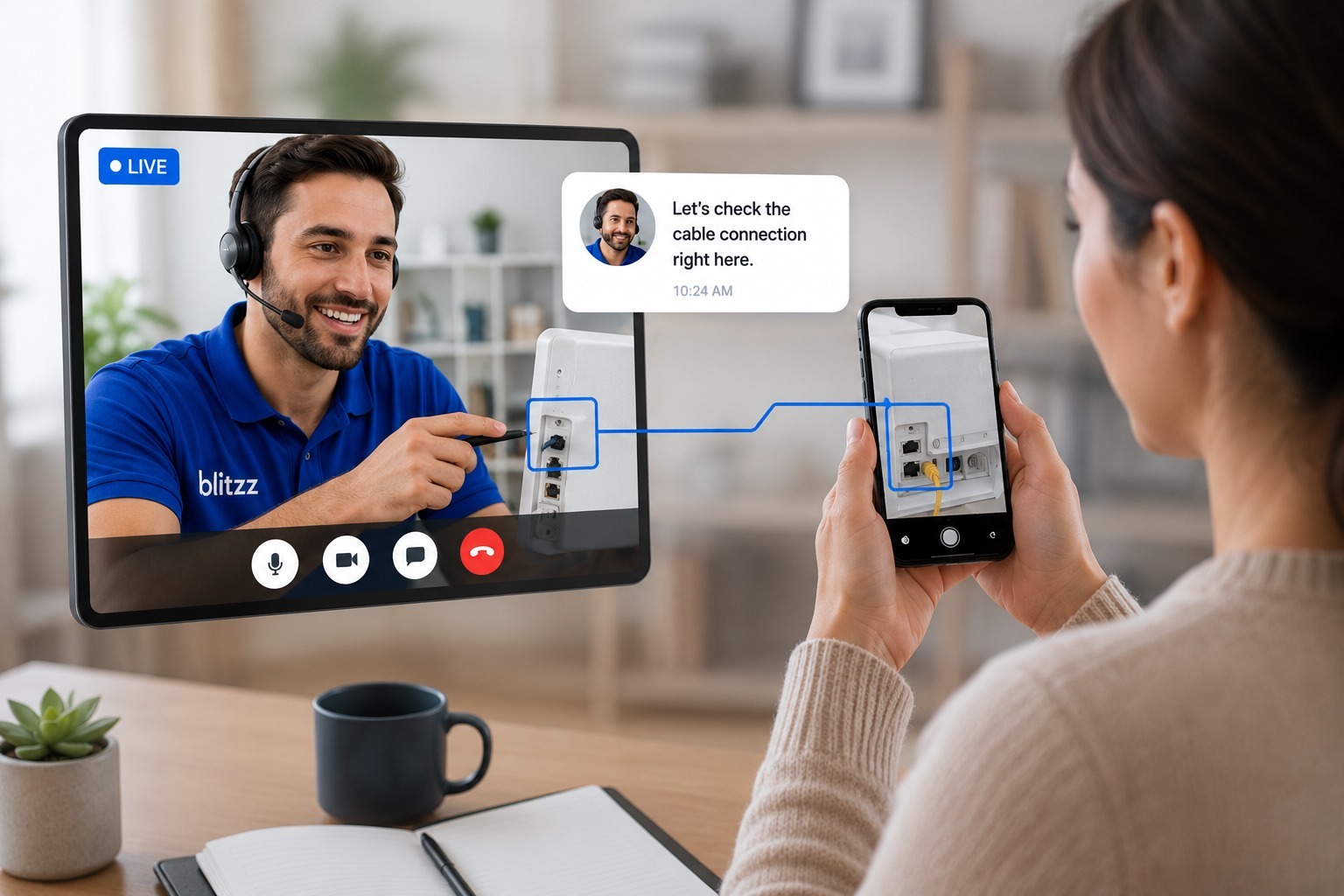
Telecom and connectivity. Router configuration and signal issues are classic "blinking light" problems where description fails and seeing succeeds. With remote visual support, an agent sees the hardware, spots the misconnected cable, and resolves it on the first call — a major telecom provider cut field visits by 60% this way.
Insurance claims. Damage verification and documentation depend entirely on seeing the loss. A visual remote assistant for insurance lets adjusters assess and document claims remotely with timestamped evidence — remote video inspection software applied directly to the claims file, with no site visit required.
E-commerce. Product defects and return validation become straightforward when AI image analysis and live video confirm the item's condition, reducing fraud and disputes through cobrowsing and visual capture.
Field service. Remote equipment inspections let a specialist assess assets without traveling, and remote video inspection software turns each session into a documented record.
AI's Role in Enhancing Visual Context
AI doesn't replace visual context — it makes it smarter and faster.
Image recognition. AI automatically identifies issues in photos or video, flagging the crack, the part number, or the anomaly without manual review. Coverage of the leading digital inspection platforms shows how far this has come.
Smart diagnostics. AI suggests likely causes based on what the camera shows, giving the agent a head start on the fix rather than a blank slate.
Guided resolution. Step-by-step assistance based on what AI "sees" helps agents and customers move through a resolution confidently. For teams embedding this into their own workflows, a developer REST API can trigger diagnostics or a visual session automatically when a ticket signals complexity.
From Guesswork to Clarity: The Support Transformation
The old model was built on text-based communication and slow, back-and-forth troubleshooting. Agents pieced together an understanding from fragments, tested fixes, and waited for the customer to report back. It was support by inference.
The new model is visual-first. Communication centers on what the agent can actually see, and problem-solving happens in real time during a single remote visual support session. The difference isn't incremental — it's the gap between guessing and knowing, and it reshapes every metric downstream.
Why Visual Context Is the Missing Piece in CX
Modern support stacks have solved two of three problems. Chatbots handle language, parsing and responding to customer queries at scale. AI handles automation, routing and resolving the repetitive. But neither solves physical reality.
Most real-world problems are visual in nature — a device, a damage, a defect, a configuration. Without seeing the issue, support is always incomplete, no matter how fast the language model or how clever the automation. Visual context is the missing layer that connects digital support to the physical world, which is why remote visual support is becoming core infrastructure rather than a premium add-on. Comparisons like Blitzz vs. legacy remote-access tools show how quickly the category is maturing.
Business Benefits of Visual Context Support
The business case is direct and measurable.
Lower operational costs. Fewer escalations and repeat tickets, plus fewer field dispatches — and avoiding a single truck roll typically saves $150 to $500.
Faster resolution times. Reduced diagnostic delays compress the entire support lifecycle, from first contact to close.
Improved agent efficiency. Agents spend less time interpreting vague descriptions and more time resolving issues, handling more cases per shift because remote visual support puts the answer in front of them. Native integrations keep session data flowing into the CRM so nothing is re-entered by hand.
Better customer experience. Visual context makes support feel more intuitive and human — the customer is guided, seen, and resolved rather than passed around.
Challenges in Implementing Visual Support
Adoption isn't without hurdles, and naming them helps teams plan.
Privacy and security. Handling customer video and image data demands enterprise-grade encryption, consent capture, and compliance — non-negotiable for regulated industries.
Adoption barriers. Some customers hesitate to use camera-based support, which is why browser-based remote visual support that requires no app download is critical to keeping completion rates high.
Technical integration. Connecting visual tools to existing support systems can stall a rollout unless the platform offers clean, native connections and an API. Roundups of the best remote visual support software in 2026 help teams choose a foundation that integrates without friction.
The Future of Customer Support Is Visual-First
The direction is set. AI plus visual intelligence will produce systems that understand what users see in real time, not just what they type. Proactive issue detection will let support identify problems before customers even report them, using visual and sensor data together. And seamless hybrid support will blend chatbots, AI, and remote visual support into one experience, with automated remote video support handling the handoffs invisibly. As this matures, remote video inspection software and live assistance will share a single platform, and seeing the problem becomes the default, not the exception.
Conclusion
Traditional support systems lean too heavily on words, and words can't capture a problem the customer can only show. Most issues require visual understanding to resolve quickly, and "See It to Solve It" names the shift that makes that possible: a visual-first customer experience built on real context, not guesswork. Companies that adopt visual context early will outperform on the three metrics that decide loyalty — speed, cost, and satisfaction.
Want to see how it works on your own use cases? Schedule a demo and watch a single remote visual support session turn guesswork into clarity.
Frequently Asked Questions
What is visual context in customer support?
Visual context is real-time visual information — live video, image uploads, screen sharing, or AI-analyzed visuals — that lets an agent see a customer's issue directly instead of relying on a description. It replaces assumptions with evidence and speeds up resolution.
Why does text-only support fall short for complex issues?
Because most real-world problems are visual, and descriptions vary from customer to customer. Critical details get lost in translation, forcing agents into repeated clarifying questions. Seeing the problem removes that ambiguity instantly.
How does visual context improve support metrics?
It raises first contact resolution, lowers average handle time, increases customer satisfaction, and reduces repeat contacts by letting agents diagnose and resolve the real issue on the first interaction.
What role does AI play in visual support?
AI enhances visual context through image recognition that flags issues automatically, smart diagnostics that suggest likely causes, and guided resolution based on what the camera shows. It makes visual support faster and more consistent.
Do customers need to download an app to use visual support?
With browser-based platforms, no. The customer clicks a secure link sent by SMS or email and connects instantly from any smartphone browser, which keeps adoption high and friction low.


.jpg)