
.png?width=120&height=55&name=Blitzz-Logo-right%20white%20eyes%20-%20not%20transparent%20(3).png)

On this page
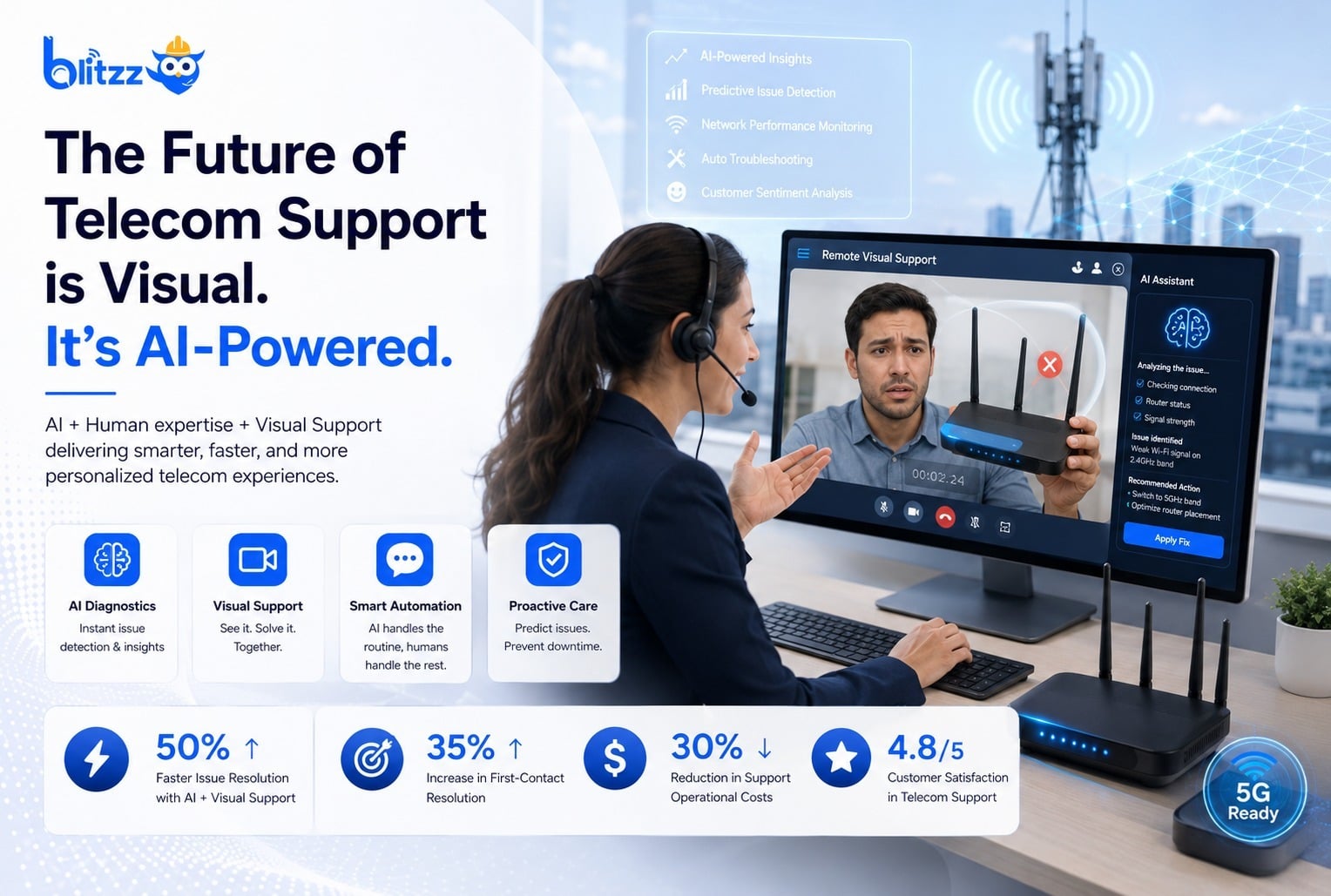
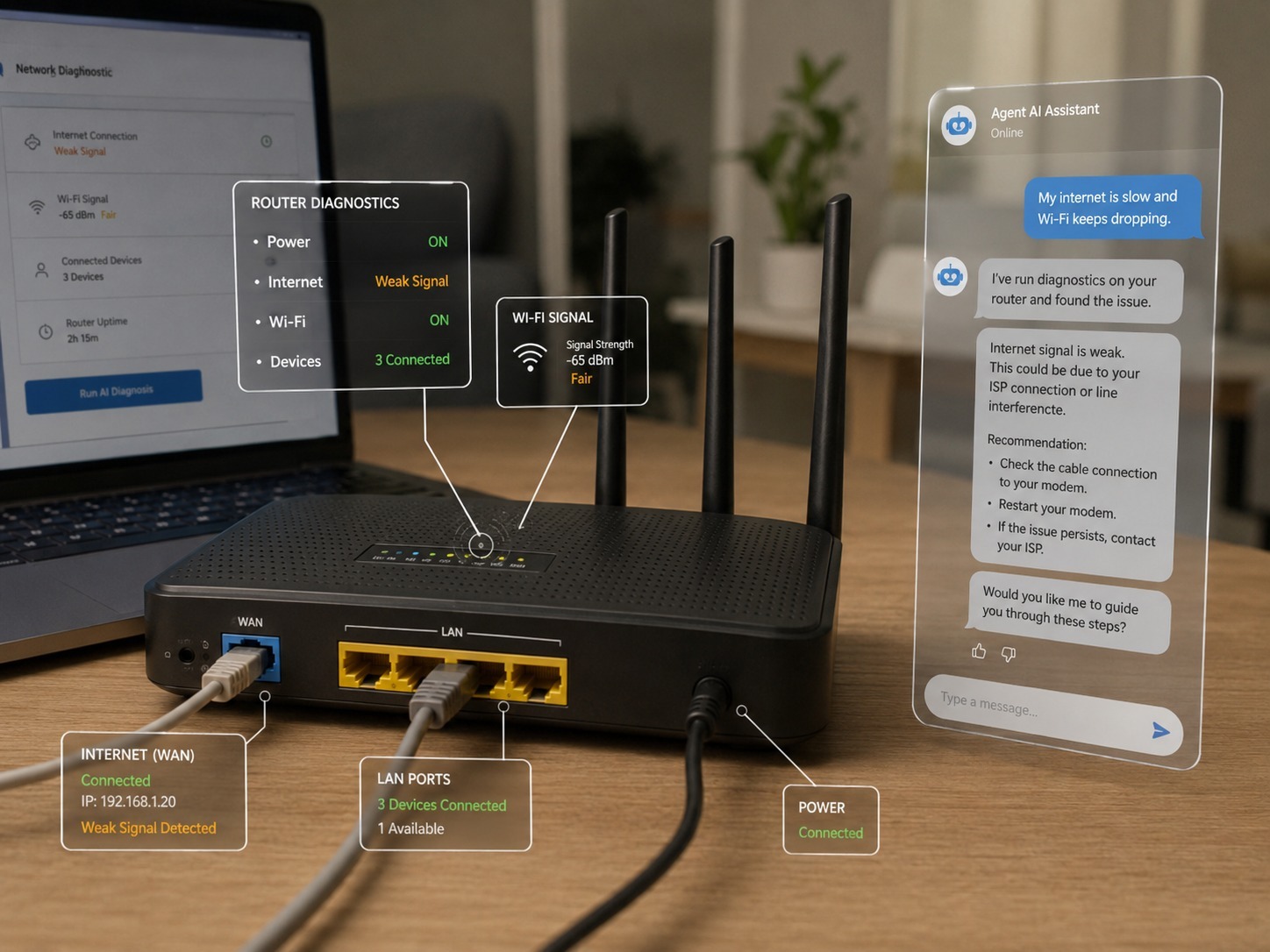
Telecom support teams use AI to diagnose router issues remotely by combining live video from the customer's location with visual AI that identifies the specific router model, reads status indicator lights directly, and matches those symptoms to known failure patterns from the company's own troubleshooting documentation — all without requiring the customer to describe technical details they may not understand or notice accurately. This approach turns one of the most common and highest-volume categories of telecom support calls into something that can be resolved faster, more accurately, and with far less back-and-forth than traditional voice-only troubleshooting.
This guide walks through why router issues are such a common support challenge, how AI-assisted video diagnosis works specifically for this use case, and what results telecom support teams typically see from adopting it.
Why Router Diagnostics Are Uniquely Well-Suited to Visual AI
Router and modem issues represent a large share of telecom and internet service provider support volume, and they share a characteristic that makes them particularly well-suited to visual diagnosis: much of the diagnostic information is communicated through indicator lights, physical connections, and small printed labels — details that are notoriously difficult for customers to describe accurately over the phone.
A customer might describe a light as "kind of orange" when it's actually solid amber, or might not notice that a light is blinking in a specific pattern that corresponds to a particular failure mode. They might struggle to read a small, worn model number printed on the underside of the device, or might not think to mention a loose cable because they don't realize it's relevant. Every one of these details, while small, can be the difference between an accurate diagnosis and a misdiagnosis — and traditional voice support has no way to independently verify any of it.
How the Process Works in Practice
When a telecom support team uses AI-assisted video diagnosis, a typical router troubleshooting call follows a distinct pattern:
The customer connects via a video link. Rather than describing the issue over the phone, the customer receives a secure link — via text, email, or another channel — that opens their camera directly in a browser, without requiring an app download.
The agent asks the customer to point the camera at the router. This is typically the only physical action required of the customer, replacing what would otherwise be a series of verbal questions about lights, connections, and labels, over a standard video session.
The AI identifies the specific router model. Rather than relying on the customer to read a model number correctly, the AI recognizes the device directly from its visual appearance and any legible markings.
The AI reads the status light pattern. Solid versus blinking, and the specific color, are read directly from the video feed, removing the ambiguity that comes with a customer's verbal description.
The AI matches this combination to known failure modes. A specific router model combined with a specific light pattern often corresponds to a well-documented issue — for example, a solid red light on a particular model indicating a WAN handshake failure during boot.
The agent receives a plain-language diagnosis and suggested fix. Rather than working through a lengthy troubleshooting script, the agent can immediately guide the customer through the specific steps that address the identified issue.
Common Router Issues This Approach Addresses
A few categories of router issues are particularly common in telecom support and particularly well-suited to this kind of visual diagnosis:
WAN connection failures. Often signaled by a specific status light pattern, these issues can frequently be resolved with a power cycle and cable re-seat once accurately identified.
Firmware or configuration issues. Some status light patterns indicate a device stuck in a particular boot or configuration state, which may require a specific reset sequence rather than a simple power cycle.
Physical connection problems. A loose or improperly connected cable is often visible in the video feed even when the customer hasn't mentioned it, since the AI is scanning the full frame rather than relying on what the customer thinks to describe — the same kind of equipment-level symptom detection used across other field service contexts.
Hardware failure indicators. Certain light patterns or physical signs — visible damage, unusual heat discoloration — can help an agent quickly determine that an issue is a genuine hardware failure requiring a replacement device, rather than continuing to troubleshoot a problem that isn't fixable remotely.
Why This Reduces Average Handle Time
The efficiency gain in this specific use case comes from eliminating several time-consuming steps that voice-only troubleshooting typically requires. Instead of an agent asking a series of clarifying questions to build an accurate picture of the router's status — a process that can take several minutes and still result in an inaccurate picture — the AI provides that information directly and immediately.
This has a compounding effect across a high-volume support operation. Telecom providers handling large numbers of connectivity-related calls each day see the time saved on identification and diagnosis multiply across every call, contributing meaningfully to lower average handle times and higher first-call resolution rates.

Why This Also Reduces Unnecessary Truck Rolls
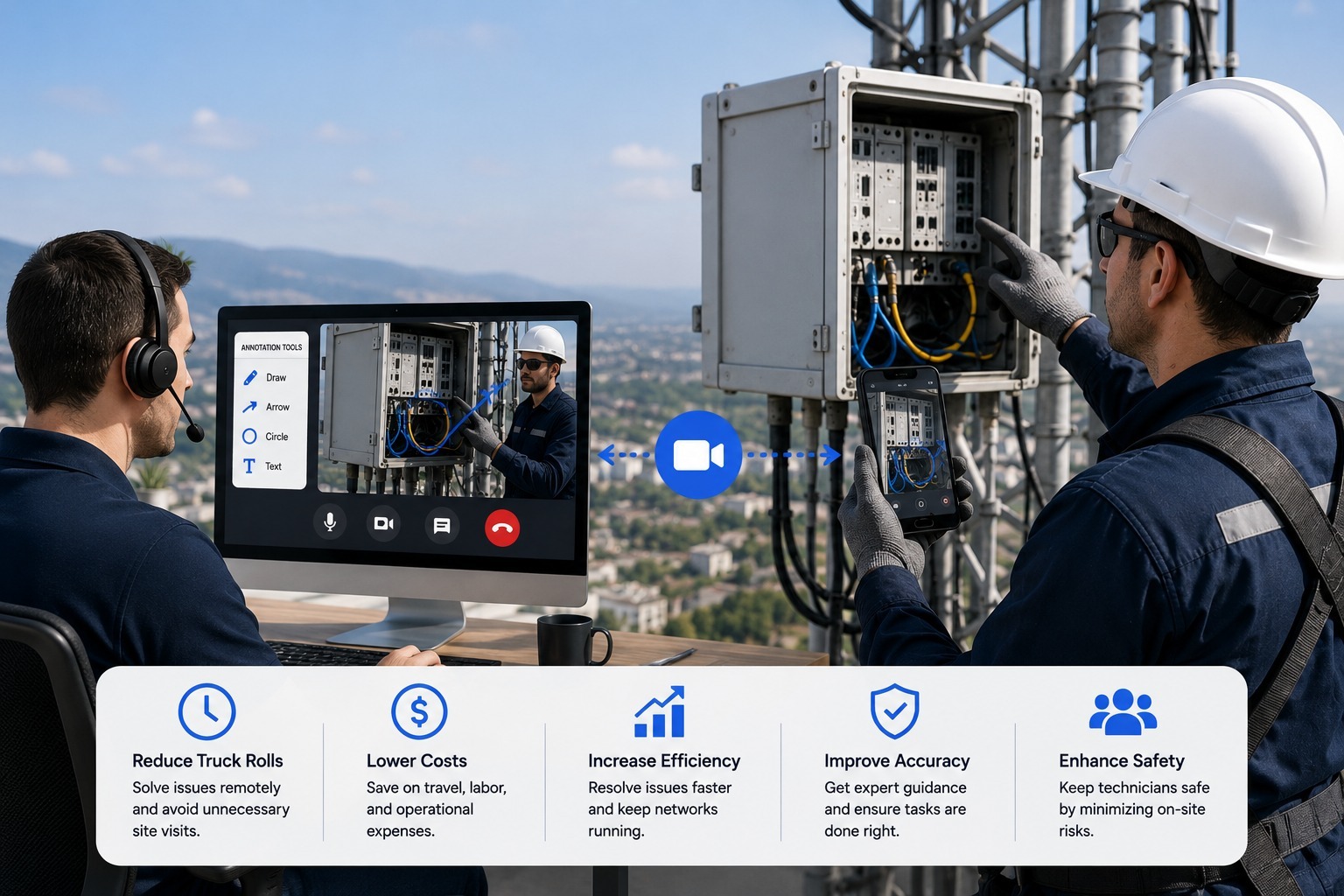
Beyond speeding up the diagnostic process itself, accurate visual diagnosis directly affects how often a telecom provider needs to schedule an in-person technician visit. Many router issues that would previously have defaulted to a scheduled visit — because voice-only diagnosis couldn't confidently rule out a hardware failure — can now be confidently diagnosed as software or configuration issues, resolvable with guided remote steps, avoiding the cost of an unnecessary truck roll entirely.
This matters significantly for telecom providers operating across large geographic areas, including rural or remote service territories where truck rolls are particularly costly and scheduling delays particularly frustrating for customers.
What Makes This Approach Work Well Specifically for Telecom
A few factors make this use case a particularly strong fit for AI-assisted visual diagnosis:
A relatively contained set of equipment. Compared to industries like manufacturing, telecom providers typically support a more limited range of router and modem models, making it more practical to train an AI system with strong recognition accuracy across that catalog.
Well-documented failure patterns. Router and modem failure modes tend to be well understood and consistently documented, providing strong training data for the reasoning and resolution stages of the process.
High call volume with repetitive issues. A large share of router-related support calls fall into a limited set of known problems, meaning the AI's knowledge base matching becomes increasingly accurate and useful over time as more cases are resolved and logged.
A Practical Example: A Complete Call Walkthrough
To make this concrete, consider a full customer interaction from start to finish. A customer reports that their internet has been "cutting out on and off" for the past several hours. In a traditional voice-only call, the agent would ask a series of questions: is any light flashing, what color, is the modem connected directly or through a splitter, has anything changed recently. Each answer depends on the customer noticing and describing details accurately, and the entire process might take several minutes before the agent has enough information to attempt a fix — often ending in a scheduled technician visit if the picture remains unclear.
With AI-assisted video diagnosis, the same call instead begins with a video link. The customer points their camera at the router, and within seconds the AI identifies the exact model and observes an intermittent pattern on the status light — not a steady failure, but a flicker consistent with a specific known issue related to signal strength at the connection point. The agent, seeing this plain-language diagnosis appear immediately, guides the customer to check and re-seat the coaxial connection, a fix that resolves the issue on the same call. No follow-up visit, no repeated troubleshooting attempts, and considerably less time spent overall compared to the voice-only equivalent.
Supporting Agents of Every Experience Level
One underappreciated benefit of this approach is how it levels the playing field between new and experienced agents. An agent who has handled thousands of router-related calls develops an intuitive sense for what a specific light pattern usually means on a specific device — but that intuition takes time to build, and it's inconsistent across a large team with varying tenure. AI-assisted diagnosis effectively gives every agent, regardless of how long they've been on the team, access to the same accurate identification and matched documentation. This tends to narrow the performance gap between new hires and veteran agents, which matters considerably for telecom support operations that deal with high call volume and, often, high agent turnover.
Common Questions About AI-Assisted Router Diagnosis
Does this approach work for all router and modem brands? Accuracy depends on whether the AI system has been trained on the specific equipment models a telecom provider supports. A system trained broadly across a provider's actual equipment catalog will perform better than one relying on generic recognition.
What happens if the customer's camera quality is poor? Video quality affects how much detail the AI can extract, though most systems are designed to work across a range of connection speeds and camera qualities, since customers connect from varied environments and devices.
Can this replace phone-based support entirely? Not necessarily — some customers prefer voice, and not every router issue requires visual diagnosis. Video-based AI diagnosis works best as an option offered specifically for issues where visual information would meaningfully help, rather than a universal replacement for every support channel.
Does this approach require customers to install any software? Most implementations run entirely in the customer's browser through a secure link, requiring no app download or installation, which helps maximize how many customers actually complete a video session successfully.
How does this affect first-call resolution rates? Telecom support teams using this approach typically see meaningful improvements in first-call resolution, since accurate visual diagnosis reduces both misdiagnosis and unnecessary escalation to a truck roll.
The Bottom Line
Router and modem issues represent one of the clearest use cases for AI-assisted visual diagnosis in telecom support, precisely because so much of the diagnostic information — status lights, physical connections, model numbers — is difficult for customers to describe accurately but easy for an AI system to read directly from a video feed. By removing the translation step that voice-only troubleshooting depends on, telecom support teams using this approach see faster resolutions, fewer unnecessary truck rolls, and a more consistent diagnostic experience regardless of which agent handles the call or how technically confident the customer is.

Blitzz Team
The Blitzz Team writes about remote video support, virtual inspections and field service. Our guides come from working with home builders, property managers, warranty teams, contact centers and field service organizations that use Blitzz to see and solve issues without a truck roll.