


On this page
A solar or battery installation is not finished when the last panel is mounted. It is finished when the local building department signs off, the utility grants permission to operate and the homeowner can turn the system on. Between the end of installation and that sign-off, projects often sit idle. Crews wait for inspectors, inspectors drive between sites, and a single failed item can push a project back by days or weeks.
Remote video inspection is changing that. Instead of requiring an inspector to visit every job in person, an increasing number of jurisdictions let installers show their work through live video or recorded photos and video. The result is faster approvals, fewer wasted trips and a clearer record of what was installed.
This guide explains how remote inspection works for solar and battery projects, what it covers, why policy momentum is building, and how installers and building departments can prepare.
Why inspections slow down solar and battery projects
Inspection delays are a quiet but significant cost in residential clean energy. Canary Media’s April 2026 reporting described how a solar inspection technician in Arizona typically drives to eight or nine homes a day to confirm that new systems are safely configured, and sometimes has to wait hours for a city or county inspector to show up.
The problems compound in several ways:
- Idle crews and equipment. Time spent waiting is time not spent on the next installation.
- Long scheduling windows. An installer at Lumina Solar told Canary Media that some Maryland counties take anywhere from a day to more than a month to schedule on-site inspections and follow-ups.
- Reinspection loops. A minor failure, such as a missing label, can require a second visit. Without remote options, the contractor fixes the problem and waits again.
- Delayed activation. Homeowners cannot use the system until inspection and utility approval are complete, which delays their savings and the installer’s final payment.
- Higher soft costs. Permitting and inspection friction is one reason U.S. rooftop solar costs more than in many other countries, according to the same report.
For building departments, the picture is mirrored. Inspectors spend large parts of the day driving, and routine residential work crowds out more complex projects.
What a remote inspection covers
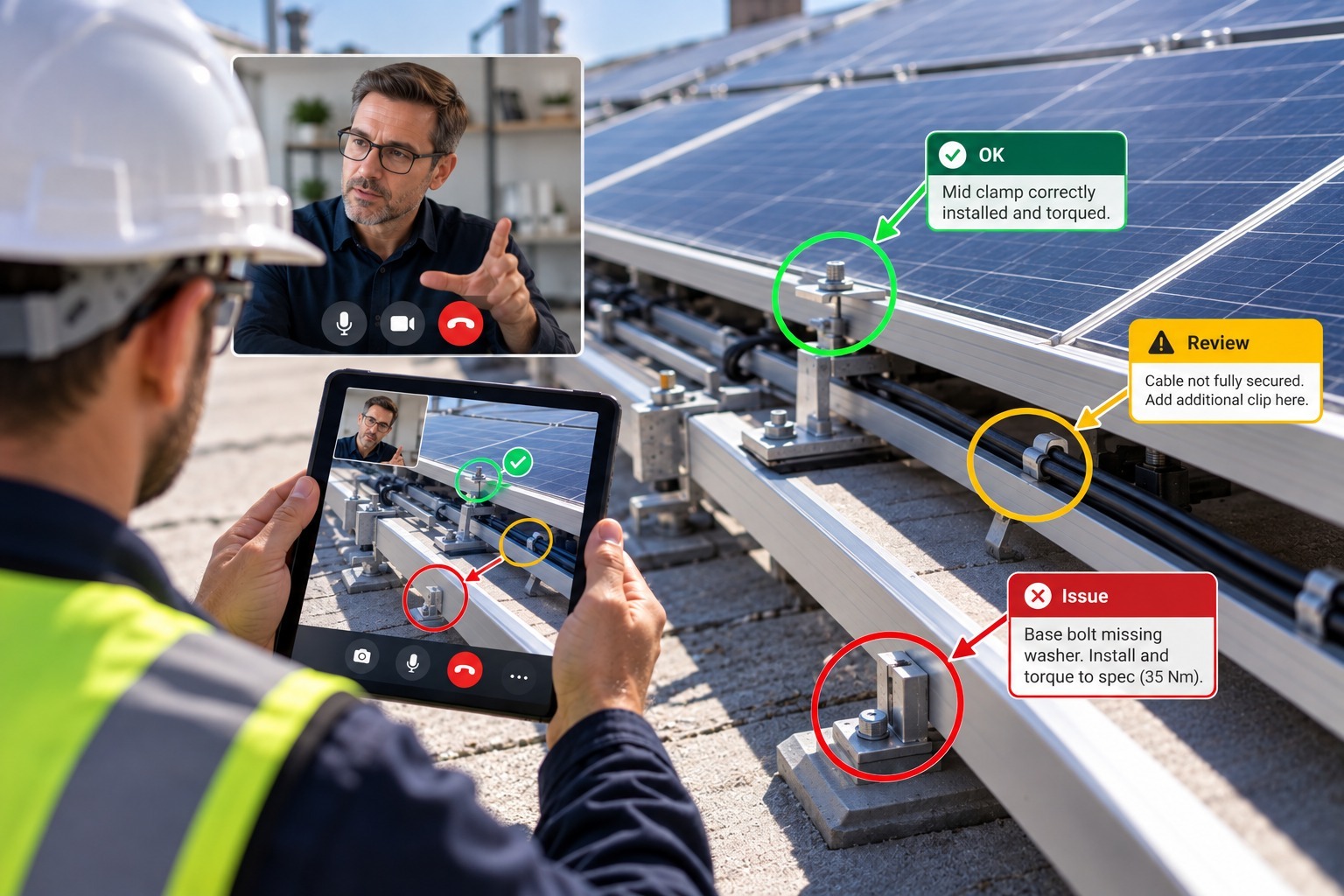
A remote solar or battery inspection checks the same code requirements as an on-site visit. The difference is how the inspector sees the work. Canary Media describes the typical process in Pima County, Arizona: the installer uses a smartphone to capture photos and video of the checklist items, including the main electrical panel and breakers, the disconnect switch, the meter, and the wiring and conduit connecting them. The county then reviews the record and sends a pass or fail notice, with instructions for any fixes.
Exact checklists depend on the local jurisdiction and the codes it has adopted, but typical items include:
Solar array
- Array layout, setbacks and access pathways
- Roof attachments and flashing, ideally photographed before they are covered
- Wiring, conduit and junction boxes
- Labels and placards, including rapid shutdown labeling
- Grounding and bonding
Battery and energy storage
- Equipment location and required clearances
- Mounting and anchoring
- Labels, disconnects and overcurrent protection
- Wiring and conduit connections
- Working space around equipment
Electrical interconnection
- Main service panel and breaker configuration
- Meter and utility disconnect
- Data plates and equipment labels
Confirm the specific checklist with your local building department, because requirements vary.
The business case for remote inspection
The savings come from time. The Interstate Renewable Energy Council’s 2026 white paper, summarized by Canary Media, estimates that technology-enabled virtual inspections can reduce costs by more than $30,000 per inspector each year and allow inspectors to complete roughly three times as many inspections per day.
Real-world programs show how that plays out.
Pima County, Arizona. The county started remote inspections for residential air-conditioning installations more than a decade ago and expanded them over time. Its deputy director said inspectors were once driving up to 150 miles a day, and virtual inspection saved vehicle and fuel costs while allowing more inspections. The time to approve a home solar project fell from hours to minutes, according to Canary Media.
Placer County, California. The county’s acting chief building official estimated that remote video inspections eliminate about 3,900 driving miles a year. The county offers remote inspections on the same day the project is completed, which contractors value because they do not need to return the next day. He also said contractors who try the program tend to keep using it because they can choose the exact inspection time.
Maryland installers. Lumina Solar’s vice president of residential operations said virtual inspections in a few Maryland counties have saved a great deal of time, especially on follow-ups. Installers can fix a flagged problem and send video evidence the same day.
Better quality, not just speed. Pima County’s former development services director said she spends more time with each contractor on remote inspections than she could if she had to drive out for five minutes, and that digital records can help inspectors catch errors that a brief on-site visit might miss.
Policy momentum
Remote inspection for solar and storage is moving from local experiment to state policy.
California. AB 1738 requires cities and counties to offer a remote inspection option by July 1, 2027, for specified residential projects. Solar and energy storage systems are on the must-offer list, along with water heaters, HVAC systems, reroofs and minor electrical work.
Maryland. The Maryland Utility RELIEF Act, which includes solar and battery permitting reforms, was signed on May 12, 2026. As Canary Media reported before final passage, counties would need to adopt online solar permitting by mid-2027, and counties that cannot meet five-day turnarounds by mid-2028 must offer a remote inspection option with inspection within five business days of a request. Check the final bill text for exact requirements.
Other states. Canary Media reports that Arizona, Florida and Texas have a significant number of jurisdictions with virtual inspection programs, and that New York’s NY-Sun solar and storage subsidy program requires virtual inspections as a follow-up to on-site local inspections. Permit Power told the outlet that about a half dozen states advanced or considered solar and battery permitting reform bills in 2026.
For more on where the trend is heading, see our article on which states are next to adopt remote building inspections.
Why it matters now. Utility bills are rising, and Canary Media notes that federal tax credits for rooftop solar were scrapped last year. In that environment, anything that reduces soft costs and shortens project timelines becomes more important to installers and homeowners.
How a remote solar or battery inspection works
Programs differ, but most follow a similar flow.
- Request and eligibility. The installer requests a remote inspection when the permit is eligible. The building department confirms the method: live video, recorded photos and video, or both.
- Preparation. The installer reviews the department’s checklist, confirms that all work is complete and accessible, and tests connectivity.
- Live session or submission. In a live session, the inspector joins by video link. Blitzz Inspect lets the person on site connect from a phone browser with no app download. The inspector directs the camera, uses remote zoom to read labels and examine connections, and uses markup or live pointer tools to point at specific items.
- Evidence capture. The inspector or installer captures timestamped HD photos with GPS location data attached.
- Decision and record. The inspector issues a pass or fail, and the department stores the session, photos and notes. A recorded session, AI call summary and inspection report create a clean file.
- Same-day correction. If something fails, the installer can fix it and show the correction, ideally during the same day.
Some departments only accept live video. Placer County’s acting chief building official told Canary Media that the agency uses live video only because it needs to know it is at the right jobsite, not looking at a random photo. That is a reasonable approach, and a reminder to follow your jurisdiction’s rules.
Installer checklist: getting ready for remote inspection
Installers who prepare well pass more often and keep the remote option available.
- Know your jurisdiction’s rules. Confirm whether the department offers live video, recorded media or both, what platform it uses and which permit types qualify.
- Build a standard remote inspection kit. Include a phone or tablet on a stable mount, a backup battery, a bright light and a second device.
- Create a shot list for every job. Cover the roof array, attachments, conduit runs, junction boxes, labels, disconnects, panel interior with the cover off, meter, battery mounting and clearances, and data plates.
- Document before you cover. Capture roof penetrations, flashing, wire routing and grounding before they are hidden.
- Do a dry run. Walk the site before the inspector joins, check that every item is visible and accessible, and fix small problems first.
- Test connectivity. Check signal at the panel, the battery location and the roof edge. If signal is weak, use offline mode to capture images and data and upload later, if the jurisdiction accepts recorded media.
- Keep paperwork in frame. Have the permit card, approved plans and manufacturer data handy and show the address and permit number at the start.
- Assign a camera operator. Choose someone who knows the system, can narrate, and can follow instructions quickly.
- Do not misrepresent. Never reuse footage, show a different installation or hide a problem. Departments can ban contractors who mislead them.
OCR text extraction can also help during live sessions by capturing serial numbers and model information from equipment labels, which reduces typing errors on closeout forms.
What building departments should consider
For permit offices, the question is how to add remote inspection without adding risk.
- Define eligible work. Solar, battery, water heater and HVAC projects are often good candidates because they are repetitive and well documented.
- Choose the right method. Live video offers stronger location verification. Recorded media can offer more flexibility. Some departments use both.
- Set standards for evidence. Publish a shot list so installers know what to show.
- Require the right to go in person. Keep the authority to require an on-site visit if something cannot be verified.
- Audit. Spot-check remote inspections on site and tell contractors you do so.
- Integrate with permit systems. Blitzz’s Accela integration can launch inspections from permit records and sync documentation back. Government teams can learn more on the government customers page.
- Plan for IT. Canary Media notes that Pima County had to upgrade its permit management software to handle digital inputs, and that smaller agencies may be wary of IT projects. Start early.
- Involve stakeholders. The former Pima County director said that getting local staff involved in the process is the best way to gain their support.
Document everything with BlitzzCam
A remote inspection is only as strong as the evidence behind it. For solar and battery installers, much of the work becomes invisible once the job is complete: flashing under panels, wire runs in attics, conduit behind walls, anchoring behind battery enclosures.
BlitzzCam field photo documentation helps crews capture a verified record as they work. Photos are stamped with GPS location and timestamp and organized by job and phase. That means an installer can show roof attachments before panels go on, wiring before covers are closed and battery mounting before finishing, and then pull those images up quickly if an inspector or auditor asks. BlitzzCam is listed as early access on the Blitzz site, so confirm availability with the Blitzz team.
Good documentation also helps with warranty claims, utility interconnection reviews, financing closeouts and customer disputes. For more on how field teams use remote video, see Blitzz’s utilities and energy and construction pages.
Safety benefits
Remote inspection reduces roof exposure for inspectors. Placer County’s chief building official said that video from installers on the roof means inspectors do not have to climb up to check the work, which eliminates safety hazards. Roofing is among the deadliest occupations in the country, so reducing unnecessary roof visits is meaningful for departments and for solar inspectors alike.
Installers still work on roofs, and remote inspection does not change their fall protection duties. But it can mean fewer additional people at height for routine checks.
Limits and best practices
Remote inspection is not a universal solution.
- Some work still needs an on-site visit. Placer County, for example, requires in-person inspection for new home builds, and inspectors will still go on site if a contractor or owner requests it.
- Jurisdictions set the rules. Some accept only live video. Others accept recorded media. Always check.
- Complex or unusual systems may require a visit. Large batteries, nonstandard installations and unusual site conditions may be better handled in person.
- Weak signal can cause delays. Plan ahead and keep backups.
- Trust must be earned. Departments are more comfortable when contractors are consistent, honest and well prepared.
Looking ahead
Remote inspection is becoming a standard part of solar and battery permitting. California’s AB 1738, Maryland’s new law and existing programs in Arizona, Florida, Texas and New York point in the same direction: faster inspections, fewer unnecessary trips and better digital records.
For installers, the practical advice is to start now. Build the shot lists, train crews to narrate their work, adopt tools that capture verified photos and learn each jurisdiction’s remote inspection rules. For building departments, a pilot on solar, storage and similar projects is a low-risk way to build experience before a mandate arrives.
To see how remote video inspection and BlitzzCam field photo documentation can support your solar and battery workflow, explore the Blitzz features, read the case studies or schedule a demo with the Blitzz team.

Blitzz Team
The Blitzz Team writes about remote video support, virtual inspections and field service. Our guides come from working with home builders, property managers, warranty teams, contact centers and field service organizations that use Blitzz to see and solve issues without a truck roll.