
.png?width=120&height=55&name=Blitzz-Logo-right%20white%20eyes%20-%20not%20transparent%20(3).png)
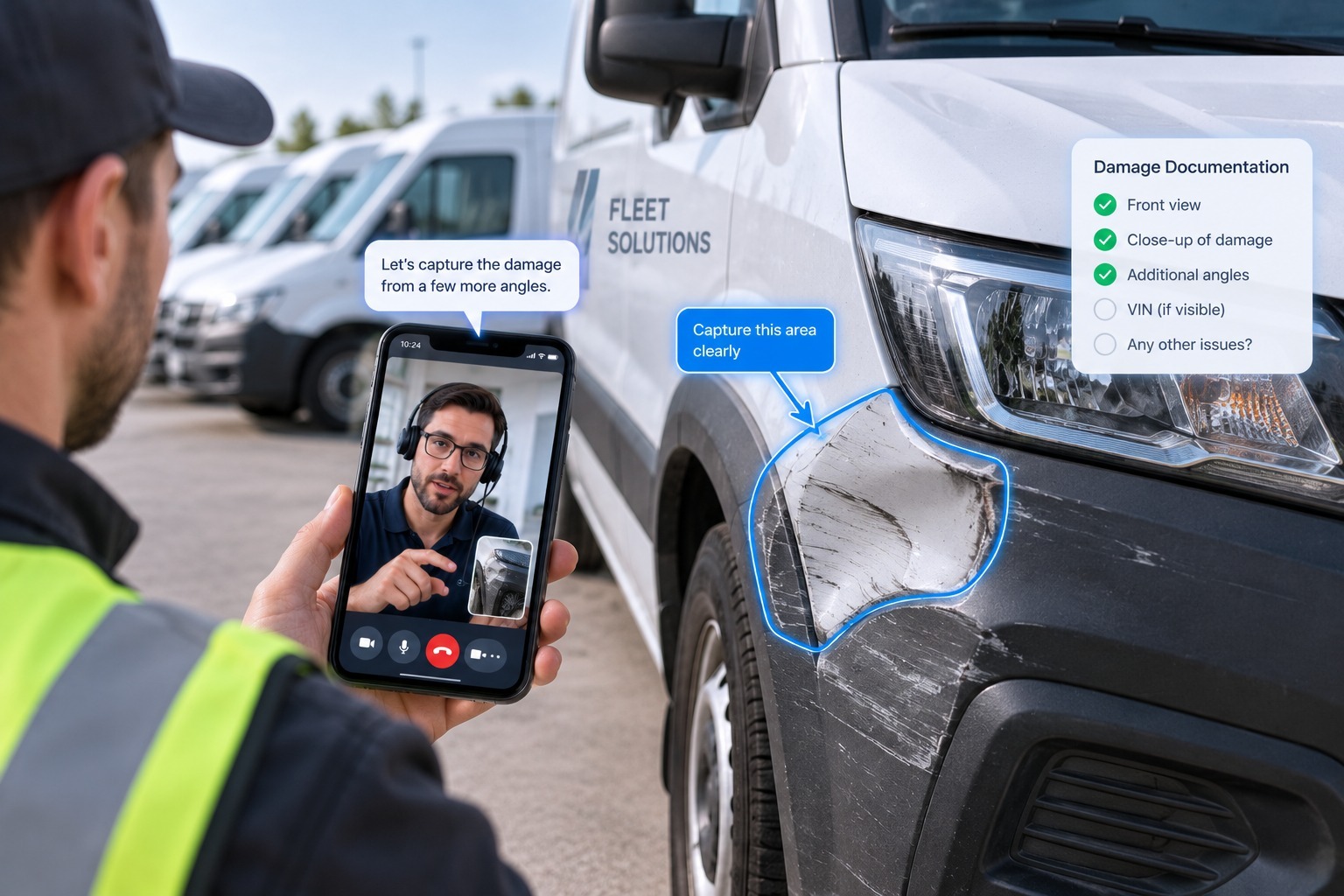
Fleet managers know the pattern well: a vehicle comes back from a driver, a rental period ends, or a leased unit is returned, and somewhere in the handoff a dent, scratch, or interior stain appears that nobody can quite pin down. Was it there at checkout? Did it happen during the rental period? Who's responsible for the repair cost? Without a clear, timestamped record of the vehicle's condition at every handoff point, these disputes become expensive guessing games — and at fleet scale, a small percentage of unresolved damage claims adds up to a serious line item on the annual budget.
Remote visual assistance gives fleet operators a way to close that gap. Instead of relying on a driver's memory or a rushed paper checklist at pickup and return, a fleet coordinator can document every vehicle's condition on live video or through verified photo capture, creating a record that actually holds up when a dispute arises.
Why Fleet Damage Disputes Are So Hard to Resolve
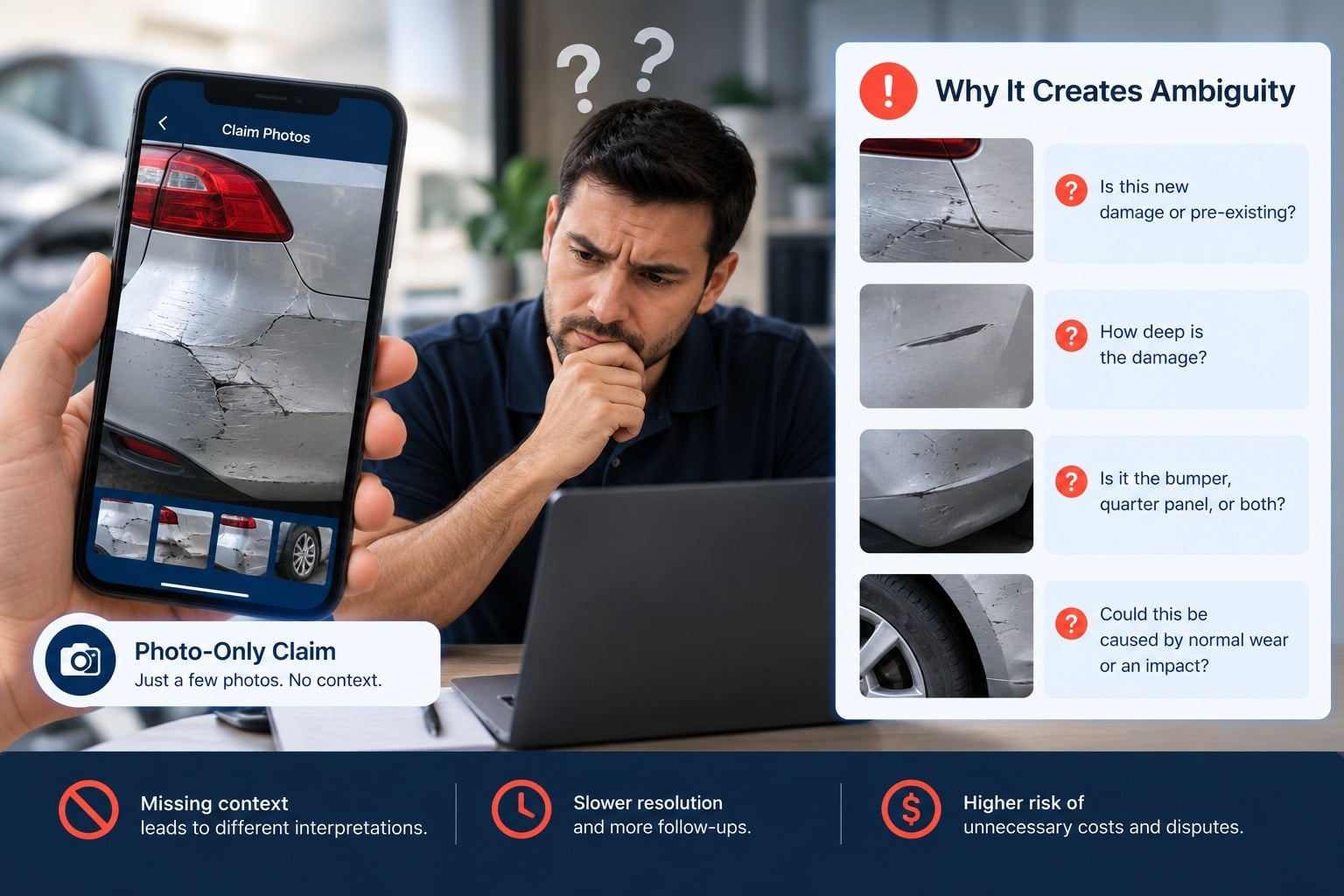
The core problem with fleet damage documentation is timing. Damage is rarely reported the moment it happens — it surfaces days or weeks later, when a vehicle is inspected for maintenance, returned to a leasing company, or handed to a new driver who notices something the previous driver never mentioned. By that point, there's no reliable way to establish when the damage occurred or who was driving at the time, which turns what should be a straightforward accountability question into a "he said, she said" dispute that often ends with the fleet operator absorbing the cost.
This is exactly the kind of ambiguity that visual context resolves in other support and inspection contexts, and fleet management is a particularly clean application of the same principle: a documented condition report at each handoff point removes the guesswork about when damage actually occurred.
Building a Documented Condition Record at Every Handoff
The most effective fleet damage programs treat vehicle condition documentation as a standard step at every handoff — checkout, return, driver reassignment, and scheduled maintenance — rather than something that only happens after a problem is already suspected. Using a tool like BlitzzCam, a coordinator or driver can capture GPS- and timestamp-verified photos of the vehicle's exterior and interior in minutes, creating a record that can't be disputed on the basis of "that photo could have been taken anytime."
This mirrors how BlitzzCam protects contractors from damage disputes on construction sites — the same principle of verified, timestamped documentation applies directly to a fleet vehicle changing hands. How BlitzzCam keeps photo data secure and audit-ready is worth reviewing for any fleet operator building a documentation program that needs to hold up not just internally, but potentially in a legal or insurance dispute down the line.
Live Video for Real-Time Damage Assessment
Photo documentation handles the routine handoff record, but when damage is reported and needs to be assessed immediately — a driver calls in after a minor incident, or a returning lease vehicle shows unexpected damage — live remote visual assistance lets a fleet coordinator or claims specialist see the damage in real time instead of waiting for the vehicle to be physically brought in for inspection. Using Blitzz Concierge, a driver or return-center employee opens a live video link directly from their phone's browser, and the coordinator can direct the camera to specific panels, close up on the damage, and make an immediate assessment of severity and likely repair cost.
This capability draws directly on the same technology used in remote vehicle diagnostics that reduce dealership service visits — seeing the vehicle live, rather than working from a verbal description, consistently produces a faster and more accurate assessment.
Why This Matters More at Fleet Scale
A single vehicle owner might tolerate some ambiguity around a minor scratch. A fleet operator managing hundreds or thousands of vehicles cannot — even a small percentage of disputed damage claims, multiplied across a large fleet, represents a significant recurring cost. Why automotive sales and service need remote visual support covers this dynamic from the dealership side, but the underlying math is even more pronounced for fleet operators, where damage disputes recur constantly across a rotating pool of drivers and vehicles rather than being a one-off event.
The mechanic's guide to implementing video support and diagnostics also applies here in a related way — once damage is documented and a vehicle goes in for repair, video verification between the fleet coordinator and the repair shop keeps the estimate and the actual repair work aligned, reducing disputes over what was and wasn't included in the original damage assessment. For fleets that also handle claims through an insurer, what makes the best insurance inspection software is a useful reference for evaluating whether a documentation tool will actually integrate cleanly with the claims side of the process.
AI-Assisted Damage Recognition
Visual AI adds consistency to fleet damage assessment that's hard to achieve when documentation quality depends entirely on which coordinator happens to be reviewing a given vehicle. Owlbert AI can recognize damage patterns on screen and flag items that need closer inspection, reducing how much of the assessment depends on any single reviewer's experience with a particular vehicle make or model. This is part of a broader shift toward AI Agent Assist watching live video calls and surfacing relevant information in real time, whether that's a known damage pattern or a component that commonly gets overlooked in a rushed visual check.
Why misdiagnosis happens on video calls is directly relevant to fleet damage assessment specifically — vehicles get misdiagnosed on video due to reviewer memory and bias just as often as any other equipment category, and a structured, AI-assisted checklist keeps damage assessments consistent regardless of which coordinator handles a given vehicle.
AR Annotation for Precise Damage Documentation
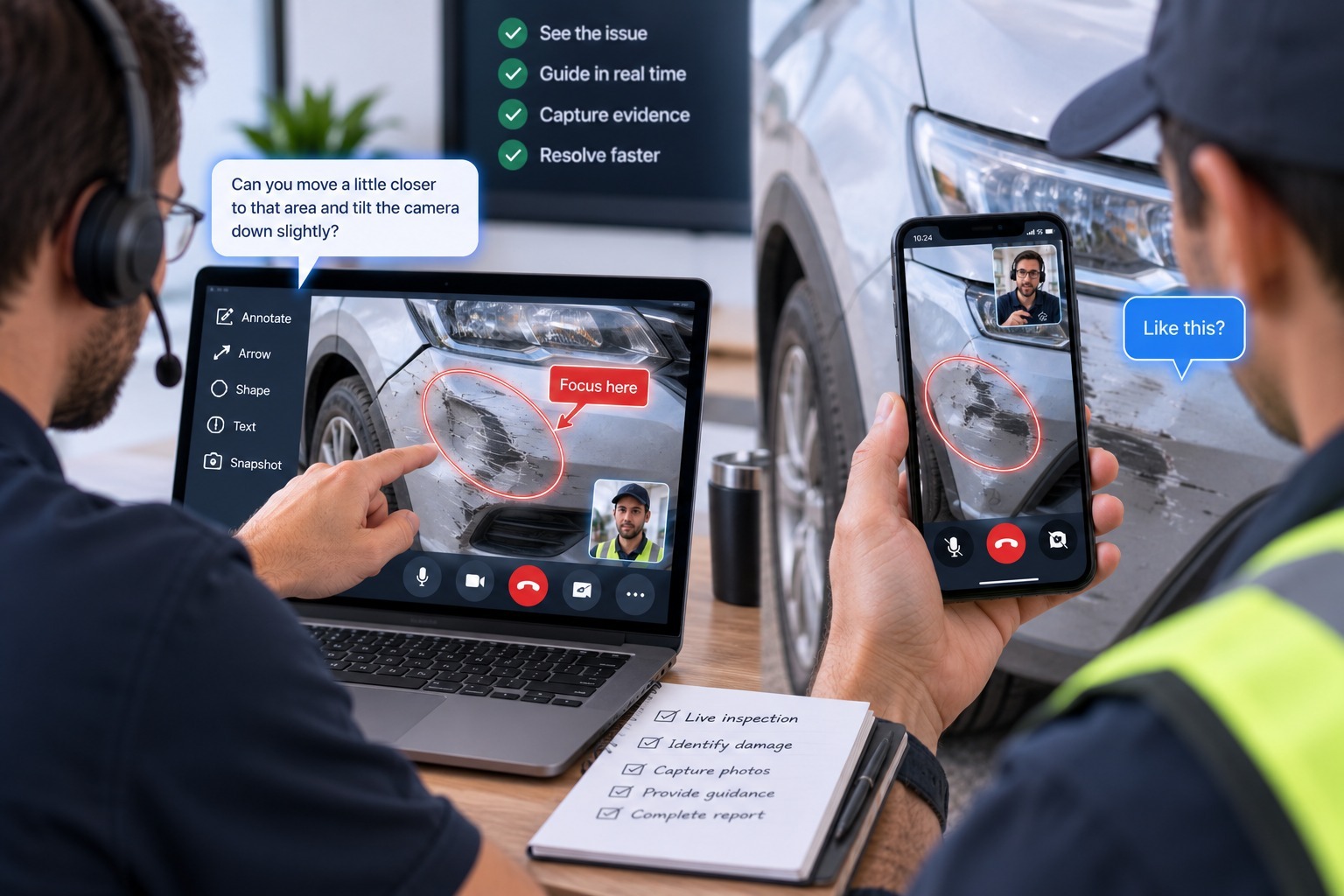
When a coordinator needs to flag the exact location and extent of a specific dent or scratch, AR annotation lets them draw directly on the driver's live video feed — circling the exact panel section in question rather than relying on a verbal description that might not match what a repair estimator sees later. This kind of precise visual marking becomes part of the documented record itself, reducing later disputes over exactly what was assessed and where.
Seeing is believing: integrating augmented reality into vehicle and clinical diagnostics covers the broader technical case for AR-assisted vehicle inspection, and fleet damage documentation is one of the more practical, everyday applications of that same underlying capability.
Integrating With Insurance and Warranty Workflows
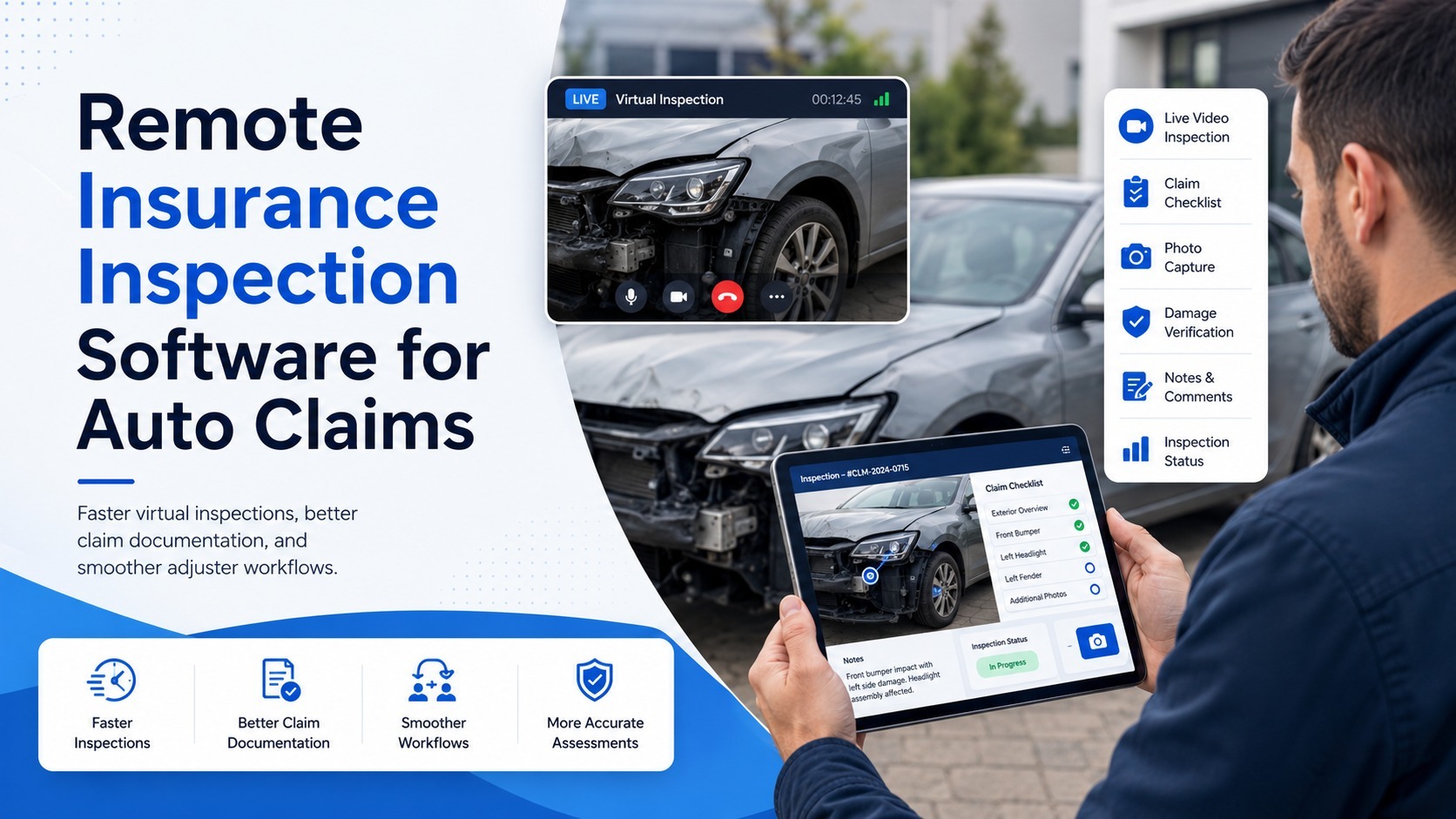
Fleet damage documentation rarely stays purely internal — a meaningful share of incidents eventually involve an insurance claim, and clean documentation at the point of handoff makes that process considerably faster. Remote insurance inspection software for auto claims covers how this connects directly to claims processing, and mastering the preliminary insurance damage assessment process is a useful reference for fleet operators building an internal documentation standard that will eventually need to satisfy an insurance adjuster's requirements as well.
For fleets running leased vehicles, the same documentation habit protects against disputed end-of-lease charges. The importance of photo documentation for warranty claims applies almost directly to lease-return condition disputes — a documented record at the point of lease signing and at each subsequent handoff removes ambiguity about whether wear and damage occurred during the lease term or was pre-existing. Fleets that also process claims through the 15 best remote insurance inspection software platforms will find much of the same documentation discipline transfers directly to that side of the workflow as well.
Reducing Fraud and Unclear Liability
Beyond simple ambiguity, fleet operations sometimes deal with drivers disputing responsibility for damage they caused, or claiming pre-existing damage that documentation would clearly show wasn't there at checkout. How to prevent warranty fraud with photos covers the underlying verification principles that apply just as directly to driver liability disputes — a verified, timestamped photo record removes most of the ambiguity that makes these disputes drag on.
Organizing Documentation at Scale
A fleet operator managing hundreds of vehicles needs more than a folder of unsorted photos to make this system work in practice. A simple system for organizing field inspection photos by job offers a structure that adapts well to fleet management — organizing by vehicle ID, handoff date, and driver, rather than dumping every photo into a single shared drive, is what actually makes the record usable months later when a dispute surfaces.
Building the Business Case
The return on a structured fleet damage documentation program tends to be straightforward to calculate: take the current rate of disputed or unresolved damage claims, estimate the average cost the fleet absorbs per disputed incident, and multiply by fleet size. Even a modest reduction in disputed claims — driven simply by having a clear, timestamped record at every handoff — usually justifies the cost of a documentation and video assistance program within the first year, particularly for larger fleets where disputes are a recurring rather than occasional cost.
Handling Disputes When They Still Happen
Even with strong documentation practices, some disputes will still arise — a driver insists damage was pre-existing despite a clean checkout record, or a leasing company disputes a return condition assessment. Having a clear escalation path for these cases matters as much as the documentation itself: a named process for who reviews contested claims, what additional evidence (a follow-up video call, a closer photo set) can resolve ambiguity, and a consistent standard for what counts as normal wear versus chargeable damage. Without this structure, even good documentation can get bogged down in inconsistent case-by-case decisions that erode driver trust in the fairness of the whole system.
Training Coordinators for Consistent Assessments
The value of a fleet damage program depends heavily on whether documentation and assessment standards stay consistent across every coordinator handling handoffs, not just the most experienced ones. A written checklist — covering exterior panels, wheels and tires, interior condition, and required documentation angles — keeps outcomes consistent regardless of who's running a given handoff. Recorded video sessions also double as training material: a library of well-documented handoffs, alongside examples of disputes that were resolved cleanly because of clear documentation, gives new coordinators a concrete reference point rather than relying purely on verbal training.
Extending the Practice to Third-Party Repair Shops
Fleet damage documentation doesn't have to stop once a vehicle goes in for repair. Using the same live video capability to verify a repair estimate against the actual documented damage — before authorizing work — catches discrepancies between what was damaged and what a shop proposes to charge for, the same way the mechanic's guide to video support and diagnostics describes for consumer vehicle repairs generally. This closes the loop on the entire damage lifecycle: documented at handoff, assessed on report, and verified again before repair costs are approved.
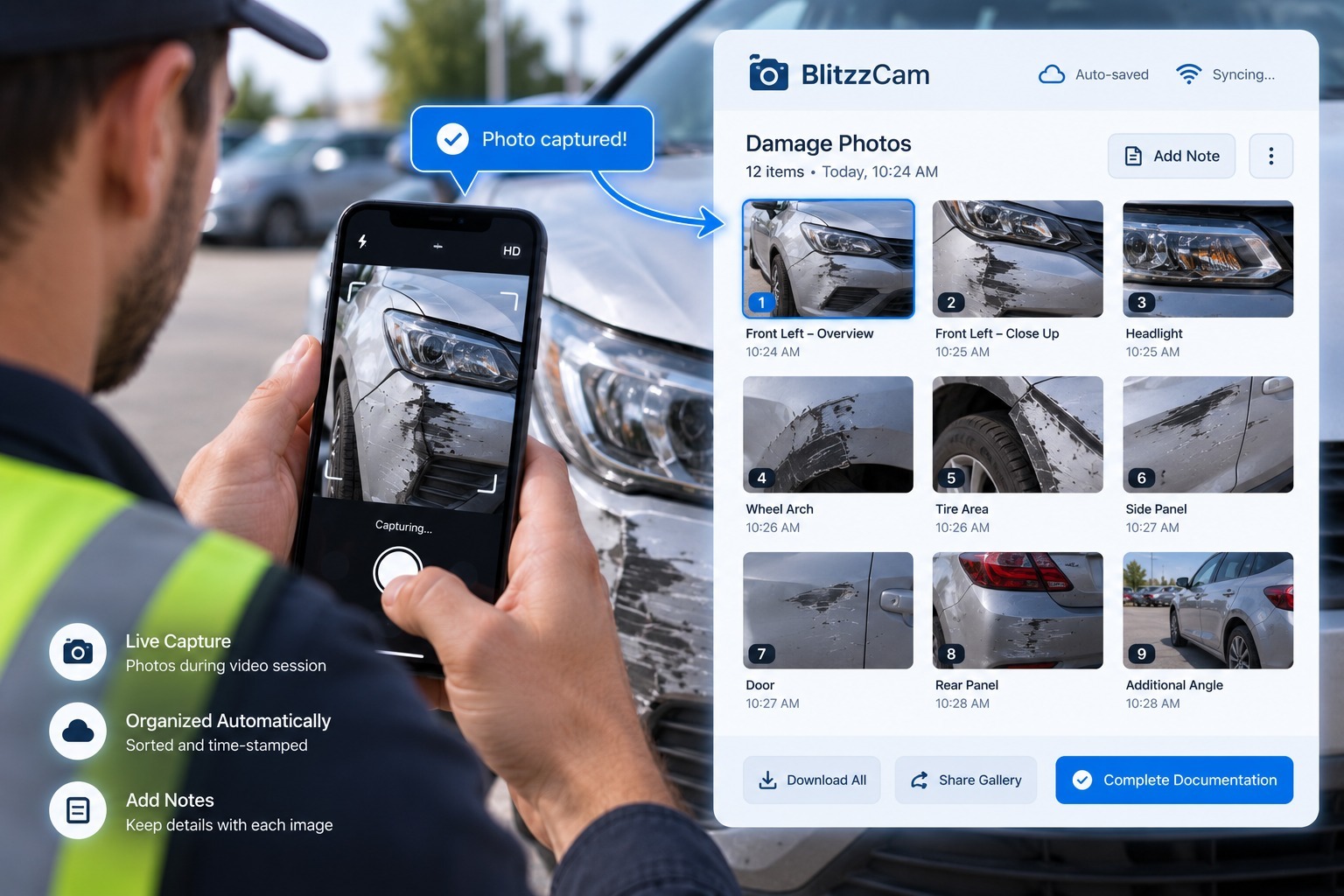
Documenting and Organizing Fleet Photos
Once a fleet operator commits to photo documentation at every handoff, the volume adds up fast — a fleet of even a few hundred vehicles, checked in and out regularly, can generate thousands of photos a month. Without a deliberate system, that volume turns into the same problem it was meant to solve: a folder of images nobody can find when a dispute actually surfaces three weeks later.
This is where a purpose-built tool like BlitzzCam matters more than it might seem at first glance. A photo taken on a driver's or coordinator's personal camera roll proves almost nothing on its own — there's no reliable way to confirm when or where it was actually taken, which is exactly the detail a damage dispute usually hinges on. BlitzzCam captures GPS location and a timestamp with every photo automatically, so the record itself carries the proof, rather than relying on someone's word for when a photo was taken.
In practice, a handoff photo set with BlitzzCam typically follows a consistent structure: a full exterior walk-around (front, rear, both sides, all four wheels), close-ups of the odometer and fuel gauge, and the interior including seats and dash. Capturing the same angles every time — rather than leaving it to whoever happens to be doing the handoff that day — is what makes photo sets genuinely comparable later, when a coordinator needs to line up a return photo against the original checkout photo for the same vehicle.
Organization matters just as much as capture. Tagging each photo set by vehicle ID, handoff type (checkout, return, reassignment, maintenance), and date turns a growing photo library into something a coordinator can actually search months later, instead of scrolling through an undifferentiated stream of images tied only to whichever phone happened to take them. Fleets running this consistently tend to build out a simple naming or tagging convention early — vehicle ID first, then date, then handoff type — so that pulling every photo for a specific vehicle's history takes seconds rather than a manual search across scattered folders.
The other advantage of a dedicated capture tool is that it removes photo documentation from the list of things that quietly get skipped under time pressure. A coordinator relying on a personal phone camera can forget to capture a required angle, or simply not bother when a handoff is rushed. A structured capture flow that prompts for each required shot, and stores it automatically in the right place, closes that gap without requiring the coordinator to remember every step themselves.
Getting Started
Rolling out remote visual assistance and structured photo documentation for fleet damage doesn't require overhauling an existing vehicle management system. Blitzz Concierge and BlitzzCam are both designed to integrate with existing fleet and CRM tools through available integrations, letting coordinators document condition and assess damage without adopting an entirely separate system.
A practical starting point is mandating structured photo documentation at checkout and return for your highest-value or highest-turnover vehicle segment first, and measuring the change in disputed claims over a full quarter before expanding the requirement fleet-wide. Given how directly this connects to avoidable cost, most fleet operators find the case for a full rollout becomes clear well before that first measurement period ends.